The Wheatstone Bridge: How to Balance a Circuit and Measure Resistance
A Wheatstone bridge measures an unknown resistance by comparing it with known resistors until a galvanometer needle stops moving. No ohmmeter reading, no calibration curve, just a zero. That zero is the whole trick, and it is why a circuit first drawn in 1833 still turns up in A-level and AP exam papers, and in strain gauge circuits today. This guide explains the layout, derives the balance condition from Kirchhoff’s laws, shows how to balance the bridge in the lab, and works two numerical examples you can copy into revision notes.
Here is the short version, for anyone in a hurry. When the galvanometer reads zero, the two arm ratios are equal, R1/R2 = R3/Rx, and the unknown follows at once as Rx = R2 x R3 / R1. Everything below fills in why that works, when it does not, and how to get the zero in practice.
What Is a Wheatstone Bridge?
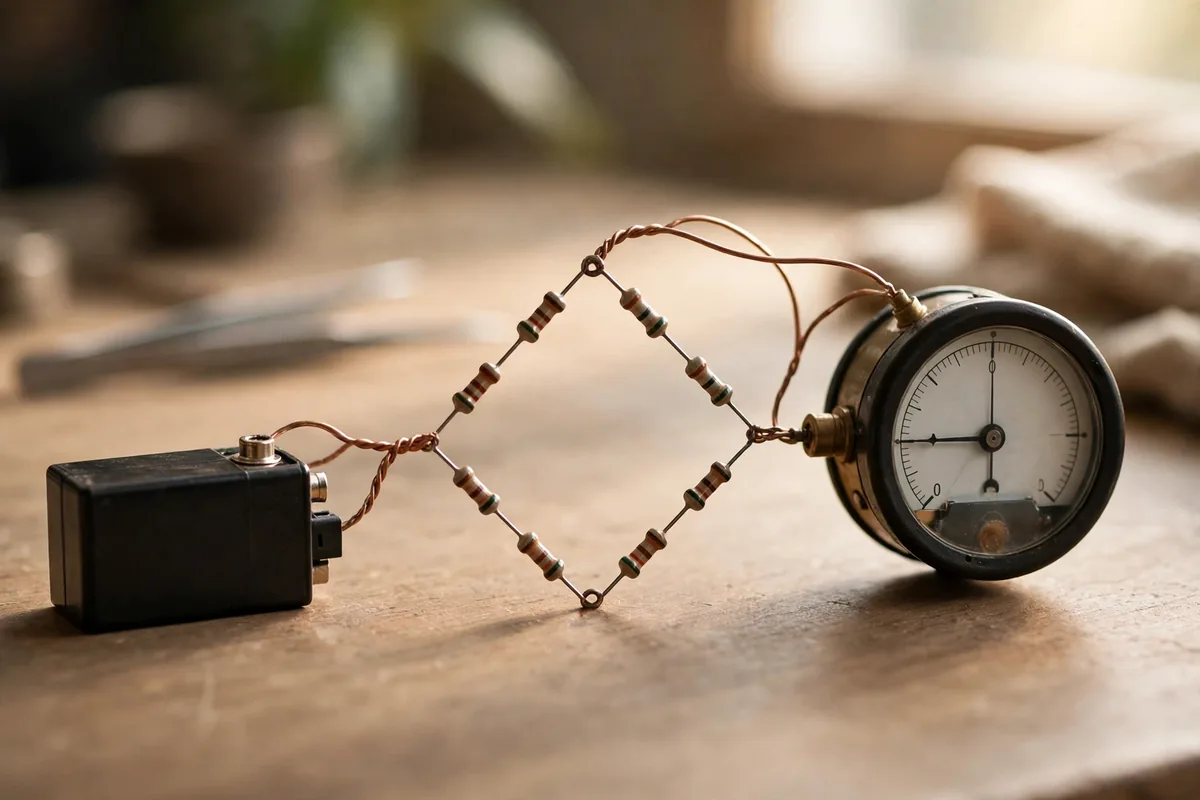
A Wheatstone bridge is a circuit of four resistors arranged in a diamond. Picture the diamond with a battery connected across one diagonal and a galvanometer connected across the other. The four resistors form the arms of the diamond, and the unknown resistor is one of them. The battery pushes current around the two outer paths of the diamond, and the galvanometer sits in the middle branch, watching for any difference between the two midpoints of the diamond.
The four arms have jobs, and it helps to name them before doing any maths. R1 and R2 form one side of the diamond and act as the ratio arms. Their ratio sets the scale of the measurement. R3 is the standard arm, usually a variable resistor whose value you can read off a dial or a resistance box.
Rx is the unknown arm, the resistor whose value you want to find. Some textbooks label the arms P, Q, R and S instead. The letters change, the circuit does not.
A galvanometer is a sensitive instrument that detects small currents. In this circuit it does not need to measure a current accurately. It only needs to show whether any current flows through the middle branch at all.
That distinction matters, because the Wheatstone bridge is a null method. You adjust the variable resistor until the galvanometer reads zero, and you read the answer off the other three resistors. The accuracy of the result comes from the zero, not from the meter.
That is the real strength of the method. A zero reading does not depend on the battery voltage, so a battery that has sagged a little still gives the same answer.
It does not depend on the galvanometer’s calibration either, because you never read a number off it. You only need it to tell zero from not zero. Compare that with an ordinary ohmmeter, which has to measure a current or a voltage and convert it into a resistance, and every part of that chain adds error. The bridge sidesteps the chain by turning the measurement into a comparison.
The circuit is older than the light bulb. Samuel Hunter Christie described it in 1833. Charles Wheatstone picked it up in 1843, refined it, and popularised it, and his name stuck to it.
Wheatstone also used the idea in early telegraph work, where finding a fault in a long cable meant finding an unknown resistance. The same principle still earns its keep. Strain gauges, which measure how much a metal bar stretches under load, are usually wired into a Wheatstone bridge, because a tiny change in resistance shows up as a small voltage across the middle branch. Resistance thermometers work the same way: the resistance of a platinum wire changes with temperature, and the bridge turns that change into a reading.
The Balance Condition of a Wheatstone Bridge
A bridge is balanced when the galvanometer reads zero. No current flows through the middle branch, and the two midpoints of the diamond sit at exactly the same potential. Potential is just the electrical height at a point in the circuit, measured in volts, and two points at the same potential have no reason for current to flow between them.
That is the whole balance condition in physical terms. The formula follows from it.
Call the current through the left side of the diamond I1 and the current through the right side I2. The left side runs through R1 and then R2, and the right side runs through R3 and then R4, where R4 is the fourth arm. At balance, the top left midpoint and the top right midpoint sit at the same potential, so the voltage drop across R1 must equal the voltage drop across R3. Ohm’s law gives each drop as current times resistance, so:
I1 x R1 = I2 x R3
The same argument holds at the bottom of the diamond. The drop across R2 must equal the drop across R4:
I1 x R2 = I2 x R4
Divide the first equation by the second. The currents cancel, and what is left is the balance condition of a Wheatstone bridge:
R1/R2 = R3/R4
In words, the bridge balances when the ratio of the two resistors on the left equals the ratio of the two resistors on the right. Notice what has vanished from the maths: the battery voltage, the galvanometer, and both currents. Only the four resistances remain. That is why the null method is so forgiving of sloppy power supplies.
Now label the fourth arm as the unknown, Rx, which is how most exam questions set it up. The balance condition becomes R1/R2 = R3/Rx. Rearranging for the unknown gives the formula you will use most:
Rx = R2 x R3 / R1
There is a handy cross-check that catches arithmetic slips. Multiply both sides of the balance condition out and you get:
R1 x Rx = R2 x R3
At balance, the product of one diagonal pair of resistors equals the product of the other pair. If your numbers do not satisfy that equality, the bridge is not balanced, or you have mixed up which resistor is which. Run this check on every worked example and it will save you marks.
An unbalanced bridge still tells you something useful. The voltage across the middle branch, the galvanometer voltage Vg, is:
Vg = V x (R1/(R1+R2)-R3/(R3+Rx))
Here V is the battery voltage. Each bracket is the fraction of the battery voltage that appears at one midpoint, found with the potential divider rule. The difference between the two fractions is the voltage across the galvanometer. When the bridge is balanced the two fractions are equal and Vg is zero, exactly as expected.
The sign of Vg tells you which way the balance is off. If the left midpoint sits at a higher potential than the right one, Vg is negative and the needle kicks one way. If the right midpoint is higher, Vg is positive and the needle kicks the other way.
In the lab that sign is your steering signal. It tells you whether to turn the variable resistor up or down, instead of hunting at random. The size of Vg tells you how far off you are, so a large deflection means a coarse adjustment and a small one means you are nearly there.
How to Balance a Wheatstone Bridge Step by Step
Balancing a bridge in the lab is a patient job, not a clever one. The procedure below is the standard one, and it works for a resistance box version and for the slide wire metre bridge alike.
First, connect the unknown resistor Rx into its arm and check every connection is tight. A loose terminal adds a resistance of its own, and that phantom resistance lands straight in your answer.
Set the ratio R2/R1 to a sensible value. If you have a rough idea of Rx, pick a ratio that puts R3 somewhere in the middle of its range. A ratio of 1, 10 or 100 is a good start, because the arithmetic stays simple.
Next, set R3 to your best guess and tap the galvanometer key briefly. Tap, do not hold. A large unbalanced current can damage a sensitive galvanometer, and the old lab habit of tapping the key before committing is worth keeping. Watch which way the needle jumps.
That tells you whether R3 needs to go up or down.
Now adjust R3 in coarse steps until the needle barely moves, then switch to fine steps.
The last part of the adjustment is the fiddly bit. Move R3 a little, tap the key, watch, and repeat. When the needle stays put on zero, the bridge is balanced.
Record R1, R2 and R3, then apply Rx = R2 x R3 / R1. Repeat the whole balance once more with a different ratio as a check. If the two values of Rx disagree, something in the wiring deserves a second look.
At balance the middle branch carries no current, so the circuit simplifies. The left branch, R1 + R2, sits in parallel with the right branch, R3 + Rx. The equivalent resistance of the whole bridge is therefore:
Req = (R1 + R2)(R3 + Rx) / (R1 + R2 + R3 + Rx)
The battery current follows from Ohm’s law:
I = V / Req
That current splits between the two outer branches, and knowing it lets you check that no resistor is being asked to dissipate more power than it can handle. It is a small check, but a hot resistor changes its own resistance, and a bridge with a drifting arm will never sit still at zero.
The metre bridge is the same Wheatstone bridge built on a 100 cm slide wire. Two of the arms are replaced by the two lengths of wire on either side of a sliding contact, and a jockey slides along the wire until the galvanometer reads zero. The balance length then gives the unknown: the ratio of the two wire lengths equals the ratio of the two resistances, because resistance is proportional to length for a uniform wire. It is a neat piece of apparatus for a school lab, since the only measuring instrument is a metre rule, and it shows the same null idea in a form you can see with your eyes.
Worked Example 1: Find the Unknown Resistance Rx in a Balanced Wheatstone Bridge
A Wheatstone bridge is balanced, so the galvanometer reads zero. The known resistors are R1 = 100 ohm, R2 = 200 ohm and R3 = 150 ohm. Find Rx.
Start by writing down what the balance condition gives you. The bridge is balanced, so the formula Rx = R2 x R3 / R1 applies. Check that first. If the question had not said the bridge was balanced, this formula would be useless, and you would need the unbalanced voltage formula instead.
Here the zero reading is given, so go ahead.
Substitute the numbers:
Rx = 200 x 150 / 100
Work the numerator first: 200 x 150 = 30,000. Then divide by 100:
Rx = 30,000 / 100 = 300 ohm
So the unknown resistance is 300 ohm. Now run the cross-check, R1 x Rx = R2 x R3. The left side is 100 x 300 = 30,000. The right side is 200 x 150 = 30,000.
The two products agree, so the arithmetic holds and the balance condition is satisfied.
The ratio form tells the same story: R1/R2 = 100/200 = 1/2, and R3/Rx = 150/300 = 1/2. Equal ratios, balanced bridge, answer confirmed.
Worked Example 2: Find the Missing Ratio Arm in a Wheatstone Bridge
A balanced Wheatstone bridge has R1 = 10 ohm, R2 = 30 ohm and the unknown resistance Rx = 24 ohm. Find the value that R3 must have at balance.
This example turns the usual question around. Instead of solving for Rx, you solve for the standard arm. The balance condition is the same: R1/R2 = R3/Rx. Rearrange it for R3:
R3 = Rx x R1 / R2
Substitute the numbers:
R3 = 24 x 10 / 30
Work the numerator first: 24 x 10 = 240. Then divide by 30:
R3 = 240 / 30 = 8.0 ohm
So the variable resistor must be set to 8.0 ohm for the galvanometer to read zero. Verify it with the balance condition. The left ratio is R1/R2 = 10/30 = 1/3. The right ratio is R3/Rx = 8/24 = 1/3.
The ratios are equal, so the bridge is balanced, and the answer checks out.
Notice the answer keeps one decimal place, 8.0 ohm rather than 8 ohm, because the given value Rx = 24 ohm carries two significant figures and the result should not claim more precision than the data supports.
Common Mistakes
Applying Rx = R2 x R3 / R1 before the bridge is balanced is the most common error in exam answers. The formula is only true at the null point. If the galvanometer is showing a deflection, the two ratios are not equal and the formula gives a wrong answer. Always check the question says the bridge is balanced, or that the galvanometer reads zero, before you use it.
Mixing up which resistor is the unknown and which is the variable arm inverts the ratio. The formula Rx = R2 x R3 / R1 only works with the labelling used here, where Rx sits opposite R1 in the diamond. If your diagram labels the arms differently, derive the ratio from the balance condition for that diagram instead of copying the formula blindly. A quick sketch with the four arms labelled saves more marks than it costs in time.
Assuming zero galvanometer current means zero current everywhere is another trap. The middle branch carries no current at balance, but current still flows through both outer branches, from the battery, around the diamond, and back. The bridge is live. The galvanometer is the only quiet part of it.
Reading the balance as “all four resistors equal” is wrong, and it is a surprisingly common one. Balance means the two ratios are equal, not the four resistances. Example 1 above balances with 100, 200, 150 and 300 ohm, and no two of those are the same. If a question gives you four equal resistors, the bridge is balanced, but that is a special case, not the rule.
Forgetting that the bridge measures DC resistance only causes trouble in the lab. A Wheatstone bridge with resistive arms cannot measure inductance or capacitance. Reactive arms need an AC impedance bridge, which is a different instrument with its own balance conditions. If a question mentions an inductor or a capacitor in one arm, reach for the AC bridge, not this one.
Confusing the Wheatstone bridge with a simple series-parallel resistor network leads students to add the arms together. The four resistors are not in series and they are not in a plain parallel combination while the middle branch is connected. Treat the bridge as its own circuit, apply Kirchhoff’s laws to it, and only use the parallel combination of the two outer branches when the bridge is balanced and the middle branch carries no current.
A Wheatstone Bridge in Four Formulas
Four formulas carry the whole topic. The balance condition says the two arm ratios are equal when the galvanometer reads zero: R1/R2 = R3/R4. The unknown resistance follows as Rx = R2 x R3 / R1. The cross-check catches slips: R1 x Rx = R2 x R3.
And the unbalanced output voltage explains the needle: Vg = V x (R1/(R1+R2)-R3/(R3+Rx)). Learn those four, plus the habit of checking that the bridge is balanced before you use them, and the Wheatstone bridge becomes one of the friendlier topics on the paper. As a next step, try the two worked examples again with different numbers, or balance a real bridge in the lab and see how small a change in R3 it takes to move the needle off zero. That sensitivity is the whole point of the instrument.
Frequently Asked Questions
What is a Wheatstone bridge used for?
A Wheatstone bridge is used to measure an unknown resistance precisely by comparing it with known resistors. Four resistors form a diamond, with a battery across one diagonal and a galvanometer across the other. You adjust the variable resistor until the galvanometer reads zero, then calculate the unknown from the other three values. The method is also used in strain gauges and resistance thermometers.
What is the Wheatstone bridge balance condition?
The balance condition of a Wheatstone bridge is R1/R2 = R3/R4, meaning the ratio of the two resistors on the left of the diamond equals the ratio of the two on the right. When this holds, the galvanometer reads zero and no current flows through the middle branch. The condition follows from Kirchhoff's laws: at balance the voltage drops I1 x R1 and I2 x R3 are equal, as are I1 x R2 and I2 x R4.
How do you calculate the unknown resistance Rx in a Wheatstone bridge?
To calculate the unknown resistance, first balance the bridge so the galvanometer reads zero, then use Rx = R2 x R3 / R1, where R1 and R2 are the ratio arms and R3 is the standard arm. For example, with R1 = 100 ohm, R2 = 200 ohm and R3 = 150 ohm, Rx = 200 x 150 / 100 = 300 ohm. Always check the cross-product R1 x Rx = R2 x R3 to catch arithmetic slips.
Why does the galvanometer read zero in a balanced Wheatstone bridge?
The galvanometer reads zero because the two midpoints of the diamond sit at exactly the same potential when the bridge is balanced. With no potential difference between them, no current flows through the middle branch. This happens when the arm ratios are equal, R1/R2 = R3/Rx, so the voltage drops across R1 and R3 match, and those across R2 and Rx match too.
What happens to a Wheatstone bridge when it is not balanced?
When a Wheatstone bridge is not balanced, the two arm ratios are unequal, so the midpoints sit at different potentials and a voltage appears across the galvanometer. The output voltage is Vg = V x (R1/(R1 + R2) – R3/(R3 + Rx)), and the galvanometer needle deflects. The sign of Vg shows which way the balance is off, and its size shows how far off it is.
How is a Wheatstone bridge different from a metre bridge?
A metre bridge is the same Wheatstone bridge circuit built on a 100 cm slide wire instead of separate resistors. Two of the arms are replaced by the two lengths of wire on either side of a sliding contact, and a jockey slides along the wire until the galvanometer reads zero. The balance length then gives the unknown, since resistance is proportional to length for a uniform wire.