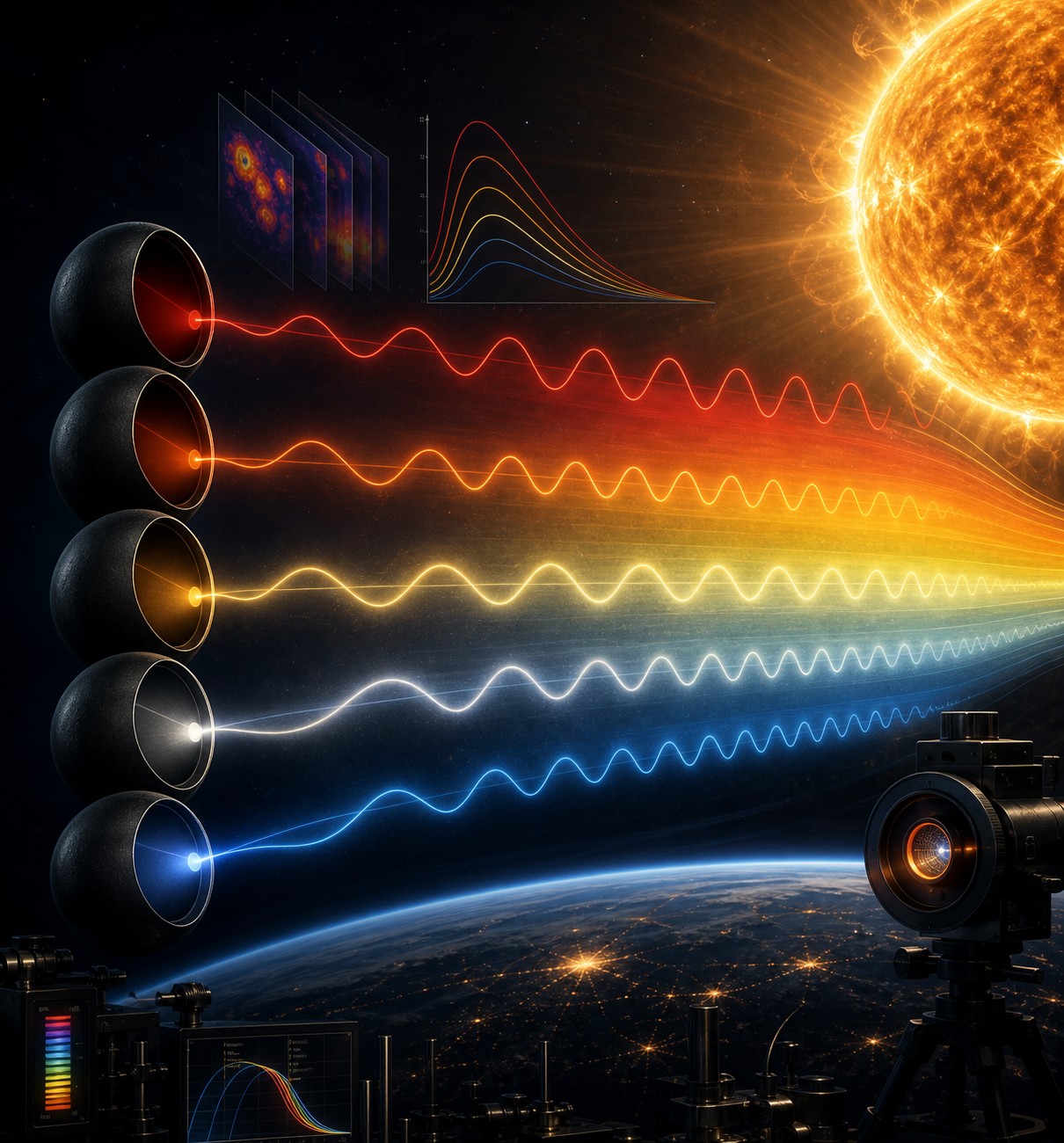
Black-Body Radiation: A Deep Dive into Wien’s Law and the Stefan-Boltzmann Law
Introduction to Black-Body Radiation and Its Significance
Black-body radiation refers to the electromagnetic radiation emitted by an idealized object, known as a black body, which perfectly absorbs all incoming radiation. This concept is essential in understanding thermodynamics and quantum mechanics. The idea dates back to the late 19th century, a time when scientists were grappling with the nature of light and heat. A black body does not reflect or transmit any light. Instead, it serves as a perfect emitter, radiating energy depending solely on its temperature.
The significance of black-body radiation lies in its foundational role in physics. Max Planck, in 1900, introduced a revolutionary idea that energy is quantized. This was a turning point that led to the development of quantum theory. Before this, scientists relied on classical physics, which couldn’t explain the observed spectrum of radiation emitted by heated objects. The so-called “ultraviolet catastrophe” highlighted the failure of classical physics to predict the intensity of radiation at shorter wavelengths. Planck’s law successfully resolved this issue, demonstrating that the energy emitted by a black body is directly linked to its temperature and wavelength.
Understanding black-body radiation is crucial for various scientific fields, from astrophysics to climate science. For instance, the Sun behaves approximately like a black body, emitting radiation that we can analyze to determine its temperature and composition. This insight allows scientists to understand stellar processes and the behavior of other celestial bodies.
In practical applications, black-body radiation principles underpin technologies like thermal imaging and climate modeling. Devices such as infrared cameras rely on the principles of thermal radiation to detect heat emitted by objects. Moreover, understanding how objects emit and absorb radiation helps in designing energy-efficient buildings and devices.
By grasping the complexities of black-body radiation, we unlock insights into the universe’s workings. This knowledge paves the way for advancements in technology and a deeper appreciation of the physical laws that govern our world.
Historical Background of Black-Body Radiation
Black-body radiation is a cornerstone of modern physics, rooted in the early explorations of thermodynamics and electromagnetic theory. The journey begins in the late 19th century, a time when scientists were grappling with the nature of light and heat. The term “black body” refers to an idealized physical object that absorbs all incident electromagnetic radiation, regardless of frequency or angle of incidence. This concept emerged from the need to understand how objects emit energy when heated.
In 1860, Gustav Kirchhoff laid the groundwork for what we now understand about black-body radiation. He introduced the idea that the emissivity of a body—its ability to emit thermal radiation—depends solely on its temperature and not its material composition. Kirchhoff also recognized that a perfect black body would emit radiation with a spectrum that depends only on temperature.
Fast forward to the late 1890s, Max Planck entered the scene. He was investigating the spectral distribution of radiation emitted by heated objects. Classical physics failed to explain why the emitted radiation from hot bodies did not align with observations, particularly at short wavelengths—a dilemma known as the ultraviolet catastrophe. In 1900, Planck proposed a revolutionary idea: energy is quantized. He introduced what we now call Planck’s law, which describes the intensity of radiation emitted by a black body as a function of wavelength and temperature. This marked the birth of quantum theory.
Albert Einstein later expanded on Planck’s work in 1905, providing a theoretical basis for the photoelectric effect. His insights further solidified the concept that light could behave as both a wave and a particle, leading to profound implications for quantum mechanics.
The early 20th century saw the realization of Wien’s Law and the Stefan-Boltzmann Law, fundamental principles derived from the study of black-body radiation. Wien’s Law, formulated by Wilhelm Wien in 1893, establishes the relationship between the temperature of a black body and the wavelength at which it emits radiation most intensely. Meanwhile, Josef Stefan, in 1879, discovered that the total energy radiated per unit surface area of a black body is proportional to the fourth power of its temperature—later refined by Ludwig Boltzmann.
Understanding black-body radiation has been pivotal not just for physicists but also for fields like astronomy and climate science. The historical journey through black-body radiation illustrates the evolution of our understanding of energy, light, and matter, laying the groundwork for much of modern physics.
Defining Black-Body Radiation: Key Characteristics
Black-body radiation refers to the electromagnetic radiation emitted by an idealized object that absorbs all incoming radiation, regardless of frequency or angle of incidence. This concept is fundamental in understanding thermal radiation and has far-reaching implications in physics and engineering.
First, let’s clarify what we mean by a “black body.” A black body is a perfect emitter and absorber of radiation. It does not reflect any light; instead, it absorbs all wavelengths of electromagnetic radiation. This characteristic allows it to reach thermal equilibrium when placed in an environment at a given temperature.
One of the core characteristics of black-body radiation is that it depends solely on the temperature of the body, not on its material composition. As the temperature increases, the intensity and spectral distribution of emitted radiation change. For example, a black body at lower temperatures emits mostly infrared radiation, while at higher temperatures, it emits visible light.
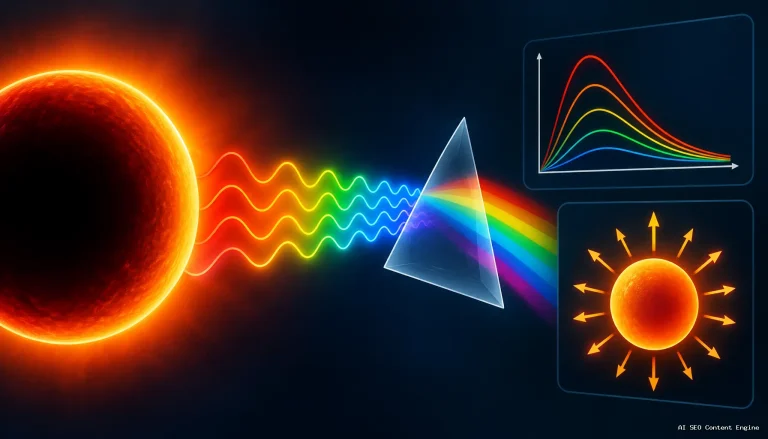
Another key feature is the shape of the spectral distribution, described by Planck’s law. This law states that the intensity of radiation emitted at a specific wavelength increases with temperature and has a peak at a particular wavelength. As the temperature rises, this peak shifts to shorter wavelengths, which is why heated metals glow red, then orange, then white as their temperature climbs.
The Stefan-Boltzmann Law also plays a crucial role here. It states that the total energy radiated per unit surface area of a black body is proportional to the fourth power of its absolute temperature. This means that even a small increase in temperature can lead to a significant increase in emitted radiation. For instance, if a black body’s temperature rises from 300 K to 600 K, the emitted energy increases by a factor of 16.
Moreover, black-body radiation exhibits a characteristic spectrum that can be described using Wien’s Displacement Law. This law tells us that the wavelength at which the emission is maximized is inversely proportional to the temperature. Thus, as temperature increases, the peak wavelength shifts toward the ultraviolet range, explaining why hot objects appear blue.
In summary, black-body radiation is a cornerstone of thermodynamics and quantum mechanics. It provides an essential framework for understanding how objects emit and absorb radiation, influencing various fields such as astrophysics, climate science, and even everyday technology like thermal imaging cameras.
Understanding Wien’s Law: Formulation and Applications
Wien’s Law explains the relationship between the temperature of a black body and the wavelength at which it emits radiation most intensely. Formulated by Wilhelm Wien in 1893, the law states that the wavelength of peak emission (\(\lambda_{max}\)) is inversely proportional to the absolute temperature (T) of the black body. Mathematically, it’s expressed as:
\(\lambda_{max} = \frac{b}{T}\)
Here, \(b\) is Wien’s displacement constant, approximately \(2.898 \times 10^{-3} \, \text{m K}\). This equation indicates that as the temperature of an object increases, the peak wavelength shifts to shorter wavelengths.
For example, consider a typical incandescent light bulb with a filament temperature around 3000 K. According to Wien’s Law, the peak wavelength of the emitted light would be around 966 nm, which is in the infrared range. This is why incandescent bulbs feel hot to the touch and emit a yellow-red light.
In contrast, stars like the Sun have surface temperatures around 5778 K. Using Wien’s Law, the peak emission wavelength for the Sun would be around 500 nm, which falls within the visible spectrum, specifically blue-green light. This difference in peak wavelengths explains why hotter objects emit light that appears blue or white, while cooler objects appear red.
Wien’s law has multiple applications across various fields. In astronomy, it helps in classifying stars based on their temperatures. By measuring the peak wavelength of a star’s emitted light, astronomers can determine its surface temperature and, consequently, its color and classification.
Moreover, Wien’s Law is crucial in thermography, where infrared cameras detect the thermal radiation emitted by objects. By analyzing the peak wavelength of the detected radiation, it’s possible to assess the temperature of various surfaces, aiding in building inspections and medical diagnostics.
In the realm of climate science, understanding the radiation emitted by Earth helps in modeling the greenhouse effect. The Earth absorbs solar energy and re-emits it as infrared radiation. By applying Wien’s Law, scientists can determine how changes in temperature can affect the emission and absorption of heat, contributing to our understanding of global warming.
In summary, Wien’s Law provides a fundamental framework for understanding thermal radiation. Its formulation not only allows for precise temperature measurements but also extends its relevance across diverse scientific disciplines.
Exploring the Stefan-Boltzmann Law: Principles and Derivations
The Stefan-Boltzmann Law is a fundamental principle in physics that describes how the energy radiated by a black body relates to its temperature. Simply put, it states that the total energy radiated per unit surface area of a black body is proportional to the fourth power of its absolute temperature. Mathematically, this relationship is expressed as:
j* = σT4
Here, j* represents the total power radiated per unit area, T is the absolute temperature in Kelvin, and σ (the Stefan-Boltzmann constant) is approximately 5.67 x 10⁻⁸ W/m2K4. This powerful equation reveals much about thermal radiation and energy transfer.
To understand the derivation of this law, one starts with Planck’s law of black-body radiation, which describes the spectral energy density of radiation emitted by a black body in thermal equilibrium at a given temperature. Planck’s law provides the foundation for deriving the Stefan-Boltzmann Law by integrating over all wavelengths.
The first step involves calculating the total energy emitted across all frequencies. This is done by integrating Planck’s law:
B(ν, T) = (2hν3)/(c2)(1/(e^(hν/kT) – 1))
where h is Planck’s constant, ν is the frequency of radiation, k is Boltzmann’s constant, and c is the speed of light. This integral, however, is complex due to the exponential term in the denominator.
Using a change of variables and properties of the integral, one can simplify the calculation. The integration over all frequencies yields a result that is proportional to T4, confirming the Stefan-Boltzmann Law.
The physical significance of the law is profound. It explains why hotter objects emit more energy than cooler ones. For instance, the sun, with a surface temperature of about 5,500 K, radiates substantially more energy than the Earth, which has an average temperature of around 288 K. This difference in emitted energy has implications in fields ranging from astrophysics to climate science.
In practice, the Stefan-Boltzmann Law helps scientists and engineers calculate radiative heat transfer in various applications, including thermal insulation, radiative cooling, and even astronomical observations. Understanding black-body radiation through the lens of the Stefan-Boltzmann Law is crucial for grasping the fundamentals of thermal dynamics and energy conservation in our universe.
The Relationship Between Wien’s Law and the Stefan-Boltzmann Law
Wien’s Law and the Stefan-Boltzmann Law are fundamental principles in thermodynamics and black-body radiation. Understanding their relationship is crucial for grasping how objects emit thermal radiation based on temperature.
Wien’s Law states that the wavelength of the peak emission of a black body is inversely proportional to its absolute temperature. Mathematically, it is expressed as:
λ_max = b/T
where λ_max is the peak wavelength, T is the temperature in Kelvin, and b is Wien’s displacement constant, approximately 2.898 × 10^-3 m·K. This relationship indicates that as temperature increases, the peak wavelength of emitted radiation shifts to shorter wavelengths. For example, a star like the Sun, with a surface temperature of about 5,800 K, emits most of its radiation in the visible spectrum, peaking in the green-yellow region.
In contrast, the Stefan-Boltzmann Law focuses on the total energy emitted by a black body per unit surface area. It states that the power radiated (P) is proportional to the fourth power of the temperature:
P = σT^4
Here, σ is the Stefan-Boltzmann constant, approximately 5.67 × 10^-8 W·m^-2·K^-4. This law suggests that a small increase in temperature leads to a significant increase in emitted energy. For instance, if the temperature of an object increases from 300 K to 600 K, the power emitted increases by a factor of 16, showcasing the dramatic effect of temperature changes on radiation.
The connection between these two laws becomes evident when considering a black body’s emission spectrum. Wien’s Law helps identify the dominant wavelength of emission at a specific temperature, while the Stefan-Boltzmann Law quantifies the total energy emitted across all wavelengths. Together, they provide a comprehensive understanding of thermal radiation.
For example, consider an object with a temperature of 500 K. According to Wien’s Law, its peak emission wavelength would be around 5.8 μm, placing it in the infrared range. Using the Stefan-Boltzmann Law, we can calculate that it radiates approximately 4.9 W/m². This relationship highlights how temperature influences both the peak wavelength and the total energy output, illustrating the interconnected nature of these two laws in the study of black-body radiation.
In practical applications, such as astrophysics, these laws allow scientists to derive the temperature of stars and other celestial bodies by observing their radiation. By applying both laws, we can infer not only the temperature but also the physical characteristics of distant objects in the universe. This synergy between Wien’s Law and the Stefan-Boltzmann Law is vital for advancing our understanding of thermal radiation in various fields, from astronomy to climate science.
Real-World Applications of Black-Body Radiation
Black-body radiation is more than just a theoretical concept; it has practical applications across various fields. Understanding how it works can lead to innovations in technology, astronomy, and even climate science.
One of the most well-known applications is in the realm of thermal imaging. Devices like infrared cameras rely on the principles of black-body radiation. These cameras detect infrared radiation emitted by objects based on their temperature. For example, a warm body emits more infrared radiation than a cooler one. This characteristic is crucial for applications such as search and rescue operations, where locating individuals in low visibility conditions can save lives.
In astrophysics, black-body radiation plays a pivotal role in understanding stars. The spectral distribution of light emitted by a star can be modeled as that of a black body. By analyzing the light curves and applying Wien’s Law, astronomers can determine a star’s temperature. This information helps classify stars and infer their size, age, and distance from Earth. For instance, the sun approximates a black body with a temperature of about 5,800 K, providing insight into its lifecycle and the energy it radiates.
Another significant application is in climate science, particularly in modeling Earth’s radiation budget. The Stefan-Boltzmann Law helps scientists estimate how much energy Earth radiates back into space. This measurement is vital for understanding the greenhouse effect and predicting climate change. By analyzing the balance between incoming solar radiation and outgoing terrestrial radiation, researchers can assess how human activities impact global temperatures.
Black-body radiation also finds relevance in everyday technology, such as light bulbs. Incandescent bulbs operate on the principle of black-body radiation. When electricity passes through the filament, it heats up and emits light as a black body would. Although LED and fluorescent lights are now more common due to energy efficiency, understanding black-body radiation is essential for developing lighting technologies.
In manufacturing, black-body radiation principles guide the design of furnaces and kilns. By optimizing temperature and energy output, industries can achieve higher efficiency and lower costs. This application is particularly important in ceramics and metalworking, where precise temperature control is essential for quality production.
These examples illustrate that black-body radiation is integral to both scientific inquiry and technological advancement. It bridges the gap between theory and practical applications, affecting various aspects of our daily lives.
Experimental Verification of Black-Body Radiation Laws
The verification of black-body radiation laws, particularly Wien’s Law and the Stefan-Boltzmann Law, has been a cornerstone in the development of modern physics. These laws describe how objects emit radiation based on their temperature, and experimental efforts have brought them to life through meticulous measurement and observation.
One of the earliest experiments was conducted by Max Planck in 1900. He used a simple cavity with a small hole to create a near-perfect black body. The emitted radiation was measured across various temperatures and wavelengths. Planck’s observations confirmed that the intensity of emitted radiation increases with temperature. This relationship is at the heart of Wien’s Law, which states that the wavelength at which the emission is at its peak is inversely proportional to the temperature.
To express this mathematically, Wien’s Law is given by the formula:
- λmax = b/T,
where λmax is the peak wavelength, T is the absolute temperature in Kelvin, and b is Wien’s displacement constant, approximately equal to 2898 µm·K. Planck’s data aligned closely with this law, illustrating how shorter wavelengths correspond to higher temperatures.
Further confirmation of the Stefan-Boltzmann Law came from experiments involving black-body radiation in a controlled environment. The law states that the total energy radiated per unit surface area of a black body is proportional to the fourth power of its absolute temperature:
- j* = σT4,
where j* is the total emitted energy per unit area, T is the absolute temperature, and σ is the Stefan-Boltzmann constant (approximately 5.67 × 10⁻⁸ W·m-2·K-4).
In practical terms, experiments often involved heating a black-body radiator and measuring the emitted energy using precise instruments such as bolometers. These devices detect the amount of infrared radiation emitted. As the temperature of the black body increased, the measurements consistently supported the Stefan-Boltzmann Law, showing that the energy output indeed grows more rapidly than linear temperature increases.
Another landmark experiment was conducted by Wilhelm Wien in the late 19th century. Wien employed spectroscopic techniques to measure the intensity of radiation emitted at various wavelengths. His results provided a clear visual representation that matched the theoretical predictions of both Wien’s and the Stefan-Boltzmann laws.
The culmination of these experiments not only verified the laws but also laid the groundwork for quantum mechanics. Planck’s introduction of quantized energy levels to explain his findings marked a significant shift in physics, leading to the development of the photon concept. The experimental evidence for black-body radiation laws remains a fundamental part of thermal physics, influencing various fields, including astronomy, climate science, and materials science.
In summary, the experimental verification of black-body radiation laws exemplifies how meticulous observation and measurement can illuminate complex principles of physics. These laws not only describe the behavior of idealized black bodies but also serve as a basis for understanding real-world applications.
Implications of Black-Body Radiation in Modern Physics
Black-body radiation has profound implications across various branches of modern physics, ranging from quantum mechanics to astrophysics. Understanding how objects emit radiation as a function of temperature reveals the core principles behind numerous scientific phenomena.
First, consider the foundational aspect of quantum mechanics. Max Planck’s resolution to the ultraviolet catastrophe through his introduction of quantized energy levels revolutionized the field. This shift marked the birth of quantum theory, which fundamentally altered our understanding of atomic and subatomic processes. Planck’s constant, a critical component in his radiation law, continues to be a cornerstone in quantum mechanics, influencing everything from the behavior of electrons to the properties of photons.
Next, black-body radiation plays a crucial role in thermodynamics, particularly in the context of heat transfer. The Stefan-Boltzmann Law demonstrates how the total energy radiated by a black body is proportional to the fourth power of its absolute temperature. This principle is essential in areas like climate science, where it helps model the Earth’s energy balance. For instance, the law helps scientists understand how changes in atmospheric conditions affect global temperatures.
In astrophysics, the implications extend further. Stars emit radiation that can be approximated as black-body radiation, allowing astronomers to estimate their temperatures and compositions. The spectrum of light emitted from a star can be analyzed to determine its surface temperature using Wien’s Displacement Law. This method is crucial for categorizing stars and understanding their life cycles. For example, hotter stars emit light at shorter wavelengths, while cooler stars emit light at longer wavelengths.
Moreover, black-body radiation is fundamental in developing technologies such as thermal imaging and radiation detectors. Devices that rely on infrared radiation detect and analyze heat emitted from objects, essential in fields ranging from medical diagnostics to military applications.
Finally, black-body radiation has paved the way for advancements in quantum field theory and cosmology. The Cosmic Microwave Background Radiation (CMB) is a remnant of the hot, dense state of the early universe. Studying the CMB provides insights into the universe’s origin and evolution, reinforcing the importance of black-body radiation concepts in understanding cosmic phenomena.
In summary, the implications of black-body radiation stretch far beyond theoretical physics, influencing practical applications and enhancing our grasp of the universe. Each exploration into its principles unravels new layers of complexity and connection, underscoring its significance in modern scientific inquiry.
Conclusion: The Importance of Black-Body Radiation in Science and Technology
Black-body radiation may seem like an abstract concept, but its implications reach far into both science and technology. Understanding this phenomenon is crucial for numerous fields, including physics, engineering, and even climate science.
At the core of black-body radiation are Wien’s Law and the Stefan-Boltzmann Law. **Wien’s Law** tells us about the relationship between temperature and emitted radiation wavelength. It helps scientists determine the temperature of distant stars and cosmic bodies by analyzing their spectral emissions. For example, astronomers can estimate the surface temperature of a star simply by measuring the peak wavelength of its emitted light. This capability enhances our understanding of stellar evolution and the lifecycle of celestial objects.
The **Stefan-Boltzmann Law** further enriches this understanding by linking the total energy radiated by a black body to its temperature. This law is pivotal in fields like thermodynamics and energy transfer. Engineers utilize it when designing systems that involve heat exchange, from power plants to refrigeration units. For instance, this principle allows for more efficient designs in solar panels and thermal management in electronics, ultimately leading to better performance and energy conservation.
In climate science, black-body radiation plays a key role in understanding Earth’s energy balance. The planet absorbs sunlight and emits radiation back into space. Knowing how much energy is radiated helps scientists model climate change and predict future scenarios. Without a solid grasp of black-body radiation, it would be challenging to comprehend the nuances of greenhouse gases and their effect on global warming.
Moreover, black-body radiation principles are foundational in developing modern technologies such as infrared cameras, which are used in various applications, from military surveillance to medical diagnostics. These cameras rely on detecting infrared radiation emitted by objects based on their temperatures.
In summary, black-body radiation is more than a theoretical construct; it’s a critical element that informs our understanding of the universe and drives technological advancements. By grasping the nuances of Wien’s Law and the Stefan-Boltzmann Law, we not only expand our scientific knowledge but also enhance our ability to innovate in practical applications, shaping a better future.