Momentum Conservation: Elastic vs Inelastic Collisions Explained
Introduction to Momentum Conservation in Physics
Momentum conservation is a fundamental concept in physics that plays a crucial role in understanding how objects interact during collisions. At its core, momentum is defined as the product of an object’s mass and its velocity. This means that the momentum of an object depends not only on how heavy it is but also on how fast it is moving.
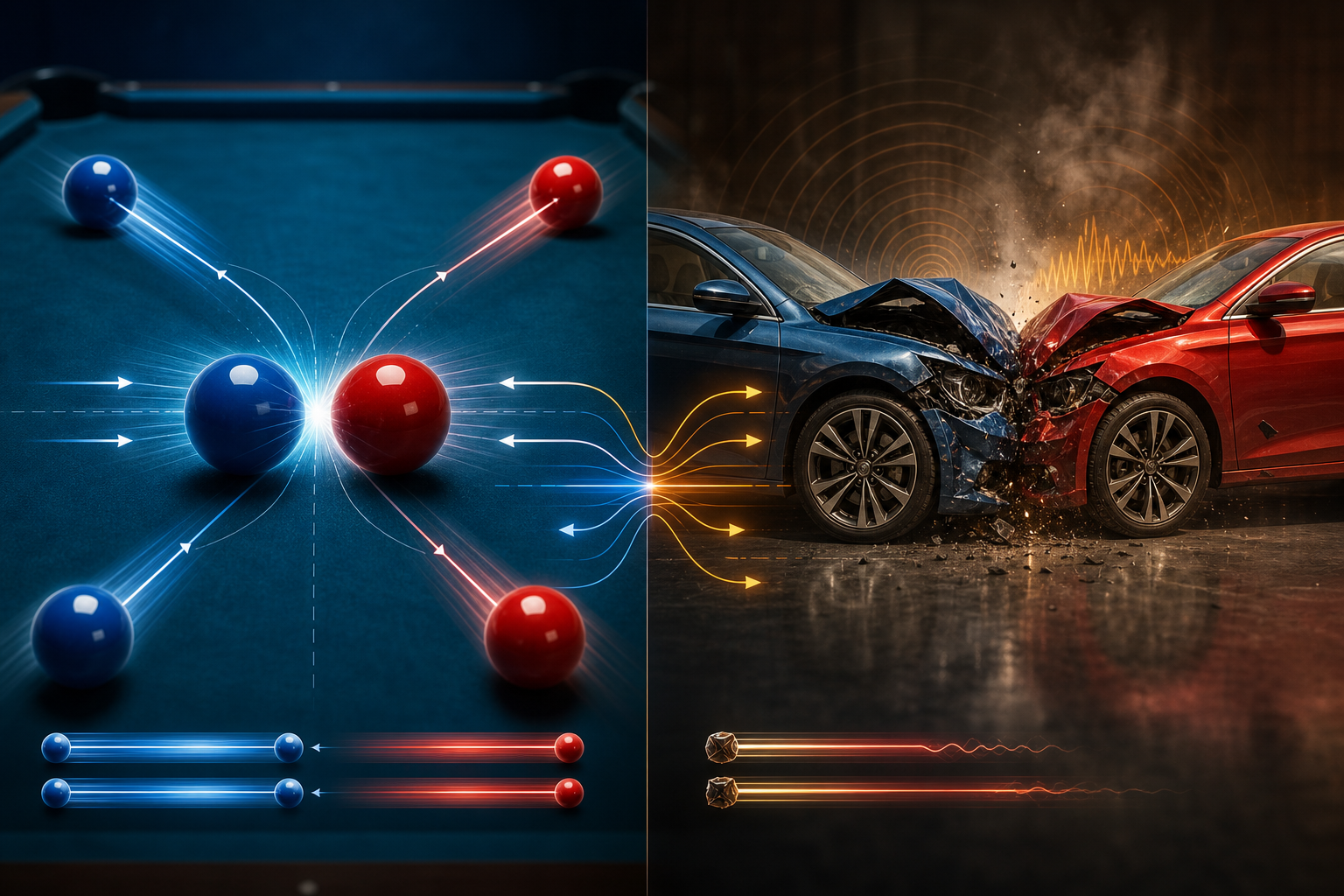
The principle of momentum conservation states that in an isolated system—where no external forces are acting—the total momentum before an event (like a collision) must equal the total momentum after that event. This idea is critical in both elastic and inelastic collisions. In elastic collisions, both momentum and kinetic energy are conserved. Think of two perfectly bouncy balls colliding: they rebound off each other without any loss of energy.
In contrast, inelastic collisions involve a different scenario. While momentum is still conserved, kinetic energy is not. A classic example is a car crash, where vehicles crumple together, and energy is transformed into sound, heat, and deformation. This distinction between elastic and inelastic collisions helps us predict the outcomes of various interactions, whether they involve sports, vehicles, or subatomic particles.
Understanding momentum conservation allows us to solve complex problems. For example, in a game of pool, when the cue ball strikes another ball, you can calculate the resulting velocities of both balls using momentum conservation principles. This principle applies universally, from simple playground physics to advanced aerospace engineering.
Real-world applications abound. Engineers use momentum conservation to design safer vehicles, ensuring crumple zones absorb energy during a crash effectively. In sports, coaches analyze player movements to enhance performance and strategy, relying on the laws of motion and momentum.
As we delve deeper into momentum conservation, we’ll explore its implications in various scenarios, providing clarity on how elastic and inelastic collisions differ and why this knowledge is essential for students, professionals, and enthusiasts alike.
Understanding Elastic Collisions: Definition and Characteristics
Elastic collisions are fascinating events in physics characterized by the conservation of both momentum and kinetic energy. In simpler terms, when two objects collide elastically, they bounce off each other without any loss of kinetic energy in the system. This is a standout feature that distinguishes elastic collisions from inelastic collisions, where kinetic energy is not conserved.
To grasp the concept of elastic collisions, let’s break down the definition further. An elastic collision occurs when two or more bodies collide, and upon separation, they retain the same total kinetic energy that they had before the collision. This means that the energy before the collision is equal to the energy after the collision, expressed mathematically as:
\[ KE_{initial} = KE_{final} \]
This equation highlights that while the individual kinetic energies of the colliding bodies may change, the total kinetic energy remains constant.
Now, let’s look at some key characteristics of elastic collisions. First, they occur in ideal conditions, often modeled in a vacuum where external forces like friction and air resistance are negligible. Real-world examples are rare, but they can often be approximated in scenarios involving gas molecules or perfectly hard spheres.
Another critical aspect is that, during an elastic collision, both momentum and kinetic energy are conserved. The conservation of momentum can be expressed as:
\[ m_1v_{1i} + m_2v_{2i} = m_1v_{1f} + m_2v_{2f} \]
Here, \(m_1\) and \(m_2\) are the masses of the colliding bodies, while \(v_{1i}\) and \(v_{2i}\) represent their initial velocities, and \(v_{1f}\) and \(v_{2f}\) denote their final velocities after the collision.
In elastic collisions, the relative velocities of the two objects before and after the collision can also be linked. They will have the same magnitude but opposite direction:
\[ v_{1i} – v_{2i} = -(v_{1f} – v_{2f}) \]
This relationship indicates that the speed at which they approach each other equals the speed at which they separate, a detail that underlines the nature of elastic interactions.
Real-life applications include scenarios like billiard balls striking each other, where they rebound off in predictable paths without losing speed. Understanding these principles not only helps in physics but also in engineering and various applied sciences where collision outcomes are crucial.
Key Features of Inelastic Collisions: Definition and Examples
Inelastic collisions are a fundamental concept in physics, particularly within the study of momentum conservation. These collisions occur when two objects collide and do not bounce apart completely. Instead, they stick together or deform, resulting in a loss of kinetic energy. This energy doesn’t vanish; it transforms into other forms, such as heat, sound, or energy used in deformation.
One key characteristic of inelastic collisions is that the total momentum of the system is conserved, even though kinetic energy is not. This principle can be summed up in the equation:
m₁v₁ + m₂v₂ = (m₁ + m₂)v_f
Where:
– m₁ and m₂ are the masses of the colliding objects,
– v₁ and v₂ are their initial velocities,
– v_f is the final velocity of the combined mass after the collision.
Consider a real-world example: a car crash. When two vehicles collide, they often crumple together, demonstrating inelastic behavior. The crumpling absorbs energy that would otherwise be kinetic, leading to a significant reduction in overall kinetic energy but maintaining the momentum of the system.
Another classic example involves clay balls. When two clay balls collide, they stick together and move as a single mass after the collision. This is a perfect illustration of an inelastic collision. The kinetic energy before the collision is greater than after, as some energy is transformed into internal energy, causing the clay to deform.
Inelastic collisions can be categorized further into perfectly inelastic collisions, where the maximum kinetic energy is lost, and the colliding bodies stick together completely. In these cases, the final velocity is the same for both bodies post-collision.
A common classroom demonstration involves dropping a rubber ball onto a surface. When it bounces back, it retains some kinetic energy, displaying elastic behavior. If, however, you drop a lump of putty, it flattens upon impact and sticks to the surface, showcasing inelastic characteristics.
Understanding inelastic collisions is crucial not just in theoretical physics but also in practical applications such as vehicle safety designs, sports, and material science. Engineers often study how materials behave under impact to improve safety features, making the study of inelastic collisions both relevant and essential in real-world scenarios.
Mathematics of Momentum Conservation: Equations and Calculations
Momentum conservation is a fundamental concept in physics, particularly when analyzing collisions. To grasp this concept, let’s dive into the essential equations and calculations that define momentum in both elastic and inelastic collisions.
Momentum (p) is defined as the product of an object’s mass (m) and its velocity (v):
p = m × v
This equation sets the foundation for understanding how momentum behaves during interactions between objects.
In any closed system, the total momentum before a collision will equal the total momentum after the collision. This can be expressed mathematically as:
p_initial = p_final
In a more detailed form, for two colliding objects, we have:
m₁v₁ + m₂v₂ = m₁v₁’ + m₂v₂’
Here, m₁ and m₂ are the masses of the two objects, v₁ and v₂ are their initial velocities, and v₁’ and v₂’ are their final velocities after the collision.
Let’s break this down further for elastic and inelastic collisions.
Elastic Collisions
In elastic collisions, both momentum and kinetic energy are conserved. The equations of conservation remain the same, but we also include kinetic energy:
KE_initial = KE_final
This can be expressed as:
1/2 m₁v₁² + 1/2 m₂v₂² = 1/2 m₁v₁’² + 1/2 m₂v₂’²
This dual conservation provides a more complete picture. For example, if we know the masses and initial velocities, we can solve for the final velocities by setting up a system of equations.
Inelastic Collisions
In inelastic collisions, momentum is still conserved, but kinetic energy is not. The objects may stick together, moving as a single entity after the collision. The momentum equation remains:
m₁v₁ + m₂v₂ = (m₁ + m₂)v_f
Here, v_f is the final velocity of the combined mass. The kinetic energy equation, however, is not applicable in the same manner. Instead, we typically calculate the kinetic energy lost:
KE_lost = KE_initial – KE_final
This loss occurs due to factors like heat and sound, which transform kinetic energy into other forms.
To illustrate, consider a scenario where a 2 kg object moving at 3 m/s collides with a stationary 3 kg object. For an elastic collision, you’d apply both momentum and kinetic energy conservation equations to find the final velocities. For an inelastic collision, you’d calculate the final combined velocity using the momentum equation, revealing how energy dissipates in less predictable ways.
Understanding these equations equips you with the tools to analyze various collision scenarios effectively.
Real-World Applications of Elastic Collisions
Elastic collisions are more than just a theoretical concept; they’re fundamental in various fields and everyday situations. Understanding these collisions helps in areas ranging from sports to engineering, and even astrophysics.
In sports, consider billiards. When a cue ball strikes another ball, the collision is nearly elastic. The cue ball transfers its momentum to the target ball, which then moves away at a similar speed. This principle allows players to strategize their shots based on angles and speeds. A well-calibrated strike results in precise movements, showcasing the importance of momentum conservation.
Another compelling example is in the world of car safety. Vehicles are designed to crumple upon impact, which primarily involves inelastic collisions. However, understanding elastic collisions helps engineers create safer designs. For instance, crash test simulations often utilize elastic collision principles to analyze how different materials absorb and distribute energy. This knowledge leads to improved safety features, like airbags and reinforced frames, reducing injury risk during accidents.
In the realm of particle physics, elastic collisions are crucial when studying subatomic particles. When particles collide at high speeds in accelerators, they often behave elastically. This behavior allows physicists to gather data on fundamental forces and particle properties. By analyzing the outcomes of these collisions, scientists can test theories about the universe’s building blocks.
Astrophysics also benefits from understanding elastic collisions. Consider galaxies colliding. When two galaxies merge, the stars within them mostly pass by one another, resulting in an elastic collision. This interaction preserves the momentum of stars, allowing them to continue on their trajectories. Such studies help astronomers comprehend galaxy formation and evolution.
In manufacturing, elastic collisions have practical applications as well. In processes like powder metallurgy, particles are compacted using techniques that rely on elastic collisions to create dense materials. Engineers must consider momentum transfer to optimize the properties of the final product, ensuring durability and performance in various applications.
Through these examples, it’s clear that elastic collisions play a vital role across multiple domains. They enhance our understanding of physical laws and improve designs in technology, safety, and research. The principles governing these collisions are not just academic; they shape the real world in significant ways.
Real-World Applications of Inelastic Collisions
Inelastic collisions aren’t just theoretical concepts; they occur in various real-world scenarios, significantly impacting engineering, safety, and technology. Understanding these applications helps us appreciate the importance of momentum conservation in everyday life.
One of the most prominent examples of inelastic collisions is in automotive safety. When cars collide, the primary objective is to protect the occupants. During a crash, vehicles often crumple, absorbing energy and preventing it from being transferred to passengers. This crumpling effect is crucial in reducing injuries. Engineers design crumple zones in cars specifically to maximize energy absorption during an inelastic collision, demonstrating practical applications of momentum conservation principles.
Consider the impact of sports equipment. In sports like football or hockey, equipment is designed to absorb and dissipate energy during inelastic collisions. For example, a football helmet is engineered to deform on impact, which reduces the force transmitted to the player’s head. This design choice minimizes the risk of concussions, showcasing how inelastic collisions directly influence athlete safety.
In the realm of particle physics, inelastic collisions are fundamental. When particles collide at high speeds in accelerators like the Large Hadron Collider, they often stick together, forming new particles. These collisions provide insights into the fundamental forces of nature and are critical for advancing our understanding of the universe. Here, conservation of momentum plays a key role in analyzing the outcomes of these high-energy interactions.
Another everyday example lies in the world of materials science. When two materials collide—think of a hammer striking a nail—the inelastic nature of the collision leads to deformation. This principle helps in understanding how materials behave under stress, influencing manufacturing processes and product design. Engineers utilize this knowledge to create more resilient products that can withstand impacts without failing.
Finally, in the realm of video games and simulations, inelastic collisions are often modeled to create realistic interactions. Game developers implement physics engines that calculate the momentum and energy transfer during inelastic collisions. This attention to detail enhances user experience, making gameplay more immersive and believable.
The applications of inelastic collisions extend far beyond classroom examples. They touch various fields, including automotive safety, sports, particle physics, materials science, and even entertainment. Understanding these concepts allows us to grasp the underlying mechanics that govern the world around us.
Comparative Analysis: Elastic vs Inelastic Collisions
When we analyze collisions in physics, two primary types emerge: elastic and inelastic collisions. Each type showcases distinct behaviors in terms of momentum and kinetic energy conservation, shaping how objects interact post-collision.
Elastic Collisions
In an elastic collision, both momentum and kinetic energy are conserved. This means that the total momentum before the collision equals the total momentum after. The same applies to kinetic energy, making these collisions somewhat idealized.
A classic example is two billiard balls striking each other. Before impact, each ball possesses a specific momentum and kinetic energy. After the collision, they bounce off without any kinetic energy lost, merely transferring energy between them. This scenario is modeled by equations that reinforce the conservation laws, allowing for precise calculations of velocities post-collision.
Mathematically, if two objects with masses \(m_1\) and \(m_2\) collide with initial velocities \(u_1\) and \(u_2\), the final velocities \(v_1\) and \(v_2\) can be derived using:
1. Conservation of momentum:
\(m_1u_1 + m_2u_2 = m_1v_1 + m_2v_2\)
2. Conservation of kinetic energy:
\(\frac{1}{2}m_1u_1^2 + \frac{1}{2}m_2u_2^2 = \frac{1}{2}m_1v_1^2 + \frac{1}{2}m_2v_2^2\)
These equations illustrate the neat symmetry of elastic collisions, making them fundamental in physics.
Inelastic Collisions
In contrast, inelastic collisions allow momentum to be conserved while kinetic energy is not. Energy is transformed into other forms, like heat or sound. A familiar example is a car crash. The vehicles crumple upon impact, and while momentum is conserved, the kinetic energy dissipates through deformation and other energy transformations.
Inelastic collisions are further categorized into perfectly inelastic collisions, where the colliding objects stick together post-impact, moving as a single unit. This results in maximum kinetic energy loss since the combined mass moves at a lower velocity than if they had separated.
The mathematical approach to inelastic collisions primarily focuses on momentum conservation:
\(m_1u_1 + m_2u_2 = (m_1 + m_2)v_f\)
Here, \(v_f\) represents the final velocity of the combined masses. The loss of kinetic energy can be computed by comparing initial and final kinetic energies:
\(\Delta KE = KE_{initial} – KE_{final}\)
This difference highlights how energy is not lost but transformed, revealing the collision’s internal mechanics.
Key Differences and Implications
Understanding these distinctions is crucial for many applications, from engineering to sports. Elastic collisions are often idealized for calculations, while inelastic collisions mirror real-world interactions more accurately.
In engineering, designing safer vehicles involves understanding inelastic collisions. Engineers analyze how energy disperses during a crash to enhance safety features. Conversely, in sports science, optimizing equipment like tennis rackets relies on the principles of elastic collisions to maximize performance.
In summary, the comparative analysis of elastic and inelastic collisions illuminates essential principles of momentum conservation and energy transformation, vital for understanding physical interactions.
Common Misconceptions About Momentum Conservation
Momentum conservation is a fundamental principle in physics, but it’s often misunderstood. Let’s address some of the most common misconceptions that can lead to confusion.
First, many people believe that momentum is always conserved in every collision. This is not entirely true. Momentum is conserved only in isolated systems where no external forces act. In real-world scenarios, friction, air resistance, and other forces can affect the momentum of colliding objects. For instance, if two cars collide on a road, external forces like friction with the ground and the impact of other vehicles can come into play, affecting the overall momentum.
Another misconception is that momentum conservation applies solely to elastic collisions. While momentum is conserved in both elastic and inelastic collisions, the distinction lies in how kinetic energy behaves. In elastic collisions, both momentum and kinetic energy are conserved. In inelastic collisions, momentum is conserved, but some kinetic energy is transformed into other forms, such as heat or sound. This is crucial to understand because it clarifies the nature of energy transformation during collisions.
Some people might think that momentum conservation means that objects will always move together after a collision. This isn’t accurate. In perfectly inelastic collisions, objects stick together after colliding, which can create the impression that they always move as one. However, in many cases, like in elastic collisions, objects bounce off each other and can have different velocities post-collision. The way they separate or continue moving depends on their masses and initial velocities.
Another common misunderstanding is the idea that momentum is a measure of speed. Momentum is the product of mass and velocity, meaning that an object can have a high momentum even if it’s moving slowly, as long as it has a large mass. For example, a heavy truck moving at a low speed can have more momentum than a small car moving at high speed. This emphasizes the importance of mass in the momentum equation and debunks the notion of momentum being tied solely to speed.
Finally, some might think that if two objects collide and one is much more massive, it won’t affect the momentum of the larger object. This is a misinterpretation of momentum transfer. The larger object will experience a change in momentum, albeit a smaller change compared to the smaller object. Understanding how momentum is exchanged during collisions is crucial for analyzing the effects on both objects involved.
By clarifying these misconceptions, we can develop a deeper understanding of momentum conservation and its applications in real-world scenarios.
Experiments to Demonstrate Elastic and Inelastic Collisions
Understanding Elastic Collisions
To grasp the concept of elastic collisions, you can conduct a simple experiment using two identical balls, such as ping pong balls. Start by suspending them from a fixed height using strings. Release one ball so it swings down and collides with the stationary ball.
You’ll notice that the first ball bounces back, while the second one moves forward. This experiment highlights the principle of momentum conservation; the total momentum before and after the collision remains constant. Measure the heights to which both balls rebound. If they reach the same height, the collision is elastic, meaning kinetic energy is conserved.
Analyzing Inelastic Collisions
Now, let’s shift our focus to inelastic collisions. For this, use two different balls, like a tennis ball and a basketball. Drop the tennis ball onto the basketball from a fixed height. Observe what happens upon impact. The tennis ball will compress and stick to the basketball, leading to a common motion.
In this scenario, momentum is conserved, but kinetic energy is not. You can calculate the initial momentum of the tennis ball and the final momentum of the combined mass. This experiment visually demonstrates that while the two objects move as one post-collision, energy has transformed into other forms, such as heat and sound.
Real-World Applications
Both types of collisions have real-world implications. Elastic collisions are evident in sports like billiards, where the balls bounce off each other, conserving both momentum and kinetic energy. On the other hand, inelastic collisions can be observed in car crashes. A vehicle’s crumpling upon impact illustrates energy loss and momentum conservation at play.
To quantify these experiments, utilize motion sensors or video analysis software. By capturing the motion before and after the collisions, you can visualize the energy transfers and momentum changes. This approach not only enhances understanding but also solidifies fundamental physics concepts.
Conclusion of Experiments
Through these experiments, the differences between elastic and inelastic collisions become clear. Understanding these principles is essential, not just for academic knowledge but also for practical applications in engineering, sports, and safety design. The experiments are straightforward yet effective in demonstrating the complexities of momentum conservation in a tangible way.
Conclusion: The Importance of Momentum Conservation in Physics
Momentum conservation isn’t just a concept in physics; it’s a fundamental principle that shapes our understanding of the physical world. Every time you see a car crash or a basketball colliding with the court, momentum conservation is at play, influencing the outcome of these events in ways that are both predictable and insightful.
The principle states that in a closed system, the total momentum before and after an event remains constant, provided no external forces intervene. This idea has profound implications. It allows us to predict the behavior of moving objects, analyze collisions, and even understand the motion of celestial bodies. For example, when two cars collide, we can calculate the velocities post-collision by applying momentum conservation. This is crucial for accident reconstruction and safety improvements in vehicle design.
In elastic collisions, both momentum and kinetic energy are conserved. This means after the collision, you can use the initial velocities and masses of the colliding bodies to find their final velocities. Take two billiard balls colliding on a pool table: they exchange momentum and energy efficiently, resulting in predictable paths. This predictability gives us powerful tools in fields ranging from engineering to sports physics.
In contrast, inelastic collisions allow for momentum conservation but not kinetic energy. Think of a football tackle. The players may crumple together, and energy dissipates as sound, heat, and deformation. This understanding helps engineers design safer cars that crumple upon impact, absorbing energy to protect passengers.
Moreover, the conservation of momentum extends beyond simple collisions. It plays a critical role in complex systems, such as rocket propulsion. When a rocket expels gas in one direction, it gains momentum in the opposite direction, propelling it forward. This fundamental aspect of momentum conservation illustrates how interconnected and dynamic our universe is.
Understanding momentum conservation not only equips us with the tools to solve practical problems but also deepens our appreciation for the laws governing motion. It connects various phenomena, reinforcing the idea that physics is not just about equations, but about the relationships and interactions that define our reality. Whether it’s in sports, vehicle safety, or space exploration, grasping this concept is vital for anyone looking to master the principles of physics.