Projectile Motion: Your Ultimate Guide with Detailed Worked Examples
Introduction to Projectile Motion: Understanding the Basics
Projectile motion refers to the motion of an object that is projected into the air and is subject to the forces of gravity and air resistance. This type of motion is a fascinating area of physics because it combines aspects of both linear and angular motion. Understanding projectile motion is crucial in various fields, including sports, engineering, and even video game design.
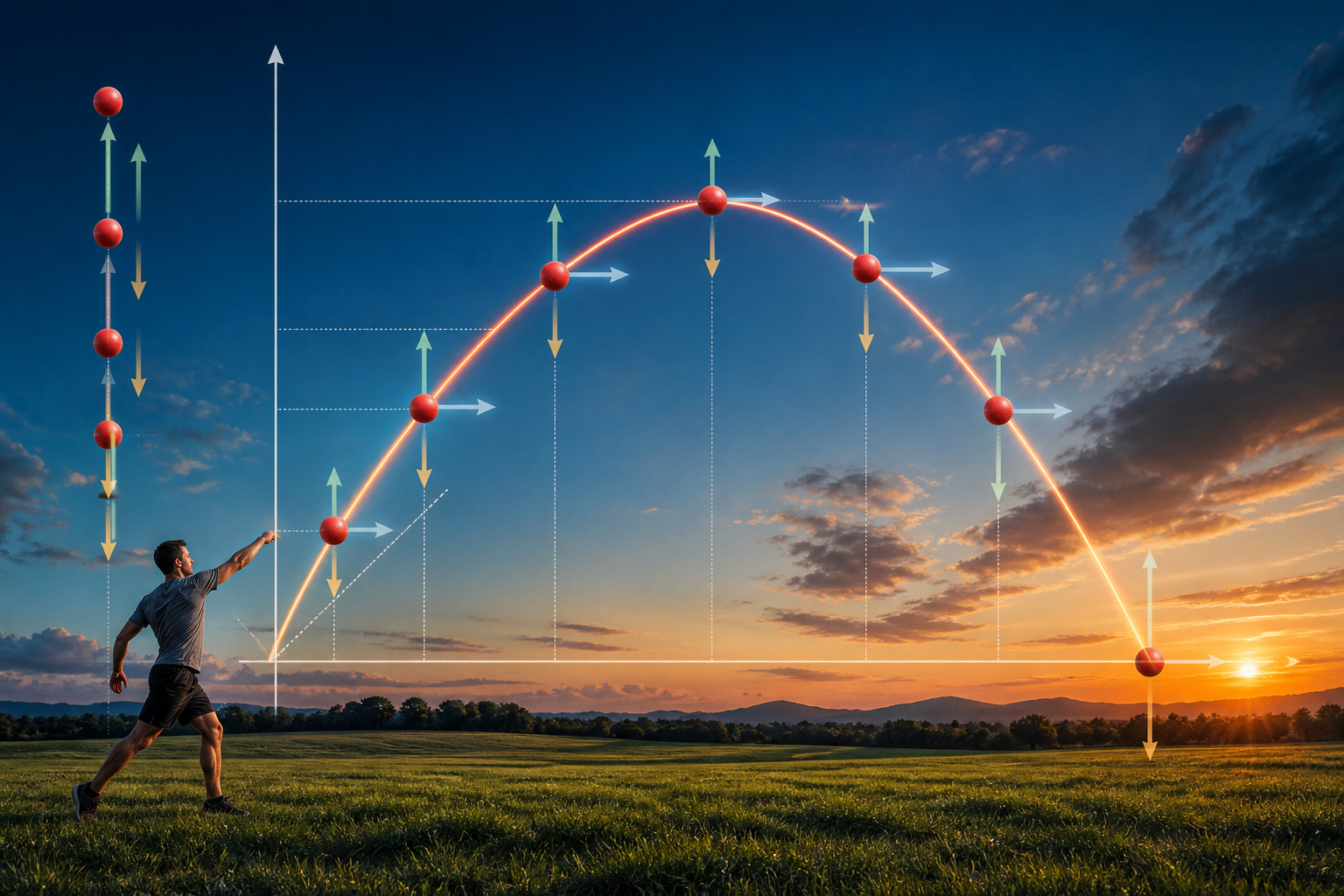
At its core, projectile motion can be broken down into two main components: horizontal motion and vertical motion. When an object is thrown, kicked, or launched, it moves simultaneously in both directions. The horizontal component is influenced primarily by the initial velocity and the absence of any significant forces acting on it, aside from air resistance, which can often be negligible in many calculations.
In contrast, the vertical component is affected by gravity, which acts downward at a constant acceleration of approximately 9.81 m/s² on Earth. This distinction is critical. While the horizontal motion remains uniform (constant velocity), the vertical motion is uniformly accelerated.
Let’s consider a simple example. Imagine you throw a ball. Initially, it moves upward due to the force of your throw. However, as it ascends, gravity begins to decelerate it until it reaches a peak height, known as the apex. After that point, gravity pulls it back down. The ball’s path is not a straight line; instead, it traces a parabolic trajectory.
This parabolic path is one of the most important features of projectile motion. The shape is influenced by several factors, including the initial launch angle, the initial speed, and the height from which the object is launched. For instance, launching an object at a 45-degree angle will generally yield the maximum range for a given initial speed in a vacuum, as this angle optimally balances the horizontal and vertical components of the motion.
Understanding these fundamentals sets the stage for more complex analyses, such as calculating range, flight time, and maximum height. Later sections will delve into the mathematics of projectile motion, providing you with the tools to solve real-world problems effectively. This foundational knowledge is essential, whether you’re trying to improve your basketball shot, calculating the trajectory of a rocket, or designing a roller coaster.
The Physics Behind Projectile Motion: Key Concepts Explained
Projectile motion is a fascinating area of physics that combines the principles of kinematics and dynamics. It describes the motion of an object launched into the air, influenced solely by the force of gravity and its initial velocity. Understanding these fundamental concepts is crucial for mastering projectile motion.
The first key concept is **initial velocity**. This is the speed and direction at which an object is projected. It consists of two components: horizontal and vertical. The horizontal component (Vx) determines how far the object travels along the ground, while the vertical component (Vy) dictates how high the object rises before falling back down.
Next, we have **acceleration due to gravity (g)**. On Earth, this value is approximately 9.81 m/s². This acceleration acts downwards, affecting the vertical motion of the projectile. It’s vital to remember that horizontal and vertical motions are independent. While gravity influences the vertical motion, it has no effect on horizontal motion after the object is launched.
The **trajectory** of a projectile is the path it follows, typically a parabolic shape. The shape results from the interplay between the initial velocity and gravitational force. The maximum height (H) reached by the projectile can be calculated using the vertical component of the initial velocity.
To find the time of flight, or how long the projectile stays in the air, you can use the formula:
Time of Flight Formula
For a projectile launched at an angle θ, the time of flight (T) can be calculated as:
T = (2 * Vy) / g
This equation shows that the time of flight is directly proportional to the vertical component of the initial velocity. Higher launch angles increase the vertical velocity, thus extending the time the projectile remains airborne.
Another important aspect is **range**. This is the horizontal distance covered by the projectile. It can be calculated using the formula:
Range Formula
Range (R) = (Vx * T)
where Vx is the horizontal component of the initial velocity and T is the time of flight. This relationship illustrates that the range depends on both the angle of projection and the initial speed.
Lastly, the **angle of projection** significantly influences the projectile’s motion. The optimal angle for achieving maximum range on level ground is 45 degrees. Launching at this angle maximizes both horizontal and vertical components of velocity, allowing for the longest trajectory.
By grasping these key concepts—initial velocity, acceleration due to gravity, trajectory shape, time of flight, range, and angle of projection—you lay the groundwork for analyzing and solving projectile motion problems effectively. Each element plays a pivotal role in determining how a projectile behaves after being launched.
Types of Projectile Motion: Horizontal and Vertical Components
Projectile motion is a fascinating topic in physics, characterized by the combination of horizontal and vertical movements. Understanding these components is crucial for mastering the concepts involved in projectile motion. Let’s break it down.
Horizontal Motion
Horizontal motion in projectile motion occurs at a constant speed. This is because, in the absence of air resistance, there are no horizontal forces acting on the projectile. The only force acting on an object in motion is gravity, which pulls it downward.
Key aspects to consider:
– **Constant Velocity**: The horizontal component maintains a constant velocity throughout the flight. For example, if a ball is thrown horizontally at 10 meters per second, it will continue to move at that speed until it impacts the ground.
– **Independence from Vertical Motion**: The horizontal and vertical motions are independent of each other. The time it takes for the projectile to reach the ground is solely determined by its vertical motion.
– **Distance Calculation**: The horizontal distance traveled can be calculated using the formula:
\[ \text{Distance} = \text{Horizontal Velocity} \times \text{Time of Flight} \]
This formula illustrates how distance is dependent on time and velocity, not on height or vertical acceleration.
Vertical Motion
Vertical motion, on the other hand, is influenced by gravity, which provides a constant downward acceleration of approximately \(9.81 \, \text{m/s}^2\). This means that the projectile’s vertical velocity changes over time.
Key points about vertical motion include:
– **Acceleration Due to Gravity**: The vertical component accelerates downward due to gravity. This affects how fast an object falls. For instance, if a projectile is thrown upward, it will initially move upward, slow down, stop momentarily, and then begin to fall back down.
– **Vertical Distance Calculation**: The vertical distance can be calculated using the equation:
\[ \text{Vertical Distance} = \text{Initial Vertical Velocity} \times \text{Time} – \frac{1}{2} g t^2 \]
where \(g\) is the acceleration due to gravity.
– **Time of Flight**: The time of flight is determined by the initial vertical velocity. If a projectile is launched vertically, the time to reach the peak height can be found using:
\[ t = \frac{V}{g} \]
where \(V\) is the initial vertical velocity.
Understanding both components—horizontal and vertical—allows for a comprehensive grasp of projectile motion. Each component plays a distinct role, yet they work together to define the path of the projectile. This knowledge is essential for solving real-world problems involving projectiles, such as in sports or engineering applications.
The Role of Gravity in Projectile Motion: Effects and Implications
Gravity is a fundamental force that plays a critical role in the dynamics of projectile motion. It’s the reason why objects follow a curved path when thrown or propelled. Understanding the specifics of how gravity influences this motion can significantly enhance your grasp of the subject.
First, let’s break down how gravity affects the trajectory of a projectile. When an object is launched, it starts with an initial velocity. This velocity can be broken into two components: horizontal and vertical. Gravity primarily acts on the vertical component.
As the projectile ascends, gravity decelerates it at a constant rate of approximately 9.81 m/s² (near the Earth’s surface). This means that the higher the object goes, the slower it moves upward until it reaches its peak point, where its vertical velocity becomes zero.
Once the peak is reached, gravity accelerates the projectile downward. This dual effect leads to a parabolic trajectory—a symmetrical path that’s characteristic of projectile motion.
Now, let’s talk about the implications of this behavior. For example, when launching a projectile at a specific angle, gravity alters the time it takes to reach the peak and the total flight time. A higher launch angle (like 60 degrees) will give a longer time in the air compared to a lower angle (like 30 degrees), assuming the same initial velocity.
Moreover, the maximum height reached by the projectile is directly influenced by gravitational pull. The formula \( h = \frac{v^2 \sin^2(\theta)}{2g} \) illustrates how the height depends on the square of the initial velocity and the sine of the launch angle, divided by twice the acceleration due to gravity.
Understanding these relationships helps in real-world applications. For instance, engineers designing sports equipment or safety devices must account for gravity’s effects to optimize performance and safety.
In conclusion, gravity is not just a force; it’s a crucial player in determining the outcomes of projectile motion. Its effects shape trajectories, influence flight times, and dictate the physics behind various applications. By mastering these concepts, you’ll be well-equipped to analyze and predict projectile behavior in any context.
Formulas for Projectile Motion: Essential Equations You Need to Know
Understanding the fundamental equations of projectile motion is crucial for mastering this topic. These formulas help you predict the trajectory of an object launched into the air. Let’s break down the key equations you need to know.
1. The Basic Kinematic Equations
Projectile motion can be described using the basic kinematic equations. These equations relate displacement, velocity, acceleration, and time. Here are the primary equations to consider:
– **Displacement**: \( s = ut + \frac{1}{2} a t^2 \)
– **Final Velocity**: \( v = u + at \)
– **Velocity Squared**: \( v^2 = u^2 + 2as \)
In these equations:
– \( s \) is the displacement,
– \( u \) is the initial velocity,
– \( v \) is the final velocity,
– \( a \) is the acceleration, and
– \( t \) is the time.
For projectile motion, remember that the acceleration \( a \) is due to gravity, which is approximately \( 9.81 \, \text{m/s}^2 \) downward.
2. Horizontal and Vertical Motion
Projectile motion consists of two components: horizontal and vertical. It’s essential to analyze them separately:
**Horizontal Motion**:
– There is no acceleration in the horizontal direction (ignoring air resistance).
– The horizontal displacement can be calculated as:
\( x = v_{0x} t \)
Where \( v_{0x} \) is the initial horizontal component of the velocity.
**Vertical Motion**:
– The vertical motion is affected by gravity.
– The vertical displacement can be described as:
\( y = v_{0y} t – \frac{1}{2} g t^2 \)
Here, \( v_{0y} \) is the initial vertical component of the velocity, and \( g \) is \( 9.81 \, \text{m/s}^2 \).
3. Time of Flight
The time of flight refers to the total time the projectile spends in the air. For an object launched at an angle \( \theta \) with an initial speed \( v_0 \), the time of flight can be determined by:
\( T = \frac{2v_{0} \sin(\theta)}{g} \)
This formula indicates that the time of flight depends on the initial speed and the angle of launch.
4. Maximum Height
The maximum height \( H \) reached by the projectile can be found using:
\( H = \frac{v_{0}^2 \sin^2(\theta)}{2g} \)
This equation shows that higher launch angles and speeds lead to greater heights.
5. Range of the Projectile
Finally, the horizontal range \( R \) of the projectile is crucial for understanding how far it will travel. The formula is:
\( R = \frac{v_{0}^2 \sin(2\theta)}{g} \)
This indicates that the range is maximized at a launch angle of \( 45^\circ \).
Conclusion
These essential equations form the backbone of your understanding of projectile motion. Using them allows you to analyze and predict the behavior of projectiles effectively. Practice applying these formulas to various problems to gain confidence in your skills.
Step-by-Step Worked Examples: Analyzing Simple Projectile Scenarios
Understanding projectile motion can feel overwhelming at first, but breaking it down into simple scenarios makes it manageable. Let’s work through a couple of examples to clarify the concepts.
Example 1: A Ball Thrown Straight Up
Imagine you throw a ball vertically upward with an initial velocity of 20 m/s. To analyze this scenario, we’ll apply the basic equations of motion.
First, we need to determine how high the ball will go before it starts to descend. We can use the formula:
h = (v² – u²) / (2g)
Where:
h = maximum height
v = final velocity (0 m/s at the peak)
u = initial velocity (20 m/s)
g = acceleration due to gravity (approximately 9.81 m/s²)
Plugging in the values:
h = (0² – 20²) / (2 * -9.81) = 20.4 meters
This means the ball reaches a maximum height of 20.4 meters. Next, let’s find out how long it takes to reach this height. We use the formula:
t = (v – u) / g
Substituting the known values:
t = (0 – 20) / -9.81 ≈ 2.04 seconds
It takes about 2.04 seconds for the ball to reach its peak height.
Example 2: A Projectile Launched at an Angle
Now, let’s consider a different scenario. Suppose a projectile is launched at an angle of 30 degrees with an initial velocity of 40 m/s. How far will it travel horizontally before hitting the ground?
First, we need to calculate the horizontal and vertical components of the velocity:
Vx = u * cos(θ)
Vy = u * sin(θ)
Where θ is the launch angle (30 degrees). Calculating these gives:
Vx = 40 * cos(30) ≈ 34.64 m/s
Vy = 40 * sin(30) = 20 m/s
Next, we find the time of flight. The time to reach the maximum height can be found using:
t = Vy / g = 20 / 9.81 ≈ 2.04 seconds
The total time of flight is double this value since the time going up equals the time coming down:
Total time = 2 * 2.04 ≈ 4.08 seconds
Finally, we calculate the horizontal range:
Range = Vx * Total time = 34.64 * 4.08 ≈ 141.9 meters
This projectile will travel approximately 141.9 meters horizontally before hitting the ground.
These examples illustrate how to break down projectile motion into manageable parts. By applying formulas step-by-step, you can analyze various scenarios with confidence.
Advanced Projectile Motion Problems: Real-World Applications and Solutions
When we talk about projectile motion, it’s easy to get lost in the equations. But, let’s shift our focus to real-world applications. Understanding these scenarios can make the abstract concepts of physics much more tangible.
Imagine you’re an engineer designing a roller coaster. You need to calculate the trajectory of the cars as they launch off a ramp. The initial speed, angle of launch, and height of the ramp are all crucial factors. To solve this, you would use the equations of motion.
First, identify the initial velocity (v₀) and the angle of launch (θ). The horizontal and vertical components of the velocity help in breaking down the motion:
– **Horizontal Component (v₀x)**: \( v₀ \cdot \cos(θ) \)
– **Vertical Component (v₀y)**: \( v₀ \cdot \sin(θ) \)
Next, the time of flight can be determined using the formula:
\[ t = \frac{2 \cdot v₀ \cdot \sin(θ)}{g} \]
where \( g \) is the acceleration due to gravity (approximately 9.81 m/s²).
Once you know how long the coaster will be in the air, calculating the distance traveled becomes straightforward. The range (R) can be calculated using:
\[ R = v₀x \cdot t \]
Now, consider another application: launching a basketball. The angle and speed of the ball will dictate whether it goes in the hoop. Here, the same principles apply, but you must also factor in air resistance. This complicates things but can be approached using numerical methods or simulations to predict the ball’s path more accurately.
For a more complex scenario, think of a projectile fired from a cliff. The height of the cliff (h) adds another layer. The time to reach the ground can be found using:
\[ h = v₀y \cdot t – \frac{1}{2}gt² \]
Solving this quadratic equation gives you the time until impact. Using this, you can find the horizontal distance traveled before hitting the ground.
Real-world problems often require iterative approaches. Sometimes, you’ll need to adjust parameters based on conditions like wind speed or terrain. The key is to remain flexible and ready to iterate on your calculations.
Understanding projectile motion through these real-world applications not only solidifies your grasp of the concepts but also prepares you for practical problem-solving in engineering, sports, and physics.
Common Misconceptions About Projectile Motion: Debunking the Myths
Projectile motion is a fascinating topic in physics, yet it’s often wrapped in myths and misconceptions. These misunderstandings can lead to confusion, especially for students trying to grasp the concepts. Let’s break down some of the most common misconceptions and clarify the truths behind them.
Myth 1: All Projectiles Follow a Perfect Parabolic Path
Many believe that every projectile follows a perfect parabolic trajectory. While it’s true that the ideal trajectory of a projectile launched in a vacuum is a parabola, real-world conditions introduce factors that can alter this path. Air resistance plays a significant role in altering the trajectory of a projectile, especially for objects with larger surface areas or those traveling at high speeds.
For example, a football thrown in the air doesn’t just follow a simple curve; it can be affected by wind, spin, and other forces. This is why understanding projectile motion in real-life scenarios often requires considering these external factors.
Myth 2: The Horizontal and Vertical Motions are Dependent
Another common misconception is that the horizontal and vertical motions of a projectile are dependent on each other. In reality, these two components operate independently. The horizontal motion is uniform, meaning it moves at a constant velocity when air resistance is negligible. The vertical motion, however, is influenced by gravity, resulting in an acceleration downwards.
This independence is crucial for solving projectile motion problems. For instance, when calculating the range of a projectile, one must treat the horizontal and vertical motions separately, applying the appropriate equations for each.
Myth 3: The Angle of Launch Doesn’t Matter
Many people think that the launch angle of a projectile has little impact on its range or height. This is misleading. The angle at which an object is launched significantly affects both its maximum height and horizontal distance traveled.
A launch angle of 45 degrees is often cited as the optimal angle for achieving maximum range. However, this only holds true in a vacuum without air resistance. In real-life scenarios, factors like wind and the shape of the object can change the optimal launch angle. Understanding this concept is vital for tasks ranging from sports to engineering applications.
Myth 4: All Projectiles Have the Same Time of Flight
Some might assume that all projectiles, regardless of their launch angle or initial velocity, share the same time of flight. This is incorrect. The time a projectile spends in the air depends on its initial vertical velocity and the height from which it is launched.
For example, a projectile launched straight up at a high initial speed will have a longer time of flight compared to one launched at a lower speed or at an angle. Each case requires specific calculations to determine how long the object will remain airborne.
Conclusion
Understanding these misconceptions about projectile motion is essential for mastering the topic. By debunking these myths, you can approach problems with a clearer mindset and apply the correct principles to achieve accurate results.
Practical Tips for Solving Projectile Motion Problems: Strategies for Success
When tackling projectile motion problems, having a clear strategy can make all the difference. Here are some practical tips to help you navigate through these challenges.
Understand the Basics
Before diving into calculations, ensure you grasp the fundamental concepts of projectile motion. Remember, a projectile only experiences the force of gravity acting on it once it’s in the air. This means the horizontal motion is uniform while vertical motion is affected by gravity.
Break Down the Problem
Start by identifying all the components of the problem. Separate the motion into horizontal and vertical components. Use the following steps:
1. **Identify Initial Conditions**: Note the launch angle, initial velocity, and height from which the projectile is launched.
2. **Draw a Diagram**: Visualizing the situation can clarify angles and distances. Sketch the projectile’s path, labeling key points like the launch, peak, and landing.
3. **Choose a Coordinate System**: Typically, it’s best to set the origin at the launch point. This simplifies calculations.
Use the Right Equations
Different equations apply to horizontal and vertical motions. For horizontal motion, use:
– \( x = v_{0x} \cdot t \)
For vertical motion, employ:
– \( y = v_{0y} \cdot t – \frac{1}{2} g t^2 \)
where \( g \) is the acceleration due to gravity (approximately \( 9.81 \, m/s^2 \)).
Don’t forget to convert angles into radians when necessary!
Calculate Time of Flight
Time of flight is a crucial factor. Use the vertical motion equations to determine how long the projectile remains in the air. For instance, if a projectile is launched from an initial height \( h \):
– Set \( y = 0 \) (ground level) and solve for \( t \) using the quadratic formula.
This gives you the total time the projectile spends aloft, essential for calculating horizontal distance.
Focus on the Range
The range, or horizontal distance traveled, is vital. You can find it using:
– \( R = v_{0x} \cdot t_{total} \)
Make sure to calculate the horizontal component of the initial velocity:
– \( v_{0x} = v_0 \cdot \cos(\theta) \)
This step ensures you accurately account for the projectile’s path.
Practice with Real-World Problems
The best way to master projectile motion is through practice. Work through various scenarios, from launching a ball to calculating the trajectory of a cannonball. Each problem adds to your understanding and helps solidify the concepts.
Stay Organized and Double-Check Your Work
Keep your calculations neat and organized. Write down each step clearly and check your units. When you arrive at a solution, take a moment to verify if it makes sense within the context of the problem.
By following these strategies, you’ll find that solving projectile motion problems becomes more intuitive and manageable. Each step builds your confidence and competence in mastering projectile motion.
Conclusion: Mastering Projectile Motion for Academic and Real-Life Applications
Understanding projectile motion goes beyond just acing your physics exams. It’s a critical component in various fields like engineering, sports science, and even video game design. Whether you’re launching a rocket or calculating the perfect angle for a basketball shot, the principles of projectile motion are everywhere.
For students, grasping these concepts lays a solid foundation for further studies in physics and mathematics. Mastering the equations of motion, understanding the role of gravity, and recognizing how angles affect trajectories can give you an edge in problem-solving. It’s not just about plugging numbers into formulas; it’s about developing a deeper understanding of how the world operates.
In the realm of engineering, the applications become even more exciting. Engineers use projectile motion principles to design everything from roller coasters to missile trajectories. They rely on accurate calculations to ensure safety and functionality. Imagine designing a bridge that interacts with forces at play. Understanding how objects move in three dimensions is crucial.
In sports, athletes utilize these principles to enhance their performance. A basketball player calculating the best angle for a shot, or a golfer determining how to hit a drive, apply these concepts naturally. Coaches can analyze players’ motions using video technology to improve techniques and strategies. This scientific approach helps athletes maximize their potential.
Moreover, the entertainment industry, especially video game design, incorporates projectile motion to create realistic gaming experiences. Developers need to ensure that characters’ movements mimic real-world physics. If a character throws a grenade, understanding the projectile’s path affects game realism and player engagement.
To truly master projectile motion, practice is key. Solve real-world problems, conduct experiments, and engage with simulations. There are numerous online resources and tools available that allow you to visualize projectile paths. Use these to see how changing variables affects the outcome.
As you continue your journey in mastering projectile motion, remember it’s a blend of theory and practical application. The more you explore, the more you’ll see how these principles shape our understanding of the physical world. Whether in the classroom or the field, the ability to analyze and apply projectile motion will serve you well in numerous aspects of life.