Newton’s Laws of Motion: Formulas, Examples, and Insights
Introduction to Newton’s Laws of Motion
Newton’s Laws of Motion are a trio of fundamental principles that form the backbone of classical mechanics. Sir Isaac Newton introduced these laws in the late 17th century, and they continue to be relevant in understanding how objects behave under various forces. Whether you’re launching a rocket, playing sports, or simply walking, these laws govern the motion of all objects.
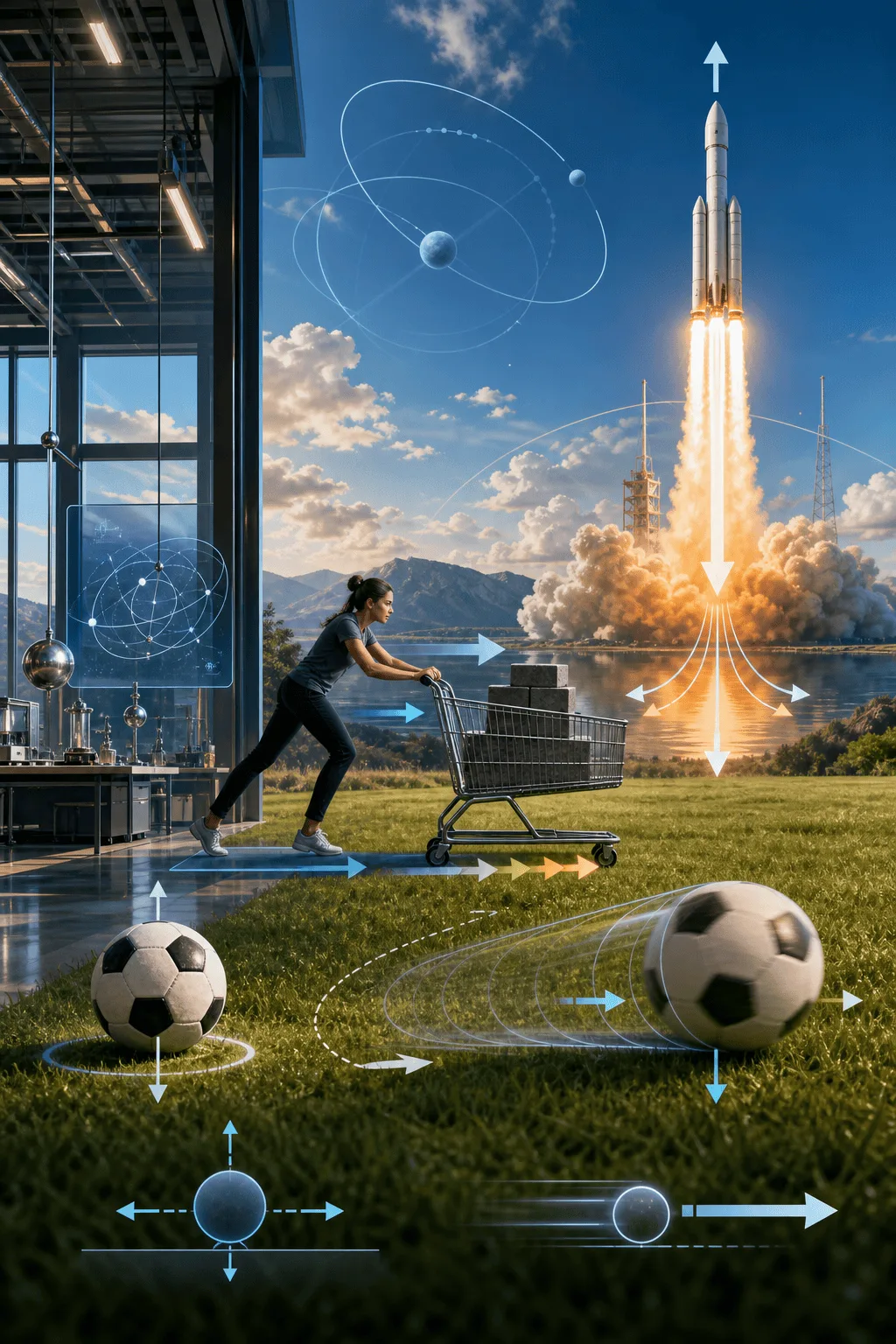
The first law, often called the law of inertia, states that an object at rest stays at rest, and an object in motion continues in motion at a constant velocity unless acted upon by a net external force. This principle emphasizes that motion is not inherently natural; rather, it requires a force to change an object’s state. Imagine a soccer ball lying still on a field. It won’t roll until someone kicks it. This law sets the stage for the concept of inertia, which explains why heavy objects are harder to move than lighter ones.
Next comes Newton’s second law, which quantifies the effect of forces on motion. It is famously encapsulated in the equation \( F = ma \), where \( F \) is the net force applied to an object, \( m \) is its mass, and \( a \) is the acceleration produced. This law reveals how acceleration is directly proportional to the net force and inversely proportional to mass. For instance, pushing a car (massive) requires more force than pushing a bicycle (light).
Lastly, the third law states that for every action, there is an equal and opposite reaction. This means forces always come in pairs. If you push against a wall, the wall pushes back with an equal force. Understanding this law is crucial for exploring various phenomena, like how rockets propel themselves into space. The thrust generated by expelling gas downwards results in an upward force, allowing the rocket to ascend.
In summary, Newton’s Laws of Motion provide critical insights into the mechanics of motion. They help us predict the behavior of objects under different forces, laying the groundwork for countless applications in engineering, physics, and everyday life. From the simplest actions to complex systems, these laws are essential for mastering motion and understanding the universe around us.
Understanding the Three Laws: A Breakdown
First Law of Motion: The Law of Inertia
Newton’s First Law states that an object at rest stays at rest and an object in motion continues in motion with the same speed and in the same direction unless acted upon by a net external force. This principle is all about inertia, which is the tendency of an object to resist changes in its state of motion.
Consider a soccer ball lying on a field. It won’t roll until someone kicks it. Once in motion, the ball keeps rolling until friction or another force stops it. This law highlights how forces are essential to change an object’s motion. In practical terms, this can be observed in vehicles. When a car suddenly stops, passengers lurch forward because their bodies want to maintain their motion, a clear demonstration of inertia.
Second Law of Motion: The Law of Acceleration
Newton’s Second Law provides a formula: F = ma, where F is the net force applied to an object, m is its mass, and a is the acceleration produced. This means that the acceleration of an object depends directly on the net force acting on it and inversely on its mass.
To illustrate, think about pushing a shopping cart. If you apply a small force, the cart accelerates slowly. But if you push harder, the cart moves faster. If you load the cart with heavy groceries, it becomes harder to accelerate with the same force. This law emphasizes that heavier objects require more force to achieve the same acceleration as lighter ones, which has real-world applications in engineering and vehicle safety.
Third Law of Motion: The Action-Reaction Law
Newton’s Third Law states that for every action, there is an equal and opposite reaction. This means that whenever one object exerts a force on another, the second object exerts a force of equal magnitude but in the opposite direction on the first object.
A classic example is a rocket launch. As the rocket engines fire downwards, the force of the expelled gases pushes the rocket upwards. This action-reaction pair is crucial in understanding propulsion systems in vehicles and airplanes. It’s also evident in everyday activities, like jumping off a small boat onto a dock; you push down on the boat, causing it to move backward while you leap forward.
Each of these laws interconnects to explain the fundamental principles of motion. Understanding them not only helps in physics but also enhances our comprehension of various phenomena in our daily lives—from driving a car to playing sports.
Mathematical Formulations of Newton’s Laws
Newton’s laws of motion are foundational principles in classical mechanics. Each law is defined mathematically, allowing for precise calculations and predictions about motion. Let’s break these down one by one to understand their mathematical formulations.
First Law: Law of Inertia
The first law states that an object remains at rest or in uniform motion unless acted upon by a net external force. Mathematically, this can be expressed as:
Fnet = 0 when a = 0
Here, Fnet represents the net external force acting on the object, and a is its acceleration. If no net force acts on the object, its velocity remains constant. This principle underlies the concept of inertia, emphasizing that objects resist changes to their state of motion.
Second Law: Law of Acceleration
The second law provides a quantitative measure of the effect of forces on motion. It can be mathematically formulated as:
Fnet = m * a
In this equation, m is the mass of the object, and a is its acceleration. This relationship indicates that the net force acting on an object is equal to the mass of the object multiplied by its acceleration. The direction of the net force determines the direction of the acceleration.
For instance, if a 10 kg object experiences a net force of 20 N, its acceleration can be calculated as:
a = Fnet / m = 20 N / 10 kg = 2 m/s²
Third Law: Action and Reaction
Newton’s third law asserts that for every action, there is an equal and opposite reaction. This can be expressed mathematically as:
FAB = -FBA
Here, FAB is the force exerted by object A on object B, while FBA is the force exerted by object B on object A. The negative sign indicates that these forces are equal in magnitude but opposite in direction. This principle is crucial in understanding interactions, such as the propulsion of a rocket where the force of the exhaust gases is equal and opposite to the force moving the rocket forward.
Applications and Implications
Understanding these mathematical formulations allows for practical applications in various fields, from engineering to astrophysics. Engineers use these laws to design safe structures and vehicles, ensuring they can withstand forces encountered during operation. In sports, athletes apply these principles to enhance performance, like optimizing the angle of a jump or the force exerted in a throw.
By mastering these formulas, you can predict the motion of objects and solve complex problems involving forces and motion, making Newton’s laws an essential part of physics education.
Real-World Applications of Newton’s Laws
Understanding Everyday Phenomena
Newton’s laws of motion aren’t just theoretical concepts; they play a vital role in our daily lives. The first law, often called the law of inertia, explains why a passenger lurches forward in a car when it suddenly stops. This happens because the passenger’s body wants to maintain its state of motion. Without a seatbelt, the inertia of the body continues to carry it forward, demonstrating the direct impact of this law in real-life scenarios.
Consider a simple game of soccer. When a player kicks a ball, the force applied causes the ball to accelerate in the direction of the kick. This is a direct application of Newton’s second law, which states that force equals mass times acceleration (F = ma). The harder the player kicks, the greater the force exerted, and consequently, the faster the ball travels. This principle explains why heavier balls require more force to achieve the same acceleration as lighter ones.
Engineering and Construction
In engineering, Newton’s laws are foundational. When designing bridges, engineers must account for the forces acting on the structure. For instance, when a load (like cars) crosses a bridge, it exerts a downward force due to gravity. Engineers use Newton’s second law to calculate how much weight the bridge can handle before it begins to deform or collapse, ensuring safety and stability.
Additionally, consider roller coasters. The thrilling experience relies heavily on Newton’s laws. As the coaster climbs, gravitational potential energy increases. Upon descent, this potential energy converts to kinetic energy, allowing the coaster to speed up. Engineers must precisely calculate the forces involved to ensure riders experience acceleration without excessive g-forces that could lead to discomfort or danger.
Aerospace Applications
In aerospace, Newton’s laws guide everything from rocket launches to satellite orbits. Newton’s third law, which states that for every action, there is an equal and opposite reaction, is critical here. When a rocket engine expels gas downwards, the rocket itself moves upwards. This reaction force propels the rocket into space, demonstrating the profound implications of Newton’s third law in overcoming Earth’s gravity.
Moreover, when satellites orbit the Earth, they do so by balancing gravitational force and their inertia. The gravitational pull keeps them tethered to Earth, while their forward motion prevents them from falling. This delicate balance allows satellites to maintain a stable orbit, facilitating communications, weather forecasting, and GPS navigation.
Sports and Physical Activity
In sports, athletes utilize Newton’s laws to enhance performance. A sprinter, for instance, applies force against the ground to propel themselves forward, illustrating Newton’s second law. Coaches analyze how athletes can maximize their acceleration by optimizing their start, emphasizing the relationship between applied force and mass.
In swimming, the interaction between water and the swimmer’s body also relies on these laws. When a swimmer pushes against the water, they create a reaction force that propels them forward. Understanding the dynamics of these forces allows swimmers to refine their techniques and improve their speed.
Conclusion
From everyday occurrences to complex engineering solutions, Newton’s laws of motion are omnipresent. They provide a framework for understanding how and why objects move, enabling advancements in technology, safety, and performance across multiple fields. Whether you’re driving a car, launching a rocket, or participating in sports, Newton’s principles are at play, connecting theory with practical applications in profound ways.
Common Misconceptions About Newton’s Laws
Understanding Newton’s Laws of Motion is crucial for students and enthusiasts alike. However, several misconceptions often cloud comprehension. Let’s unpack some of these misunderstandings.
Misconception 1: Objects in Motion Stay in Motion Because of Their Own Force
A common belief is that an object in motion keeps moving because it has some sort of internal force propelling it. This idea contradicts Newton’s First Law, which states that an object will remain in motion unless acted upon by an external force. In reality, friction or air resistance often opposes motion. A classic example is a hockey puck sliding on ice. It glides smoothly until friction from the ice or contact with a stick slows it down.
Misconception 2: Newton’s Laws Only Apply to Objects at Rest or in Motion on Earth
Another prevalent misunderstanding is that Newton’s Laws apply solely to objects on Earth. While it’s true that we often illustrate these laws using terrestrial examples, they hold true in space too. For instance, consider a spacecraft in the vacuum of space. It will continue to drift indefinitely if no forces (like thrust from engines or gravitational pull from a planet) act upon it. This principle is vital in space exploration, where Newton’s Laws help predict the motion of satellites and spacecraft.
Misconception 3: Action and Reaction Forces Cancel Each Other Out
Many believe that action and reaction forces, as described by Newton’s Third Law, cancel each other out. This notion leads to confusion about why objects still move. For example, when a swimmer pushes against the water, they exert a force backward. The water exerts an equal and opposite force forward, propelling the swimmer. These forces act on different objects—water and swimmer—so they don’t cancel each other out.
Misconception 4: Weight and Mass Are the Same
People often use weight and mass interchangeably, but they are distinct concepts. Mass is a measure of the amount of matter in an object, typically measured in kilograms. Weight, however, is the force exerted by gravity on that mass, measured in newtons. On Earth, weight can be calculated with the formula \( W = mg \), where \( g \) is the acceleration due to gravity. In space, an astronaut’s mass remains constant, but their weight can change based on their location.
Misconception 5: Inertia Is a Force
Inertia is frequently misunderstood as a force. In reality, inertia is a property of matter that causes it to resist changes in its state of motion. An object with greater mass has more inertia. For example, pushing a heavy car requires more effort than pushing a bicycle due to the car’s greater inertia. Recognizing that inertia is not a force but a characteristic of mass is essential for grasping how objects behave under various conditions.
In summary, clearing these misconceptions enhances our understanding of Newton’s Laws and their applications in real-world scenarios.
Detailed Examples: Applying the Laws in Everyday Scenarios
Newton’s First Law: The Law of Inertia
Picture a hockey puck gliding across the ice. Once it’s in motion, it keeps going until friction with the ice and air resistance slow it down. This illustrates Newton’s First Law, which states that an object at rest stays at rest, and an object in motion stays in motion unless acted upon by an external force.
Now consider your car. When you’re driving and suddenly hit the brakes, your body lurches forward. That’s inertia at work. You were moving at the same speed as the car, and when it stopped, your body wanted to continue moving forward. Wearing seatbelts counters this effect, applying a force that keeps you safely in place.
Newton’s Second Law: Force Equals Mass Times Acceleration
Let’s say you’re pushing a grocery cart. If you push harder (increasing the force), the cart accelerates faster. If the cart is empty, it moves quickly. If it’s loaded with heavy items, you need to exert more force to achieve the same acceleration.
Mathematically, this can be expressed with the formula F = ma, where F is force, m is mass, and a is acceleration. For example, if you push a cart weighing 10 kg, and it accelerates at 2 m/s², you apply a force of 20 Newtons. This principle is crucial in car design. Engineers must consider the car’s weight and the required acceleration when calculating the engine’s power output.
Newton’s Third Law: Action and Reaction
This law is evident when you jump off a small boat onto the dock. As you exert a downward force on the boat (action), the boat pushes you upward (reaction), causing it to move backward.
Another everyday scenario involves walking. Each time you push down and backward against the ground, the ground pushes you forward. This interaction is what allows us to move. The force you exert is equal to the force the ground exerts back on you, propelling you forward.
Real-World Applications: Engineering and Safety
In engineering, understanding these laws is vital. For instance, in bridge construction, engineers must account for forces acting on the structure. They analyze loads, including vehicles and pedestrians, ensuring the bridge can support these forces without collapsing.
In terms of safety, consider car airbags. In an accident, the car decelerates rapidly, but your body wants to continue moving. The airbag deploys, providing a cushion that slows your body more gradually, applying a force over a longer time to reduce injury.
These laws aren’t just theoretical; they’re fundamental principles that shape our understanding of motion in everyday life. From sports to engineering, their applications are vast and critical for safety and efficiency.
The Historical Context of Newton’s Discoveries
Newton made his mark during a time when the scientific revolution was gaining momentum. The late 16th and 17th centuries saw a shift from a reliance on Aristotelian physics to a new approach based on observation and experimentation. Galileo Galilei had already laid the groundwork by challenging traditional views on motion and falling bodies. His experiments with inclined planes and pendulums were pivotal in setting the stage for Newton.
In 1665, during a plague outbreak, Newton returned to his family estate in Woolsthorpe. Isolated from the academic community, he turned his attention to mathematics and physics, pondering the principles of motion. This marked a critical phase in his development, leading to the formulation of his three laws of motion. It was in this period he conceived the notion of universal gravitation, inspired by the falling apple story, which symbolized a significant breakthrough in understanding forces acting at a distance.
The intellectual climate of the time was charged with ideas. René Descartes had introduced his own theories on motion and inertia, which contrasted with Newton’s views. While Descartes emphasized the mechanical nature of the universe, Newton brought a mathematical framework that transcended the mechanical description. His work would eventually unify celestial and terrestrial mechanics under a single set of laws, a monumental leap.
Newton published his seminal work, “Philosophiæ Naturalis Principia Mathematica,” in 1687. This text built upon earlier studies but introduced a systematic approach to motion, combining mathematics with empirical observations. His laws of motion and the law of universal gravitation were not merely theoretical constructs; they provided a foundation upon which classical mechanics was built.
The impact of Newton’s discoveries spread quickly. His laws explained not only terrestrial phenomena but also celestial movements, such as the orbits of planets and the tides. The acceptance of these laws marked a turning point in science, influencing future thinkers like Albert Einstein, who would later expand upon Newtonian concepts. Newton’s ability to articulate complex ideas clearly and quantitatively established a methodology that would dominate science for centuries.
In summary, the historical context surrounding Newton’s discoveries was rich and complex. It was a time of transition in scientific thought, characterized by a shift toward empirical methods and mathematical reasoning. Newton’s work, emerging from this fertile ground, would forever alter our understanding of motion and forces, laying the groundwork for modern physics.
Advanced Topics: Newton’s Laws in Modern Physics
Connecting Newton’s Laws to Relativity
Newton’s laws of motion laid the groundwork for classical mechanics, but how do they hold up under the lens of modern physics, particularly Einstein’s theory of relativity? At low speeds, Newton’s laws are reliable and provide accurate predictions. However, as speeds approach the speed of light, relativistic effects become significant.
In this realm, mass isn’t a constant. Instead, it increases as an object’s speed increases. The famous equation from relativity, E=mc², illustrates how mass and energy are interchangeable. This concept can create a paradox when applied to Newton’s laws, especially the second law, F=ma. The “a” (acceleration) must consider relativistic mass, which complicates calculations significantly compared to classical mechanics.
Quantum Mechanics and Newton’s Laws
Now, let’s pivot to quantum mechanics. At the quantum level, particles behave in ways that defy Newtonian physics. For instance, particles like electrons don’t follow deterministic paths. Instead, they exist in a probabilistic state, represented by a wave function.
This unpredictability challenges the foundation of Newton’s first law: an object in motion stays in motion unless acted upon by a force. At quantum scales, forces appear to influence particles in non-intuitive ways. The famous double-slit experiment showcases this phenomenon, where particles behave like waves, creating interference patterns without a clear path.
Non-Inertial Frames and Modern Applications
In modern applications, we often deal with non-inertial frames, where Newton’s laws still apply, but with corrections for acceleration. Take the example of a car making a sharp turn. Passengers experience an apparent force pushing them outward. This is a manifestation of inertia and can complicate calculations in engineering and physics.
In aerospace applications, understanding these forces is crucial. Engineers must consider how rockets accelerate through varying gravitational fields, especially when launching from Earth and entering orbit.
Practical Implications in Technology
The principles derived from Newton’s laws are integral to technology. For instance, in computer simulations of physical systems, Newtonian mechanics provides foundational algorithms. These algorithms allow for the modeling of everything from automotive crashes to aerospace dynamics.
In robotics, understanding motion laws helps engineers create more efficient systems. Robots must predict the forces acting on them while moving, ensuring they operate smoothly and safely.
While Newton’s laws may seem simplistic in the face of modern physics, their relevance endures. They provide a framework that, when adapted, still informs our understanding of the universe, whether at the macro or micro scale.
Practical Tips for Mastering Newton’s Laws
Understanding Newton’s laws can seem daunting, but with the right approach, you can master them. Here are practical tips to help you grasp these fundamental principles of physics.
Start with the Basics
Before diving into complex problems, ensure you have a solid understanding of the basics. Newton’s three laws are:
- First Law (Inertia): An object at rest stays at rest, and an object in motion stays in motion unless acted upon by a net external force.
- Second Law (F=ma): The acceleration of an object is directly proportional to the net force acting on it and inversely proportional to its mass.
- Third Law (Action-Reaction): For every action, there is an equal and opposite reaction.
Understanding these laws conceptually will make it easier to apply them in various scenarios.
Visual Learning
Use diagrams and visual aids to enhance your understanding. Drawing free-body diagrams can clarify how forces act on an object. For instance, when analyzing a falling object, sketch the forces of gravity and air resistance. This visual representation helps conceptualize the balance of forces and the resulting motion.
Real-World Applications
Connect the laws to real-world examples. For instance, think about a car accelerating. How does the second law apply? The greater the force applied (like pressing the gas pedal), the greater the acceleration. This connection makes the laws more relatable and easier to grasp.
Practice Problems
Practice is key. Start with simple problems that require applying one law at a time. Gradually increase the complexity. For example:
- Calculate the force acting on a 10 kg object that accelerates at 2 m/s² using F=ma.
- Analyze a scenario involving a rocket launch, applying all three laws.
Working through these problems reinforces your understanding and builds confidence.
Collaborative Learning
Engage with peers. Discussing concepts and solving problems together can deepen your understanding. Teaching others is also a powerful method to solidify your knowledge. When you explain Newton’s laws to a friend, you will clarify your own understanding.
Utilize Online Resources
Many online platforms offer simulations and interactive tools. Websites like PhET provide visualizations of forces and motion. Engage with these resources to see Newton’s laws in action. Experiment with different variables to observe how changes affect outcomes.
By following these practical tips, you’ll find yourself mastering Newton’s laws of motion in no time. Remember, the key is to stay curious and practice consistently.
Conclusion: The Importance of Newton’s Laws in Science and Engineering
Newton’s laws of motion aren’t just academic concepts; they’re foundational principles that underpin much of modern science and engineering. Understanding these laws opens the door to a plethora of applications, from the simple act of walking to the complex workings of spacecraft navigation.
In engineering, Newton’s first law—often called the law of inertia—plays a crucial role. It describes how an object at rest stays at rest and an object in motion maintains its velocity unless acted upon by an external force. This principle is vital for designers and engineers who must calculate the forces acting on structures, vehicles, and machinery. For instance, when designing a bridge, engineers must consider how it will remain stable under various forces such as wind, traffic loads, and even seismic activity.
Newton’s second law, which states that force equals mass times acceleration (F=ma), is equally significant. This law provides the framework for solving problems in dynamics. Engineers routinely use this principle to determine how much force is needed to move an object at a certain acceleration. For example, when designing elevators, engineers must calculate the weight of the elevator and its maximum load to ensure the motor can apply sufficient force to accelerate the cabin smoothly.
Now, let’s consider Newton’s third law: for every action, there is an equal and opposite reaction. This law is fundamental in multiple disciplines, including aerospace engineering. When a rocket launches, it expels gas downwards, and in reaction, the rocket is propelled upwards. This principle isn’t just theoretical; it’s what makes space travel possible.
In everyday life, Newton’s laws help us understand phenomena such as vehicle dynamics. When you accelerate a car, the force generated by the engine must overcome inertia. Understanding this interplay of forces allows engineers to optimize fuel efficiency and improve safety features, like anti-lock braking systems and traction control.
Moreover, Newton’s laws are essential in fields like robotics and biomechanics, where understanding motion can lead to more effective designs and applications. For instance, robotic arms must operate smoothly and accurately, relying on the manipulation of forces defined by these laws.
In summary, the significance of Newton’s laws in science and engineering can’t be overstated. They provide a framework for understanding motion, enabling advancements that enhance our daily lives and propel technology forward. Whether it’s in the design of a simple tool or the launch of a spacecraft, these laws remain at the heart of innovation, proving that classical mechanics is more relevant than ever.