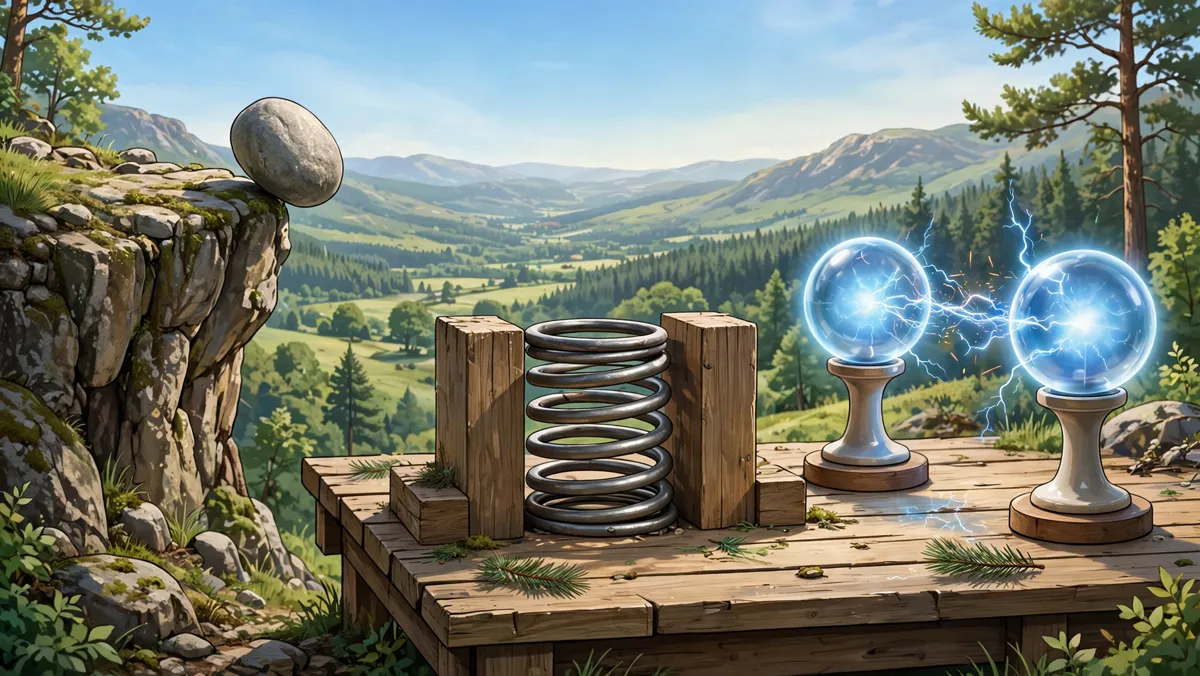
Potential Energy — Gravitational, Elastic and Electric Forms Explained
Hold a book out at arm’s length and keep it still. Nothing is moving, yet something has changed. If you let go, the book will fall, speed up, and hit the floor with a thud. Where did that energy of motion come from? It was already there, quietly stored, before anything moved. That stored energy is called potential energy.
Potential energy is one of the most useful ideas in physics because it explains how energy can be kept in reserve and released later. A book held high, a stretched rubber band, and two electric charges held apart all have something in common: each one is storing energy that can be turned into motion. In this article you will learn one clear definition of potential energy, the three main formulas for its gravitational, elastic, and electric forms, and worked numbers you can use in homework and exam revision.
The focus keyword of this article is potential energy, and by the end you will be able to recognise it in all three of its most common forms, calculate it with confidence, and avoid the mistakes that most often cost students marks.
What Is Potential Energy?
Potential energy is energy stored in a system because of the relative positions or configuration of its parts. The word “configuration” simply means the way the parts are arranged. A stretched spring has a different configuration from a relaxed spring. A book on a high shelf has a different position, relative to the Earth, from a book on the floor. In each case, the arrangement itself stores energy.
It is important to understand that potential energy belongs to a system and an interaction, not to a single object alone. This is a subtle point, but it matters. A book on its own does not have gravitational potential energy. The book and the Earth together, interacting through gravity, have gravitational potential energy. The same is true of a spring: the energy is stored in the stretched spring as a whole system, and the same is true of two charges interacting electrically. Whenever you talk about potential energy, you are really talking about an interaction between two or more things.
Only conservative forces have an associated potential energy. A conservative force is a force for which the work done in moving an object between two points does not depend on the path taken, and for which energy can be fully recovered. Gravity is a conservative force: lifting a book straight up or carrying it up a winding staircase to the same height stores the same amount of energy. The spring force is also conservative, and so is the electrostatic force between electric charges. Friction, by contrast, is not a conservative force. Energy lost to friction turns into heat and cannot be fully recovered as motion, so there is no such thing as “friction potential energy.”
Another key idea is the reference point rule. Only changes in potential energy matter, so the zero level can be chosen freely. For a book in a room, you might choose the floor as the zero level. For a satellite, physicists often choose infinite separation as the zero level. Neither choice is wrong, because what matters in a calculation is how much the potential energy changes when the system moves from one arrangement to another. If you lift a book by one metre, its gravitational potential energy increases by the same amount whether you measure heights from the floor, from the ground outside, or from sea level.
All three forms of potential energy covered in this article are measured in the same unit: the joule, symbol J. The joule is the standard unit of energy in physics. One joule is a small amount of energy in everyday terms — roughly the energy needed to lift a small apple about one metre — but the same unit applies whether the energy is stored by gravity, by a spring, or by electric charges. Keeping the units consistent is one of the simplest ways to check your answers.
Gravitational Potential Energy
Gravitational potential energy, often shortened to GPE, is the energy stored when an object is raised in a gravitational field. When you lift a book, you do work against gravity. That work does not disappear. It is stored as gravitational potential energy, and it can be recovered as kinetic energy — the energy of motion — when the book falls.
Near the Earth’s surface, gravitational potential energy is calculated with a simple formula:
GPE = mgh
In this formula, m is the mass of the object in kilograms (kg), g is the acceleration due to gravity, which is 9.8 metres per second squared (m/s²) near the Earth’s surface, and h is the height above the chosen reference level in metres (m). The result is in joules. Notice that the formula uses height, not the distance travelled. This is why the path does not matter: lifting a book straight up by one metre and carrying it up a ramp to the same vertical height both store exactly the same gravitational potential energy, because the vertical height h is the same in both cases.
The simple formula GPE = mgh works well near the Earth’s surface, but it has a limit. It assumes that g stays constant at 9.8 m/s². That is a good approximation when the height h is tiny compared with the Earth’s radius, which is about 6,400 kilometres. A book on a shelf, a diver on a diving board, and a roller coaster car at the top of a hill all satisfy this condition easily. For satellites and planets, however, g changes noticeably with distance from the Earth, so a different formula is needed.
For large distances, the general form of gravitational potential energy is:
U = −GMm/r
Here, U is the symbol often used for potential energy in general, G is the gravitational constant, M and m are the two masses involved, and r is the distance between their centres, measured in metres. The minus sign is the most important part of this formula, and it is worth understanding properly. In this general form, the zero of potential energy is set at infinite separation — that is, when the two masses are infinitely far apart and no longer interacting. Any real system of masses held together by gravity is below that zero, so its potential energy is negative. A negative value does not mean “less than nothing” in a mysterious sense. It means the system is bound together: you would have to add energy to pull the masses apart to infinity. The more tightly bound the system, the more negative its potential energy.
So, when should you use which formula? Use GPE = mgh for everyday heights near the Earth’s surface, where g can be treated as constant. Use U = −GMm/r for satellites, planets, and any situation where the distance is large enough that gravity changes significantly. In an exam, the question will usually make it clear which situation you are in: if it gives you a height above the ground and a value of g, use mgh; if it gives you masses and the distance between their centres, use the general form.
Elastic Potential Energy
Elastic potential energy, often shortened to EPE, is the energy stored when an elastic object is stretched or compressed. An elastic object is one that returns to its original shape when the stretching or compressing force is removed. Springs, rubber bands, trampolines, and diving boards are all examples. When you stretch a rubber band, you do work against its elastic force, and that work is stored as elastic potential energy. Let go, and the stored energy is released as motion.
Elastic potential energy is calculated with this formula:
EPE = ½kx²
In this formula, k is the spring constant, measured in newtons per metre (N/m), and x is the extension or compression from the natural length, measured in metres (m). The natural length is the length of the spring when no force is acting on it. The spring constant k tells you how stiff the spring is: a large k means a stiff spring that needs a large force to stretch it by a small amount, while a small k means a soft, easily stretched spring.
The formula is closely linked to Hooke’s law, which describes the force needed to stretch or compress a spring:
F = −kx
Hooke’s law says that the force F is proportional to the extension or compression x. The minus sign means the spring force acts in the opposite direction to the stretch: pull a spring to the right, and it pulls back to the left. The factor of one half in EPE = ½kx² comes from the fact that the force is not constant while the spring is being stretched. It starts at zero, when the spring is at its natural length, and grows steadily to kx when the extension reaches x. The energy stored is the area under the force-extension graph, which is a triangle with base x and height kx, giving an area of one half times base times height, or ½kx². That is why the one half is there, and why you must not leave it out.
Elastic potential energy is always positive. This is because x is squared in the formula, and the square of any number, positive or negative, is positive. Stretching a spring by 0.10 m and compressing it by 0.10 m therefore store exactly the same amount of energy. The direction of the stretch does not matter; only the size of the deformation matters.
Everyday examples of elastic potential energy are all around you. A drawn bow stores elastic potential energy in its bent limbs and stretched string, and releases it to send the arrow flying. A trampoline stores elastic potential energy as its surface stretches downward under a jumper, then returns it to launch the jumper back into the air. A diving board bends downward under a diver’s weight, storing energy that helps propel the diver upward. In each case, the same idea applies: deform an elastic object, store energy, and release it as motion.
Electric Potential Energy
Electric potential energy is the energy stored when electric charges are held in a particular arrangement. Like gravitational potential energy, it belongs to a system of interacting objects — in this case, two or more electric charges interacting through the electrostatic force. The electrostatic force is the force between electric charges: like charges repel each other, and opposite charges attract each other.
For two point charges, electric potential energy is calculated with this formula:
E = kQq/r
In this formula, k is Coulomb’s constant, which has the value 8.99 × 10⁹ newton square metres per coulomb squared (N m²/C²). Q and q are the two charges, measured in coulombs (C), and r is the separation between the charges, measured in metres (m). A point charge is an idealised charge that is treated as if all its charge were concentrated at a single point. Real charges always have some size, but the point-charge formula is a good approximation when the charges are small compared with the distance between them.
The sign rule for electric potential energy is worth learning carefully. Like charges give positive electric potential energy, because work must be done to push two repelling charges together against their repulsion. Opposite charges give negative electric potential energy, because they attract each other, and energy is released as they come together. In both cases, the zero of electric potential energy is set at infinite separation, exactly as in the general gravitational case. Two charges infinitely far apart have zero electric potential energy, and bringing them to a finite distance changes that energy in a way that depends on whether they attract or repel.
Students often confuse electric potential energy with electric potential, so it is worth separating them clearly now. Electric potential energy is measured in joules, and it is the energy stored for a particular charge in a particular arrangement. Electric potential, on the other hand, is energy per unit charge, measured in volts (V). One volt is one joule per coulomb. Electric potential describes the electrical “landscape” at a point in space, regardless of which charge you place there, while electric potential energy tells you the actual energy of the specific charge you have placed there. If you double the charge, you double its electric potential energy, but the electric potential at that point stays the same.
Everyday cases of electric potential energy include charges stored in a capacitor and ions held in a crystal lattice. A capacitor is a device that stores electric charge on two conducting plates separated by an insulator. Work must be done to move charge onto the plates against their repulsion, and that work is stored as electric potential energy, which the capacitor can later release into a circuit. In a crystal lattice — the regular, repeating arrangement of ions in a salt crystal, for example — positive and negative ions are held together by their mutual attraction, and the system has negative electric potential energy because the ions are bound together.
Worked Example 1: Gravitational Potential Energy
Let us work through a gravitational potential energy calculation step by step, using the first example from the brief. Read each step slowly, and check the units at every stage.
Question: A 2 kg book is lifted 5 m above the floor. Calculate its gravitational potential energy.
Step 1 — Identify what you know. The mass m is 2 kg. The height h is 5 m. The acceleration due to gravity g is 9.8 m/s². The reference level is the floor, so h is measured from the floor.
Step 2 — Choose the formula. Near the Earth’s surface, use GPE = mgh.
Step 3 — Substitute the values. GPE = 2 × 9.8 × 5.
Step 4 — Calculate. First, 2 × 9.8 = 19.6. Then, 19.6 × 5 = 98.
Step 5 — State the answer with units. GPE = 98 J.
The book therefore has 98 joules of gravitational potential energy relative to the floor. If the book is dropped, that 98 J is converted into kinetic energy as it falls, ignoring air resistance. Just before it hits the floor, almost all of the 98 J will have become kinetic energy, and the book will be moving at its fastest. This is a clear example of potential energy turning into kinetic energy.
Worked Example 2: Elastic Potential Energy
Now let us work through an elastic potential energy calculation, again step by step.
Question: A spring with a spring constant of 200 N/m is compressed by 0.10 m. Calculate the elastic potential energy stored in the spring.
Step 1 — Identify what you know. The spring constant k is 200 N/m. The compression x is 0.10 m. Note that x is already in metres, which is the unit the formula requires.
Step 2 — Choose the formula. Use EPE = ½kx².
Step 3 — Substitute the values. EPE = ½ × 200 × (0.10)².
Step 4 — Calculate. First, square x: (0.10)² = 0.01. Then, ½ × 200 = 100. Finally, 100 × 0.01 = 1.
Step 5 — State the answer with units. EPE = 1 J.
The compressed spring stores 1 joule of elastic potential energy. Two warnings are worth remembering from this example. First, x must be in metres, not centimetres, before you square it. If you had mistakenly used 10 cm instead of 0.10 m, you would have calculated ½ × 200 × 100 = 10,000 J, which is wildly wrong. Second, doubling the compression quadruples the stored energy, because x is squared. Compress this spring by 0.20 m instead of 0.10 m, and the stored energy becomes 4 J, not 2 J.
Potential Energy Turning Into Kinetic Energy
Potential energy is most interesting when it changes into something else. In many everyday situations, potential energy falls as kinetic energy rises, and the total mechanical energy stays constant, provided only conservative forces are acting. Total mechanical energy is simply the sum of kinetic energy and potential energy in a system. When friction and air resistance are negligible, that total does not change, even though the balance between kinetic and potential energy shifts constantly.
Consider a falling object. At the top of its fall, it has maximum gravitational potential energy and little or no kinetic energy. As it falls, its height decreases, so its gravitational potential energy decreases, while its speed increases, so its kinetic energy increases. The energy is not lost; it is converted from one form to another.
A pendulum swing shows the same exchange in a repeating cycle. At the highest point of each swing, the pendulum bob momentarily stops, and its energy is almost entirely gravitational potential energy. At the lowest point, it is moving fastest, and its energy is almost entirely kinetic energy. The energy swings back and forth between the two forms, just as the bob swings back and forth.
A released spring shows the elastic version of the same story. A compressed spring holds elastic potential energy. When it is released, the spring pushes an object forward, and the stored energy becomes the object’s kinetic energy. A roller coaster descent combines both forms: at the top of a hill, the car has maximum gravitational potential energy, and as it descends, that energy becomes kinetic energy, making the car speed up. The climb up the next hill reverses the process, turning kinetic energy back into gravitational potential energy.
This conversion is the heart of the conservation of energy principle, which states that energy cannot be created or destroyed, only transferred or transformed. Potential energy is simply energy in its stored, waiting form, ready to become motion whenever the system is allowed to move. A fuller treatment of conservation of energy is given in the companion article on that topic, but the key idea to carry from this article is simple: work done against a conservative force is stored as potential energy, and that stored energy can be fully recovered as kinetic energy.
Common Mistakes
Potential energy calculations are straightforward once the formulas are clear, but a few mistakes appear again and again. Watch out for these:
- Using the height travelled along a slope instead of the vertical height in GPE = mgh. Only the vertical rise counts. Walking a long way up a gentle slope to a height of 10 m stores the same energy as climbing a ladder straight up 10 m.
- Forgetting to convert centimetres to metres before squaring x in EPE = ½kx². Convert first, then square. A centimetre error becomes a hundredfold error once squared.
- Dropping the minus sign or misreading it in the general gravitational form U = −GMm/r. The minus sign means the system is bound, with zero set at infinite separation. It is not a mistake to be corrected away.
- Mixing up electric potential energy (measured in joules, and depending on the particular charge) with electric potential (measured in volts, and equal to energy per coulomb). Check the units: joules mean energy, volts mean energy per charge.
- Treating potential energy as belonging to one object alone instead of to the interacting system, and forgetting that only changes in potential energy are physically meaningful. The choice of zero level is free, but the change between two arrangements is fixed.
- Using mgh for satellites or large heights where g is no longer constant. When the height is a significant fraction of the Earth’s radius, use the general form U = −GMm/r instead.
Conclusion
Potential energy is stored energy — energy held in a system because of the positions or configuration of its parts, ready to be released as motion. The three forms covered in this article each have their own formula, and together they describe most of the stored energy you will meet in introductory physics.
The key formulas to remember are these. Gravitational potential energy near the Earth: GPE = mgh. Gravitational potential energy in general, for large distances: U = −GMm/r. Elastic potential energy: EPE = ½kx². Electric potential energy for two point charges: E = kQq/r. Each formula comes with its own units — kilograms, metres, newtons per metre, and coulombs — and each gives an answer in joules.
One idea ties all three forms together: work done against a conservative force is stored and can be recovered. Lift an object, stretch a spring, or push charges together, and you store energy. Let go, and that stored potential energy becomes kinetic energy. Once you can see that single pattern behind the three formulas, potential energy stops being three separate topics to memorise and becomes one idea you can apply anywhere.
Frequently Asked Questions
What is potential energy in simple terms?
Potential energy is energy stored in a system because of the relative positions or configuration of its parts, ready to be released as motion. A book held high, a stretched spring, and two charges held apart all store potential energy, even though nothing is moving. It belongs to the interacting system, not to one object alone, and it is measured in joules.
What is the gravitational potential energy formula, and when can GPE = mgh be used?
Gravitational potential energy near Earth's surface is calculated with GPE = mgh, where m is mass in kilograms, g is 9.8 metres per second squared, and h is vertical height in metres above a chosen reference level. It can be used only when h is tiny compared with Earth's radius, so g stays constant. For satellites and large distances, use the general form U = −GMm/r instead.
How do you calculate elastic potential energy with EPE = ½kx²?
Elastic potential energy is calculated with EPE = ½kx², where k is the spring constant in newtons per metre and x is the extension or compression from the natural length in metres. First convert x to metres, then square it, multiply by k, and halve the result. For example, a spring with k = 200 N/m compressed by 0.10 m stores ½ × 200 × (0.10)² = 1 J.
What is electric potential energy, and why can it be negative?
Electric potential energy is the energy stored when electric charges are held in a particular arrangement, calculated for two point charges with E = kQq/r. It can be negative because zero is set at infinite separation. Opposite charges attract, so bringing them together releases energy and gives negative electric potential energy, while like charges repel and give positive electric potential energy.
What is the difference between gravitational potential energy and elastic potential energy?
Gravitational potential energy is stored by raising an object in a gravitational field, while elastic potential energy is stored by stretching or compressing an elastic object. Gravitational potential energy near Earth uses GPE = mgh and depends on vertical height, whereas elastic potential energy uses EPE = ½kx² and depends on the square of the extension or compression. Both are measured in joules.
Can potential energy be negative, and what does negative potential energy mean?
Yes, potential energy can be negative in the general gravitational form U = −GMm/r and for opposite electric charges. Negative potential energy does not mean less than nothing; it means the system is bound together, with zero set at infinite separation. Energy must be added to pull the masses or charges apart to infinity, and the more negative the value, the more tightly bound the system is.