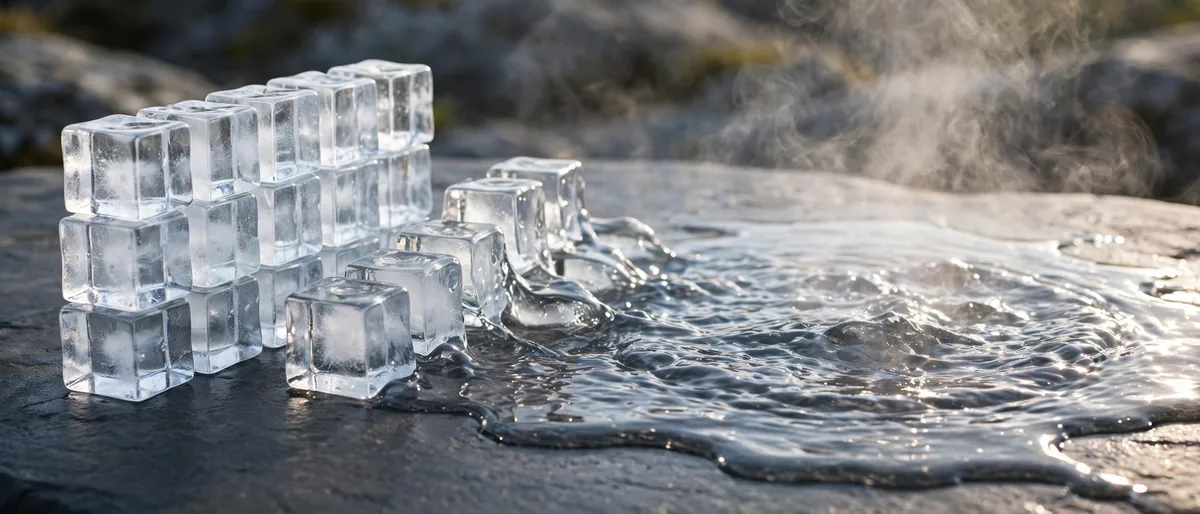
What Is Entropy? Definition, Formula and the Second Law
A tidy room turns messy on its own. A messy room never tidies itself while everyone sleeps. That one way street sits at the heart of thermodynamics, and this article answers what is entropy in words a first year student can use. You get a clear definition, the two formulas that matter, the second law in plain language, and two worked examples with every step shown.
Entropy carries the symbol S. We measure it in joules per kelvin, written J/K. Chemists often use joules per mole per kelvin instead, because they work with amounts of substance.
The number tells you how spread out energy is in a system, and how many different microscopic arrangements can produce the same big picture state. A high entropy value means energy has spread widely and many arrangements are possible. A low value means energy sits concentrated and few arrangements fit the picture. That spread is the whole story.
What Is Entropy? The Definition in Plain Words
Start with disorder, because that is the meaning most textbooks print first. A tidy desk has low entropy. Papers scattered across the desk have high entropy. The scattered state wins because far more arrangements count as scattered than count as tidy.
Disorder here means the number of ways things can sit, not how dirty something looks.
Shuffle a fresh deck of cards once and you will almost certainly hold an arrangement no one has ever held before, because the number of possible orders dwarfs the number of seconds since the universe began.
Physicists sharpen the idea by talking about energy dispersal. Energy spreads from concentrated places to spread out places whenever it gets the chance. Hot coffee cools in a cool room because thermal energy spreads into the air and the cup.
Entropy measures that spreading. The more spread out the energy, the higher the entropy.
Two words from statistical mechanics make the definition exact. A macrostate describes the big picture with quantities you can measure, such as temperature or pressure. A microstate describes one exact arrangement of every particle and its energy. Count the microstates that match one macrostate and you have the key number.
More matching microstates means higher entropy. A gas at room temperature has vastly more microstates than the same substance frozen solid, which is why gases carry the highest entropy of the three common phases.
Entropy is a state function. That term means its value depends only on the current state of the system, never on the path the system took to get there.
Climb a hill by a steep track or a winding road and you end at the same height. Change a gas from one state to another by any route and its entropy change comes out the same. This property turns entropy into a reliable bookkeeping tool. Measure the start and the end, and the middle stops mattering.
Two Formulas That Do All the Work
Two formulas cover almost every entropy question a student meets. The first comes from classical thermodynamics. The second comes from statistical mechanics. Learn when each one applies and half the exam questions answer themselves.
The thermodynamic formula
When heat flows reversibly into a system at absolute temperature T, the entropy change is ΔS = Qrev / T. Qrev stands for the heat transferred in a reversible process, measured in joules. T stands for absolute temperature in kelvin.
A reversible process runs so slowly that the system stays in equilibrium at every step, which lets us treat the heat transfer as exact. Divide a modest amount of heat by a low temperature and you get a large entropy change. Divide the same heat by a high temperature and the change shrinks, because the same energy spreads into a system that already holds plenty.
Temperature must sit in kelvin. Room temperature is about 293 K, and 0 °C equals 273 K. Plug in a Celsius value and the answer comes out wrong, which is one of the most common exam slips. You will meet it again in the mistakes section near the end.
Boltzmann’s formula
Boltzmann’s formula reads S = kB ln W. The symbol kB stands for the Boltzmann constant, 1.38 × 10⁻²³ J/K. W stands for the number of microstates available to the system. The letters ln stand for the natural logarithm.
Double the number of microstates and entropy rises by kB ln 2. The formula ties the abstract idea of disorder to a count you can, in principle, calculate.
Use the first formula when a question gives you heat and temperature. Use the second when a question asks about arrangements, or about why entropy behaves the way it does. Exam papers lean on the first formula for numbers and on the second for explanations.
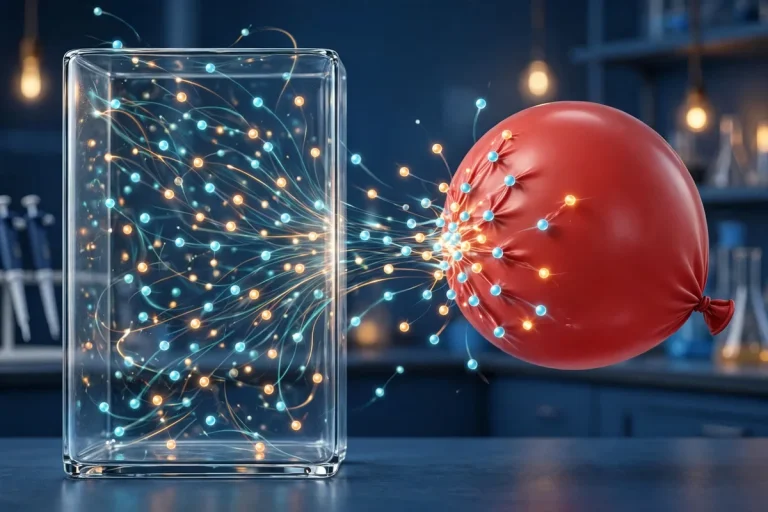
A gas expanding into a vacuum gains entropy because W grows, even though no heat flows at all. That single fact shows why the Boltzmann view matters.
Temperature sometimes changes while heat flows. Then the simple division stops working and the integral form takes over: ΔS = ∫ dQrev / T. You add up small heat transfers, each divided by the temperature at that moment. Most school questions keep temperature constant so you never need the integral, but knowing it exists stops the simple formula looking like a trick.
The Second Law of Thermodynamics
The second law states that the total entropy of an isolated system never decreases. An isolated system exchanges neither matter nor energy with its surroundings, so nothing outside can bail it out. Left alone, its entropy stays the same or rises. It never falls.
Real processes involve a system plus its surroundings, so the useful form splits the total in two: ΔStotal = ΔSsystem + ΔSsurroundings > 0 for a spontaneous process. A spontaneous process runs on its own once started, with no outside push. The greater than sign carries the whole message.
If the sum comes out positive, the process can run. If the sum would come out negative, the process cannot run on its own.
A reversible process sits exactly on the boundary, with ΔStotal = 0. An irreversible process pushes the total upward.
Every real process carries some irreversibility: friction, mixing, heat flowing across a temperature gap. That is why perpetual motion machines of the second kind fail. They would need to turn heat completely into work with no entropy rise, and the second law forbids it.
Heat flowing from hot to cold gives the most familiar example. A hot cup loses entropy as it cools, and the cool room gains entropy as it warms. The room gains more than the cup loses, because the same heat lands at a lower temperature. The total rises, so the flow runs on its own.
Heat never flows from cold to hot by itself, because that would shrink the total. A fridge moves heat the other way only by paying for it with work from outside.
The Carnot cycle marks the ideal limit here. A Carnot engine runs through reversible steps, so its total entropy change stays zero and its efficiency sets the ceiling every real engine falls short of. Our site already covers Carnot efficiency in its own article, and the second law explains why that ceiling exists. Real engines add irreversibility at every step, and each step adds entropy the engine cannot recover.
What Makes Entropy Go Up or Down
You can often predict the sign of an entropy change without touching a calculator. Melting pushes entropy up. Boiling pushes it up further.
Forming a gas from a liquid or a solid does the same. Particles gain room to move, and the number of microstates jumps.
Dissolving usually raises entropy too, because a solid crystal breaks into particles that move freely through the liquid. Freezing and condensation run the other way. Particles lock into place and entropy falls.
A reaction that produces more gas molecules than it consumes raises entropy, while one that consumes gas molecules lowers it. Count the gas molecules on each side of the equation and the sign often stares back at you.
| Change | Sign of ΔS |
|---|---|
| Solid melts | Positive |
| Liquid boils | Positive |
| Gas forms in a reaction | Positive |
| Salt dissolves in water | Positive |
| Gas condenses | Negative |
| Liquid freezes | Negative |
| Gas molecules decrease in a reaction | Negative |
Compare the phases directly and the order never changes. Gases carry the most entropy. Liquids sit in the middle. Solids carry the least.
The third law of thermodynamics adds a fixed reference point at the bottom of the scale: a perfect crystal at 0 K has zero entropy, because only one microstate fits it.
Worked Example 1: Entropy Change When Ice Melts
A 100 g block of ice melts at 0 °C. The latent heat of fusion of ice is 334 J/g. Find the entropy change of the ice.
- Find the heat needed to melt the ice. Multiply mass by latent heat: Q = mL = 100 g × 334 J/g = 33,400 J. The grams cancel and leave joules.
- Convert the temperature to kelvin. Melting happens at 0 °C, which equals 273 K. Entropy formulas always take kelvin.
- Apply the formula ΔS = Qrev / T. Substitute the numbers: ΔS = 33,400 J / 273 K = 122.3 J/K, which rounds to +122 J/K. The plus sign matters. Melting raises the entropy of the ice because liquid water molecules move far more freely than molecules locked in a crystal.
The surroundings tell the other half of the story. They supply the 33,400 J, so their entropy falls by about 122 J/K at the same temperature. Add the two changes and the total sits near zero. That near zero total marks a reversible change at equilibrium.
At exactly 0 °C ice and water coexist, and the melt can run in either direction. Warm the surroundings slightly and melting wins. Cool them slightly and freezing wins.
Worked Example 2: Entropy Change in an Isothermal Gas Expansion
One mole of an ideal gas doubles its volume at a constant temperature of 300 K. Find the entropy change of the gas.
- Pick the right formula. Volume changes at constant temperature, so use ΔS = nR ln(V2 / V1). Here n stands for moles of gas, R stands for the gas constant 8.31 J/mol·K, and V2 / V1 stands for the ratio of final volume to initial volume.
- Find the volume ratio. The volume doubles, so V2 / V1 = 2. The natural logarithm of 2 is 0.693.
- Substitute the numbers: ΔS = 1 mol × 8.31 J/mol·K × 0.693 = 5.76 J/K. The mole units cancel and leave joules per kelvin. The answer is positive, as expected. The gas gains entropy when it expands.
Boltzmann’s formula explains the same result from the other side. Doubling the volume doubles the room each molecule can occupy, so the number of microstates grows and entropy rises with it.
The temperature stays fixed at 300 K, so the internal energy of the ideal gas stays fixed too. Heat flows in to match the work the gas does as it expands, and that heat divided by temperature gives the same 5.76 J/K. Two formulas, one answer.
Common Mistakes
Entropy questions punish the same five slips year after year. Watch for them before you hand in a paper.
- Mixing up entropy with energy or enthalpy. Energy stays conserved in every process. Entropy does not. Enthalpy tracks heat content at constant pressure, which is a different quantity again. Keep the three names apart and half the confusion disappears.
- Thinking everything always gets messier. Local order can rise. Water freezes into neat crystals, and living cells build ordered structures all day. The second law only demands that total entropy rises. The surroundings pay for local order with a larger entropy gain of their own.
- Using Celsius in ΔS = Q / T. The temperature in this formula is absolute temperature, so convert to kelvin first. A question that gives 25 °C wants 298 K in the denominator.
- Forgetting the mole numbers in a reaction entropy. For a chemical reaction, ΔS equals the total standard entropy of the products minus the total for the reactants. Standard entropies come per mole, so multiply each one by its coefficient in the balanced equation before you subtract. Skip that step and the answer drifts by a whole multiple.
- Treating a negative system entropy change as proof a process cannot happen. The system alone never decides. Add the surroundings, check the total, and only then judge. Many everyday processes cool their system down while warming their surroundings more.
The Formulas to Remember Before Your Exam
If someone asks you what is entropy during revision, start with the definition: entropy measures how spread out energy is, and how many microstates match a macrostate.
Then write the three formulas that answer nearly every question. The entropy formula ΔS = Qrev / T handles heat and temperature. S = kB ln W connects entropy to microstates. ΔStotal = ΔSsystem + ΔSsurroundings > 0 states the second law for a spontaneous process.
Work the two examples above with the numbers covered, then change one number in each and solve them again. A fresh set of numbers turns a memorised answer into a method you can trust under exam pressure.
Frequently Asked Questions
What is entropy in simple words?
Entropy is a measure of how spread out energy is in a system and how many microscopic arrangements can produce the same observable state. A tidy desk has low entropy because few arrangements count as tidy, while scattered papers have high entropy because many arrangements count as scattered. Entropy has the symbol S and is measured in joules per kelvin, written J/K.
What is the formula for entropy change ΔS?
The entropy change for a reversible heat transfer is ΔS = Q_rev / T, where Q_rev is the heat transferred in joules and T is the absolute temperature in kelvin. Divide a given amount of heat by a low temperature and you get a large entropy change, while the same heat at a high temperature gives a smaller change. Always convert Celsius to kelvin before you use this formula.
What does the second law of thermodynamics say about entropy?
The second law says the total entropy of an isolated system never decreases. For a real process, ΔS_total = ΔS_system + ΔS_surroundings > 0 when the process is spontaneous, so it can run on its own. A reversible process keeps the total constant at ΔS_total = 0, while an irreversible process increases it. That is why heat flows from hot to cold on its own and never the reverse.
Can entropy ever decrease?
Yes, the entropy of a system can decrease, but the total entropy of the system plus its surroundings cannot. Freezing water lowers the entropy of the water as molecules lock into a crystal, yet the surroundings gain more entropy than the water loses. Local order can increase whenever the surroundings pay for it with a larger entropy rise, so the total still increases.
What is the difference between entropy and enthalpy?
Entropy measures how spread out energy is and how many microstates match a macrostate, while enthalpy tracks heat content at constant pressure. Energy stays conserved in every process, but entropy does not, and enthalpy is a different quantity again. Keep the three names apart: entropy is about dispersal and arrangements, enthalpy is about heat content, and energy is the quantity that is conserved.
How do you calculate entropy change when ice melts?
Use ΔS = Q_rev / T with the heat needed to melt the ice and the melting temperature in kelvin. For 100 g of ice, Q = 100 g × 334 J/g = 33,400 J, and the melting temperature is 0 °C, which equals 273 K. ΔS = 33,400 J / 273 K = +122 J/K. The positive sign shows that melting raises the entropy of the ice because liquid water molecules move more freely than molecules in a crystal.