Thermal Energy and Internal Energy — Q = mcΔT Explained
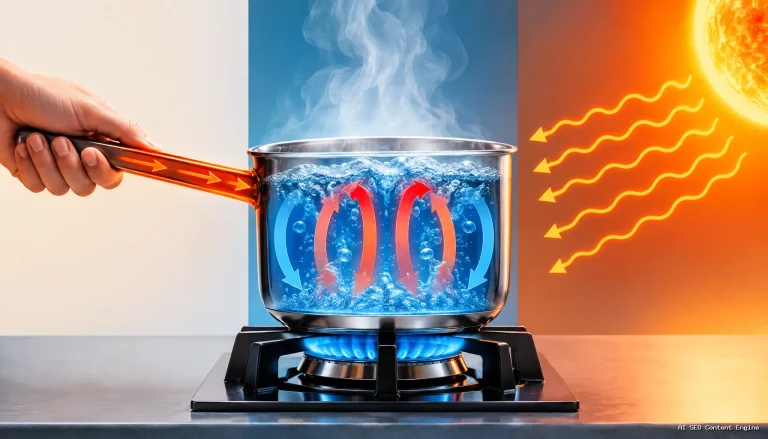
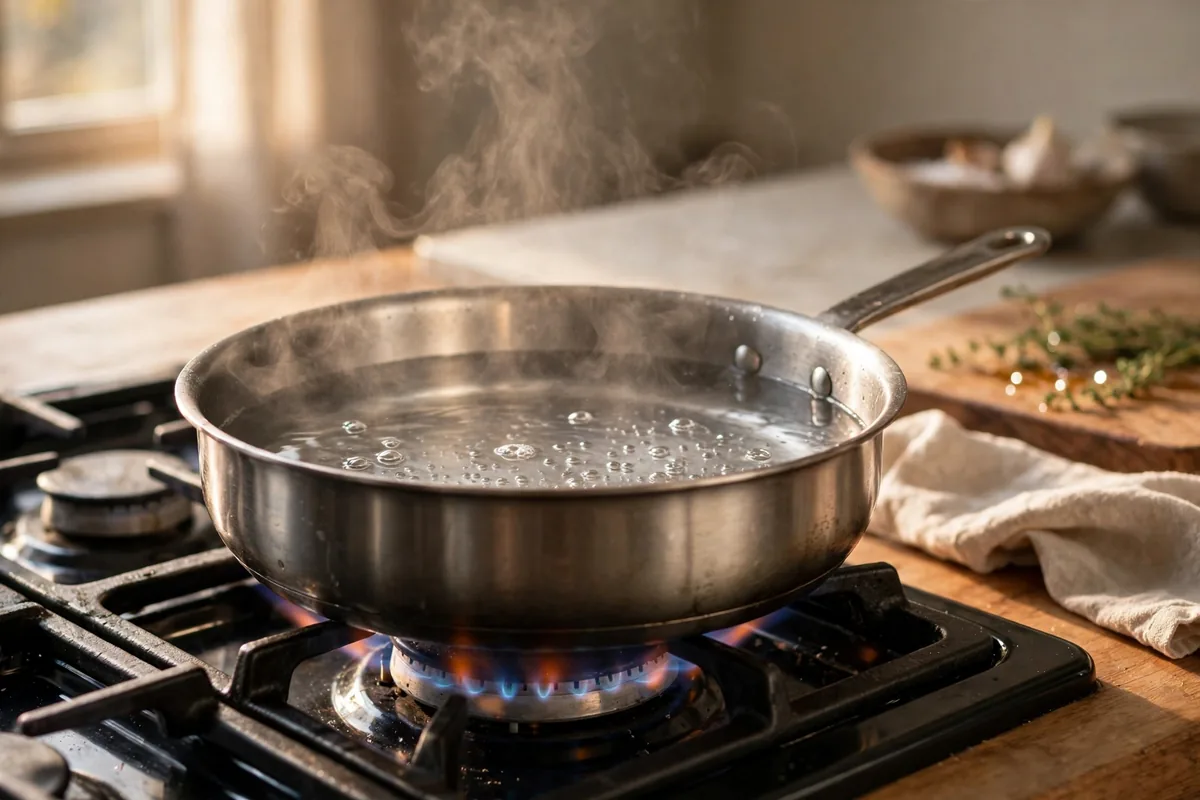
Put an empty metal pan on a stove and it gets hot in seconds. Fill the same pan with water and put it back on the same stove, and you will be waiting a lot longer. The flame is the same, the pan is the same, so why does the water take so much more time to heat up? The answer is not that the water is being difficult. It is that heating something is not only about making it hotter. It is also about how much material there is, and what that material is made of.
This article explains thermal energy and internal energy in plain language, and teaches you the one formula that ties the whole story together: Q = mcΔT. By the end, you will know what each symbol in the formula means, what units to use, how to rearrange it when the unknown is different, and which mistakes to avoid in exams. You will also understand the difference between how hot something is and how much thermal energy it holds, which is one of the most commonly confused ideas in physics.
What Is Thermal Energy?
Thermal energy is the total energy stored in the particles of an object because of how those particles move and interact. Every solid, liquid, and gas is made of tiny particles — atoms and molecules — and those particles are never completely still. In a solid they vibrate in place. In a liquid they slide past one another. In a gas they fly around freely and collide. All of that motion is a form of energy, and together with the energy stored in the interactions between particles, it makes up the thermal energy of the object.
The unit of thermal energy is the joule, written with the symbol J. One joule is a small amount of energy — about the energy needed to lift a small apple one metre — so in everyday heating problems you will often see kilojoules, where 1 kJ = 1000 J. Whenever energy is transferred into or out of an object because of a temperature difference, physicists call the transferred energy heat, and give it the symbol Q, also measured in joules. So when we say an object “absorbs 5000 J of thermal energy,” we mean that 5000 joules of energy have been transferred into it as heat.
Adding energy to an object usually raises its temperature. That is the everyday experience: a kettle heats up as energy flows in, and a cup of tea cools down as energy flows out into the room. The temperature rises because the average energy of the particles is increasing, so they move or vibrate more vigorously. But — and this is an important exception that we will come back to — adding energy does not always raise the temperature. When ice melts, for example, energy flows in but the temperature stays at 0 °C until all the ice has melted. The energy goes into breaking the bonds between particles rather than into making them move faster. Keep that exception in mind, because it sets the boundary for where the formula in this article applies.
Another way to think about thermal energy is as a quantity that depends on the whole object, not just on one point of it. A swimming pool and a teacup can both be at the same temperature, but the pool holds vastly more thermal energy, because it contains vastly more particles. This “how much stuff, and how energetic is it” idea is the key to everything that follows.
What Is Internal Energy?
Internal energy, given the symbol U, is the total energy stored inside a system due to the motion and interactions of all its particles. That definition should sound familiar, because it is very close to the definition of thermal energy given above. In everyday language, the two terms are often used almost interchangeably: both describe the energy locked up in the particles of an object. But in careful physics usage, there is a distinction worth knowing.
Internal energy is the broader, more precise term. It is defined as the sum of the kinetic energies of all the particles in a system — the energy they have because they are moving or vibrating — plus the potential energies of all the particles — the energy stored in the forces and bonds between them. The kinetic part grows when the temperature rises, because hotter particles move faster on average. The potential part depends on how the particles are arranged and how strongly they attract or repel one another, which is why it changes during processes like melting or stretching, even when the temperature stays the same.
Thermal energy, by contrast, is most often used in school physics to mean the part of the internal energy that is connected with temperature, or simply as a less formal name for the same idea. When a textbook says “the thermal energy of the water increased,” it generally means the same thing as “the internal energy of the water increased.” The safest way to handle the two terms is this: internal energy is the formal total, thermal energy is the everyday name for the energy you are tracking when something heats up or cools down, and in the heating problems in this article they point at the same quantity. Where they differ is in advanced topics — for example, when work is done by or on a system — and that belongs to the separate topic of the First Law of Thermodynamics, which is not derived here.
For one special case, there is a neat supporting formula. For an ideal gas — a simplified model of a gas in which the particles are treated as having no interactions between them, so their potential energy is effectively zero — the internal energy depends only on temperature, and is given by U = (3/2)nRT, where n is the number of moles of gas, R is the gas constant, and T is the absolute temperature in kelvin. This is a supporting note only, not the main formula of this article. It shows the same pattern you will see throughout: internal energy grows with temperature, but it also depends on how much material is present.
Temperature vs Thermal Energy — Why They Are Not the Same
Temperature and thermal energy are related, but they are not the same thing, and confusing them is one of the most common errors students make. Temperature is a measure of the average kinetic energy of the particles in an object. It tells you how hot something is. It is an intensive quantity, which means it does not depend on how much of the material you have: a spoonful of boiling water and a bathtub of boiling water are both at 100 °C, even though one contains far more water than the other.
Thermal energy, on the other hand, is an extensive quantity: it depends on the amount of material as well as on its temperature. It also depends on the material itself, because different materials store different amounts of energy for the same temperature rise, as you will see in the specific heat capacity table later. So thermal energy depends on three things: the temperature, the mass, and the material.
Here is the classic comparison that makes the difference clear. Imagine a huge iceberg floating in cold seawater at 0 °C, and a small cup of tea at 80 °C. The tea is much hotter — its particles have a much higher average kinetic energy — but the iceberg holds far more thermal energy in total, because it contains an enormous number of particles, each carrying a little energy. If you could somehow transfer energy from the iceberg to the tea, the tea would heat up a great deal, even though the iceberg is “cold.” The iceberg wins on total energy because of its size, even though it loses on temperature.
This comparison also explains why a spark from a sparkler can land on your skin without burning you badly, while a pot of boiling water is dangerous. The spark is extremely hot, but it is tiny, so the total thermal energy it carries is small. The pot of water is cooler than the spark, but it holds far more energy, and that energy keeps flowing into your skin for much longer.
One more concept belongs here: thermal equilibrium. Two objects are in thermal equilibrium when they are at the same temperature, so there is no net transfer of thermal energy between them. Energy may still move back and forth at the microscopic level, but on average nothing changes. When you leave a cold drink in a warm room, energy flows from the room into the drink until both reach the same temperature — until they are in thermal equilibrium — and then the net flow stops. Temperature differences drive energy transfer; equilibrium is what happens when the difference disappears.
The Formula Q = mcΔT, Symbol by Symbol
We can now put the whole story into one formula. When an object’s temperature changes without any phase change, the thermal energy transferred is given by:
Q = mcΔT
Here is what each symbol means, and the units you must use:
- Q is the thermal energy transferred, measured in joules (J). A positive value means energy was absorbed by the object; a negative value means energy was released by it. Always say which direction you mean.
- m is the mass of the object, measured in kilograms (kg).
- c is the specific heat capacity of the material, measured in joules per kilogram per kelvin (J/kg·K), or equivalently joules per kilogram per degree Celsius (J/kg·°C). It tells you how much energy is needed to raise 1 kg of the material by 1 K (or 1 °C).
- ΔT is the change in temperature, defined as ΔT = T_final − T_initial, measured in kelvin (K) or degrees Celsius (°C). The Greek letter Δ (delta) means “change in.”
The most reassuring fact about this formula is that a temperature change is the same number whether you measure it in °C or in K. A rise from 20 °C to 80 °C is a change of 60 °C, and it is also a change of 60 K, because the Celsius and kelvin scales have the same size of degree — they just start at different zero points. So for ΔT, no conversion is ever needed. You only need to be careful when a formula asks for an absolute temperature, such as the ideal gas formula above, where you must use kelvin. For Q = mcΔT, a temperature difference is all that matters.
Specific heat capacity is a property of the material, not of the object. A kilogram of water and a kilogram of copper need very different amounts of energy for the same temperature rise, because their particles store energy differently. Water has an unusually high specific heat capacity because of hydrogen bonding: water molecules attract one another strongly, and much of the energy you put in goes into loosening those attractions rather than into making the molecules move faster. That is why water heats up slowly and cools down slowly, why coastal climates are milder than inland ones, and why water is such a good coolant.
Here is a table of specific heat capacities for common materials:
| Material | Specific heat capacity (J/kg·K) |
|---|---|
| Water | 4186 |
| Aluminium | 900 |
| Iron | 450 |
| Copper | 385 |
| Lead | 130 |
Notice the pattern: water needs roughly ten times as much energy per kilogram as copper for the same temperature rise. That is exactly why the pan of water takes so much longer to heat than the empty metal pan. The metal of the pan has a low specific heat capacity and there is not much of it; the water has a high specific heat capacity and there is a lot of it.
Often the unknown in a problem is not Q. The formula rearranges easily, and you should be comfortable with all three rearrangements:
- Q = mcΔT — find the energy transferred.
- m = Q / (cΔT) — find the mass.
- c = Q / (mΔT) — find the specific heat capacity of an unknown material.
- ΔT = Q / (mc) — find the temperature change.
To rearrange, divide both sides of the original equation by whatever is multiplied by the unknown. For example, to solve for ΔT, divide both sides by mc, giving ΔT = Q / (mc). Practice these rearrangements until they feel automatic, because the second worked example below depends on one of them.
Worked Example 1: Heating Water
Problem: How much thermal energy is needed to heat 2.0 kg of water from 20 °C to 80 °C? The specific heat capacity of water is 4186 J/kg·K.
Step 1 — List what you know. Mass m = 2.0 kg. Specific heat capacity c = 4186 J/kg·K. Initial temperature T_initial = 20 °C. Final temperature T_final = 80 °C.
Step 2 — Find the temperature change. ΔT = T_final − T_initial = 80 − 20 = 60 K. Remember, a change of 60 °C is the same as a change of 60 K, so no conversion is needed.
Step 3 — Write the formula and substitute the numbers. Q = mcΔT = 2.0 × 4186 × 60.
Step 4 — Calculate. First multiply 2.0 × 4186 = 8372. Then multiply 8372 × 60 = 502,320. So Q = 502,320 J.
Step 5 — Convert to kilojoules, since the number is large. Divide by 1000: 502,320 / 1000 = 502.32, so Q ≈ 502 kJ.
Sense check: water has a very high specific heat capacity, and we are heating a full 2 kg through a large temperature rise of 60 K, so an answer of several hundred kilojoules is exactly what we should expect. If your answer had come out as a few hundred joules, you would know something had gone wrong — probably a unit mix-up.
Worked Example 2: Finding the Temperature Rise (Rearranged Formula)
Problem: A 0.80 kg copper block absorbs 9,240 J of thermal energy. By how much does its temperature rise? The specific heat capacity of copper is 385 J/kg·K. If the block starts at 20 °C, what is its final temperature?
Step 1 — List what you know. Mass m = 0.80 kg. Specific heat capacity c = 385 J/kg·K. Energy absorbed Q = 9,240 J. This time Q is known and ΔT is the unknown, so we need the rearranged formula.
Step 2 — Rearrange the formula. Start from Q = mcΔT and divide both sides by mc: ΔT = Q / (mc). Writing the rearrangement step explicitly is important — students most often go wrong here by trying to substitute into the original formula with the unknown still buried in it.
Step 3 — Substitute the numbers. ΔT = 9240 / (0.80 × 385). First work out the denominator: 0.80 × 385 = 308. So ΔT = 9240 / 308 = 30 K.
Step 4 — Find the final temperature. ΔT = T_final − T_initial, so T_final = T_initial + ΔT = 20 + 30 = 50 °C.
Sense check: copper has a low specific heat capacity, so a modest amount of energy produces a noticeable temperature rise, and 30 K is a reasonable rise for nearly ten thousand joules going into less than a kilogram of metal. Also note that the answer is a temperature change of 30 K and a final temperature of 50 °C — the two are different kinds of quantity, and keeping them apart avoids one of the common mistakes listed below.
When Q = mcΔT Does Not Apply
Every formula has its limits, and knowing them is part of knowing the formula. Q = mcΔT applies only when the temperature of the material is actually changing and no phase change is taking place. As soon as the material starts melting or boiling, the rule changes.
During a phase change — melting from solid to liquid, or boiling from liquid to gas — the temperature stays constant while energy is transferred. Ice melts at 0 °C and stays at 0 °C until it has all become water; water boils at 100 °C and stays at 100 °C until it has all become steam. The energy flowing in during this time does not raise the temperature; it breaks the bonds holding the particles in their old arrangement. For these processes, the formula is Q = mL instead, where L is the specific latent heat of the material. The specific latent heat of fusion, Lf, is used for melting and freezing, and the specific latent heat of vaporisation, Lv, is used for boiling and condensing. These are named here only so you recognise them; their values and worked examples belong to the topic of latent heat.
There is a second boundary worth knowing. For gases, the specific heat capacity depends on the conditions: the value at constant pressure, called cp, is different from the value at constant volume, called cv, because a gas heated at constant pressure expands and does work on its surroundings, which takes extra energy. For solids and liquids the distinction is small enough to ignore in school problems, but for gases it matters, so be careful which value a question gives you.
Finally, one boundary note: work done by or on a system — for example, a gas expanding and pushing a piston — belongs to the separate topic of the First Law of Thermodynamics. It is not derived here, and you should not try to fold it into Q = mcΔT. This article covers heating and cooling at rest; the First Law adds work to the picture.
Common Mistakes
These are the errors that appear again and again in homework and exams. Check your work against this list before you hand it in.
- Mixing grams with J/kg·K values, or kilograms with J/g·°C values. Units must match: if c is in J/kg·K, m must be in kilograms; if c is in J/g·°C, m must be in grams. A mass of 500 g must be converted to 0.500 kg before you use a J/kg·K value.
- Using the absolute temperature instead of the temperature change. The formula needs ΔT, the difference between final and initial temperatures — not the final temperature on its own.
- Forgetting that ΔT needs no °C-to-K conversion. A rise of 40 °C is a rise of 40 K. Converting it to 313 K is wrong and will wreck your answer.
- Applying Q = mcΔT across a phase change. If ice is melting or water is boiling, the temperature is not changing, so this formula cannot be used; Q = mL is the right tool.
- Calling temperature and thermal energy the same thing. Temperature measures average particle kinetic energy; thermal energy is the total energy in all the particles. The iceberg and the cup of tea prove they are different.
- Giving Q a sign without saying whether energy was absorbed or released. A bare number is ambiguous: state clearly whether the object gained energy (heating) or lost energy (cooling).
- Using the wrong material’s c value. Water’s value of 4186 J/kg·K applies to liquid water only — not to ice or steam, which have different specific heat capacities. Always check that the c value matches the material and the state it is actually in.
Conclusion
The puzzle we started with — why water takes so much longer to heat than an empty pan — now has a complete explanation. Thermal energy is the total energy stored in an object’s particles, and internal energy is the formal name for that total: the sum of the kinetic and potential energies of all the particles. Heating an object adds to that total, and the amount added is governed by a simple formula with three ingredients: how much material there is, what it is made of, and how much its temperature changes.
To recap the key formulas: Q = mcΔT gives the thermal energy transferred when a temperature changes, where Q is in joules, m is in kilograms, c is the specific heat capacity in J/kg·K, and ΔT = T_final − T_initial. Its three rearrangements are m = Q / (cΔT), c = Q / (mΔT), and ΔT = Q / (mc). Specific heat capacity, c, is a property of the material: it is the energy needed to raise 1 kg of the material by 1 K, and water’s unusually high value comes from hydrogen bonding. And finally, the temperature vs thermal energy distinction in one sentence: temperature measures the average kinetic energy of the particles, while thermal energy is the total energy in all of them, so a large cold object can hold more thermal energy than a small hot one.
With the formula, its rearrangements, and the common mistakes in hand, you can now tackle any heating or cooling problem that does not involve a phase change — and you will know exactly when to stop and reach for Q = mL instead. Thermal energy and internal energy are no longer vague ideas: they are quantities you can define, distinguish, and calculate.
Frequently Asked Questions
What is thermal energy, and how is thermal energy different from temperature?
Thermal energy is the total energy stored in an object’s particles from their motion and interactions, measured in joules. Temperature, by contrast, measures only the average kinetic energy of those particles, telling you how hot something is. Thermal energy is extensive: it grows with mass and depends on the material, so a large cold object can hold more of it than a small hot one. Temperature is intensive and does not depend on amount.
What is internal energy, and is internal energy the same thing as thermal energy?
Internal energy, symbol U, is the total energy inside a system: the sum of the kinetic and potential energies of all its particles. In everyday language it is often used interchangeably with thermal energy, and in heating problems they point at the same quantity. In careful physics usage, however, internal energy is the broader formal term, while thermal energy is the everyday name for the energy tracked when something heats up or cools down.
How do you use Q = mcΔT to calculate the thermal energy transferred when something heats up?
Use Q = mcΔT by identifying Q as the thermal energy transferred in joules, m as the mass in kilograms, c as the specific heat capacity in J/kg·K, and ΔT as the final temperature minus the initial temperature. Multiply the three together, for example 2.0 × 4186 × 60 = 502,320 J, about 502 kJ, for heating 2.0 kg of water through 60 K. Remember that a change in °C equals the same change in K.
Why does Q = mcΔT not work during a phase change, even though thermal energy is still being transferred?
Q = mcΔT does not work during a phase change because the formula requires a temperature change, and during melting or boiling the temperature stays constant. The thermal energy transferred goes into breaking the bonds between particles rather than making them move faster, so ΔT is zero even though energy is flowing in. For phase changes use Q = mL instead, where L is the specific latent heat, with Lf for melting and Lv for boiling.
What is specific heat capacity in the Q = mcΔT formula, and why is the specific heat capacity of water so high?
Specific heat capacity, c, is the energy needed to raise 1 kg of a material by 1 K, measured in J/kg·K, and it is a property of the material, not the object. Water’s value is unusually high, about 4186 J/kg·K, compared with copper at about 385 J/kg·K, because water molecules attract one another strongly through hydrogen bonding. Much of the energy put in loosens those attractions instead of making molecules move faster, so water heats up and cools down slowly.
Can a cold object have more thermal energy and internal energy than a hot object?
Yes, a cold object can hold more thermal energy and internal energy than a hot object, because thermal energy depends on mass and material as well as temperature. An iceberg at 0 °C contains a vast number of particles, each carrying a little energy, so its total energy exceeds that of a cup of tea at 80 °C. The tea is hotter, since temperature measures average particle kinetic energy, but the iceberg wins on total energy because of its size.