Understanding the Efficiency of a Heat Engine: Exploring the Carnot Cycle
Have you ever wondered how efficient a heat engine can truly be? Imagine transforming heat into work with the utmost precision and minimal energy loss. This is the essence of the Carnot cycle, a fascinating concept that sits at the heart of thermodynamics. Whether you’re a curious mind or someone keen on understanding energy systems, grasping the fundamentals of the Carnot cycle unveils the secrets behind the optimal efficiency of heat engines. Join us as we demystify this pivotal cycle, shedding light on how it defines the limits of efficiency in the world of engines and energy conversion.
Introduction to Heat Engines
Heat engines are pivotal devices in the realm of energy conversion, playing a crucial role in transforming thermal energy into mechanical work. These engines are integral to various applications, from powering vehicles to generating electricity, making them indispensable in modern technology and industrial processes. Understanding the fundamental principles of heat engines is essential for delving into their efficiency and the ultimate potential offered by the Carnot cycle.
What is a Heat Engine?
A heat engine operates on the basic principle of converting heat into work. It absorbs heat from a high-temperature source, converts part of this energy into useful work, and then expels the remaining heat to a lower temperature sink. This cyclical process enables the continuous conversion of thermal energy into mechanical energy, which can then be used to perform various tasks.
Key Components of Heat Engines
- Heat Source: The high-temperature reservoir from which the engine absorbs energy.
- Working Substance: The medium (such as gas or steam) that undergoes expansion and compression to produce work.
- Engine Mechanism: Converts the energy absorbed into mechanical work through pistons, turbines, or other mechanical systems.
- Heat Sink: The low-temperature reservoir where the remaining waste heat is discharged.
Understanding Heat Engine Efficiency
The efficiency of a heat engine is a measure of how well it converts heat into work. This is a crucial aspect, as it determines the engine’s effectiveness in energy conversion. The efficiency is defined by the ratio of work output to the heat input, often expressed as a percentage. However, due to the second law of thermodynamics, no heat engine can be 100% efficient, as some energy is always lost as waste heat.
The concept of Carnot heat engine efficiency comes into play when considering the theoretical limits of this efficiency. The Carnot cycle represents an idealized engine with maximum possible efficiency, setting an upper boundary on how efficient real-world heat engines can be. This cycle is instrumental in guiding the design and improvement of engines and is a benchmark against which other cycles are measured.
The Role of Thermodynamics
Thermodynamics serves as the foundation for understanding heat engines. It provides the laws and principles that govern the energy transformations and efficiency limits of these devices. With the second law of thermodynamics dictating the inevitable presence of inefficiencies in real systems, the study of heat engines becomes a quest to approach the theoretical maximum efficiency delineated by the Carnot cycle.
In summary, heat engines are complex yet fascinating systems that illustrate the intricate dance between heat and work. By exploring the workings of these engines, we gain insights into the broader principles of thermodynamics and the quest for improved energy conversion efficiency, leading us directly into the detailed exploration of the Carnot cycle.
Who Was Sadi Carnot?
Sadi Carnot, often heralded as the “Father of Thermodynamics,” was a pioneering French physicist and engineer whose work laid the groundwork for the field of thermodynamics. Born on June 1, 1796, in Paris, Nicolas Léonard Sadi Carnot was the son of Lazare Carnot, a prominent military engineer and mathematician known for his role in the French Revolutionary Wars. Inspired by his father’s intellectual pursuits and the technological advancements of the Industrial Revolution, Sadi Carnot embarked on a quest to understand the principles governing heat engines.
The Birth of a Revolutionary Idea
- **Educational Background**: Carnot attended the prestigious École Polytechnique in Paris, where he received rigorous training in mathematics and engineering, equipping him with the analytical skills necessary to tackle complex scientific problems.
- **Career and Research**: After graduating, Carnot joined the French army’s engineering corps. However, his passion for understanding the nature of heat led him to focus on theoretical research, culminating in his seminal work, “Reflections on the Motive Power of Fire,” published in 1824.
Contributions to Thermodynamics
Carnot’s treatise introduced the concept of the idealized heat engine, known as the Carnot cycle, which established the theoretical upper limit of heat engine efficiency. This work was revolutionary, providing a new framework for understanding energy conversion and setting the stage for future advancements in thermodynamics.
- **Carnot Cycle**: He conceptualized a hypothetical engine operating on a reversible cycle, now termed the Carnot cycle, which demonstrated that the efficiency of a heat engine depends solely on the temperatures of the heat reservoirs.
- **Carnot Heat Engine Efficiency**: His insights revealed that no engine can be more efficient than a Carnot engine operating between the same two temperatures, thus defining the maximum possible efficiency for real-world engines.
Legacy and Impact
Although Sadi Carnot’s work received little recognition during his lifetime, it profoundly influenced later scientists, such as Lord Kelvin and Rudolf Clausius, who extended his theories, leading to the formulation of the second law of thermodynamics. Carnot’s pioneering ideas continue to be a cornerstone in the study of heat engine efficiency and the development of technologies like heat pumps, striving to achieve optimum energy conversion efficiency.
In summary, Sadi Carnot’s contributions have been instrumental in shaping modern thermodynamics and understanding the limitations and potential of heat engines. His legacy endures, inspiring ongoing research and innovation in the pursuit of higher efficiency and sustainable energy solutions.
Understanding the Carnot Cycle
The Carnot cycle is fundamental to understanding how heat engines operate at maximum efficiency. This theoretical model, conceptualized by Sadi Carnot, outlines an idealized process that no real engine can surpass in terms of efficiency. It provides a benchmark for the maximum efficiency achievable by any heat engine operating between two temperatures.
The Four Stages of the Carnot Cycle
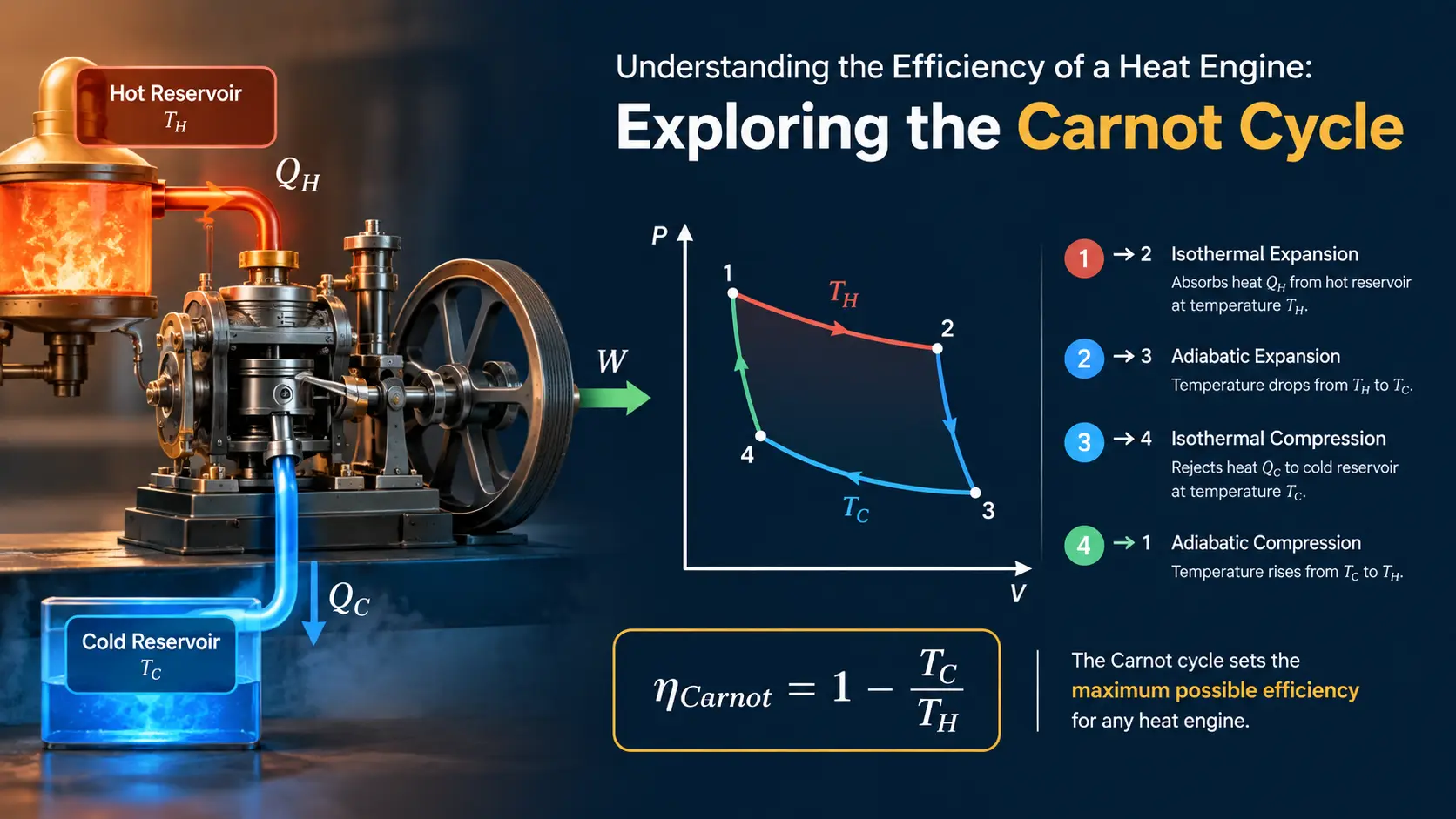
The Carnot cycle consists of four reversible processes involving two isothermal and two adiabatic transformations. These processes can be described as follows:
- Isothermal Expansion: The cycle begins with the gas in the engine absorbing heat from a high-temperature reservoir at a constant temperature. This causes the gas to expand, performing work on the surroundings. The key here is maintaining a constant temperature to ensure maximum heat absorption.
- Adiabatic Expansion: Following the isothermal expansion, the gas continues to expand without exchanging heat with its surroundings. This adiabatic process results in a drop in temperature as the gas performs work, converting internal energy into mechanical energy.
- Isothermal Compression: In this stage, the gas is compressed by the surroundings at a constant lower temperature. During this process, it releases heat to a low-temperature reservoir. Maintaining a steady temperature ensures that the maximum amount of heat is expelled.
- Adiabatic Compression: Finally, the gas is further compressed, increasing its temperature without any heat exchange. This process restores the gas to its initial state, completing the cycle.
Efficiency of the Carnot Heat Engine
The efficiency of a Carnot heat engine is determined by the temperatures between which it operates. It is defined by the formula:
Efficiency (η) = 1 – (Tc/Th)
where Tc is the absolute temperature of the cold reservoir, and Th is the absolute temperature of the hot reservoir. This equation illustrates that the efficiency of a Carnot cycle depends solely on these temperatures, emphasizing that higher efficiency can be achieved by increasing the temperature difference between the reservoirs.
Implications in Thermodynamics
The Carnot cycle is more than just a theoretical construct; it is a guiding principle in thermodynamics, illustrating the second law of thermodynamics. It stresses that no engine operating between two heat reservoirs can be more efficient than a Carnot engine. This sets the upper limit for heat engine efficiency, serving as a crucial reference in designing and evaluating real-world engines and heat pumps.
By understanding the Carnot cycle, engineers and scientists can better grasp the constraints and potentials of heat engines, driving innovations that enhance heat pump efficiency and sustainable energy solutions. The insights gained from the Carnot cycle continue to inspire advancements in thermodynamic research and technology development.
Isothermal and Adiabatic Processes
To fully appreciate the intricacies of the Carnot cycle, it’s essential to delve into the fundamental processes that underpin its operation: the isothermal and adiabatic processes. These processes are pivotal to understanding how the Carnot cycle achieves its theoretical maximum efficiency and why it serves as a benchmark for heat engine efficiency.
Isothermal Processes
An isothermal process is characterized by a constant temperature throughout the process. In the Carnot cycle, there are two isothermal processes:
- Isothermal Expansion: This occurs when the working substance, typically a gas, expands while absorbing heat from a high-temperature reservoir. The temperature remains constant because the heat absorbed compensates for the work done by the gas during expansion. This stage is crucial as it allows the Carnot engine to perform work while maintaining thermal equilibrium with the reservoir.
- Isothermal Compression: During this phase, the working substance is compressed while releasing heat to a low-temperature reservoir. Again, the temperature remains constant, ensuring that the system is in equilibrium with its surroundings. This step is essential for resetting the system to its initial state, ready for the next cycle.
These isothermal processes are integral to the Carnot cycle because they allow the engine to operate efficiently between two temperature reservoirs, maximizing the work output for a given amount of heat input.
Adiabatic Processes
In contrast to isothermal processes, adiabatic processes occur without any heat exchange with the surroundings. The two adiabatic processes in the Carnot cycle are:
- Adiabatic Expansion: Following the isothermal expansion, the gas undergoes adiabatic expansion, wherein it continues to expand without exchanging heat. The temperature of the gas decreases as it does work on the surroundings, converting internal energy into work.
- Adiabatic Compression: After the isothermal compression, the gas undergoes adiabatic compression. In this process, the gas is compressed without heat exchange, leading to an increase in temperature as work is done on the gas.
Adiabatic processes are critical in the Carnot cycle because they allow the system to transition between the two isothermal processes without heat transfer, preserving the efficiency of the cycle.
Together, these isothermal and adiabatic processes define the Carnot cycle’s capability to achieve maximum theoretical efficiency. By maintaining precise control over temperature and heat transfer, the Carnot cycle exemplifies the pinnacle of heat engine efficiency as dictated by the laws of thermodynamics.
The Second Law of Thermodynamics and Heat Engine Efficiency
The Second Law of Thermodynamics is fundamental to understanding the limitations and capabilities of heat engines. It states that energy spontaneously tends to flow only from being concentrated in one place to becoming diffused and spread out. In the context of a heat engine, this law implies that heat energy will naturally flow from a hot reservoir to a cold reservoir, and not the other way around, without external work being applied.
Implications for Heat Engine Efficiency
The Second Law of Thermodynamics introduces the concept of irreversibility in real-world processes. No heat engine operating between two heat reservoirs can be more efficient than a reversible engine operating between the same reservoirs. This idea sets a theoretical upper limit on the efficiency of any heat engine, known as the Carnot efficiency.
- Carnot Heat Engine Efficiency: The Carnot cycle represents an idealized heat engine and defines the maximum efficiency a heat engine can achieve. This efficiency is determined solely by the temperatures of the hot and cold reservoirs.
- Efficiency Formula: The efficiency of a Carnot engine is given by the formula:
Efficiency = 1 – (Tc/Th)
where Tc is the absolute temperature of the cold reservoir, and Th is the absolute temperature of the hot reservoir. - Heat Pump Efficiency: While the Carnot cycle is often associated with heat engines, it also applies to heat pumps and refrigerators, dictating their maximum possible efficiency.
Practical Considerations
In practical applications, no heat engine can achieve the Carnot efficiency due to several factors:
- Irreversible Processes: Real-world processes involve friction, turbulence, and other forms of energy dissipation that are absent in the idealized Carnot cycle.
- Heat Loss: Some energy is always lost as waste heat due to imperfect insulation and other factors, reducing the overall efficiency.
- Material Limitations: The materials used in constructing engines have limitations on how high temperatures they can withstand, which affects the achievable temperature difference between reservoirs.
Understanding these limitations helps engineers design more efficient engines by minimizing irreversibilities and optimizing the temperature ranges. The Second Law of Thermodynamics thus serves as both a guide and a challenge in the pursuit of maximizing heat engine efficiency.
Calculating the Efficiency of the Carnot Cycle
The efficiency of a Carnot cycle, a theoretical model that represents the most efficient heat engine possible, is fundamentally determined by the temperatures of the heat reservoirs between which it operates. The concept is rooted in the second law of thermodynamics, which dictates the limitations of converting heat into work with complete efficiency.
Understanding Carnot Heat Engine Efficiency
The efficiency of a Carnot cycle is expressed through a simple yet profound equation, which provides a benchmark for all heat engines:
Efficiency (η) = 1 – (TC/TH)
- TH: The absolute temperature of the hot reservoir (measured in Kelvin).
- TC: The absolute temperature of the cold reservoir (measured in Kelvin).
This equation highlights that the efficiency of a Carnot heat engine depends solely on the temperatures of the hot and cold reservoirs. The efficiency increases as the temperature difference between these two reservoirs becomes larger.
Key Insights into Heat Engine Efficiency
- Absolute Temperatures: The use of absolute temperature (Kelvin) is crucial as it ensures that efficiency calculations reflect the true thermodynamic potential of the system.
- Maximum Efficiency: In theory, achieving a 100% efficiency is impossible unless the cold reservoir is at absolute zero, a condition unattainable in practice.
- Comparative Benchmark: The Carnot cycle serves as a comparative benchmark for real-world heat engines, allowing engineers to assess how closely a practical engine approaches this ideal efficiency.
Implications for Thermodynamics and Engineering
Understanding the Carnot cycle efficiency helps engineers and scientists to design better thermal systems, including engines and heat pumps. While no real engine can achieve the Carnot efficiency due to irreversibilities and material limitations, the principles behind the Carnot cycle guide the development of innovative strategies to minimize energy losses.
For example, by optimizing the temperature range and reducing friction and heat losses, engineers can enhance the actual efficiency of heat engines and heat pumps, getting closer to the Carnot limit. This ongoing pursuit of efficiency not only benefits industrial applications but also plays a critical role in sustainable energy practices.
In summary, while the Carnot cycle represents an unattainable ideal, its efficiency calculation remains a cornerstone of thermodynamic studies and a continual source of inspiration for engineering advancements. Through meticulous design and practical innovation, we strive to bridge the gap between theoretical potential and real-world performance.
Practical Applications and Limitations
The principles of the Carnot cycle extend beyond theoretical frameworks and find substantial application in various real-world systems. Despite its idealized nature, the Carnot cycle serves as a benchmark for evaluating the maximum possible efficiency of heat engines, which is crucial for numerous industrial and engineering applications.
Applications of the Carnot Cycle
- Power Generation: In thermal power plants, understanding the limitations and potential of the Carnot heat engine efficiency helps engineers to design more efficient turbines and boilers. By striving to operate within optimal temperature ranges and minimizing heat losses, power plants can improve their overall heat engine efficiency.
- Refrigeration and Air Conditioning: The principles derived from the Carnot cycle inform the design and operation of refrigeration cycles. By approximating the ideal cycle, modern refrigerators and air conditioners achieve higher heat pump efficiency, reducing energy consumption and operational costs.
- Automotive Engines: The automotive industry utilizes insights from the Carnot cycle to enhance engine performance. By optimizing combustion processes and reducing friction, car manufacturers aim to achieve better fuel efficiency, thus getting closer to the theoretical limits set by the Carnot efficiency.
Limitations of Real-World Heat Engines
While the Carnot cycle provides a theoretical upper limit on efficiency, several factors limit the performance of real-world heat engines:
- Irreversibilities: Real processes are not reversible, as assumed in the Carnot cycle. Friction, turbulence, and non-ideal material properties introduce irreversibilities that reduce the actual efficiency of engines.
- Material Constraints: The Carnot cycle operates between two thermal reservoirs at extreme temperatures. However, materials used in engines have limitations regarding their thermal stability and strength, preventing the attainment of such high temperatures.
- Heat Losses: In practical scenarios, some amount of heat is invariably lost to the surroundings due to imperfect insulation and other factors, which decreases the heat engine efficiency.
Despite these limitations, the ongoing pursuit of bridging the gap between Carnot cycle efficiency and practical performance fuels innovation in thermodynamics and engineering. Through advanced materials, precision engineering, and cutting-edge technologies, industries continue to improve the efficiency of heat engines, aiming for sustainable and economically viable energy solutions.
Refrigerators and Heat Pumps
Refrigerators and heat pumps are fascinating applications of thermodynamics that essentially operate as heat engines in reverse. While traditional heat engines convert thermal energy into work, refrigerators and heat pumps use work to transfer heat from a cooler space to a warmer one. This process is crucial in both domestic and industrial settings, providing essential services like cooling and heating.
Understanding the Basics
Both refrigerators and heat pumps leverage the principles of the Carnot cycle to achieve their functions. However, their objective is not to produce work but to move heat against its natural flow (from cold to hot), which requires the input of external work. The efficiency of these systems can be analyzed similarly to heat engine efficiency, often focusing on the coefficient of performance (COP) rather than efficiency ratios.
Coefficient of Performance (COP)
The COP is a measure of a refrigerator or heat pump’s performance. It is the ratio of the heat moved to the work input:
- For Refrigerators: The COP is calculated as \( \text{COP}_{\text{refrigerator}} = \frac{Q_c}{W} \) where \( Q_c \) is the amount of heat removed from the cold reservoir.
- For Heat Pumps: The COP is expressed as \( \text{COP}_{\text{heat pump}} = \frac{Q_h}{W} \) where \( Q_h \) is the heat delivered to the hot reservoir.
In both cases, the higher the COP, the more efficient the system is in transferring heat per unit of work input.
Role of the Carnot Cycle
The theoretical maximum COP for refrigerators and heat pumps can be determined using the Carnot cycle principles. The Carnot cycle sets the upper limit for efficiency, providing a benchmark against which real-world systems can be compared:
- The Carnot efficiency for a refrigerator is given by \( \text{COP}_{\text{Carnot, refrigerator}} = \frac{T_c}{T_h – T_c} \) where \( T_c \) and \( T_h \) are the absolute temperatures of the cold and hot reservoirs, respectively.
- For a heat pump, the formula becomes \( \text{COP}_{\text{Carnot, heat pump}} = \frac{T_h}{T_h – T_c} \).
Practical Considerations
While the Carnot cycle provides an idealized framework, actual refrigerators and heat pumps face challenges similar to those of heat engines, such as:
- Irreversibilities: Real systems experience friction and turbulence, reducing their COP compared to the ideal Carnot cycle.
- Material Limits: Just like in heat engines, the materials used have thermal and mechanical limitations, affecting performance.
- Heat Loss: Imperfections in insulation can lead to heat losses, impacting overall system efficiency.
Nevertheless, advancements in technology continue to enhance the performance of refrigerators and heat pumps, narrowing the efficiency gap with their theoretical limits. Innovations in compressor design, refrigerants, and materials are central to achieving higher COPs, thereby making these systems more sustainable and cost-effective.
Example Calculation of Maximum Efficiency
To fully comprehend the efficiency potential of a heat engine operating under the Carnot cycle, we need to delve into an illustrative example. This exercise will demonstrate how to calculate the maximum efficiency of an idealized Carnot heat engine.
Understanding the Formula
The efficiency (η) of a Carnot heat engine is determined by the temperatures of the hot and cold reservoirs. The formula for Carnot heat engine efficiency is:
η = 1 – (Tc/Th)
- Th: Absolute temperature of the hot reservoir (in Kelvin)
- Tc: Absolute temperature of the cold reservoir (in Kelvin)
Both temperatures must be converted to Kelvin, as the efficiency calculation is valid only in absolute terms.
Example Calculation
Imagine a heat engine operating between a hot reservoir at 500 Kelvin and a cold reservoir at 300 Kelvin. The steps to calculate the maximum efficiency are as follows:
- Identify the temperatures:
- Hot reservoir temperature (Th) = 500 K
- Cold reservoir temperature (Tc) = 300 K
- Apply the Carnot efficiency formula:
- η = 1 – (Tc/Th)
- η = 1 – (300/500)
- Calculate the efficiency:
- η = 1 – 0.6
- η = 0.4 or 40%
Interpretation of Results
This calculation indicates that the maximum theoretical efficiency of the given heat engine is 40%. This means that under ideal conditions, 40% of the heat energy absorbed from the hot reservoir can be converted into work, while the remaining 60% must be expelled to the cold reservoir.
Real-World Implications
While the Carnot cycle serves as a benchmark for the maximum possible efficiency, actual heat engines are subject to various inefficiencies due to irreversibilities and material constraints. Therefore, the real-world efficiency is typically lower than the theoretical maximum.
Understanding these calculations is crucial for engineers and scientists working to optimize thermal systems, striving to approach the Carnot limit as closely as possible through advanced materials and innovative design techniques.
Conclusion
In conclusion, the efficiency of a heat engine is a critical concept in thermodynamics, and the Carnot cycle provides the theoretical framework to understand the upper limit of this efficiency. While real-world applications may never achieve the ideal efficiency predicted by the Carnot cycle, understanding this concept allows engineers and scientists to design more efficient systems by minimizing energy losses. The Carnot cycle serves as a benchmark against which real heat engines can be compared, emphasizing the fundamental limits imposed by the laws of thermodynamics.
Frequently Asked Questions
What is the efficiency of a Carnot heat engine?
The efficiency of a Carnot heat engine is determined by the temperatures of the hot and cold reservoirs. It is calculated using the formula: efficiency = 1 – (T_cold / T_hot), where T represents the absolute temperature in Kelvin. The Carnot efficiency sets the maximum possible efficiency any heat engine can achieve operating between these two temperatures.
Can a heat engine ever be 100% efficient?
No, a heat engine can never be 100% efficient due to the second law of thermodynamics. There will always be some waste heat that is not converted into work, making it impossible to convert all the input energy into useful work.
Can a Carnot engine be 100% efficient?
No, a Carnot engine cannot be 100% efficient unless the cold reservoir is at absolute zero temperature, which is physically unattainable. Thus, while the Carnot cycle represents the most efficient cycle possible, it still cannot achieve perfect efficiency.
What is the efficiency of a Carnot heat pump?
The efficiency of a Carnot heat pump is expressed as a coefficient of performance (COP) rather than efficiency. The COP is calculated as COP = T_hot / (T_hot – T_cold), where T represents absolute temperatures in Kelvin. The Carnot heat pump’s performance is maximized when the temperature difference between the hot and cold reservoirs is minimized.