g = GM/r² — Gravitational Field Strength, Field Lines and Orbital Speed
Imagine an astronaut floating inside the International Space Station. She drifts past a window, pushes gently off a wall, and floats across the cabin as if gravity had simply switched off. It is a familiar image, and it suggests an easy conclusion: there must be almost no gravity up there.
That conclusion is wrong, and the reason it is wrong is one of the most useful lessons in classical mechanics. Gravitational field strength at the height of the space station is still about 8.7 newtons per kilogram, which is nearly 90 percent of its value at Earth’s surface. The astronauts feel weightless not because gravity has gone away, but because they are in continuous free fall around Earth.
This article explains the three tools that resolve that puzzle. First, you will learn what gravitational field strength means and how it is measured. Second, you will derive the formula g = GM/r² from Newton’s law of gravitation and see how to use it at a height above a planet. Third, you will learn how to read gravitational field lines, and then how the same ideas lead directly to the orbital speed formula v = √(GM/r). Along the way, you will work through two fully solved numerical examples and meet the mistakes that most often cost marks in examinations.
What Is Gravitational Field Strength?
A gravitational field is the region of space around a mass in which another mass experiences a gravitational force. Earth, for example, is surrounded by a gravitational field. Any object placed in that field, whether it is an apple, a satellite, or the Moon, feels a pull toward Earth.
To describe how strong that pull is at a particular place, physicists use a quantity called gravitational field strength. Its symbol is g, and it is defined as the force per unit mass experienced by a small test mass placed at that point in the field. In symbols:
g = F / m
Here, F is the gravitational force on the test mass, measured in newtons (N), and m is the mass of the test mass, measured in kilograms (kg). Gravitational field strength is therefore measured in newtons per kilogram (N/kg).
A test mass is a small object used, in thought or in calculation, to probe a field. It is assumed to be so small that its own gravitational field does not disturb the field being measured. This idea matters because it lets us talk about the field itself, rather than about one particular object in it. If you double the test mass, the force on it doubles too, but the force per unit mass stays the same. That is why gravitational field strength is a property of the field at a point, not a property of the object placed there.
Gravitational field strength is a vector quantity. A vector is a quantity that has both magnitude and direction. The direction of g at any point is the direction of the force that would act on a test mass placed there. For a planet or a star, that direction is toward the centre of the mass that creates the field. Gravity is always attractive, so g always points inward, toward the source mass, never away from it.
Near Earth’s surface, the gravitational field is often treated as uniform. A uniform field is one in which the field strength has the same magnitude and direction everywhere in the region being considered. Close to the ground, over distances that are tiny compared with Earth’s radius, the field lines are effectively parallel and equally spaced, and g is approximately 9.81 N/kg everywhere. This is the value students usually meet first, often simply called “g” and used in weight calculations through W = mg, where W is weight in newtons.
Over larger distances, however, Earth’s field is not uniform. It is radial, meaning that its direction changes from place to place, always pointing toward Earth’s centre, and its strength decreases with distance from the centre. A satellite high above Earth experiences a weaker field than an object on the ground, and the direction of the pull is different at different points around the planet. The formula g = GM/r² describes exactly how that strength falls off with distance.
Deriving g = GM/r²
The derivation of g = GM/r² starts from Newton’s law of gravitation. That law states that the gravitational force between two masses is directly proportional to the product of the masses and inversely proportional to the square of the distance between their centres. In symbols, for two masses M and m separated by a distance r:
F = GMm / r²
In this equation, F is the gravitational force in newtons, M is the mass of the source mass in kilograms, m is the mass of the test mass in kilograms, and r is the distance between the centres of the two masses in metres. The symbol G is the universal gravitational constant. It is a constant of nature, with the value G = 6.674 × 10⁻¹¹ N·m²/kg². It is the same everywhere in the universe, for every pair of masses.
Now apply the definition of gravitational field strength, g = F / m. The field in question is the field created by the source mass M, and the test mass m is the object experiencing the force. Dividing both sides of Newton’s law by m gives:
g = F / m = (GMm / r²) / m = GM / r²
The test mass m cancels. That cancellation is the key insight of the whole derivation. It tells us that gravitational field strength depends only on the mass creating the field, M, and on the distance from its centre, r. It does not depend on the mass of the object placed in the field. A feather and a hammer, placed at the same point in the same field, experience the same gravitational field strength, even though the forces on them are different.
The formula g = GM/r² is therefore a compact statement of two ideas. First, field strength is proportional to the source mass: double M, and g doubles. Second, field strength follows an inverse-square law with distance: if r doubles, g falls to one quarter of its previous value, because the r² in the denominator becomes (2r)² = 4r². If r triples, g falls to one ninth. This rapid fall-off is the reason gravity weakens so noticeably as you move away from a planet, even though it never truly reaches zero.
At the surface of a spherical planet, the distance r is the planet’s radius, usually written R. The surface field strength is therefore:
g = GM / R²
For Earth, M = 5.972 × 10²⁴ kg and R = 6.371 × 10⁶ m. Putting those values into the formula, together with G = 6.674 × 10⁻¹¹ N·m²/kg², gives g ≈ 9.81 N/kg. This matches the familiar surface value used in everyday weight calculations, and it confirms that the formula describes the real world, not just an abstract model.
At a height h above the surface, the distance from the centre is no longer R alone. It is the radius plus the height, r = R + h. The field strength at that height is therefore:
g = GM / (R + h)²
This is one of the most common sources of error in examination questions, so it is worth stating plainly: h is the height above the surface, but r in the formula is always the distance from the centre. You must add the radius before you square. Using h alone in place of r gives a wildly wrong answer, as the worked example below will show.
A final point of language will prevent a great deal of confusion. The capital letter G and the lower-case letter g are different quantities. G is the universal gravitational constant, a fixed number that appears in Newton’s law. The lower-case g is gravitational field strength, a quantity that varies from place to place. On Earth’s surface g is about 9.81 N/kg, on the Moon it is about 1.6 N/kg, and far from any planet it approaches zero. G, by contrast, is the same in all of those places.
Gravitational Field Lines
A gravitational field line is a line drawn so that, at every point along it, the tangent to the line shows the direction of the gravitational force that would act on a small test mass placed there. In other words, a field line is a map of the direction of the field. If you imagine placing a tiny test mass at a point on the line, it would be pulled along the direction of the line at that point.
Around a point mass, or around a spherical mass such as a planet, the field lines form a radial pattern. Radial means spreading outward from a centre like the spokes of a wheel, except that for gravity the arrows point inward, toward the centre, because gravity is always attractive. The lines converge on the mass. Far from the mass, the lines are widely spaced. Close to the mass, they are crowded together.
The spacing of the lines carries information about the strength of the field. Where the lines are close together, the field is strong. Where they are far apart, the field is weak. This is not just a drawing convention; it matches the inverse-square law. As you move outward from a planet, the same number of lines spreads over a larger and larger area, so the lines get further apart, just as g = GM/r² gets smaller. Close to the surface, where g is largest, the lines are densest. Far away, where g is small, the lines are sparse.
Several rules govern how field lines must be drawn, and examiners check them carefully. First, field lines never cross. A crossing would mean that the field at the crossing point had two different directions at once, which is impossible: a test mass at that point can only be pulled in one direction. Second, field lines point toward the mass, never away from it, because gravity attracts. Third, field lines are drawn with arrows to show that inward direction.
Near Earth’s surface, over a small region, the field is treated as uniform, and its field lines are drawn as parallel, equally spaced lines, all pointing downward. The equal spacing shows that the strength is the same everywhere in that small region, and the parallel directions show that the direction does not change noticeably over such short distances. This is an approximation, and a good one for laboratory-scale problems, but it breaks down over distances comparable to Earth’s radius, where the radial pattern takes over.
Field lines also help to explain why two masses attract each other without touching. The field is a real physical influence spread through space, not an action at a distance with no mechanism. Each mass creates a field, and each mass responds to the field of the other. When students draw the field around Earth, they are drawing the influence that makes an apple fall, holds the Moon in orbit, and keeps a satellite circling the planet.
It is worth comparing this picture with the surface approximation once more, because the two pictures answer different questions. The uniform-field picture is useful when the height involved is tiny compared with Earth’s radius, for example a ball thrown a few metres into the air. The radial picture, with g = GM/r², is needed whenever the distance from Earth’s centre changes by a significant fraction, for example for aircraft at cruising altitude in precise work, and certainly for satellites hundreds or thousands of kilometres up.
From Field Strength to Orbital Speed
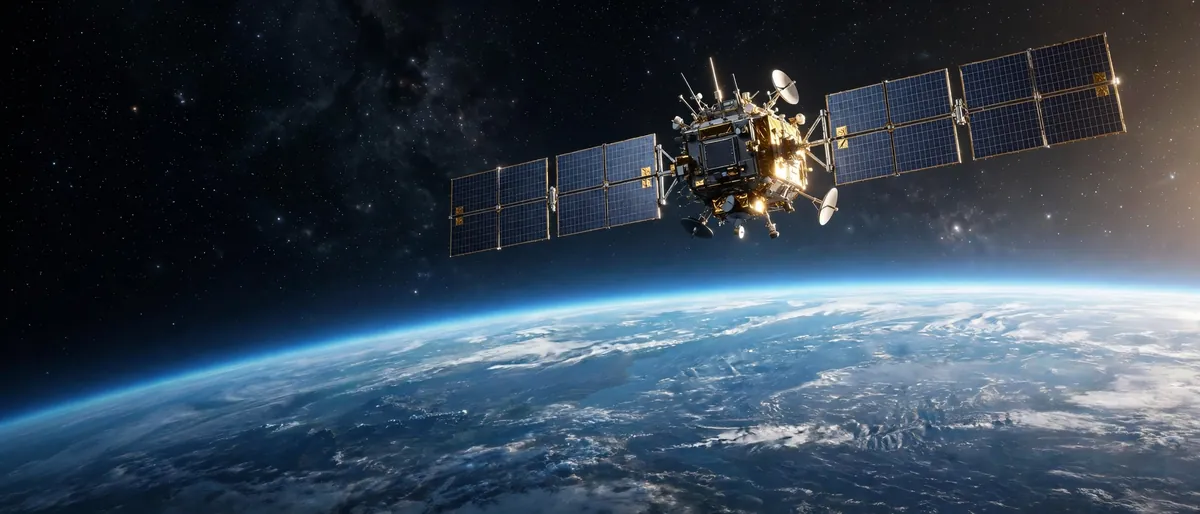
A satellite in a circular orbit is in a state of continuous free fall. Free fall means falling under gravity alone, with no other force such as air resistance or engine thrust acting in a significant way. The satellite is constantly falling toward Earth, but it also has a large sideways velocity. As it falls, Earth’s surface curves away beneath it at the same rate, so the satellite never gets any closer to the ground. It falls around Earth, rather than falling into Earth.
This picture leads directly to the orbital speed formula. For a satellite in a circular orbit, the gravitational force provides the centripetal force needed to keep it moving in a circle. A centripetal force is a force directed toward the centre of a circular path, which continuously changes the direction of motion without changing the speed. In this case, gravity plays that role.
The gravitational force on a satellite of mass m at orbital radius r from Earth’s centre is GMm / r². The centripetal force required for circular motion at speed v is mv² / r. Setting the gravitational force equal to the required centripetal force gives:
GMm / r² = mv² / r
Once again, the satellite’s mass m appears on both sides and cancels. Dividing both sides by m and multiplying both sides by r gives v² = GM / r, and taking the square root gives the orbital speed formula:
v = √(GM / r)
Here, v is the orbital speed in metres per second, G is the universal gravitational constant, M is the mass of the central body, and r is the orbital radius, measured from the centre of the central body, not from its surface. As with g = GM/r², you must use r = R + h for a satellite at height h above the surface.
The cancellation of m carries an important consequence: the orbital speed at a given radius does not depend on the satellite’s mass. A tiny CubeSat and a massive space station, placed in the same orbit, need the same speed to stay in that orbit. A heavier satellite needs a larger gravitational force to hold it in the circle, but gravity provides exactly that larger force, because the gravitational force itself is proportional to the satellite’s mass. The two effects balance perfectly.
The formula also shows that higher orbits are slower. Because r is in the denominator, a larger orbital radius gives a smaller value of GM / r, and therefore a smaller speed. A satellite skimming just above the atmosphere, at an orbital radius close to Earth’s radius, needs about 7.9 km/s. A satellite at 300 to 400 km altitude needs about 7.7 km/s. A geostationary satellite, which orbits at a radius of about 42,200 km from Earth’s centre so that it stays above the same point on the equator, needs only about 3.1 km/s. The pattern is consistent: further out means slower.
The orbital period follows from the speed. The period, T, is the time taken for one complete orbit. In one orbit, the satellite travels the circumference of its circular path, 2πr, at speed v, so T = 2πr / v. Substituting v = √(GM / r) gives:
T = 2π√(r³ / GM)
This shows that a larger orbital radius means a much longer period, because T grows with r to the power of three halves. Low-orbit satellites circle Earth in about 90 minutes, while a geostationary satellite takes 24 hours, matching Earth’s rotation. That is why higher orbits are both slower and longer in period, two sides of the same result.
There is a neat link back to field strength. Since g at the orbit radius is GM / r², multiplying by r gives gr = GM / r, so the orbital speed can also be written as:
v = √(gr)
Here, g means the field strength at the orbit radius, not the surface value of 9.81 N/kg. This form is useful as a check: if you have already calculated g at the satellite’s height, you can find its orbital speed from that value alone. It also reinforces the central idea of this article, that orbital motion is governed by the local strength of the gravitational field.
The weightlessness of astronauts now has a clear explanation. In orbit, the gravitational field strength is still large, about 8.7 N/kg at space-station altitude, so gravity is still pulling strongly on both the station and the astronauts inside it. But both are falling together, with the same acceleration, so there is no contact force pushing the astronauts against the floor. Weight, as felt by a person, is the contact force from a supporting surface, and in free fall that contact force is zero. The astronauts are weightless because everything around them is falling at the same rate, not because gravity has disappeared.
Worked Example 1: Gravitational Field Strength at the Space Station’s Altitude
Question: Calculate the gravitational field strength at an altitude of 400 km above Earth’s surface. Use G = 6.674 × 10⁻¹¹ N·m²/kg², Earth’s mass M = 5.972 × 10²⁴ kg, and Earth’s radius R = 6.371 × 10⁶ m.
Step 1: Find the distance from Earth’s centre. The altitude is the height above the surface, so it must be added to Earth’s radius. First convert 400 km to metres: 400 km = 0.400 × 10⁶ m. Then r = R + h = 6.371 × 10⁶ m + 0.400 × 10⁶ m = 6.771 × 10⁶ m.
Step 2: Write down the formula. The field strength at distance r from the centre is g = GM / r².
Step 3: Calculate the numerator, GM. Multiply G by M: GM = (6.674 × 10⁻¹¹) × (5.972 × 10²⁴) = 3.986 × 10¹⁴ N·m²/kg. Keeping the units in view helps to confirm that the final result will come out in N/kg after dividing by a squared distance in m².
Step 4: Calculate the denominator, r². Square the centre distance: r² = (6.771 × 10⁶ m)² = 45.85 × 10¹² m² = 4.585 × 10¹³ m².
Step 5: Divide. g = (3.986 × 10¹⁴) / (4.585 × 10¹³) = 8.69 N/kg, which rounds to about 8.7 N/kg.
Step 6: Interpret the result. The value 8.7 N/kg is about 89 percent of the surface value of 9.81 N/kg. Gravity at space-station altitude is only slightly weaker than on the ground. If you had mistakenly used h alone, 0.400 × 10⁶ m, in place of r, you would have obtained a value over 2000 N/kg, which is plainly absurd and a clear sign that the radius was forgotten. The astronauts feel weightless because the station and everyone inside it are in free fall together, as explained above, not because the field has become weak.
Worked Example 2: Orbital Speed of a Satellite at 300 km Altitude
Question: Calculate the orbital speed of a satellite in a circular orbit 300 km above Earth’s surface. Use the same values of G, M, and R as in the previous example, and cross-check your answer using the orbital period.
Step 1: Find the orbital radius from Earth’s centre. Convert 300 km to metres: 300 km = 0.300 × 10⁶ m. Then r = R + h = 6.371 × 10⁶ m + 0.300 × 10⁶ m = 6.671 × 10⁶ m.
Step 2: Write down the formula. The orbital speed is v = √(GM / r).
Step 3: Use the value of GM from the previous example: GM = 3.986 × 10¹⁴ N·m²/kg.
Step 4: Divide GM by r: GM / r = (3.986 × 10¹⁴) / (6.671 × 10⁶) = 5.975 × 10⁷ m²/s².
Step 5: Take the square root: v = √(5.975 × 10⁷) = 7,730 m/s. Converting to kilometres per second gives v ≈ 7.7 km/s.
Step 6: Cross-check with the orbital period. The period is T = 2πr / v. The circumference of the orbit is 2πr = 2 × π × 6.671 × 10⁶ m ≈ 4.192 × 10⁷ m. Dividing by the speed gives T ≈ (4.192 × 10⁷) / 7,730 ≈ 5,420 seconds. Dividing by 60 gives about 90 minutes, which matches the well-known period of low-orbit satellites. The agreement confirms that the speed is consistent.
Step 7: Note the independence from satellite mass. Nowhere in this calculation did the satellite’s own mass appear, because it cancelled in the derivation. A satellite ten times heavier, in the same orbit, would travel at the same 7.7 km/s. What would change is the size of the gravitational force acting on it, which would also be ten times larger, exactly as needed to provide the larger centripetal force for the heavier object.
| Orbit | Approximate altitude | Approximate orbital speed | Approximate period |
|---|---|---|---|
| Just above the surface (in theory) | 0 km | 7.9 km/s | About 84 minutes |
| Low Earth orbit | 300–400 km | 7.7 km/s | About 90 minutes |
| Geostationary orbit | About 35,800 km | 3.1 km/s | 24 hours |
This table summarises the trend to remember: as altitude and orbital radius increase, orbital speed decreases and orbital period increases.
Common Mistakes
Using height instead of centre distance. The most frequent error is putting h, the height above the surface, into g = GM/r² or v = √(GM/r) in place of r. Always use r = R + h. For a satellite at 400 km, r is about 6,771 km, not 400 km, and the difference changes the answer enormously.
Confusing G with g. The universal gravitational constant G is a fixed number, 6.674 × 10⁻¹¹ N·m²/kg², while gravitational field strength g varies with position. Writing one in place of the other, or treating surface g as if it applied at all heights, leads to wrong answers. Check every equation to see which symbol you need.
Thinking a heavier satellite orbits faster. The satellite’s mass cancels in both derivations, in g = GM/r² and in v = √(GM/r). Orbital speed at a given radius is set by the central mass and the radius alone. A heavier satellite experiences a larger force, but it also needs a larger centripetal force, so the speed is unchanged.
Thinking gravity is zero in orbit because astronauts float. As the worked example shows, gravitational field strength at space-station altitude is still about 8.7 N/kg. Astronauts float because they are in free fall, falling together with their spacecraft, so no contact force acts on them. Weightlessness in orbit is a consequence of free fall, not of absent gravity.
Thinking field lines can cross or point away from a mass. Field lines never cross, because the field at a point has a single direction. They always point toward the mass creating the field, because gravity is attractive. Lines drawn pointing outward, or crossing lines, describe a repulsive field, not gravity.
Forgetting the inverse-square rule. Doubling the distance from the centre does not halve the field strength; it quarters it. Tripling the distance reduces it to one ninth. Any answer that halves g when r doubles has missed the square in r². A quick check with g = GM/r² will catch this error before it costs marks.
Mixing up units. Distances in these formulas must be in metres and masses in kilograms if G is used in its standard units. Altitudes given in kilometres must be converted to metres first, and orbital speeds calculated in metres per second are usually converted to kilometres per second only at the end. Keeping units attached to every step makes these slips easy to spot.
Conclusion
Gravitational field strength ties together the ideas in this article. It begins with a simple definition, the force per unit mass, g = F/m, measured in newtons per kilogram. Applying Newton’s law of gravitation to that definition gives the central formula g = GM/r², where G is the universal gravitational constant, M is the mass creating the field, and r is the distance from its centre. At a planet’s surface, this becomes g = GM/R², giving about 9.81 N/kg for Earth, and at a height h above the surface it becomes g = GM/(R + h)².
Field lines give a visual summary of the same physics. They point toward the mass, never cross, and are closer together where the field is stronger, spreading apart as the inverse-square law weakens the field with distance. Near a surface they appear as parallel, equally spaced lines, the signature of a uniform field.
Orbital motion follows from the same starting point. Setting the gravitational force equal to the required centripetal force, GMm/r² = mv²/r, and cancelling the satellite’s mass, gives the orbital speed formula v = √(GM/r), equivalently v = √(gr) at the orbit radius, and the period formula T = 2π√(r³/GM). Both formulas carry the same message: higher orbits are slower and take longer to complete.
With these formulas, the opening puzzle is fully resolved. The space station’s astronauts experience a gravitational field strength of about 8.7 N/kg, nearly as strong as on the ground, but they feel weightless because they are falling freely around Earth at about 7.7 km/s. Learn to use r = R + h without fail, keep G and g distinct, and remember that doubling r quarters g, and the whole topic becomes a reliable source of marks rather than a trap.
Frequently Asked Questions
What is gravitational field strength, and what does g = GM/r² tell us?
Gravitational field strength is the force per unit mass felt by a small test mass at a point in a gravitational field, measured in newtons per kilogram (N/kg). The formula g = GM/r² shows it depends only on the mass M creating the field and the distance r from its centre. Doubling M doubles g, while doubling r quarters it, following the inverse-square law.
How do you calculate gravitational field strength at a height using g = GM/r²?
First find the distance from the planet's centre, r = R + h, where R is the planet's radius and h is the height above its surface. Then substitute r into g = GM/r², with G = 6.674 × 10⁻¹¹ N·m²/kg² and M the planet's mass. At 400 km above Earth, this gives about 8.7 N/kg, roughly 89 percent of the 9.81 N/kg surface value.
What do gravitational field lines show about a gravitational field?
Gravitational field lines show the direction of the force that would act on a small test mass placed at each point along the line. Their spacing shows field strength: lines close together mean a strong field, while widely spaced lines mean a weak field. Around a planet, lines form a radial pattern pointing inward, because gravity is always attractive, and field lines never cross.
How is the orbital speed formula v = √(GM/r) derived from gravitational field strength?
A satellite in a circular orbit stays in that orbit because gravity provides the centripetal force it needs. Setting the gravitational force GMm/r² equal to the required centripetal force mv²/r gives GMm/r² = mv²/r. The satellite's mass m cancels from both sides, leaving v² = GM/r, so taking the square root gives v = √(GM/r), where r is the orbital radius from the centre of the central body.
Why does orbital speed decrease as the orbital radius increases in v = √(GM/r)?
In v = √(GM/r), the orbital radius r sits in the denominator, so a larger r gives a smaller value of GM/r and therefore a smaller speed. A satellite skimming just above Earth's atmosphere needs about 7.9 km/s, one at 300–400 km needs about 7.7 km/s, and a geostationary satellite at about 42,200 km from Earth's centre needs only about 3.1 km/s. Higher orbits are also longer in period.
If gravitational field strength is still strong in orbit, why do astronauts feel weightless?
Astronauts feel weightless because they are in continuous free fall, not because gravity has disappeared. At space-station altitude, gravitational field strength is still about 8.7 N/kg, nearly 90 percent of its surface value. The station and the astronauts fall toward Earth together at the same rate, so no contact force pushes them against the floor, and weight as felt through a supporting surface is zero.