Understanding Light Polarization: Malus’s Law Explained for Everyone
How Does Light Get Polarised? is a question that opens a fascinating window into the world of optics, where the invisible becomes visible and ordinary light transforms into something extraordinary. Whether you’re a curious mind, a student, or just someone intrigued by the mysteries of light, understanding how polarization works can be both enlightening and captivating. But what exactly causes light to polarize, and how does Malus’s Law come into play? Before diving into the details, it’s essential to grasp the basics of light behavior, especially in our world where polarized sunglasses, camera lenses, and even LCD screens utilize this phenomenon.
At its core, light polarization is about controlling the direction of light waves, which can have numerous practical applications. To truly appreciate its impact, we need to explore the science behind it, especially Malus’s Law, which provides a mathematical description of how light intensity changes as it passes through polarizing filters. This principle is not just for physicists; it’s something that can be understood and appreciated by everyone. For those eager for a deeper dive, you might find this Wikipedia article on light polarization an excellent starting point.
For more on how these concepts can be applied practically and in everyday technology, feel free to explore our home page, where we delve into various scientific phenomena and their real-world applications. How Does Light Get Polarised? Malus’s Law Explained is not just a topic for experts; it’s a gateway to understanding the unseen yet powerful forces shaping our visual world.
Introduction to Light Polarization
Light polarization is a fundamental concept in the field of optics that describes the orientation of light waves. To understand how light becomes polarized, it’s crucial to first recognize that light is an electromagnetic wave, comprising oscillating electric and magnetic fields. These fields vibrate perpendicularly to the direction of the wave’s travel. In unpolarized light, such as sunlight, these vibrations occur in all possible directions perpendicular to the wave’s motion.
**Polarization** occurs when these vibrations are restricted to a single plane. This can happen through several mechanisms, including reflection, refraction, and the use of polarizing filters. A common example of polarization by reflection is observable when light strikes a non-metallic surface, such as water or glass, at a specific angle known as Brewster’s Angle. At this angle, reflected light is perfectly polarized parallel to the surface. This phenomenon is articulated through Brewster’s Law, which is integral to understanding polarization through reflection.
Types of Polarization
- Linear Polarization: In this form, the electric field of the light wave oscillates in a single plane along the direction of propagation. This is often achieved using polarizing filters, which allow only light vibrating in a certain direction to pass through, effectively producing linearly polarized light.
- Circular and Elliptical Polarization: These occur when the electric field of light describes a circle or an ellipse over time. This is often due to the phase difference between two perpendicular components of the light wave.
The practical applications of light polarization are vast. For instance, polarizing filters are used in photography to reduce glare and enhance contrast. In the realm of optics, understanding polarization is crucial for interpreting how light interacts with materials, which can be vital for fields ranging from astronomy to materials science.
Malus’s Law and the Intensity of Polarized Light
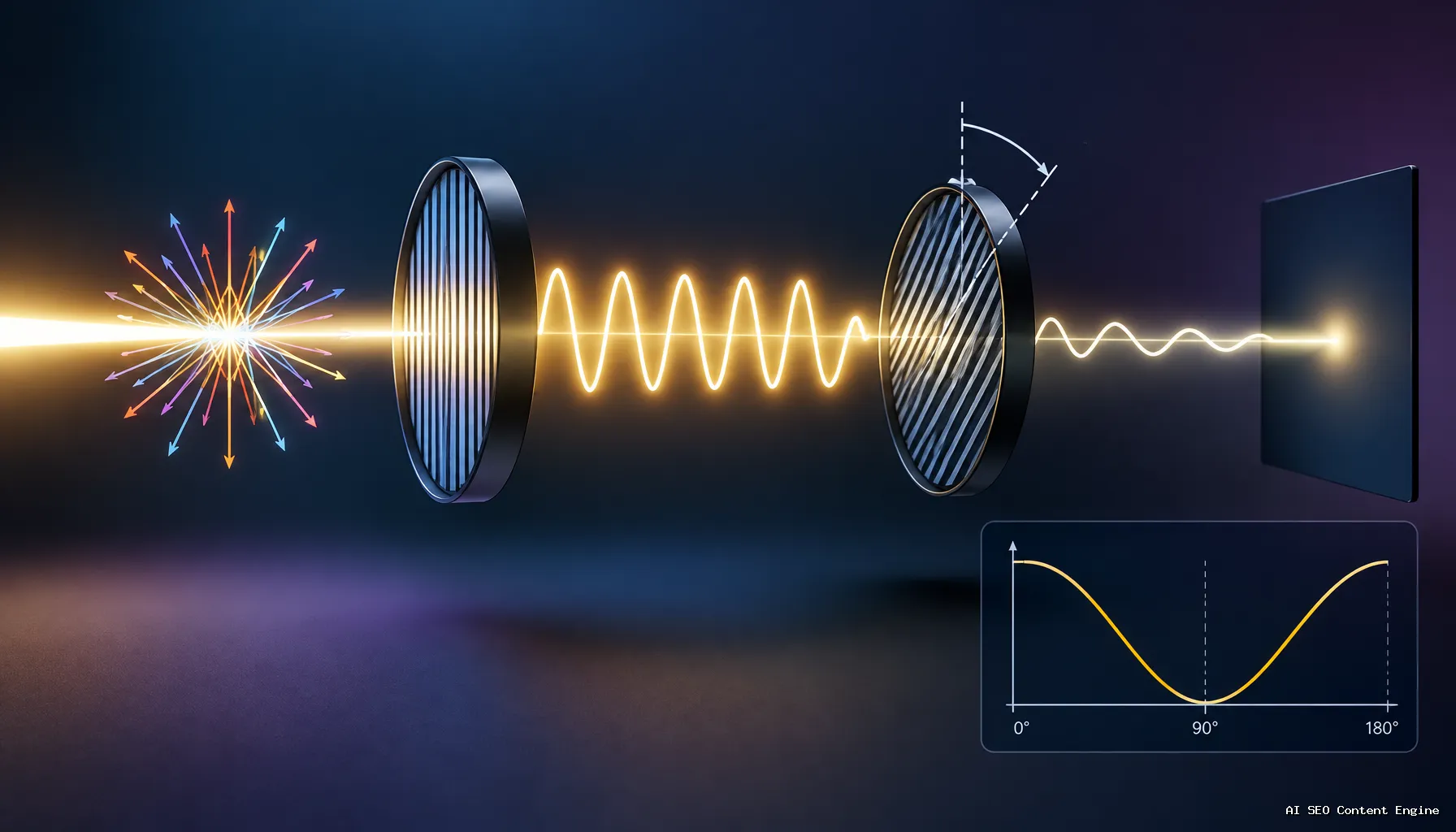
Malus’s Law provides a quantitative measure of the intensity of polarized light as it passes through a polarizing filter. According to the law, the intensity (I) of light passing through a polarizer is proportional to the square of the cosine of the angle (θ) between the light’s initial polarization direction and the axis of the polarizer, expressed mathematically as:
I = I0 cos²(θ)
Where I0 is the initial intensity of the light. This principle is pivotal in understanding how the orientation of polarizing filters affects the intensity of transmitted light. For more in-depth explorations of scientific phenomena and their applications, such as the relationship between light and energy, you might find our article on Nuclear Fission vs Fusion intriguing.
By delving into “How Does Light Get Polarised? Malus’s Law Explained,” we unravel the complexities of light behavior in a way that not only enhances our understanding of everyday optical devices but also enriches our appreciation for the intricate dance of light waves.
How Does Light Become Polarized?
Understanding how light becomes polarized is crucial in the field of optics and has significant implications in both scientific and practical applications. Light, by its nature, is an electromagnetic wave that oscillates in multiple planes. However, when it becomes polarized, these oscillations are restricted to a specific plane.
Natural Polarization
Light can become polarized through several natural processes:
- Reflection: When light reflects off a surface, such as water or glass, it can become partially polarized. This phenomenon is described by Brewster’s Law, which states that light is perfectly polarized when the angle of incidence equals the Brewster angle.
- Scattering: As sunlight passes through the atmosphere, it scatters off air molecules and small particles. This scattering causes the light to become partially polarized, giving the sky its characteristic blue hue and creating polarized light patterns.
Artificial Polarization Methods
Artificial mechanisms are often employed to achieve desired polarization effects for scientific and technological purposes:
- Polarizing Filters: These are optical filters that allow only light waves of a certain polarization to pass through. They are commonly used in photography and in reducing glare from surfaces.
- Birefringent Materials: Certain crystals, like calcite, split light into two rays with perpendicular polarization states. This property is exploited in various optical devices to produce linearly polarized light.
In the context of “How Does Light Get Polarised? Malus’s Law Explained,” it’s essential to understand the role of polarizing filters. When unpolarized light passes through a polarizing filter, it becomes linearly polarized, meaning it oscillates in one plane. The intensity of this polarized light can then be manipulated using additional filters, a principle crucial for devices such as sunglasses and camera lenses.
For those interested in exploring similar phenomena in physics, our article on Nuclear Fission vs Fusion: Understanding E = mc², Binding Energy, and Their Mechanisms offers a deep dive into the energy transformations integral to nuclear reactions.
By examining how light becomes polarized, we can appreciate both the natural beauty and the technological applications of polarized light, from reducing glare to enhancing visual clarity in various optical instruments.
Explaining Malus’s Law
In the realm of optics, Malus’s Law is a fundamental principle that describes how the intensity of light changes as it passes through a polarizing filter. This law is pivotal in the discussion of “How Does Light Get Polarised? Malus’s Law Explained,” as it provides a quantitative understanding of the behavior of polarized light. Malus’s Law is mathematically expressed as:
I = I₀ cos²θ
where:
- I is the intensity of the polarized light after passing through the filter.
- I₀ is the initial intensity of the light before entering the filter.
- θ is the angle between the light’s polarization direction and the axis of the polarizing filter.
Understanding the Components of Malus’s Law
To delve deeper into Malus’s Law, it’s essential to understand the key components involved:
- Initial Intensity (I₀): This is the intensity of the light before it encounters any polarizing filter. Unpolarized light, which oscillates in various planes, can have its intensity measured in this state.
- Polarizing Angle (θ): The angle θ is critical as it determines how much of the light’s intensity is reduced. When θ is 0, the light is perfectly aligned with the filter’s axis, resulting in minimal intensity loss. Conversely, at 90 degrees, the light’s intensity is entirely absorbed.
- Intensity After Filter (I): This value represents the remaining intensity of light post-filtration. As θ increases, I decreases, demonstrating the filter’s role in controlling light intensity.
Applications of Malus’s Law
Malus’s Law not only enhances our understanding of light polarization but also finds practical applications in various optical technologies:
- Polarizing Filters: Used in photography to reduce glare and enhance image clarity, polarizing filters operate based on the principles of Malus’s Law.
- Optical Instruments: Devices such as microscopes and telescopes utilize polarizing filters to manage light intensity and improve visual accuracy.
- Everyday Applications: Sunglasses with polarizing lenses apply Malus’s Law to diminish reflective glare, offering better visibility in bright conditions.
Understanding Malus’s Law is essential for appreciating how devices capitalize on light polarization to enhance functionality. For further insights into physical phenomena, consider exploring our article on Understanding Alpha, Beta, and Gamma Decay: How Radioactive Decay and Half-Life Work, which delves into the intricate details of radioactive processes.
By grasping the nuances of “How Does Light Get Polarised? Malus’s Law Explained,” one can appreciate the profound impact of light polarization in both practical applications and theoretical physics.
Mathematical Derivation of Malus’s Law
The mathematical derivation of Malus’s Law is a cornerstone in understanding how light polarization occurs and is quantified. This derivation helps answer the question, “How Does Light Get Polarised? Malus’s Law Explained,” by providing a detailed analytical framework. Below, we delve into the steps demonstrating how this principle governs the behavior of linearly polarized light.
1. Introduction to Polarized Light
When unpolarized light passes through a polarizing filter, it becomes linearly polarized. This means that the electric field vectors of the light waves are oriented in a single plane. The intensity of polarized light after passing through a second polarizer is predicted by Malus’s Law.
2. Formula Representation
Malus’s Law is mathematically expressed as:
I = I0 cos²θ
- I is the intensity of the polarized light after passing through the second polarizer.
- I0 is the initial intensity of the light before the second polarizer.
- θ is the angle between the light’s initial polarization direction and the axis of the second polarizer.
3. Derivation Process
- **Step 1: Initial Polarization** – When unpolarized light first encounters a polarizer, it becomes polarized with an intensity I0 that is half of the original intensity of the unpolarized light.
- **Step 2: Analyzing Intensity Change** – As this polarized light encounters a second polarizing filter, the intensity of the light that emerges from this filter depends on the cosine of the angle θ.
- **Step 3: Applying Cosine Squared Law** – The intensity I of the transmitted light is proportional to the square of the cosine of the angle θ between the polarization direction and the filter’s axis. Thus, I = I0 cos²θ.
4. Practical Implications
Understanding this derivation is crucial for fields such as photography and optics, where precise control over light intensity is necessary. For example, nuclear physics similarly relies on mathematical precision to explain phenomena, demonstrating the interdisciplinary importance of such laws.
5. Conclusion
By comprehending the mathematical underpinnings of Malus’s Law, one gains insight into the fundamental question of “How Does Light Get Polarised? Malus’s Law Explained.” This law not only elucidates the behavior of polarized light but also serves as a pivotal principle in the application of optical technologies, enhancing both theoretical understanding and practical utility.
Applications of Polarized Light
Understanding the principles of light polarization, including Malus’s Law, offers numerous practical applications across various industries. These applications demonstrate the significant impact of polarized light on technology and science, answering the critical question: How Does Light Get Polarised? Malus’s Law Explained.
Photography and Imaging
In photography, polarizing filters are essential tools for enhancing image quality. By selectively blocking certain light waves, these filters can reduce reflections, enhance contrast, and saturate colors. This is particularly useful for capturing vibrant landscapes and reducing glare from water or glass surfaces.
Optical Devices
Polarized light plays a crucial role in the development of advanced optical devices such as LCD screens. These devices utilize linearly polarized light to control the display of images, ensuring clarity and color accuracy.
Scientific Research
Polarization is extensively used in scientific research to study the properties of materials. Techniques like polarimetry leverage the principles of light polarization to analyze molecular structures and chemical compositions. This application is vital in fields such as chemistry and biology.
Communication Technologies
Polarization is pivotal in enhancing the efficiency of communication systems. By using polarized signals, the bandwidth and reliability of wireless communication can be significantly improved, reducing interference and increasing data transmission rates.
Medical Diagnostics
In the medical field, polarized light is used in diagnostic techniques such as optical coherence tomography. This non-invasive imaging method provides high-resolution cross-sectional images of biological tissues, aiding in early diagnosis and treatment of various conditions.
Safety and Vision
Polarized sunglasses are a common application of light polarization, designed to reduce glare from reflective surfaces like roads and water, thereby enhancing visual comfort and safety. This is particularly beneficial for drivers and outdoor enthusiasts.
For a deeper understanding of the principles underlying these technologies, one might explore related physical laws. For instance, the interplay of different forces in nuclear physics is similarly intricate, as discussed in our article on nuclear fission and fusion.
These diverse applications underscore the importance of understanding how light behaves when polarized, guided by the foundational principles of Malus’s Law and other related laws like Brewster’s Law. By leveraging these insights, industries can continue to innovate and develop technologies that enhance both our daily lives and scientific endeavors.
Experiments Demonstrating How Does Light Get Polarised?
Understanding ‘How Does Light Get Polarised? Malus’s Law Explained’ involves conducting various experiments that vividly demonstrate the principles of light polarization. These experiments not only highlight the significance of Malus’s Law but also offer a hands-on approach to comprehend the intricate behavior of polarized light. Below, we delve into some key experiments that elucidate the concept effectively.
Using Polarizing Filters
One of the most straightforward experiments involves using two polarizing filters, also known as polarizers. Here’s how it works:
- Initial Setup: Place the first polarizer in the path of an unpolarized light source such as a laser or a flashlight. This filter will convert the unpolarized light into linearly polarized light.
- Adding a Second Polarizer: Introduce a second polarizer after the first, and rotate it. As you adjust the angle between the two polarizers, observe the intensity of the transmitted light.
- Observations: When the polarizers are aligned (0 degrees), the light intensity is at its maximum. As you rotate the second polarizer to 90 degrees relative to the first, the light intensity decreases and can reach zero, demonstrating Malus’s Law.
Quantitative Analysis
For a deeper exploration, measure the intensity of polarized light at various angles using a photometer. According to Malus’s Law, the intensity \( I \) of light passing through the second polarizer is given by:
\( I = I_0 \cos^2(\theta) \)
Where \( I_0 \) is the initial intensity and \( \theta \) is the angle between the light’s initial polarization direction and the axis of the second polarizer. This quantitative analysis underscores how the intensity varies with the cosine squared of the angle, providing a precise mathematical understanding of ‘How Does Light Get Polarised? Malus’s Law Explained’.
Experimenting with Brewster’s Angle
To further explore light polarization, you can examine Brewster’s Law using a glass slab:
- Setup: Shine a light beam at a glass surface and adjust the angle of incidence.
- Brewster’s Angle: At a specific angle, known as Brewster’s angle, the reflected light will be completely polarized. This angle is where the reflected and refracted rays are perpendicular to each other.
- Verification: Use a polarizing filter to confirm the polarization of the reflected light by rotating the filter until the light intensity drops to zero.
These experiments provide a comprehensive understanding of light polarization and the practical implications of Malus’s Law. For those interested in exploring related physical phenomena, our article on nuclear fission and fusion offers insights into the complex interplay of forces in atomic physics, drawing parallels to the principles of light behavior.
Common Misunderstandings and Mistakes
Understanding the process of how light gets polarized and the application of Malus’s Law can often be complicated by several common misconceptions. Clarifying these misunderstandings is crucial for a more accurate comprehension of light polarization, particularly for those delving into the topic of ‘How Does Light Get Polarised? Malus’s Law Explained’. Let’s explore some of these common errors:
Mistaking Polarization for Reflection
One prevalent misunderstanding is confusing light polarization with reflection. While reflection is a broad phenomenon where light bounces off surfaces, polarization refers specifically to the orientation of light waves. Many assume all reflected light is polarized, which is only true at Brewster’s angle. It’s important to differentiate that not all reflection results in polarization unless specific conditions are met, such as those described in Brewster’s Law.
Confusion Between Linearly Polarized Light and Unpolarized Light
Another frequent mistake is the assumption that all light is naturally polarized. In reality, most natural light sources emit unpolarized light, where the light waves vibrate in multiple planes. Linearly polarized light, however, vibrates in a single plane, which can be achieved using polarizing filters. This distinction is crucial for correctly applying Malus’s Law, which pertains to the intensity of polarized light.
Misapplication of Malus’s Law
Malus’s Law is often misunderstood or misapplied, particularly concerning the intensity of polarized light. The law states that the intensity of light passing through a polarizing filter is proportional to the cosine squared of the angle between the light’s initial polarization direction and the axis of the filter. A common mistake is neglecting the angle factor, leading to incorrect calculations of light intensity.
Overlooking the Role of Polarizing Filters
Polarizing filters are indispensable tools in the study of light polarization. However, their role is often underestimated, leading to misconceptions about how they function. These filters work by blocking certain orientations of light waves, allowing only specific angles to pass through, thus creating linearly polarized light. Understanding the function and correct usage of polarizing filters is essential for accurate experimentation and application of Malus’s Law.
Failure to Link Related Physical Phenomena
Finally, a common oversight is not relating the principles of light polarization to other physical phenomena. For instance, understanding the nuances of light behavior can be enriched by exploring related topics like nuclear fission and fusion, which similarly involve complex interactions of physical forces.
By addressing these misunderstandings, learners can better grasp the intricacies of ‘How Does Light Get Polarised? Malus’s Law Explained’, leading to a more thorough and accurate understanding of light polarization.
Beyond Malus’s Law: How Does Light Get Polarised? Malus’s Law Explained with Brewster’s Law and Other Phenomena
While Malus’s Law provides a foundational understanding of light polarization, it is crucial to explore other phenomena that further explain how light becomes polarized. One significant concept that complements Malus’s Law is Brewster’s Law, which offers insight into the behavior of light at interfaces.
Understanding Brewster’s Law
Brewster’s Law describes the relationship between the angle of incidence and polarization. According to this principle, when light hits a surface at a specific angle—known as the Brewster angle—the reflected light becomes completely polarized. This occurs because the reflected and refracted rays are perpendicular to each other, allowing only one plane of vibration to persist.
- Brewster Angle: The formula to calculate the Brewster angle (θB) is given by tan(θB) = n2/n1, where n1 and n2 are the refractive indices of the two media.
- Applications: Brewster’s Law is widely used in designing anti-reflective coatings and in photography to reduce glare.
Other Polarization Phenomena
Beyond Brewster’s Law, several other phenomena contribute to our understanding of light polarization:
- Scattering: When light passes through the atmosphere, it scatters due to interaction with air molecules. This scattering causes the sky to appear blue and results in partial polarization of light, especially noticeable at 90° from the sun.
- Dichroism: Certain materials can absorb specific orientations of light, resulting in linearly polarized light. This principle underlies the function of polarizing filters, which are crucial for enhancing contrast and reducing reflections in photography.
For those interested in exploring related physical phenomena, such as the complex interactions observed in nuclear fission and fusion, understanding how light polarization operates can offer additional insights.
By delving deeper into these concepts, learners can expand on the fundamental principles of ‘How Does Light Get Polarised? Malus’s Law Explained’, gaining a comprehensive understanding of how light behaves in various contexts. Such knowledge not only supports academic pursuits but also enhances practical applications in technology and scientific research.
Conclusion
Understanding how light gets polarized and the principles of Malus’s Law offers significant insight into the behavior of light waves in various environments. Polarization not only plays a crucial role in scientific applications and technologies, such as photography and LCD screens, but it also enhances our understanding of the fundamental nature of light. By comprehending the concept of polarization, we can better appreciate the intricacies of light’s interaction with matter and its practical implications in our daily lives.
Frequently Asked Questions
How does light become polarized?
Light becomes polarized when its waves oscillate in a single plane. This can happen through processes such as reflection, refraction, or by passing through a polarizing filter. When light reflects off surfaces like water or glass, it can become partially polarized, with the reflected light waves vibrating predominantly in one direction.
Can you explain Brewster’s law of polarization of light?
Brewster’s Law states that light is perfectly polarized when it reflects off a surface at a specific angle, known as the Brewster angle. At this angle, the reflected and refracted light waves are perpendicular to each other, and the reflected light is completely polarized parallel to the surface. This phenomenon is commonly used in the design of anti-glare coatings and sunglasses.
Can you explain the polarization of light in a simple way?
Polarization of light refers to the orientation of light waves in a particular direction. Imagine holding a rope and moving it up and down or side to side; the wave follows the direction of your movement. Similarly, polarized light waves vibrate in a specific direction. Polarization can occur naturally, such as when light passes through the atmosphere, or can be induced using polarizing filters.
What does it mean for light to be linearly polarized?
When light is linearly polarized, its electric field oscillates in a single plane along the direction of propagation. This means that the light waves are aligned in parallel lines, as opposed to unpolarized light, which has waves vibrating in multiple directions. Linear polarization is often achieved using polarizing filters, which block all waves except those vibrating in a particular direction.