How Fast Is the Speed of Light, and How Was It First Measured?
For most of human history, nobody knew whether light travelled instantly or took time to get from one place to another. When you switch on a lamp, the room seems to fill with light at once. When lightning flashes, you see it at the same moment it happens, as far as your senses can tell. It was natural to assume that light moved infinitely fast, arriving everywhere the instant it left its source.
That assumption turned out to be wrong. The speed of light in a vacuum is exactly 299,792,458 metres per second. It is enormous, but it is not infinite, and light does take time to travel. This article gives you that answer up front, and then tells the story of how astronomers and laboratory physicists pinned the number down, experiment by experiment, over more than three centuries.
By the end, you will know the exact value of the speed of light and its handy rounded forms, how the first measurements worked, why the speed of light is now defined rather than measured, and how to calculate light travel times yourself. You will also meet the classic mistakes students make with this topic, so you can avoid them in exams.
What Is the Speed of Light?
The speed of light in a vacuum is given the symbol c. A vacuum is a space with no matter in it at all, no air, no water, no glass, just empty space. When physicists talk about the speed of light without any extra detail, they usually mean c, the speed of light in a vacuum.
The exact value is:
c = 299,792,458 m/s
That is 299,792,458 metres every second. In other common units, the same value is 299,792 kilometres per second, and about 186,282 miles per second. For quick exam calculations, physicists round it to:
c = 3.00 x 10^8 m/s
The notation 10^8 means 10 multiplied by itself eight times, which is 100,000,000. So 3.00 x 10^8 m/s means about 300,000,000 metres per second. This rounded value is close enough for most school and college problems, but it is not the exact value. Keep the difference in mind, because confusing the two is one of the most common mistakes on this topic.
Two ideas about c matter more than the digits. First, the speed of light in a vacuum is the same for all observers, no matter how fast they are moving. Whether you stand still or race towards a beam of light, you will always measure its speed as c. This surprising fact is one of the foundations of modern physics, and it leads to Einstein’s theory of relativity.
Second, c is the universe’s speed limit. Nothing that carries information, no signal, no message, no spacecraft, can travel faster than c in a vacuum. This is not a rule about technology being too weak. It is built into the way space and time work.
Two simple formulas connect the speed of light to distance, time, and waves. The first is the general speed formula:
speed = distance / time, or v = d / t
Here v is speed, d is distance, and t is time. You will use this formula in the worked examples later in this article. The second formula links the speed of a wave to its frequency and wavelength:
c = f x wavelength
Frequency, written f, is how many waves pass a point each second. Wavelength is the distance between one wave crest and the next. For light, frequency times wavelength always equals c in a vacuum. If the frequency goes up, the wavelength must go down, and the other way round, because their product stays fixed at c.
Was Light Always Thought to Be Instant?
For centuries, the smartest thinkers of their time assumed that light moved instantly. The ancient Greeks debated the question, and later thinkers such as Descartes argued that light must travel infinitely fast, because otherwise we would notice a delay. Everyday experience supported them. Light seemed to arrive everywhere at once, and no experiment anyone could think of showed otherwise.
Galileo Galilei tried to settle the question in 1638 with a practical experiment. His plan was simple. Two people would stand on distant hills at night, each holding a covered lantern. The first person would uncover their lantern, and the second person would uncover theirs the instant they saw the first flash. By measuring the time between uncovering the first lantern and seeing the return flash, Galileo hoped to measure how long light took to make the round trip.
The experiment failed, and the reason is instructive. Human reaction time is the time it takes a person to notice something and respond to it, and it is roughly a fifth of a second. Light, meanwhile, covers the distance between two hills in a tiny fraction of a second. The delay Galileo was trying to measure was far smaller than the wobble in his assistants’ reaction times. His result told him nothing, except that light was either instant or far too fast for his method.
Galileo’s failure points to the real problem. To measure the speed of light, you need either a very long distance, so that the travel time becomes big enough to notice, or a very fast timing device. In the 1600s, nobody had a fast timer. The breakthrough came from the opposite direction: using distances so huge that even light takes a measurable time to cross them. Those distances were found not on Earth, but in the solar system.
Roemer’s First Measurement: Jupiter’s Moon Io (1676)
Ole Roemer was a Danish astronomer working in Paris. He was studying Io, one of the four large moons of Jupiter. Io is a small world that orbits Jupiter once every 42.5 hours, and on each orbit it passes behind Jupiter and disappears into the planet’s shadow. Astronomers call this disappearance an eclipse of Io. Because Io’s orbit is so regular, these eclipses happen like clockwork, and astronomers could predict exactly when each one should occur.
Roemer noticed something strange. When Earth was on the far side of its orbit from Jupiter, the eclipses of Io happened later than predicted. When Earth was on the near side, they happened on time. The delay grew and shrank through the year, reaching a maximum of about 16.6 minutes when Earth was farthest from Jupiter.
Roemer’s insight was brilliant in its simplicity. The eclipses were not actually late. Instead, the light carrying the news of each eclipse had farther to travel when Earth was far from Jupiter. When Earth was on the far side of its orbit, light from Jupiter had to cross the whole diameter of Earth’s orbit, the extra distance across the circle Earth travels around the Sun, before reaching telescopes on Earth. That extra journey took extra time, about 16.6 minutes.
His calculation used the basic speed formula, rearranged:
c = distance / time delay
Here the distance is the diameter of Earth’s orbit, and the time delay is the extra time light needed to cross it. Using the size of Earth’s orbit as it was known in Roemer’s day, this gives a value of about 220,000 kilometres per second. Different sources quote slightly different numbers, roughly 214,000 to 220,000 kilometres per second, because they use different values for the size of Earth’s orbit, which was not known precisely at the time.
Do not judge Roemer by the accuracy of his number. His real achievement was bigger. He proved that light has a finite speed, that it takes time to travel. Before Roemer, that was an open question. After Roemer, it was settled. The speed of light was a real, measurable quantity, and the race to measure it precisely had begun.
Bradley, Fizeau, and Foucault: Sharpening the Number
Roemer’s method used the whole solar system as its measuring stick. The next steps brought the measurement closer to home, and each one improved the value.
Bradley and stellar aberration (1728)
James Bradley, an English astronomer, discovered a tiny apparent wobble in the positions of stars, which he called stellar aberration. Aberration means a small shift in the apparent direction of something, caused by the motion of the observer. Bradley realised that, just as rain seems to slant towards you when you run through it, starlight seems to slant slightly because Earth is moving around the Sun.
The size of the slant depends on Earth’s orbital speed divided by the speed of light, so Bradley could work out c from the angle of the wobble. His result was about 301,000 kilometres per second, remarkably close to the modern value, and it confirmed Roemer’s conclusion independently.
Fizeau and the toothed wheel (1849)
The next breakthrough came in a laboratory, not an observatory. Hippolyte Fizeau, a French physicist, built the first apparatus that measured the speed of light on Earth. His device used a toothed wheel, a disc with teeth cut around its edge, like a gear, which could spin very fast. A beam of light passed through a gap between two teeth, travelled about 8 kilometres to a mirror, and came back through the same wheel.
Here is the clever part. If the wheel was spinning slowly, the returning light passed back through the same gap it had left through. As the wheel spun faster, the returning light arrived to find a tooth in the way instead of a gap, and the beam was blocked.
By finding the exact spinning speed at which the light was first blocked, Fizeau knew that the wheel had advanced by exactly one tooth during the time light took for the round trip. From the number of teeth and the spinning speed, he could work out that round-trip time, and from the distance he could work out the speed.
His formula was:
c = 2 x distance x teeth x rotations per second
In this formula, distance is the one-way distance to the mirror, teeth is the number of teeth on the wheel, and rotations per second is how fast the wheel spins. The factor of 2 appears because light makes a round trip, travelling twice the one-way distance.
Fizeau’s result was about 315,000 kilometres per second. It was less accurate than Bradley’s, but it was the first measurement made in a laboratory on Earth, and that was a landmark: the speed of light could now be measured without waiting for planets to move.
Foucault and the rotating mirror (1862)
Leon Foucault, another French physicist, improved on Fizeau’s idea by replacing the toothed wheel with a rotating mirror. A mirror spins, reflects the beam to a distant fixed mirror, and catches the returning beam after having turned slightly. The small shift in the returning beam’s direction reveals how far the mirror turned while the light was away, and therefore how long the light took. The rotating mirror allowed a much shorter baseline, the distance between the apparatus and the far mirror, and much better precision.
Foucault’s result was about 298,000 kilometres per second, far closer to the modern value than Fizeau’s. Foucault also made a second important discovery with the same apparatus. He showed that light travels slower in water than in air. This settled a long argument about the nature of light, because the wave theory of light predicted exactly that, while the older particle theory of the time predicted the opposite. Foucault’s experiment was a double victory: a better value for c, and a decisive test of what light is.
Michelson and the Modern Value
Albert Michelson, an American physicist, spent much of his career refining the rotating-mirror method. His measurements in 1879 gave about 299,910 kilometres per second. By 1926, using a baseline of about 35 kilometres between mountaintops in California, he had refined the value to about 299,796 kilometres per second. Michelson received the Nobel Prize in Physics in 1907, the first American to win a science Nobel Prize, in recognition of his precision optical instruments and measurements.
In the 1950s, 1960s, and 1970s, new tools took over. Cavity resonators, hollow metal boxes in which microwaves bounce back and forth at a known frequency, and lasers, devices that produce a very pure, single-colour beam of light, allowed physicists to measure the frequency and wavelength of light with extraordinary precision.
Since c equals frequency times wavelength, these measurements gave c with ever smaller uncertainty. By the early 1970s, the best measurements had converged on 299,792.457 kilometres per second, with an uncertainty of only a few centimetres per second.
At that point, physicists faced an odd situation. They could measure c more precisely than they could measure the metre itself. The metre was then defined by a metal bar kept in Paris, and comparing lengths against that bar was less precise than measuring c. So in 1983, the international community made a bold decision: fix c exactly, and define the metre from it.
The metre is now defined as the distance light travels in a vacuum in 1/299,792,458 of a second. Turn that definition around, and you get the exact value of c:
c = 299,792,458 m/s, exactly, by definition
This is why the speed of light is no longer something scientists measure to refine its value. It is fixed. What improves over time is our measurement of distances, because we now measure lengths by timing light, using c as the ruler. If a future experiment seems to give a different value for c, physicists will conclude that their distance measurement was off, not that c has changed.
Worked Example 1: How Long Does Sunlight Take to Reach Earth?
Here is a calculation you can reuse in exams. The question: how long does light take to travel from the Sun to Earth?
Step 1: Write down what you know. The distance from the Sun to Earth is about 1.496 x 10^11 metres. The speed of light in a vacuum is about 2.998 x 10^8 metres per second. We use the rounded value 2.998 x 10^8 m/s here, which is the same as 299,792,458 m/s written in scientific notation.
Step 2: Choose the formula. Time = distance / speed, or t = d / v.
Step 3: Substitute the numbers. t = 1.496 x 10^11 / 2.998 x 10^8. Dividing the numbers gives 1.496 / 2.998 = 0.499, and dividing the powers of ten gives 10^11 / 10^8 = 10^3, which is 1,000. So t = 0.499 x 10^3 = 499 seconds.
Step 4: Convert to minutes. 499 seconds divided by 60 seconds per minute is 8.32 minutes, which is about 8 minutes and 20 seconds.
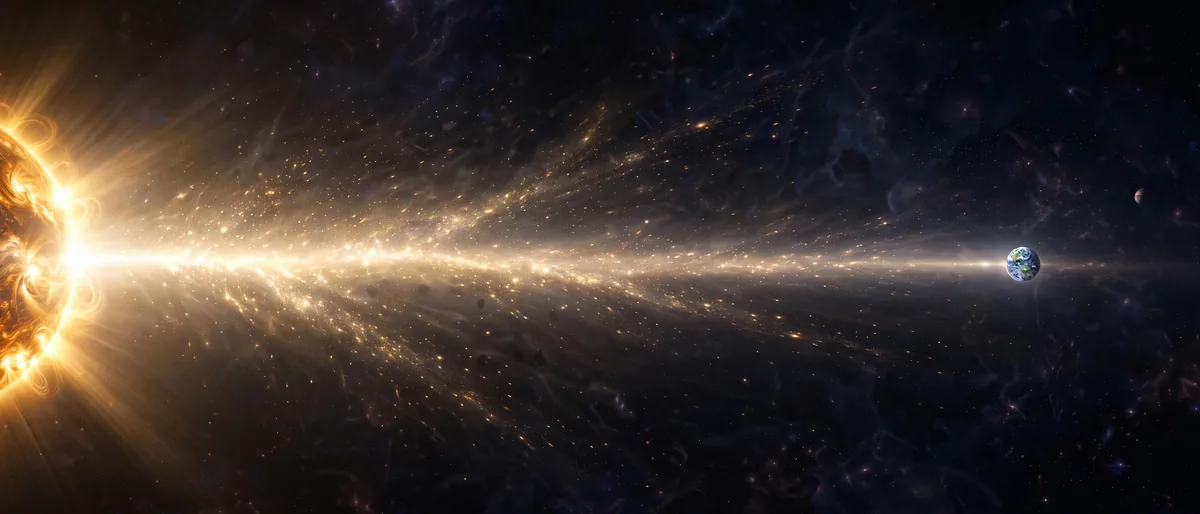
Conclusion: the sunlight we see left the Sun about 8 minutes ago. When you look at the Sun, you are seeing it as it was 8 minutes in the past. Astronomers call this a light travel time delay, and it applies to everything in the sky. The farther away an object is, the older the light you see from it.
Worked Example 2: How Long Does Light Take to Reach the Moon?
Now try the same method for a closer neighbour. The question: how long does light take to travel from Earth to the Moon?
Step 1: Write down what you know. The distance from Earth to the Moon is about 384,400 kilometres. The speed of light is 299,792 kilometres per second. Notice that both numbers are in kilometres, so the units match and the answer will come out in seconds.
Step 2: Choose the formula. Time = distance / speed, or t = d / v.
Step 3: Substitute the numbers. t = 384,400 / 299,792 = 1.28 seconds, to two decimal places.
Step 4: Work out the round trip. A signal sent from Earth to the Moon and back travels twice the distance, so the round-trip time is 2 x 1.28 = 2.56 seconds.
Conclusion: light takes about 1.28 seconds to reach the Moon one way, and about 2.56 seconds for a round trip. This is why laser ranging, bouncing laser pulses off reflectors left on the Moon to measure its distance precisely, involves a delay of a few seconds. It is also why radio conversations with astronauts on the Moon had a noticeable pause: every reply took at least 2.56 seconds to come back, before anyone even started speaking.
Speed of Light in Water, Glass, and Other Media
So far we have talked about the speed of light in a vacuum. But most of the light you meet in daily life travels through air, water, or glass, and in those materials light slows down. A medium is any material through which light travels, such as air, water, or glass.
The speed of light in a medium is given by:
v = c / n
Here v is the speed of light in the medium, c is the speed of light in a vacuum, and n is the refractive index of the medium. The refractive index is a number that describes how much a material slows light down. A refractive index of 1 means light travels at full speed, as in a vacuum. A higher refractive index means slower light.
For water, n is about 1.33. So v = 299,792 / 1.33 = about 225,000 kilometres per second. For glass, n is about 1.5. So v = 299,792 / 1.5 = about 200,000 kilometres per second. Air has a refractive index very close to 1, about 1.0003, so light in air travels at almost exactly c, and for most purposes you can treat it as c.
One point needs emphasis, because it confuses many students. Light slowing down in water or glass does not break the cosmic speed limit. The limit applies to c, the speed of light in a vacuum. When light enters a medium, it interacts with the atoms of that material, and the overall progress of the wave is slowed, but c itself, the vacuum value, is unchanged. Nothing in this process travels faster than c, and the rule stands.
Common Mistakes
- Confusing the rounded exam value 3.00 x 10^8 m/s with the exact defined value 299,792,458 m/s. Use the rounded value for quick calculations, but quote the exact value when a question asks for it.
- Saying that light travels at c in water or glass. It does not. In a medium, light travels at v = c / n, which is slower than c. Only in a vacuum does light travel at exactly c.
- Crediting Fizeau with the first measurement of the speed of light. Roemer’s 1676 astronomical measurement came first. Fizeau’s 1849 experiment was the first measurement made on Earth in a laboratory, which is a different claim.
- Mixing up kilometres per second and metres per second. One kilometre is 1,000 metres, so 299,792 km/s equals 299,792,458 m/s. Forgetting the factor of 1,000 gives an answer that is wrong by a thousand times.
- Thinking that scientists are still measuring the speed of light to refine its value. Since 1983, c has been fixed by definition. What improves is our measurement of distances, because the metre is now defined from c.
- Assuming that Galileo’s experiment failed because light is infinitely fast. It failed because human reaction time was far too slow to measure such a tiny travel time over such a short distance. The experiment could not distinguish between instant light and extremely fast light.
Conclusion
The speed of light in a vacuum, c, is exactly 299,792,458 metres per second, or about 3.00 x 10^8 m/s for quick calculations. It is the same for all observers and is the fastest speed at which information can travel. The key formulas of this article are worth memorising: speed = distance / time, c = frequency x wavelength, and v = c / n for light in a medium with refractive index n.
The story of how we learned this number is a story of growing precision. Roemer proved in 1676 that light takes time to travel, by noticing that Io’s eclipses ran late when Earth was far from Jupiter. Fizeau brought the measurement into the laboratory in 1849 with his spinning toothed wheel.
Foucault refined it in 1862 with a rotating mirror and proved light slows in water. Michelson perfected it over a 35-kilometre baseline by 1926. And in 1983, modern physics turned the whole problem around, fixing c exactly and defining the metre as the distance light travels in 1/299,792,458 of a second.
Every time you see sunlight, remember that it left the Sun about 8 minutes ago, and that it took humanity more than three hundred years to measure the speed of the light that carries it. That measurement, from Roemer’s delayed moons to laser-defined metres, is one of the great achievements of physics, and its formulas will serve you in every exam and problem you meet on this topic.
Frequently Asked Questions
How fast is the speed of light in a vacuum in metres per second and kilometres per second?
The speed of light in a vacuum is exactly 299,792,458 metres per second, which equals 299,792 kilometres per second. In everyday terms, that is about 186,282 miles per second. For quick exam calculations, physicists round it to 3.00 x 10^8 m/s. Remember that the rounded value is only an approximation; when a question asks for the exact value, quote 299,792,458 m/s.
Who first measured the speed of light, and how did Roemer's observation of Jupiter's moon Io give a value for the speed of light?
Ole Roemer, a Danish astronomer, first measured the speed of light in 1676 by timing eclipses of Jupiter's moon Io. Io disappears behind Jupiter every 42.5 hours like clockwork, yet its eclipses ran up to about 16.6 minutes late when Earth was farthest from Jupiter. Roemer realised the delay was light crossing the diameter of Earth's orbit, so c equals distance divided by time delay, giving about 220,000 kilometres per second.
How did Fizeau's toothed wheel experiment measure the speed of light in a laboratory?
Fizeau's 1849 experiment sent a beam of light through a gap in a spinning toothed wheel to a mirror about 8 kilometres away and back. He increased the wheel's speed until the returning light was blocked by a tooth instead of passing through a gap, showing the wheel had advanced by exactly one tooth during the round trip. Using c equals 2 x distance x teeth x rotations per second, he obtained about 315,000 kilometres per second.
Why is the speed of light slower in water than in air, and what does v = c / n mean?
Light is slower in water than in air because water slows light, as described by v = c / n, where v is the speed of light in the medium, c is the speed of light in a vacuum, and n is the refractive index. Water's refractive index is about 1.33, so v equals 299,792 divided by 1.33, or about 225,000 kilometres per second. Air's refractive index is about 1.0003, so light in air travels at almost exactly c.
How long does light take to travel from the Sun to Earth at the speed of light?
Light takes about 8 minutes and 20 seconds to travel from the Sun to Earth. Using time equals distance divided by speed, t equals 1.496 x 10^11 metres divided by 2.998 x 10^8 metres per second, which gives 499 seconds. Dividing 499 seconds by 60 gives 8.32 minutes, or about 8 minutes and 20 seconds. The sunlight we see therefore left the Sun about 8 minutes ago.
Why is the speed of light now a defined constant rather than a measured number?
The speed of light is now a defined constant because, in 1983, physicists fixed c exactly at 299,792,458 metres per second and defined the metre from it. The metre is now the distance light travels in a vacuum in 1/299,792,458 of a second. Scientists no longer measure c to refine its value; instead, they improve measurements of distance by timing light, using c as the ruler.