How to Calculate Speed, Distance and Time: The Triangle Formula
You know how far something travelled and how long it took, and you need its speed. Or you know the speed and the time, and you need the distance. Every one of these questions runs on the same piece of maths, the speed distance time formula, and it has only three versions. Speed equals distance divided by time. Distance equals speed multiplied by time. Time equals distance divided by speed. Learn one triangle and you never have to memorise which way round any of them goes.
That is the whole job of this article. You will see what each quantity means, how the triangle works, two worked examples done step by step, the unit conversions that catch people out, and the average speed trap that has cost many exam marks. Nothing here needs maths beyond division and multiplication.
What speed, distance and time actually mean
Speed tells you how much distance an object covers in each unit of time. A car doing 60 kilometres per hour covers 60 kilometres in every hour it keeps going. A sprinter at 10 metres per second covers 10 metres in every second. The number only makes sense with its unit attached, because 60 on its own could mean 60 kilometres per hour or 60 metres per second, and those are very different speeds.
Distance is how far the object travels along its path. It is a length, so you measure it in metres or kilometres, or in miles if the question uses miles. Time is how long the motion takes, measured in seconds, minutes or hours. Put the three together and you get the core relationship of this whole topic: speed equals distance divided by time. In symbols, s = d / t, where s stands for speed, d stands for distance and t stands for time.
One thing worth clearing up early is the difference between speed and velocity. Speed is a scalar quantity, which means it has size but no direction. Velocity is speed with a direction attached, like 60 kilometres per hour north. This article is about the calculation, so it uses speed throughout. The triangle and the three formulas work the same way either way, but the answers here are speeds, not velocities.
Symbols can look different from one textbook to another, and that trips up more students than the maths does. In this article, s means speed and d means distance, because that is how the triangle is usually drawn in school maths. In physics textbooks you will often see v used for speed instead of s, and s used for distance instead of d. The letters change, the relationship does not. Speed is still distance divided by time, whatever letters your book uses. If a question gives you v = d / t, read it as exactly the same formula with different labels.
The speed distance time formula triangle
Here is the memory aid that makes the whole topic easy. Draw a triangle and split it into three parts. Put distance, d, at the top. Put speed, s, and time, t, side by side underneath it. That picture holds all three formulas at once, and you never need to rearrange an equation again.
The method is called the cover up method, and it works like this. Cover the quantity you want to find with your finger, and the two letters left showing tell you the calculation. Cover d at the top and you see s next to t on the bottom row, which means multiply them: d = s x t.
Cover s and you see d over t, which means divide: s = d / t. Cover t and you see d over s, which means divide again: t = d / s. The line between the top and the bottom of the triangle means divide. The two letters sitting side by side on the bottom row mean multiply.
Students sometimes draw the triangle with distance at the bottom. That version is wrong, and it gives wrong answers, because it flips every formula. Distance sits on top for a reason. Speed and time are the two quantities you divide distance by or multiply together, so they belong underneath. If you ever forget the layout, remember that the formula you probably already know is speed equals distance divided by time, and the thing being divided goes on top.
The three formulas in one place, so you can see them together:
- Speed: s = d / t
- Distance: d = s x t
- Time: t = d / s
Before you use any of them, check the units. That single habit prevents more lost marks than any other. If distance is in kilometres and time is in hours, speed comes out in kilometres per hour. If distance is in metres and time is in seconds, speed comes out in metres per second. The units of your answer come from the units you put in, so they have to match each other before you start.
How to calculate speed
Calculating speed is the most direct use of the triangle. You have a distance and a time, so you cover s and read off s = d / t. Then you substitute the numbers, divide, and write the answer with its unit. The worked example below shows every step, because exam markers give credit for the working, and because a clear method is what saves you when the numbers get awkward.
Worked example 1: a cyclist on a morning ride
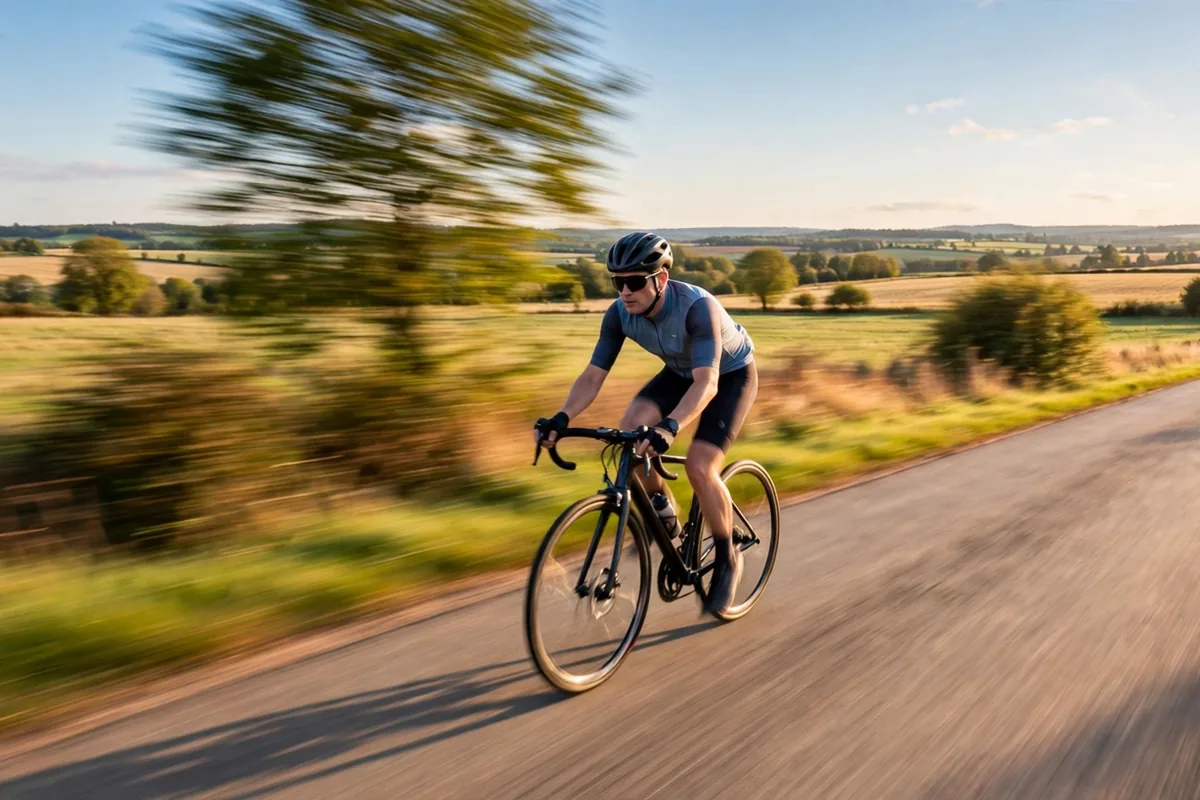
A cyclist rides 45 km in 3 hours. Calculate the speed of the cyclist.
Step 1: Write down what you know. Distance, d, equals 45 km. Time, t, equals 3 hours. You need speed, s.
Step 2: Choose the formula. You want speed, so cover s in the triangle. The letters left showing are d over t, so s = d / t.
Step 3: Substitute the numbers. s = 45 / 3.
Step 4: Work it out. 45 divided by 3 is 15, so s = 15 km/h. The unit is kilometres per hour because the distance was in kilometres and the time was in hours.
That is the full method. Nothing is hidden. Write down what you know, pick the formula from the triangle, substitute, calculate, and finish with the unit. If you practise that order, the harder questions feel the same as this one, because the only thing that changes is the numbers and sometimes a unit conversion first.
A quick check in metres per second
Try the same method with different units. A sprinter covers 100 m in 10 s. Calculate the speed of the sprinter.
Distance is 100 m and time is 10 s, so s = d / t = 100 / 10 = 10 m/s. The sprinter’s speed is 10 metres per second. Notice how the unit follows the same rule. Metres divided by seconds gives metres per second. A quick check like this is worth doing whenever you finish a question, because it shows whether the method has stuck. If you can do the 100 metre sprint in your head, you can do any speed question with a calculator and the same four steps.
One more thing to watch when you calculate speed is the size of your answer. A walking pace is around 1.4 m/s, or about 5 km/h. A car on a motorway does roughly 30 m/s, or about 110 km/h. If your answer for a cyclist comes out as 150 km/h, something went wrong, probably a misplaced decimal or a time that should have been converted first. A rough sense of realistic speeds is a free error check, and it takes two seconds.
Finding distance and time with the same triangle
The triangle earns its keep when the question asks for distance or time instead of speed, because those are the two formulas students forget. You do not need to memorise them separately. Cover the letter you want and read off the calculation, exactly as before. Distance is d = s x t. Time is t = d / s.
Worked example 2: a train trip with a time conversion
A train travels at 90 km/h for 2 hours 20 minutes. Calculate the distance travelled by the train.
Step 1: Write down what you know. Speed, s, equals 90 km/h. Time, t, equals 2 hours 20 minutes. You need distance, d.
Step 2: Fix the units before anything else. The speed is in kilometres per hour, so the time must be in hours. 2 hours 20 minutes is not 2.20 hours, and writing it that way is one of the most common errors in this topic. Convert the minutes first: 20 minutes divided by 60 equals 1/3 of an hour, so the time is 2 1/3 hours, which is 7/3 hours.
Step 3: Choose the formula. You want distance, so cover d in the triangle. The letters left showing are s next to t, so d = s x t.
Step 4: Substitute the numbers. d = 90 x 7/3.
Step 5: Work it out. 90 divided by 3 is 30, and 30 multiplied by 7 is 210, so d = 210 km. The train travels 210 kilometres.
There are two ways to check that answer. The rough check is that 90 km/h for 2 hours is 180 km, and the extra 20 minutes adds another 30 km, which gives 210 km. The exact check is the working above. Both agree, which is a good sign. The step that mattered most was step 2, the conversion. Skip it and the answer comes out wrong no matter how neat the rest of the working is.
Finding time: a car trip
A car must cover 240 km at a speed of 80 km/h. Calculate the time taken.
Distance is 240 km and speed is 80 km/h, so you want time. Cover t in the triangle and you read off t = d / s. Substitute the numbers: t = 240 / 80 = 3 hours. The car takes 3 hours.
Time questions sometimes ask for the answer in hours and minutes rather than as a decimal. If your division gives 2.5 hours, that is 2 hours 30 minutes, not 2 hours 50 minutes. The decimal part is a fraction of an hour, so multiply it by 60 to get the minutes. 0.5 x 60 is 30, so 2.5 hours is 2 hours 30 minutes. This conversion is worth practising on its own, because it appears in exam questions about arrival times as well as in time calculations.
Units: where most answers go wrong
Most wrong answers in speed, distance and time questions are not caused by the formula. They are caused by units that do not match. The formula only works when the units line up, so the first job in every question is to check them. If the speed is in kilometres per hour, the time must be in hours and the distance will come out in kilometres. If the speed is in metres per second, the time must be in seconds and the distance will come out in metres. Mixed units give mixed up answers.
Converting between kilometres per hour and metres per second is the conversion that appears most often. To go from km/h to m/s, divide by 3.6. To go from m/s to km/h, multiply by 3.6.
The number 3.6 comes from the units themselves. One kilometre is 1000 metres and one hour is 3600 seconds, so 1 km/h equals 1000 divided by 3600 metres per second, which is 1 divided by 3.6 metres per second. That is why dividing by 3.6 works, and it is worth knowing the reason rather than just the rule, because reasons are harder to forget under exam pressure.
Here is a quick example. A car travels at 72 km/h. In metres per second, that is 72 divided by 3.6, which is 20 m/s. Going the other way, a runner at 5 m/s is moving at 5 multiplied by 3.6, which is 18 km/h.
Both conversions use the same number, 3.6, and the only thing to remember is which way round it goes. Kilometres per hour is the bigger number for the same speed, so converting to metres per second makes the number smaller, which means divide. Converting to kilometres per hour makes the number bigger, which means multiply.
Time conversions cause just as much trouble. To turn minutes into hours, divide by 60. 30 minutes is 0.5 hours, 45 minutes is 0.75 hours, and 15 minutes is 0.25 hours. The one that catches people out is 45 minutes, because it looks as if it should be 0.45 hours. It is not. An hour has 60 minutes, not 100, so 45 out of 60 is three quarters, which is 0.75.
Writing 0.45 hours for 45 minutes is a decimal place error that comes from treating time like money, and it is a mistake markers see again and again.
To turn decimal hours back into hours and minutes, multiply the decimal part by 60. 2.25 hours is 2 hours plus 0.25 x 60 minutes, which is 2 hours 15 minutes. 1.75 hours is 1 hour 45 minutes.
0.1 hours is 6 minutes, which surprises people who expect it to be 10 minutes, but 0.1 of an hour is one tenth of 60 minutes, and one tenth of 60 is 6. Keep a short table of these conversions in your notes until they feel automatic: a quarter of an hour is 15 minutes, half an hour is 30 minutes, and three quarters is 45 minutes.
The safest habit is to do every conversion before you touch the formula. Write the converted values down, then substitute. That way the formula step itself stays simple, and if the answer looks wrong you know the problem is in the arithmetic, not in a unit you forgot to change. Exam questions often hide the conversion inside an ordinary sounding sentence, like a train leaving at 09:40 and arriving at 11:10, so reading the question twice is part of the method, not a waste of time.
Average speed and the trap almost everyone falls into
Average speed is the total distance travelled divided by the total time taken. The word total does a lot of work in that definition, and forgetting it is the classic trap of this topic. You cannot find average speed by averaging two speeds, because the two speeds usually apply for different amounts of time, and the slower part of the trip takes longer, so it counts for more.
Here is the trap in numbers. A driver covers 60 miles at 40 mph, then returns over the same 60 miles at 60 mph. What is the average speed for the whole round trip?
Work it out in stages. The outward leg takes 60 divided by 40, which is 1.5 hours. The return leg takes 60 divided by 60, which is 1 hour. Total distance is 60 plus 60, which is 120 miles. Total time is 1.5 plus 1, which is 2.5 hours. Average speed is total distance divided by total time, so 120 divided by 2.5, which is 48 mph.
The tempting wrong answer is 50 mph, the mean of 40 and 60. That answer is wrong because the driver spent 1.5 hours at 40 mph and only 1 hour at 60 mph. More of the trip happened at the slower speed, so the true average sits below the halfway point between the two speeds, at 48 mph.
Averaging the speeds only works when the time spent at each speed is exactly the same, which is rarely the case in an exam question. If the question gives you distances, work out each time, add the distances, add the times, and divide. That is the whole method, and it never fails.
One more detail belongs here. Stops count in the total time. If a car drives for 2 hours, stops for 30 minutes, then drives for another hour, the total time is 3.5 hours, not 3 hours. The speedometer reads zero during the stop, but the clock keeps running, and average speed is measured against the clock. Questions sometimes include a rest break precisely to test whether you remembered this, so add every part of the trip, moving or not, before you divide.
Common mistakes
Every mistake below shows up in real exam scripts every year. Knowing them in advance is worth more than extra practice on questions you already get right, because each one is easy to avoid once you have seen it named.
- Mixing minutes and hours without converting. A time of 45 minutes must become 0.75 hours before it goes into a formula that uses km/h. Putting 45 straight into the calculation treats the time as 45 hours, and the answer is nonsense.
- Forgetting the unit in the answer. A bare number like 15 earns fewer marks than 15 km/h, and in a real world context it means nothing. Write the unit every time, and check that it matches the units you started with.
- Averaging two speeds instead of using total distance over total time. The mean of two speeds is only the average speed when the time at each speed is equal. Work out each time separately, add the distances, add the times, then divide.
- Using velocity and speed interchangeably when direction matters. Speed has no direction, velocity does. A car driving round a track and back to its starting point has travelled a real distance at a real speed, even though its displacement is zero. If a question asks for speed, give speed.
- Writing the triangle upside down. Distance must sit on top of the triangle. Put speed or time on top and every formula comes out flipped. If you are unsure, check that covering s gives you d over t, the formula you already know.
- Rounding too early and carrying the error. Keep the full number through the working and round only at the end. Rounding 7 divided by 3 to 2.3 early in a calculation can shift the final answer enough to lose the accuracy mark, while the unrounded value gives the right answer.
Keep the triangle in your head and the units in order
The speed distance time formula is three formulas in one picture. Speed is distance divided by time, s = d / t. Distance is speed multiplied by time, d = s x t. Time is distance divided by speed, t = d / s. Draw the triangle with distance on top and speed and time underneath, cover the letter you want, and read off the calculation. That is the method, and it handles every question in this topic, from a cyclist riding 45 km in 3 hours to a train covering 210 km at 90 km/h.
Two habits decide whether your answers are right. Convert the units before you substitute, so minutes become hours and kilometres per hour become metres per second when the question needs it. And remember that average speed is total distance divided by total time, never the average of two speeds. Keep those two habits alongside the triangle and the marks take care of themselves.
Try it on a trip you know. Pick a distance and a time from your own day, a bus ride or a walk to school, cover up the speed in the triangle, and work it out. One question done by hand teaches the method better than ten read through, and once you have done it, the triangle stays with you.
Frequently Asked Questions
What is the speed distance time formula?
The speed distance time formula links the three quantities with one relationship: speed equals distance divided by time, written as s = d / t. It rearranges into two more versions, distance equals speed multiplied by time, d = s x t, and time equals distance divided by speed, t = d / s. Use any version when you know the other two values and the units match.
How does the speed distance time triangle work?
The triangle works by the cover up method, with distance at the top and speed and time underneath. Cover the quantity you want and read off the calculation from the letters left showing. Cover distance and you see speed next to time, so multiply: d = s x t. Cover speed and you see distance over time, so divide: s = d / t. Cover time and you see distance over speed, so divide: t = d / s.
How do I calculate speed using the speed distance time formula?
Calculate speed with s = d / t, dividing distance by time. First write down the distance and the time with their units, then check the units match, so kilometres go with hours and metres go with seconds. Substitute the numbers into the formula and divide. For example, a cyclist who rides 45 km in 3 hours travels at 45 divided by 3, which is 15 km/h. Always finish by writing the unit in your answer.
How do I find distance with the speed distance time formula?
Find distance with d = s x t, multiplying speed by time. First check that the time is in the unit the speed needs, so convert minutes to hours if the speed is in kilometres per hour. Then substitute the speed and the time into the formula and multiply. For example, a train at 90 km/h for 2 1/3 hours covers 90 multiplied by 7/3, which is 210 km. Your answer comes out in kilometres.
How do I calculate time using the speed distance time formula?
Calculate time with t = d / s, dividing distance by speed. Write down the distance and the speed, then check the units match, so kilometres go with kilometres per hour and metres go with metres per second. Substitute the numbers and divide. For example, a car covering 240 km at 80 km/h takes 240 divided by 80, which is 3 hours. If the answer is a decimal, multiply the decimal part by 60 to turn it into minutes.
Why is average speed not the average of two speeds in the speed distance time formula?
Average speed is not the average of two speeds because the slower part of a journey takes longer, so it counts for more of the total time. Average speed is total distance divided by total time. Driving 60 miles at 40 mph and back at 60 mph takes 2.5 hours, so the average is 120 divided by 2.5, which is 48 mph, not 50 mph. Only average the speeds when the time at each speed is exactly the same.