The Lens and Mirror Equation: Understanding 1/f = 1/u + 1/v
Introduction to the Lens and Mirror Equation
Understanding the lens and mirror equation is essential for anyone interested in optics, whether you’re a student, a hobbyist, or a professional in the field. The equation, expressed as \( \frac{1}{f} = \frac{1}{u} + \frac{1}{v} \), represents the relationship among the focal length (f), the object distance (u), and the image distance (v). Each component plays a critical role in how lenses and mirrors manipulate light to form images.
First, let’s dissect what each term means. The **focal length (f)** is the distance from the lens or mirror to its focal point, where parallel rays of light converge (for converging lenses and mirrors) or appear to diverge from (for diverging lenses and mirrors). This distance is pivotal. A shorter focal length results in a stronger lens or mirror, capable of bending light more sharply.
Next, we consider the **object distance (u)**, which is the distance from the object being viewed to the lens or mirror. This measurement is typically a positive value when the object is in front of the lens or mirror. The position of the object relative to the lens or mirror significantly influences the characteristics of the formed image, including size, orientation, and type.
Finally, the **image distance (v)** is the distance from the lens or mirror to the image formed. Like the object distance, this value can also be positive or negative, depending on whether the image is real or virtual. A real image, formed when light converges, has a positive image distance, while a virtual image, formed when light appears to diverge, has a negative image distance.
The lens and mirror equation is more than just a mathematical formula; it’s a fundamental principle that allows us to predict the behavior of light in various optical systems. For example, by rearranging the equation, you can find any one of the three distances if you know the other two.
This relationship is crucial in designing optical devices, from eyeglasses to cameras and telescopes. A thorough grasp of the lens and mirror equation opens doors to understanding complex optical phenomena and enhances our ability to manipulate light effectively.
Historical Context of Optical Physics
Optical physics, the study of light and its interactions with matter, has roots that stretch back to ancient civilizations. The earliest written accounts of optical phenomena can be traced to the Greeks. Think of Euclid and Ptolemy, who laid the groundwork for geometric optics. They explored concepts like reflection and refraction. Their works were foundational, but they lacked the mathematical rigor we use today.
The Middle Ages brought a shift in perspective. Scholars in the Islamic Golden Age, such as Ibn al-Haytham, made significant contributions. His seminal work, “Book of Optics,” published in the 11th century, challenged previous theories. He proposed that vision occurs when light rays enter the eye, a concept that contradicted the prevailing belief that the eye emitted light. Al-Haytham’s experiments on lenses and mirrors set the stage for future advancements.
The Renaissance was a period of rebirth for many scientific disciplines, including optics. The invention of the telescope in the early 17th century by Hans Lippershey marked a pivotal moment. Galileo Galilei’s use of the telescope revolutionized astronomy. He discovered celestial bodies like Jupiter’s moons, expanding our understanding of the universe. This period also saw the development of the microscope by Antonie van Leeuwenhoek, opening new realms of biology.
In the 18th century, Isaac Newton made a profound impact with his work on light. He demonstrated that white light is composed of a spectrum of colors through his famous prism experiments. Newton’s theories on color and light propagation laid the groundwork for later studies. At the same time, Christian Huygens proposed the wave theory of light, introducing the concept of light behaving as a wave.
The 19th century ushered in the era of electromagnetism. James Clerk Maxwell formulated his equations, demonstrating that light is an electromagnetic wave. This theory unified optics with electricity and magnetism. It was a groundbreaking moment that altered our understanding of light’s nature.
Twentieth-century advancements brought even more clarity. Albert Einstein’s work on the photoelectric effect introduced the concept of light quanta, or photons. This duality of light as both a wave and a particle has been foundational in modern physics. The understanding of optical physics has evolved dramatically, but the principles established by early thinkers remain crucial.
Understanding the Variables: f, u, and v
In the realm of optics, comprehending the variables in the lens and mirror equation is crucial for grasping how these optical devices function. The equation, represented as 1/f = 1/u + 1/v, connects three key variables: f, u, and v. Each of these plays a distinct role in determining how light interacts with lenses and mirrors.
Focal Length (f)
The focal length, denoted by f, is the distance from the optical center of a lens or mirror to the focal point. The focal point is where parallel rays of light converge after passing through the lens or reflecting off the mirror. For converging lenses, such as convex lenses, f is positive, indicating that light rays converge. Conversely, for diverging lenses, like concave lenses, f is negative as the rays appear to diverge from a common point.
Understanding focal length is vital because it helps in predicting how a lens or mirror will magnify or reduce the size of an image. A shorter focal length results in a greater magnification, while a longer focal length produces a smaller, less magnified image. This relationship plays a significant role in applications ranging from photography to microscopy.
Object Distance (u)
The object distance, represented as u, is the distance between the object being viewed and the lens or mirror. This distance is typically measured from the object to the optical center of the lens or mirror. It’s essential to note that u is conventionally taken as negative for real objects in lens and mirror calculations. This convention arises from the Cartesian sign convention, which establishes a standardized method for calculating distances in optics.
Understanding u helps in determining the nature of the image produced—whether it is real or virtual. When the object is placed beyond the focal point, a real image is formed. If it’s within the focal length, a virtual image appears, which cannot be projected on a screen.
Image Distance (v)
The image distance, denoted as v, represents the distance from the lens or mirror to the image produced. Similar to u, the sign of v depends on the type of lens or mirror and the nature of the image. For real images produced by converging lenses, v is positive. In contrast, for virtual images, it is negative. Understanding this aspect is crucial as it directly impacts how we interpret the image formed.
As we analyze the equation 1/f = 1/u + 1/v, it becomes clear that f, u, and v are intertwined. Adjusting one variable affects the others, leading to different image characteristics. This relationship is fundamental in designing optical systems for various applications, including cameras, telescopes, and corrective lenses.
Deriving the Lens and Mirror Equation
To understand the lens and mirror equation, we need to start from the fundamental principles of geometrical optics. At the heart of this exploration is the relationship between object distance (u), image distance (v), and focal length (f). The equation itself, expressed as \( \frac{1}{f} = \frac{1}{u} + \frac{1}{v} \), reveals how these quantities interconnect for both lenses and mirrors.
First, let’s define our terms clearly. The object distance (u) is the distance from the object to the lens or mirror. The image distance (v) is the distance from the image to the lens or mirror. The focal length (f) is a measure of how strongly the lens or mirror converges (or diverges) light. For a converging lens or a concave mirror, f is positive; for a diverging lens or a convex mirror, f is negative.
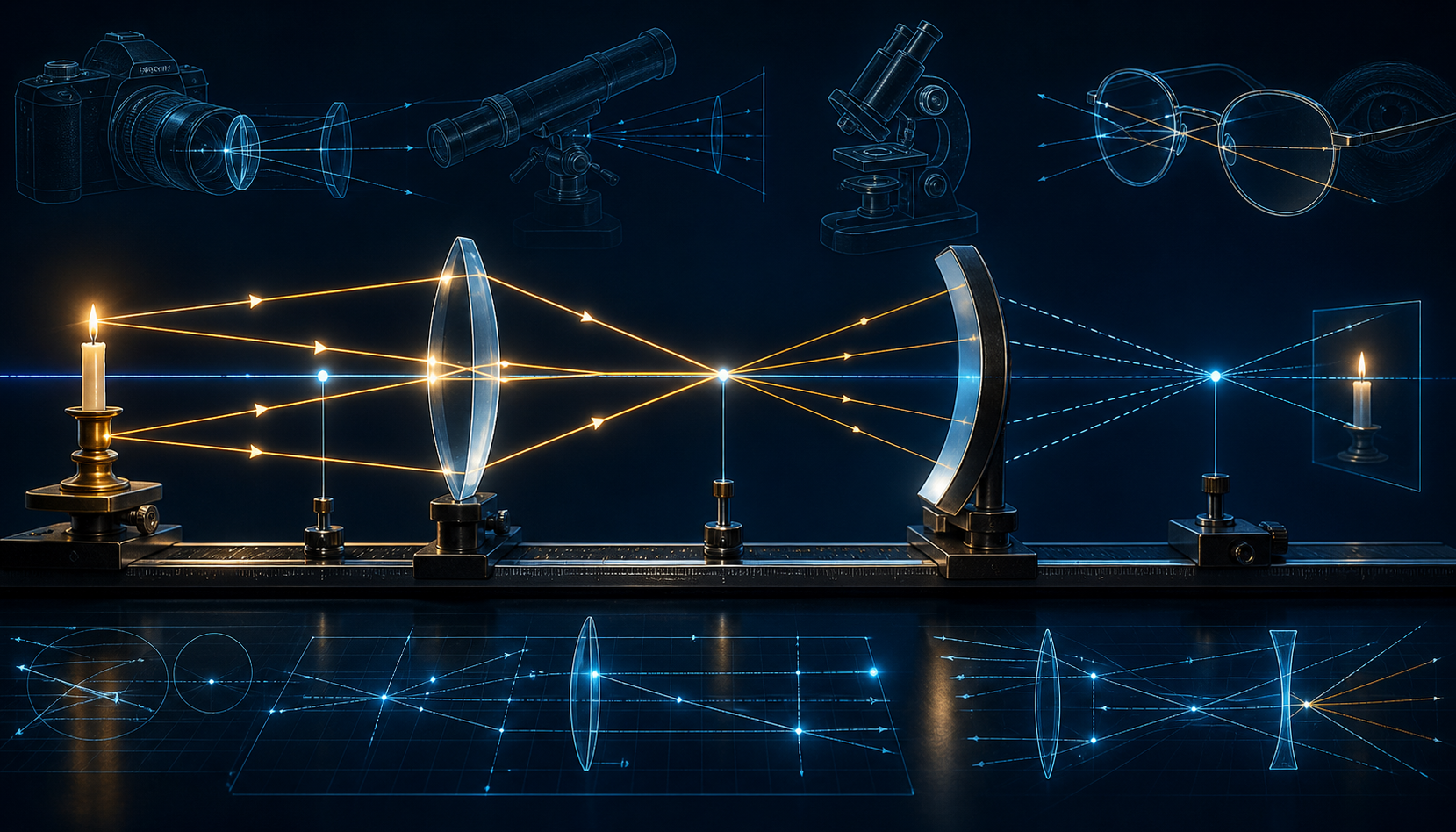
Now, how do we derive this equation? We start by considering the geometry of the situation. Draw a ray diagram for a converging lens. Place the lens in the center, the object on the left, and the image on the right. The focal point (F) lies on the optical axis, and the distances from the lens to the object and image are marked as u and v.
Using similar triangles, we can establish the relationships between these distances. The height of the object (h) and the height of the image (h’) are proportional to their respective distances from the lens. The principle of similar triangles gives us two equations:
1. \( \frac{h’}{h} = \frac{v}{u} \)
2. \( \frac{h’}{h} = \frac{f}{u} \)
Rearranging these equations will lead us toward our goal. If we express h’ in terms of h, we can relate all three distances. By combining these relationships, we rearrange our equations to isolate the terms involving f:
– From the first equation, \( h’ = h \cdot \frac{v}{u} \)
– From the second equation, \( h’ = h \cdot \frac{f}{u} \)
Setting these equal gives:
\( h \cdot \frac{v}{u} = h \cdot \frac{f}{u} \)
This simplification leads us to the realization that \( \frac{1}{u} + \frac{1}{v} = \frac{1}{f} \).
This same geometric approach applies to mirrors, with slight adjustments to account for the nature of reflection as opposed to refraction. When deriving the equation for mirrors, remember that the image distance is measured differently.
In summary, the lens and mirror equation \( \frac{1}{f} = \frac{1}{u} + \frac{1}{v} \) emerges from fundamental geometrical relationships and the properties of similar triangles. Understanding this derivation is critical for mastering optics, as it forms the basis for analyzing complex optical systems.
Applications of the Lens and Mirror Equation in Optics
The lens and mirror equation, expressed as 1/f = 1/u + 1/v, serves as a foundational tool in optics, impacting various domains from photography to medical imaging. Understanding its applications can illuminate the underlying principles that govern how we manipulate light.
Photography and Camera Design
In photography, the lens and mirror equation is crucial for designing camera systems. Photographers often need to calculate the correct focal length (f) to achieve the desired image size and distance. When you focus on a subject, the distance from the lens to the object (u) and the distance from the lens to the image sensor (v) must relate through the equation.
For example, if you’re capturing a subject 2 meters away from a lens with a 50 mm focal length, you can rearrange the equation to find the image distance. This calculation ensures that the image is sharp and clear, which is essential for high-quality photography.
Optical Instruments
Optical instruments such as microscopes and telescopes rely on the lens and mirror equation for optimal performance. In a microscope, multiple lenses work together, and the equation helps design the system to achieve high magnification and resolution.
For instance, in a compound microscope, the objective lens focuses light from the specimen onto the eyepiece. Here, knowing the focal lengths and distances allows for precise image formation. If the focal length of the objective is 4 mm and the specimen is positioned at 10 mm, you can easily calculate the image distance to ensure the intermediate image is accessible for further magnification.
Medical Imaging
In medical imaging, particularly in ultrasound and endoscopy, the lens and mirror equation plays a vital role. For instance, in endoscopes, where light must travel through a series of lenses and mirrors, understanding the distances becomes critical for obtaining clear images of internal organs.
The precise arrangement of optical components is vital. If the focal length of the endoscope’s lens system is known, medical professionals can compute how far the light should travel to create a clear image of tissues or organs, improving diagnostic accuracy.
Vision Correction
Another significant application of the lens and mirror equation is in vision correction. Eyeglasses and contact lenses are designed using these principles. The equation helps optometrists determine the necessary lens power to correct refractive errors like myopia or hyperopia.
For example, if a patient’s vision requires a lens with a focal length of +2.0 diopters, the equation can help determine how far the lens must be positioned from the eye to achieve the desired visual clarity. This knowledge directly impacts the design of corrective lenses, ensuring they’re tailored to individual needs.
Conclusion
The lens and mirror equation is more than just a mathematical formula; it’s a key player in various fields of optics. From enhancing our photographic experiences to advancing medical imaging techniques, its applications continue to be invaluable. Understanding these applications not only deepens our comprehension of optics but also enhances our ability to manipulate light effectively in practical scenarios.
Common Misconceptions About the Equation
Misunderstanding the lens and mirror equation, represented as 1/f = 1/u + 1/v, is surprisingly common among students and enthusiasts alike. Let’s tackle some of the most prevalent misconceptions.
First, many believe that the variables f, u, and v represent arbitrary distances without context. In reality, **f** is the focal length, the key point where parallel rays converge or appear to diverge. This length is fixed for a specific lens or mirror type. **u** is the object distance from the lens or mirror, while **v** is the image distance. The relationship between these three variables is not just a mathematical fancy; it reflects the physical behavior of light.
Another misconception involves the sign conventions. A common error is assuming that all distances must be positive. In the lens maker’s convention, distances measured in the direction of incoming light (towards the lens or mirror) are negative. Conversely, distances measured in the direction of outgoing light (away from the lens or mirror) are positive. This sign convention is essential for correctly applying the equation. For instance, if you place an object in front of a concave mirror, the object distance (u) will be negative, while the image distance (v) can be positive or negative based on whether the image is real or virtual.
Some also think that the equation only applies to lenses. This notion overlooks that the same principles apply to mirrors. While the geometry may differ, the underlying physics governing light behavior remains consistent. For example, in concave mirrors, a real image forms when the object is placed beyond the focal point. This relationship still holds true when using the same equation.
Lastly, there’s a misunderstanding about the types of images produced. Many believe that every object will produce a real image. This isn’t accurate. Depending on the position of the object relative to the focal point, the image can be real or virtual. This leads to confusion on whether the image can be projected onto a screen. Knowing how to apply the equation accurately helps clarify these distinctions.
Addressing these misconceptions is crucial for mastering the lens and mirror equation. Understanding the nuances of these concepts prepares you for deeper explorations in optics.
Real-World Examples of Lens and Mirror Applications
Camera Lenses
Camera lenses are prime examples of the lens formula in action. They manipulate light to capture sharp images. A camera lens typically comprises multiple glass elements, each contributing to the overall focal length and image quality. When you take a photograph, the lens focuses light from the scene onto the camera sensor. Applying the lens equation, 1/f = 1/u + 1/v, helps photographers understand how changing the distance from the lens to the subject (u) alters the image distance (v) and how this impacts the final image composition.
For instance, if you’re photographing a landscape at a distance of 1000 mm from the lens, and the focal length of the lens is 50 mm, you can rearrange the equation. Plugging in the numbers helps you determine the required distance from the sensor to the lens for optimal focus, which in this case would be approximately 50.5 mm.
Projectors
Projectors use lenses to enlarge an image and project it onto a screen. The lens system in a projector works similarly to that of a camera, manipulating light paths to achieve the desired image size and clarity. The lens equation is crucial here, especially in determining how far the projector must be from the screen (v) to achieve a specific projection size.
For example, if a projector has a focal length of 25 mm and needs to project an image at a distance of 2 meters, the relationship between the object distance (u) and the image distance (v) can be calculated. This ensures the image is sharp and clear, essential for presentations or movie screenings.
Telescopes
Telescopes, both amateur and professional, depend heavily on the principles of lenses and mirrors. In optical telescopes, lenses gather light from distant celestial objects. The arrangement of these lenses determines the telescope’s ability to resolve fine details in the night sky.
Consider a telescope with a primary lens (or mirror) of focal length 1000 mm. If you want to observe a star located millions of kilometers away, the image produced must be focused precisely on the eyepiece or camera sensor. By applying the lens equation, astronomers can calculate how adjustments in the eyepiece’s position affect the clarity and size of the observed image.
Magnifying Glasses
Magnifying glasses are everyday tools that illustrate the lens equation’s principles in a straightforward manner. When you hold a magnifying glass over a small object, the lens creates a virtual image that appears larger. Here, the focal length is typically short, allowing for a significant magnification effect.
If the object distance (u) is 10 cm and the focal length (f) of the magnifying glass is 5 cm, using the lens equation allows you to find the image distance (v). For practical use, this means you can determine how close to the lens you can hold the object while still achieving a clear, magnified view.
Concave Mirrors in Makeup Mirrors
Concave mirrors are frequently used in makeup mirrors, allowing users to see a magnified image of their face. When you position your face at a certain distance from the mirror, the image produced can either be real or virtual, depending on your distance from the mirror’s focal point.
If the focal length of a concave mirror is 20 cm and you place your face at 15 cm, the mirror equation helps calculate the image distance and reveals how large and clear the reflected image will be. This is especially significant for tasks requiring precision, like applying makeup or shaving.
In these examples, the lens and mirror equation plays a pivotal role in various applications, demonstrating how fundamental optics principles shape our understanding and interaction with light in everyday life.
Advanced Topics: Thin vs. Thick Lenses
When diving into optics, understanding the distinction between thin and thick lenses is crucial. Each type behaves differently, affecting how we apply the lens and mirror equation, 1/f = 1/u + 1/v.
Thin Lenses
Thin lenses are characterized by their minimal thickness compared to their radius of curvature. A common example is a simple magnifying glass. Because the thickness is negligible, the lens can be treated as if all the refraction occurs at a single plane.
In terms of the lens formula, this simplification makes calculations straightforward. The focal length (f) remains constant regardless of the lens’s thickness. For thin lenses, the focal point is precisely located along the axis of the lens, making it easy to predict where the image will form based on the object distance (u).
Mathematically, for a thin lens, the curvature of the lens and the refractive index play vital roles. The lensmaker’s equation, given by:
f = (n – 1) * (1/R1 – 1/R2)
This equation highlights how the focal length depends on the radii of curvature (R1 and R2) and the refractive index (n) of the lens material.
Thick Lenses
Thick lenses, in contrast, have a significant thickness that cannot be ignored. This complexity arises because the refraction occurs at multiple surfaces. Each surface affects the light path differently, resulting in additional calculations.
When dealing with thick lenses, we must consider the effective focal length, which may differ from the ideal calculations typical for thin lenses. The lens equation still applies, but adjustments are required to account for the extra distance light travels through the lens.
For thick lenses, the focal length can be derived from the lensmaker’s equation as well, but it involves more intricate relationships among the lens surfaces. The effective focal length can be determined using:
1/f = (n – 1) [(1/R1 – 1/R2) + (t/(nR1R2))]
Here, the term (t) represents the thickness of the lens. This equation shows how both curvature and thickness impact the lens’s optical properties.
Real-World Applications
In practical applications, the choice between thin and thick lenses significantly impacts optical performance. Thin lenses are often used in applications like eyeglasses, where minimal distortion is crucial. Conversely, thick lenses find use in more complex systems, such as camera lenses or telescopes, where multiple elements work together to focus light accurately.
Understanding these differences not only enhances our grasp of the lens and mirror equation but also provides insight into designing optical devices that meet specific requirements. This knowledge is essential for anyone looking to master optics in real-world situations.
Practical Tips for Solving Optical Problems
When you’re tackling optical problems, especially those involving lenses and mirrors, a strategic approach can make all the difference. Here are some practical tips that can enhance your problem-solving skills in optics.
Understand the Lens and Mirror Equation
Before diving into specific problems, ensure you grasp the lens and mirror equation: \( \frac{1}{f} = \frac{1}{u} + \frac{1}{v} \). Here, \( f \) represents the focal length, \( u \) is the object distance, and \( v \) is the image distance. Knowing how to manipulate this equation is crucial for solving problems.
Use Ray Diagrams
Ray diagrams are invaluable. They provide a visual representation of how light interacts with lenses and mirrors. Start by drawing the principal axis. Then, mark the focal points. For lenses, draw an object arrow perpendicular to this axis. For mirrors, remember to adjust your angle of incidence equal to the angle of reflection.
Use three key rays:
1. A ray parallel to the principal axis, refracting through the focal point.
2. A ray passing through the focal point, refracting parallel to the principal axis.
3. A ray passing through the center of the lens or mirror, which continues straight.
These rays will help you locate the image accurately.
Pay Attention to Sign Conventions
Sign conventions are critical. In optics, distances measured in the direction of the incident light are positive, while those measured against it are negative. For concave mirrors, the focal length is negative, while for convex mirrors, it’s positive. This distinction can affect your calculations significantly.
Practice Common Scenarios
Familiarize yourself with common scenarios. For instance, consider the case of real and virtual images. A real image is formed when light rays converge at a point, while a virtual image occurs when light rays appear to diverge from a point. Understanding these concepts will help you apply the lens and mirror equation more effectively.
Check Units and Dimensions
Always check your units. When calculating distances, ensure they’re all in the same unit system (meters or centimeters). This attention to detail can prevent minor errors that lead to incorrect conclusions.
Work on Sample Problems
Finally, practice makes perfect. Solve a range of problems, from basic to advanced. Start with simple setups, then gradually increase complexity. Over time, you’ll develop intuition for how changes in object distance, focal length, and image distance affect the overall system.
By employing these practical tips, you’ll be better equipped to tackle optical problems with confidence and clarity.
Conclusion and Further Reading on Optical Physics
Understanding the lens and mirror equation, expressed as 1/f = 1/u + 1/v, is foundational to optical physics. This equation encapsulates the relationships between the focal length (f), the object distance (u), and the image distance (v) in both lenses and mirrors. By mastering this equation, you unlock a deeper comprehension of how light behaves when it encounters different mediums and shapes.
The practical applications of this knowledge are vast. For instance, in photography, the lens equation helps photographers achieve the desired focus and composition. In medical imaging, understanding how lenses work can enhance techniques in endoscopy and other visual assessments. In astronomy, the principles of this equation guide the design of telescopes that allow us to explore distant galaxies and celestial phenomena.
But mastering the lens and mirror equation isn’t just about applications. It invites you to explore the broader field of optical physics. You can delve into concepts like refraction, diffraction, and polarization. Each of these topics opens doors to new understandings of light’s behavior. For example, the study of refraction involves Snell’s Law, which describes how light bends when entering a new medium, adding another layer of complexity to optical studies.
Want more? Consider exploring the wave-particle duality of light. This principle explains how light exhibits both wave-like and particle-like properties, challenging our perceptions and leading to groundbreaking technologies like lasers and fiber optics.
For those eager to expand their knowledge, I recommend a few key texts. “Optics” by Eugene Hecht offers a comprehensive overview of optical principles, filled with practical examples and clear explanations. Another excellent resource is “Introduction to Modern Optics” by Grant R. Fowles, which delves into the mathematical underpinnings of optics, making it perfect for those who enjoy rigorous analysis.
Online platforms like Coursera and edX also offer courses on optics and photonics that can be incredibly beneficial. These courses often include interactive simulations and lab work, allowing you to see the lens and mirror equation in action.
In conclusion, the lens and mirror equation is just the beginning. The world of optical physics is rich with concepts and applications that can illuminate both scientific inquiry and practical technologies. Whether you’re a student, a professional, or just a curious mind, there’s always more to learn about how light shapes our universe.