Understanding the Relationship Between Wave Speed, Frequency, and Wavelength
How Are Wave Speed, Frequency and Wavelength Related? This intriguing question lies at the heart of understanding the fundamental principles of wave mechanics. Whether you’re a curious learner or a budding physicist, grasping the intricate relationship between these three core concepts is essential. Wave speed, frequency, and wavelength are intertwined in a dance of physics that explains phenomena from the gentle ripples on a pond to the invisible waves of the electromagnetic spectrum.
These principles not only form the backbone of physics but also have practical applications in technology and communication. To dive deeper into this topic, the relationship can be mathematically expressed and visually explained, offering insights into how waves propagate through different mediums. If you’re ready to explore the science behind these waves, you might find the Wikipedia article on waves a useful resource.
For those looking to broaden their understanding of this topic, exploring the intricate connections between wave speed, frequency, and wavelength can be both educational and enlightening. If you want to discover more about foundational scientific concepts, be sure to visit our homepage for a wealth of resources and articles.
Introduction to Waves: How Are Wave Speed, Frequency and Wavelength Related?
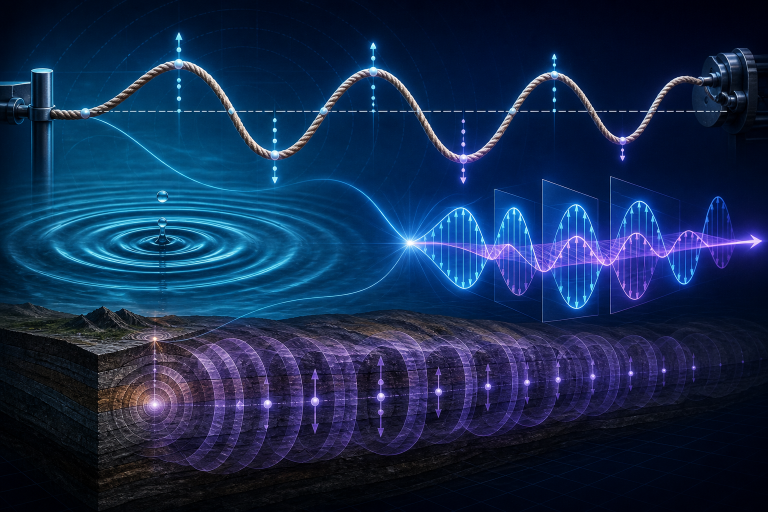
Waves are fundamental phenomena that occur across various domains, from the undulating motion of the ocean to the invisible frequencies of electromagnetic waves. At their core, waves are disturbances that transfer energy from one point to another without the physical transport of matter. Understanding the properties and behaviors of waves is crucial in the fields of physics, engineering, and technology.
In the study of wave mechanics, three primary characteristics are crucial: wave speed, frequency, and wavelength. But how are wave speed, frequency and wavelength related? These components are interconnected through the wave equation, a powerful tool that mathematically describes their relationship. The wave equation states that the wave speed (\(v\)) is the product of the frequency (\(f\)) and the wavelength (\(\lambda\)), expressed as:
Wave Equation:
- \(v = f \times \lambda\)
These concepts are not just theoretical; they have practical implications across various applications. For example, the speed of sound waves in different media can be understood through these relationships, affecting how we design everything from concert halls to telecommunications systems.
Key Properties of Waves
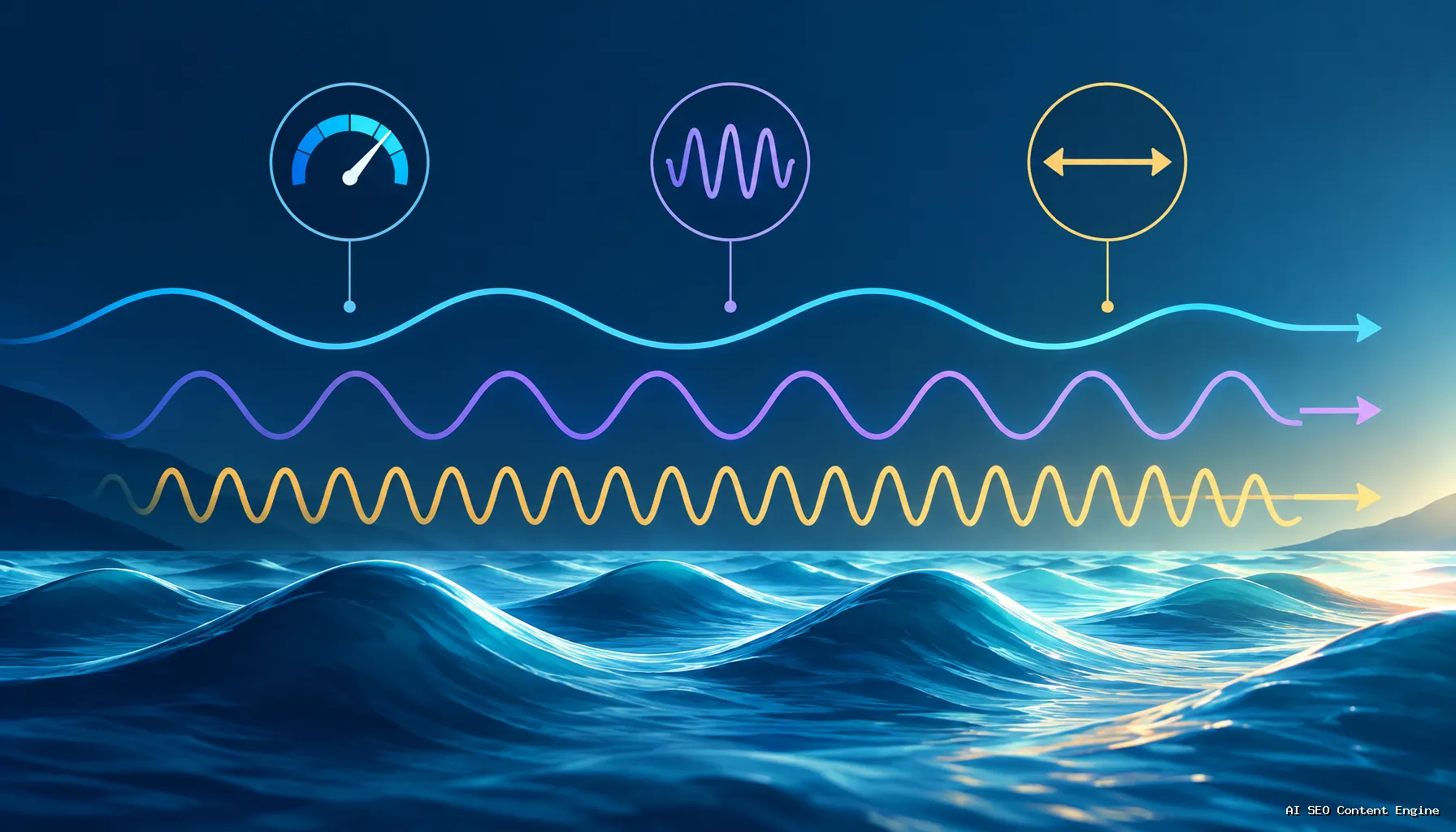
- Wave Speed: The speed at which a wave propagates through a medium. It varies depending on the type of wave and the medium through which it travels.
- Frequency: The number of times a wave oscillates per unit of time, typically measured in Hertz (Hz). Higher frequency means more oscillations per second.
- Wavelength: The distance between successive crests (or troughs) of a wave. It determines the wave’s spatial periodicity.
The interrelation between these parameters can be observed in numerous scenarios. For instance, in the realm of electromagnetic waves, light waves demonstrate how changes in frequency can affect wavelength and vice versa, impacting the entire electromagnetic spectrum.
For those interested in exploring related topics such as the physics of energy transfer, our article on Nuclear Fission vs Fusion: Understanding E = mc², Binding Energy, and Their Mechanisms provides insight into how these concepts are applied in energy production.
In summary, understanding how wave speed, frequency, and wavelength are related is essential for grasping the broader principles of wave behavior and their applications in real-world scenarios. This fundamental knowledge is a stepping stone to exploring more complex wave phenomena and their technological implications.
How Are Wave Speed, Frequency and Wavelength Related: Defining Wave Speed, Frequency, and Wavelength
To comprehend the intricate relationship between wave speed, frequency, and wavelength, it is essential to define each term with precision, as these are fundamental concepts in the physics of waves. Their interdependence is not only a cornerstone of wave theory but also pivotal in understanding the behavior of waves across different media, from the speed of sound waves to electromagnetic waves.
Wave Speed
The wave speed refers to the rate at which a wave propagates through a medium. It is the distance traveled by a wave per unit of time and is typically measured in meters per second (m/s). The wave speed is determined by the medium’s properties and remains constant for a given medium under consistent conditions. For example, the speed of sound waves is approximately 343 m/s in air at room temperature.
Frequency
Frequency is defined as the number of wave cycles that pass a fixed point in one second. It is measured in hertz (Hz), where one hertz equates to one cycle per second. Frequency determines how often the wave oscillates and is a critical factor in the wave equation, which mathematically intertwines these wave properties.
Wavelength
Wavelength is the spatial period of a wave—the distance over which the wave’s shape repeats. It is the distance between consecutive crests or troughs and is typically measured in meters. Wavelength is inversely related to frequency; as the frequency of a wave increases, its wavelength decreases, assuming the wave speed remains unchanged.
Interrelation: How Are Wave Speed, Frequency and Wavelength Related?
The relationship between these parameters is elegantly expressed in the wave equation:
- **Wave Speed (v) = Frequency (f) × Wavelength (λ)**
This fundamental equation highlights how the three aspects are interconnected. If the frequency increases while the wave speed remains constant, the wavelength must decrease, and vice versa. This dynamic is crucial in understanding various phenomena, such as the behavior of electromagnetic waves across the spectrum.
Understanding these relationships not only aids in the theoretical comprehension of wave phenomena but also has practical implications. For instance, the design of musical instruments relies on manipulating these properties to produce desired sounds, while telecommunications depend on them to transmit signals effectively.
For those intrigued by the broader applications of wave dynamics, particularly in energy contexts, our article on Nuclear Fission vs Fusion provides further exploration into how these foundational concepts translate into energy production technologies.
How Are Wave Speed, Frequency and Wavelength Related? The Mathematical Relationship: Wave Equation
The wave equation is pivotal in linking the core properties of waves: speed, frequency, and wavelength. This relationship is not just a theoretical construct but a practical tool that finds applications across various fields of physics, from understanding the speed of sound waves to analyzing electromagnetic waves.
The Wave Equation Explained
At the heart of the wave equation is the basic formula:
Wave Speed (v) = Frequency (f) × Wavelength (λ)
This equation succinctly answers the question, “How Are Wave Speed, Frequency and Wavelength Related?” by illustrating that wave speed is the product of its frequency and wavelength. Let’s delve deeper into each component:
- Wave Speed (v): This is the rate at which the wave propagates through a medium. It can vary depending on the medium’s properties, such as density and elasticity, especially in mechanical waves like sound.
- Frequency (f): Measured in Hertz (Hz), frequency refers to the number of wave cycles that pass a given point per second. Higher frequency means more cycles per second.
- Wavelength (λ): This is the distance between successive crests (or troughs) of a wave. In electromagnetic waves, wavelength determines the type of radiation, from radio waves to gamma rays.
Practical Implications of the Wave Equation
Understanding the mathematical relationship between wave speed, frequency, and wavelength is essential for numerous practical applications:
- Telecommunications: Modulating frequency and wavelength allows for efficient signal transmission over various distances and through different media.
- Music and Acoustics: The design and tuning of musical instruments rely heavily on manipulating these wave properties to produce harmonious sounds.
- Scientific Research: Research into nuclear fission and fusion utilizes wave dynamics to understand energy transformations at a subatomic level.
For those exploring further into wave dynamics, particularly in their energy applications, understanding the wave equation is crucial. As one delves into the fundamental concepts of radioactive decay, for example, the interplay of these wave properties becomes even more apparent.
In conclusion, the wave equation is not just a formula but a gateway to understanding the intricate dance between wave speed, frequency, and wavelength, providing insights that resonate through both theoretical physics and practical applications.
How Are Wave Speed, Frequency and Wavelength Related? Understanding How Frequency Affects Wavelength
When exploring the question, How Are Wave Speed, Frequency and Wavelength Related?, one must delve into the intricate relationship between frequency and wavelength. These two fundamental aspects of wave dynamics are inversely proportional, meaning that as the frequency of a wave increases, its wavelength decreases, provided the wave speed remains constant. This relationship is pivotal in understanding various wave properties and is encapsulated in the wave equation:
Wave Equation: v = f × λ
- v represents the wave speed.
- f is the frequency of the wave.
- λ (lambda) denotes the wavelength.
In this equation, the speed of the wave (v) is equal to the product of its frequency (f) and its wavelength (λ). This demonstrates that an increase in frequency results in a decrease in wavelength when the speed remains unchanged, which is a key principle in the physics of waves.
Applications of Frequency-Wavelength Relationship
The interplay between frequency and wavelength has profound implications across various fields:
- Electromagnetic Waves: Higher frequency electromagnetic waves, such as gamma rays, have shorter wavelengths than lower frequency waves like radio waves. This property is crucial in telecommunications, where different frequencies are used to transmit data over vast distances.
- Speed of Sound Waves: In acoustics, understanding how frequency affects wavelength aids in designing musical instruments and enhancing sound quality, as higher frequency sounds (treble) have shorter wavelengths compared to lower frequency sounds (bass).
Visualizing the Relationship
To visualize how frequency affects wavelength, consider the surface of a pond. When you drop a stone, ripples form, creating waves. If you tap the water surface rapidly (increasing frequency), the distance between consecutive ripples (wavelength) decreases. This analogy helps in grasping the abstract concept of wave dynamics and their interdependence.
In summary, understanding How Are Wave Speed, Frequency and Wavelength Related? is crucial for anyone studying wave phenomena. The inverse relationship between frequency and wavelength not only underpins fundamental physics principles but also has practical applications, from engineering to scientific research. For those interested in related physics concepts, exploring topics like nuclear fission and fusion can provide further insights into the power of wave dynamics.
Impact of Different Mediums on Wave Speed: How Are Wave Speed, Frequency and Wavelength Related?
The speed at which a wave travels is significantly influenced by the medium through which it propagates. Understanding how are wave speed, frequency and wavelength related within different mediums is crucial for grasping the broader concepts of wave dynamics and physics.
Key Factors Influencing Wave Speed
- Density: Generally, waves travel faster in less dense mediums. For example, sound waves travel faster in air than in water because air is less dense.
- Elasticity: The more elastic the medium, the faster a wave can travel through it. Solids, being highly elastic, often allow waves to move faster compared to liquids and gases.
- Temperature: Higher temperatures typically increase the speed of sound waves in gases, as warmer air particles move faster and transmit energy more efficiently.
Wave Speed in Different Mediums
Different types of waves, including electromagnetic waves and sound waves, exhibit unique behaviors when interacting with various mediums:
- Sound Waves: In a solid medium, sound waves can travel at speeds exceeding 5000 m/s, whereas in air, they travel at approximately 343 m/s. This variance is due to the differences in molecular composition and density.
- Electromagnetic Waves: These waves, which include light, can travel through a vacuum at the speed of light—approximately 299,792 km/s. However, when passing through materials like glass or water, their speed reduces due to the refractive index of the medium.
Practical Applications and Implications
Understanding how wave speed is affected by different mediums is essential in numerous fields, from engineering to telecommunications. For instance:
- **Acoustic Engineering:** Designing auditoriums or concert halls requires precise calculations of sound wave speed to ensure optimal acoustics.
- **Telecommunications:** The transmission of signals over fiber-optic cables relies on the principles governing the speed of light in different materials to maximize efficiency.
For those interested in exploring related concepts, examining the mechanisms of nuclear fission and fusion provides further insight into the transformative power of wave dynamics in energy production.
Practical Examples: How Are Wave Speed, Frequency and Wavelength Related?
To understand how wave speed, frequency and wavelength are related, examining practical examples such as sound waves, light waves, and electromagnetic waves provides valuable insights. Each type of wave demonstrates unique characteristics that help illustrate these fundamental relationships.
Sound Waves
Sound waves are mechanical waves that travel through a medium, such as air, water, or solids. The speed of sound waves is influenced by the medium’s properties, such as temperature, density, and elasticity. For instance:
- Temperature: Sound travels faster in warmer air because the molecules move more quickly, facilitating faster wave propagation.
- Density and Elasticity: In denser materials like steel, sound waves move faster due to the closer proximity of the molecules and the material’s ability to return to its original shape after deformation.
The relationship between speed, frequency, and wavelength in sound waves is captured by the wave equation: v = fλ, where v is the wave speed, f is the frequency, and λ is the wavelength. Understanding this relationship is crucial in acoustic engineering and designing spaces with optimal sound quality.
Light Waves
Light waves are a form of electromagnetic waves, and they travel at the speed of light in a vacuum, approximately 299,792 kilometers per second. However, when light enters a medium like glass or water, its speed decreases due to the refractive index, which affects the wavelength while the frequency remains constant. This phenomenon has practical implications in:
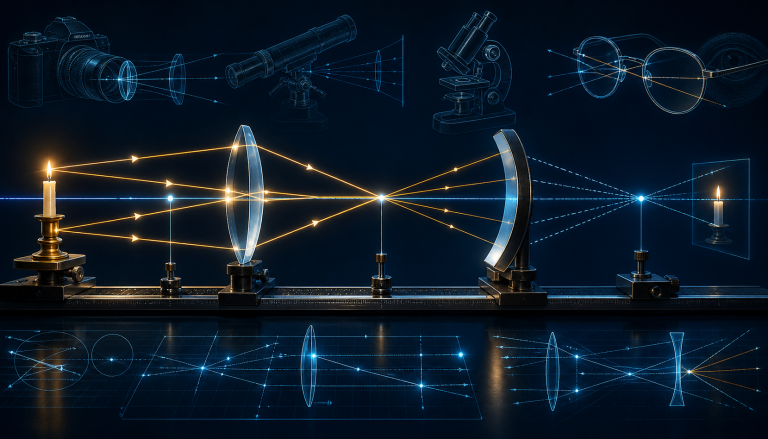
- Optics: Lenses and prisms use the principles of refraction to focus or disperse light, essential for applications like cameras and glasses.
- Telecommunications: Fiber-optic cables rely on the refraction of light to transmit data over long distances efficiently.
These applications highlight the importance of comprehending how the wave speed, frequency, and wavelength of light interact under different conditions.
Electromagnetic Waves
Electromagnetic waves, which include radio waves, microwaves, and X-rays, exhibit properties dictated by their frequency and wavelength. The physics of waves in this context can be understood through the electromagnetic spectrum, where different types of waves are classified based on their frequency and wavelength:
- Radio Waves: These have long wavelengths and low frequencies, making them ideal for communication over long distances.
- Microwaves: With shorter wavelengths, microwaves are used in radar technology and for cooking in microwave ovens.
- X-Rays: These have very short wavelengths and high frequencies, allowing them to penetrate materials, which is useful in medical imaging.
Understanding these properties is essential for fields ranging from medical imaging to wireless communication and further emphasizes the intricate relationship between wave speed, frequency, and wavelength.
For those interested in exploring related physics concepts, you might find our article on why projectile motion forms a parabola informative. It delves into the fundamental principles of motion and trajectory, providing a complementary perspective on wave dynamics.
Solving Problems Using the Wave Equation: How Are Wave Speed, Frequency and Wavelength Related?
Understanding how to solve problems using the wave equation is crucial for students and professionals working in physics and related fields. The wave equation is a fundamental concept that expresses the relationship between wave speed, frequency, and wavelength, often represented by the formula:
**Wave Speed (v) = Frequency (f) × Wavelength (λ)**
This equation is pivotal in answering the question, “How Are Wave Speed, Frequency and Wavelength Related?” Let’s break down its components and explore how each affects wave behavior:
Key Components of the Wave Equation
– **Wave Speed (v):** This is the speed at which a wave travels through a medium. It can vary based on the type of wave and the medium it is traveling through. For instance, the speed of sound waves depends on factors like temperature and the medium’s density.
– **Frequency (f):** Measured in Hertz (Hz), frequency refers to the number of wave cycles that pass a point per second. Higher frequencies mean more wave cycles are completed in a given time.
– **Wavelength (λ):** This is the distance between consecutive crests (or troughs) of a wave. It is usually measured in meters.
Applying the Wave Equation
To solve practical problems using the wave equation, follow these steps:
1. **Identify Known Values:** Determine the values given in the problem, such as frequency or wavelength, and note the units used.
2. **Determine the Unknown:** Decide whether you need to find the wave speed, frequency, or wavelength.
3. **Use the Wave Equation:** Substitute the known values into the wave equation to solve for the unknown variable.
For example, if you know the frequency of an electromagnetic wave is 500 Hz and its wavelength is 600 meters, you can calculate the wave speed as follows:
**v = 500 Hz × 600 m = 300,000 m/s**
Practical Applications
The wave equation is not just a theoretical tool; it has practical applications across various fields:
– **Electromagnetic Waves:** Understanding wave properties is essential for designing communication systems, including radios and cell phones.
– **Medical Imaging:** Techniques like ultrasound rely on precise calculations of wave speed to generate images of internal body structures.
For more insights into the physics of waves and their applications, you might find our article on Nuclear Fission vs Fusion enlightening, as it explores energy transformations in a different context.
By mastering the wave equation, you can better understand the underlying principles that govern the behavior of waves in various media, enhancing both theoretical knowledge and practical skills in the physics of waves.
Conclusion
Understanding the relationship between wave speed, frequency, and wavelength is crucial for comprehending various phenomena in physics and engineering. These three properties are intricately linked through the wave equation, which states that wave speed is the product of frequency and wavelength. By manipulating one of these properties, you inevitably affect the others. Whether you are exploring sound waves, light waves, or any other type of wave, grasping these concepts is essential for predicting wave behavior and applying this knowledge in practical scenarios.
Frequently Asked Questions
What is the relationship between frequency and wavelength?
Frequency and wavelength are inversely related. This means that as the frequency of a wave increases, its wavelength decreases, and vice versa. This relationship is described by the wave equation: wave speed = frequency × wavelength. Thus, for a constant wave speed, an increase in frequency results in a shorter wavelength.
Is wavelength proportional to speed?
Wavelength is directly proportional to wave speed when the frequency is constant. This means that if the speed of a wave increases while its frequency remains unchanged, the wavelength will also increase. The relationship is expressed by the equation: wave speed = frequency × wavelength.
Does higher wavelength mean faster speed?
Not necessarily. A higher wavelength does not automatically mean a faster speed. Wave speed is determined by the medium through which the wave travels and is the product of frequency and wavelength. Therefore, a higher wavelength could be a result of a lower frequency rather than an increase in speed.
Are wavelength and frequency directly related?
Wavelength and frequency are not directly related; they are inversely related. As one increases, the other decreases, provided the wave speed remains constant. This inverse relationship is a fundamental aspect of wave behavior and is key to understanding wave dynamics across different media.