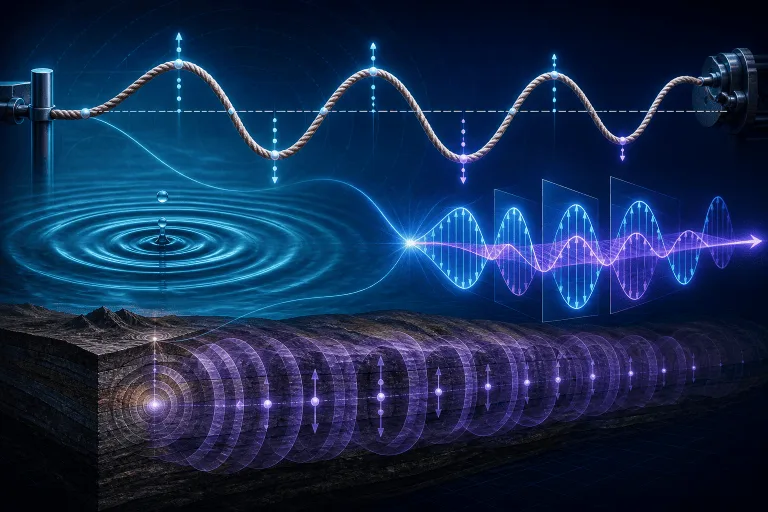

Superposition of Waves: Phase Difference, Interference and Beats Explained
Stand in front of two loudspeakers playing exactly the same tone and something strange happens. In some spots the sound is loud, yet a few steps to the side it almost disappears, even though both speakers are still playing. A guitar player meets a second puzzle: pluck a string that is slightly out of tune next to a tuning fork and the sound throbs in a slow pulse instead of staying steady.
Both effects come from one simple rule, the superposition of waves: when two or more waves meet, their displacements simply add together. That single idea explains loud and quiet spots, the silence inside noise-cancelling headphones, and the throbbing of beats. In this article you will learn the superposition rule, the resultant amplitude formula, the conditions for constructive and destructive interference in terms of both phase difference and path difference, the two phase difference formulas, and the beat frequency formula.
What Is the Principle of Superposition of Waves?
The principle of superposition states that when two or more waves meet at a point in a medium at the same time, the resultant displacement at that point equals the sum of the displacements each wave would produce on its own at that instant:
y = y1 + y2
Displacements are signed quantities, and the signs matter. A displacement is a shift from the rest position of the medium. A crest — the highest point of a wave — counts as a positive displacement, and a trough — the lowest point — counts as a negative displacement. So a crest of +3 cm meeting a crest of +4 cm gives +7 cm, a bigger crest; but a crest of +3 cm meeting a trough of −4 cm gives +3 + (−4) = −1 cm, a small trough.
Two conditions must hold. The waves must overlap — passing through the same part of the same medium at the same time. And, surprisingly, the waves do not change each other: after passing through one another, each wave continues exactly as if the other had never been there. Two ripples crossing on a pond emerge completely unchanged; only while they overlap does their combined shape look different. Superposition adds displacements, temporarily and locally — it does not add amplitudes in general.
Adding Two Waves: Resultant Displacement and Resultant Amplitude
The basic method is point-by-point addition: at any point, add the displacement of the first wave to the displacement of the second, keeping the signs. Exam questions, however, usually ask for the amplitude of the combined wave when two waves of the same frequency travel in the same direction, shifted relative to each other by a fixed phase difference Δφ (explained fully below). If their amplitudes are A1 and A2, the resultant amplitude is:
AR = √(A1² + A2² + 2A1A2 cos Δφ)
The cos Δφ term makes the formula cover every possible shift, not just the perfect cases. When the waves are exactly in phase (Δφ = 0), cos Δφ = 1 and AR = A1 + A2, the maximum possible resultant. When they are exactly in antiphase (Δφ = π), cos Δφ = −1 and AR = |A1 − A2|, the minimum; the vertical lines mean the positive value, since an amplitude cannot be negative. For two waves of equal amplitude A, the formula shortens to AR = 2A cos(Δφ/2).
One last result: the intensity of a wave — the energy it carries per second through each square metre — is proportional to the square of its amplitude, I ∝ A². Two equal waves combining in phase double the amplitude but give four times the intensity of one wave, not double. No energy is created: in a real interference pattern, the extra energy at loud spots is balanced by the missing energy at quiet spots.
Constructive and Destructive Interference
Interference is the pattern produced when two waves superpose. Where the waves arrive in step, they reinforce and produce a large amplitude: constructive interference. Where they arrive exactly out of step, they cancel as much as they can: destructive interference. In displacement language, constructive interference is crest meeting crest and trough meeting trough; destructive interference is crest meeting trough, one wave pushing the medium up exactly where the other pulls it down.
The conditions are stated two equivalent ways. The path difference Δx is the extra distance one wave has travelled compared with the other when they arrive at a point.
| Type | Phase difference Δφ | Path difference Δx | Resultant amplitude |
|---|---|---|---|
| Constructive | 0, 2π, 4π, … i.e. Δφ = 2nπ (even multiples of π) | 0, λ, 2λ, … i.e. Δx = nλ (whole wavelengths) | A1 + A2 (maximum) |
| Destructive | π, 3π, 5π, … i.e. Δφ = (2n + 1)π (odd multiples of π) | λ/2, 3λ/2, 5λ/2, … i.e. Δx = (n + 1/2)λ (odd half wavelengths) | |A1 − A2| (minimum) |
Here n = 0, 1, 2, 3, … and λ is the wavelength. The logic is memorable: a path difference of one whole wavelength means the second wave has fallen behind by exactly one complete cycle, so it lines up with the first wave again — constructive. Half a wavelength of path difference means its crests land on the other wave’s troughs — destructive.
One warning: complete cancellation, a resultant of exactly zero, needs two things at once — antiphase and equal amplitudes. With unequal amplitudes the bigger wave survives in reduced form, with amplitude |A1 − A2|, which is not zero.
Phase Difference Explained: How Far Through Its Cycle a Wave Is
A wave repeats the same pattern endlessly: crest, falling slope, trough, rising slope, crest again. One complete repetition is a cycle. The phase of a wave tells you how far through its cycle it is, expressed as a fraction of a complete cycle and measured in degrees or radians — one full cycle being 360° or 2π radians. Halfway through a cycle, at the trough, the phase is 180° or π radians.
The phase difference Δφ between two waves is the difference between their phases: how far out of step they are. Waves with zero phase difference are in phase — they crest together, cross zero together and trough together. Waves with a phase difference of half a cycle, 180° or π radians, are in antiphase — one crests exactly when the other troughs, doing the opposite at every moment.
Phase difference is the decisive quantity of this topic. Put any Δφ into the resultant amplitude formula and you get the combined amplitude; check it against the conditions table and you know whether the interference is constructive, destructive, or in between.
Calculating Phase Difference From Path Difference and Time Difference
Questions rarely hand you Δφ directly. They give a path difference or a time difference Δt — the delay between two waves, such as the second starting a fraction of a second later — and you must convert. Both conversions rest on one idea: one full cycle of phase, 2π radians, corresponds to one wavelength of extra path and to one period of extra time. The period T is the time for one complete cycle.
From path difference
Δφ = (2π/λ) × Δx — a path difference of one wavelength is one full cycle of phase, so any other path difference is the same fraction of 2π. Check: Δx = λ/2 gives Δφ = π, antiphase, exactly as the table says.
From time difference
Δφ = (2π/T) × Δt — a time difference of one period is one full cycle of phase, so any other delay is the same fraction of 2π. Check: Δt = T/4 gives Δφ = π/2.
To switch units, use 2π radians = 360°: radians = degrees × (π/180) and degrees = radians × (180/π). Finally, keep the pairs matched — path difference goes with λ, time difference goes with T. Mixing them is a classic way to lose marks.
Beats: When Two Frequencies Are Almost Equal
Beats appear when two waves of slightly different frequencies travel in the same direction and overlap at the same place, typically at a listener’s ear. They start in phase, so the sound is loud. But one wave gradually gains on the other, the phase difference grows until they are in antiphase and the sound fades, then the faster wave gains a whole cycle and they are in phase again. Constructive and destructive interference alternate in time, and the loudness pulses regularly. Each loud pulse is a beat.
fbeat = |f1 − f2|
The modulus signs make the beat frequency always positive: subtract the smaller frequency from the larger. The time between beats is 1 / fbeat. The pitch actually heard is the average frequency, favg = (f1 + f2)/2 — beats are a loudness effect, not a pitch effect.
Clear beats need frequencies close but not equal (too far apart and the pulsing is too fast to follow), the waves arriving at the same point, and amplitudes not too different, otherwise the quiet part is not quiet and the beats are weak. The famous application is tuning: play a guitar string alongside a tuning fork, and if the string is slightly off you hear beats. Adjust the string and the beats slow as its frequency approaches the fork’s; when they disappear, the string is exactly in tune. Piano tuners work the same way.
Where Superposition Shows Up in Real Life
The loud and quiet spots between two loudspeakers are interference in space: at each position, the path difference from the two speakers decides whether the waves reinforce or cancel. Noise-cancelling headphones use destructive interference deliberately — a microphone samples the incoming noise and the headphones generate an inverted, antiphase copy that cancels it at your ear.
For light, the same addition gives the swirling colours on soap films and oil slicks, where waves reflected from the top and bottom surfaces of a thin layer reinforce some colours and cancel others; anti-reflective lens coatings are engineered to cancel reflections the same way. And beats — superposition in time — keep orchestras in tune.
Worked Example 1 — Resultant Amplitude From a Path Difference
Question. Two waves of the same frequency travel in the same direction through the same medium. Their wavelength is λ = 0.60 m, their amplitudes are A1 = 3.0 cm and A2 = 4.0 cm, and the second wave arrives with a path difference of Δx = 0.15 m. Find the amplitude of the resultant wave.
Step 1 — Convert path difference to phase difference. The question gives a path difference and a wavelength, so use Δφ = (2π/λ) × Δx:
Δφ = (2π / 0.60) × 0.15 = π/2 radians (90°). Slowly: 0.15/0.60 = 0.25, so the path difference is a quarter of a wavelength, and a quarter of a full cycle of phase (2π) is π/2.
Step 2 — Use the resultant amplitude formula. AR = √(A1² + A2² + 2A1A2 cos Δφ):
AR = √(3.0² + 4.0² + 2 × 3.0 × 4.0 × cos 90°) = √(9 + 16 + 0) = √25 = 5.0 cm. The last term vanishes because cos 90° = 0 — at a quarter-cycle phase difference the extra term contributes nothing, giving the neat 3-4-5 result.
Step 3 — Sanity-check against the extremes. In phase, these waves would give A1 + A2 = 3.0 + 4.0 = 7.0 cm; in antiphase they would give |A1 − A2| = |3.0 − 4.0| = 1.0 cm. Every other phase difference must land between 1.0 cm and 7.0 cm — and 5.0 cm does. An answer outside that range always means an error.
Worked Example 2 — Beat Frequency When Tuning a Guitar String
Question. A tuning fork sounds the standard A note at f1 = 440 Hz while a guitar string sounds at f2 = 444 Hz. Find the beat frequency, the time between beats, and the pitch heard, and explain what happens as the string is loosened toward the correct pitch.
Step 1 — Beat frequency. fbeat = |f1 − f2| = |440 − 444| = 4 Hz. The combined sound throbs 4 times per second, because the waves drift through a full cycle of in-phase then antiphase four times each second.
Step 2 — Time between beats and pitch heard. Time between beats = 1 / fbeat = 1 / 4 = 0.25 s. The pitch heard is the average: favg = (440 + 444)/2 = 442 Hz. So the player hears a note near 442 Hz whose loudness pulses every quarter of a second.
Step 3 — The tuning point. As the string is loosened, its frequency drops toward 440 Hz, the difference shrinks — 4 Hz, 3 Hz, 2 Hz, 1 Hz — and the beats slow down. At exactly 440 Hz the difference is zero, the phase no longer drifts, and the beats disappear into one steady note. That disappearance is the tuner’s signal that the string is perfectly in tune.
Common Mistakes
- Adding amplitudes instead of displacements. Superposition adds displacements, with signs; a trough is negative. Adding amplitudes as if all were positive fails whenever a crest meets a trough.
- Expecting complete cancellation in antiphase with unequal amplitudes. The resultant is |A1 − A2|, which is zero only for equal amplitudes. Unequal waves leave a smaller wave, not silence.
- Mixing up the condition sets. Constructive: whole wavelengths (nλ) and even multiples of π (2nπ). Destructive: odd half wavelengths ((n + 1/2)λ) and odd multiples of π ((2n + 1)π). Swapping them reverses every answer.
- Using the phase formula with the wrong quantity. Path difference pairs with λ in Δφ = (2π/λ) × Δx; time difference pairs with T in Δφ = (2π/T) × Δt. Check what the question gave you first.
- Dropping the modulus in the beat formula. fbeat = |f1 − f2|. A negative beat frequency is meaningless; the rate of pulsing is always positive.
- Thinking beats need equal frequencies. Equal frequencies give a steady resultant of constant amplitude. Beats exist precisely because the frequencies are slightly different.
- Saying interference destroys the waves. The waves are redistributed only while they overlap; afterwards each continues unchanged, as if it had travelled alone.
Conclusion
Everything here grows from one rule: when waves meet, their displacements add. The formulas to memorise are:
- Superposition: y = y1 + y2, adding displacements with their signs.
- Resultant amplitude: AR = √(A1² + A2² + 2A1A2 cos Δφ) — A1 + A2 in phase, |A1 − A2| in antiphase.
- Constructive interference: Δφ = 2nπ and Δx = nλ.
- Destructive interference: Δφ = (2n + 1)π and Δx = (n + 1/2)λ.
- Phase difference: Δφ = (2π/λ) × Δx and Δφ = (2π/T) × Δt.
- Beats: fbeat = |f1 − f2|, heard at the average frequency.
Master the superposition of waves in these forms and you hold the key to all overlapping-wave behaviour — interference is superposition seen at one place, and beats are superposition seen over time.
Frequently Asked Questions
What does the principle of superposition say about the resultant displacement when two waves meet at a point?
The resultant displacement equals the sum of the displacements each wave would produce on its own at that instant, written y = y1 + y2. Displacements are signed: a crest counts as positive and a trough as negative, so a crest meeting a trough partly cancels. The addition happens only while the waves overlap; afterwards each wave continues unchanged, exactly as if the other had never been there.
What phase difference and what path difference are needed for constructive interference between two waves?
Constructive interference needs the waves to arrive in phase, so the phase difference must be Δφ = 0, 2π, 4π, …, in general Δφ = 2nπ, an even multiple of π. Equivalently, the path difference must be a whole number of wavelengths, Δx = 0, λ, 2λ, …, in general Δx = nλ. Crest then meets crest and trough meets trough, giving the maximum resultant amplitude, A1 + A2.
How do I calculate the phase difference between two waves from their path difference using Δφ = (2π/λ) × Δx?
Multiply the path difference by 2π/λ: Δφ = (2π/λ) × Δx. One full wavelength of path difference equals one full cycle of phase, 2π radians, so any other path difference is the same fraction of 2π. For example, with λ = 0.60 m and Δx = 0.15 m, Δφ = (2π/0.60) × 0.15 = π/2 radians, or 90°. Keep the pairing right: path difference always goes with λ.
How is phase difference calculated from a time difference using Δφ = (2π/T) × Δt?
Multiply the time difference by 2π/T: Δφ = (2π/T) × Δt, where Δt is the delay between the waves and T is the period. One full period of time difference equals one full cycle of phase, 2π radians, so any shorter delay is the same fraction of 2π. For example, a delay of Δt = T/4 gives Δφ = (2π/T) × (T/4) = π/2 radians, a quarter of a cycle.
Two waves in antiphase do not cancel completely — what resultant amplitude does superposition give when the amplitudes are unequal?
The resultant amplitude is |A1 − A2|, the difference between the two amplitudes. In antiphase, cos Δφ = −1 in the resultant amplitude formula, so the smaller wave subtracts from the larger instead of adding to it. Complete cancellation, a resultant of exactly zero, happens only when the amplitudes are equal. With unequal amplitudes the bigger wave survives in reduced form, with amplitude |A1 − A2|, which is not zero.
How is beat frequency calculated with f_beat = |f1 − f2|, and why do the beats disappear when an instrument is perfectly in tune?
The beat frequency is the absolute difference between the two frequencies, f_beat = |f1 − f2|. A 440 Hz tuning fork against a 444 Hz guitar string gives f_beat = |440 − 444| = 4 Hz, so the loudness throbs 4 times per second. Beats disappear in tune because the frequency difference is then zero: the waves no longer drift in and out of phase, so the loudness stays steady with no pulsing.