Work Done by a Gas: W = pΔV, Isothermal and Adiabatic Processes Explained
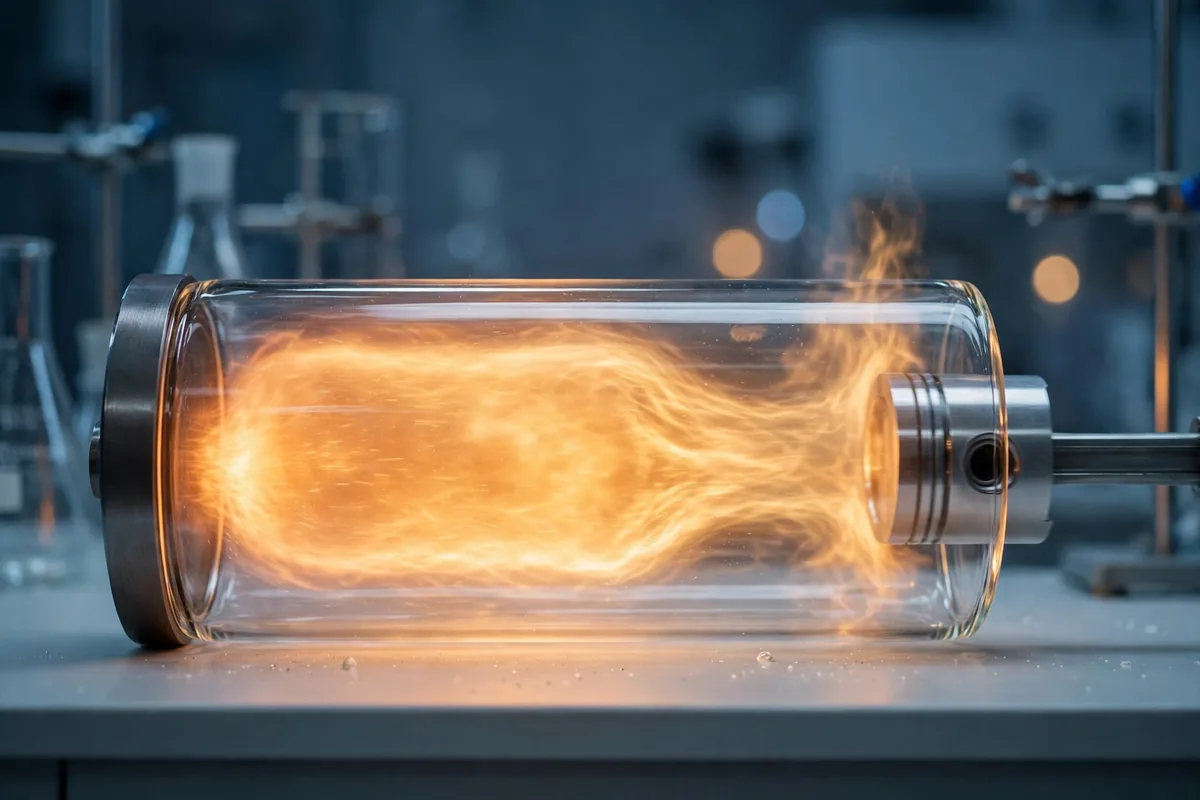
Picture a gas trapped in a cylinder with a movable piston on top. Heat the gas and it pushes the piston up. That push, a force acting through a distance, is the work done by a gas. It is the same idea as lifting a weight, only the thing doing the lifting is a crowd of fast moving molecules banging against a wall.
This article gives you the W = pΔV formula, shows how to read work off a pV diagram, and explains why the same expansion does different amounts of work when it runs at constant temperature versus with no heat flow at all. Two worked examples finish the job, one isothermal and one adiabatic, with every substitution shown.
What Is Work Done by a Gas?
Start with the plain definition of work. Work happens when a force moves something. In symbols, W = F × d, where F is the force and d is the distance moved in the direction of the force.
Push a box across a floor and you do work on the box. A gas does the same thing to a piston.
Take a cylinder of cross sectional area A, closed by a piston that slides freely. The gas inside pushes on the piston with pressure p. Pressure means force per unit area, so the force on the piston is F = pA. Now let the gas expand and shove the piston outward by a distance Δx.
The work the gas does is W = FΔx = pAΔx. But AΔx is just the change in volume, ΔV, because the piston sweeps out a volume equal to its area times the distance it travels. That gives the most used formula in this whole topic:
W = pΔV
One warning before you use it. That short formula only works when the pressure stays constant while the volume changes. Real expansions often let the pressure fall as the volume grows, and then you need the general version.
The sign convention matters, so fix it now and use it everywhere. When a gas expands, ΔV is positive, W comes out positive, and we say the gas does work on its surroundings. When a gas is compressed, ΔV is negative, W comes out negative, and that negative sign tells you work is done on the gas instead.
Some chemistry textbooks flip this sign and count work done on the system as positive. Physics texts, and this article, count work done by the gas as positive.
Pick one convention per problem and stick to it.
Units check out neatly. Pressure in pascals times volume in cubic metres gives joules: 1 Pa·m3 = 1 J. A pascal is a newton per square metre, so Pa·m3 is N·m, which is a joule.
If a problem hands you litres, convert first. One litre equals 10−3 m3.
For the general case, where pressure changes during the expansion, work becomes an integral:
W = ∫p dV
Read that as adding up a huge number of tiny strips, each one p × dV, as the volume creeps from its starting value to its final value. On a pV diagram, a graph of pressure against volume, that sum is exactly the area under the curve between the starting volume and the final volume.
This is why pV diagrams matter so much. You can see the work. A taller curve, or a wider stretch of volume, means more area and more work.
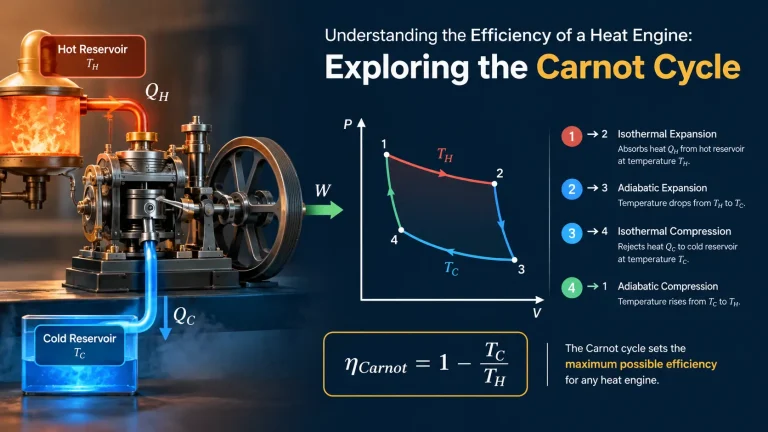
A cycle adds one more picture worth knowing. Run a gas around a closed loop on a pV diagram and it returns to its starting state, so its internal energy ends where it began. The net work is the area enclosed by the loop.
A clockwise loop does net work on the surroundings. An anticlockwise loop takes net work in. Engines live on clockwise loops.
Direction decides the sign on a pV diagram too. Travel right, toward bigger volume, and the area counts as positive work done by the gas. Travel left, toward smaller volume, and the same area counts as negative work.
The shape never changes. Only the direction does.
One more special case deserves a sentence. If the volume cannot change at all, ΔV is zero and the gas does no work, whatever the pressure does. A sealed rigid tank can heat up and build pressure, but with nowhere to expand, W = 0.
Work Done in an Isobaric Process (Constant Pressure)
An isobaric process holds the pressure constant. The word comes from Greek roots meaning same pressure. This is the one process where the short formula applies exactly as written:
W = p(V2 − V1) = pΔV
On a pV diagram the process is a horizontal line, and the work is the rectangle under it. The height is the pressure, the width is the change in volume, and the area is their product.
A gas heated in a cylinder with a free piston gives the classic example. The piston can slide, so as the gas warms and tries to expand, the piston moves out and the pressure stays put at whatever the atmosphere plus the piston weight sets. The gas takes in heat, some of it raises the temperature and the internal energy, and the rest leaves as work done pushing the piston. The first law of thermodynamics keeps the books:
ΔU = Q − W
Here ΔU is the change in internal energy, Q is the heat added to the gas, and W is the work the gas does. In an isobaric expansion, Q splits between ΔU and W. Neither one is zero, and you cannot find the work from the temperature change alone. You need the pressure and the volume change.
Work Done in an Isothermal Process (Constant Temperature)
An isothermal process holds the temperature constant. That single condition changes the bookkeeping completely, because the internal energy of an ideal gas depends only on its temperature. Hold T fixed and the internal energy cannot change:
ΔU = 0
Put that into the first law, ΔU = Q − W, and you get Q = W. Every joule of heat that flows into the gas comes straight back out as work, and the gas itself keeps none of it. Compress the gas instead and the sign flips. Work goes in, the same amount of heat flows out, and the temperature still sits still.
How does a gas expand without cooling down? Slowly, and in contact with something that can supply heat. A slow expansion in a water bath is the textbook picture. Slow wins.
The gas does work, its temperature starts to dip, and heat flows in from the bath to top it back up. Rush the expansion and the heat cannot keep up, so the gas cools and the process stops being isothermal.
The formula for isothermal work comes from the integral. For n moles of an ideal gas at temperature T, the ideal gas law gives p = nRT/V. Slot that into W = ∫p dV and integrate from V1 to V2:
W = nRT ln(V2/V1)
The symbol ln means the natural logarithm, log base e. That detail matters and trips up students every year, as the mistakes section explains. The volume ratio sits inside the log, so the units of volume cancel. Litres or cubic metres, the ratio comes out the same, which is why you can skip the litre conversion in this formula if you like.
Still, convert anyway when a question also asks for the pressure, because p = nRT/V needs SI units.
For an ideal gas at constant temperature, p1V1 = p2V2. That is Boyle’s law, and it gives you a quick way to find the final pressure once you know the volumes. If the volume doubles, the pressure halves. If the volume quadruples, the pressure drops to a quarter of its starting value.
Check the sign with the log. Expanding means V2 is bigger than V1, so the ratio tops 1, ln gives a positive number, and W comes out positive. The gas does work.
Compressing means the ratio drops below 1, ln goes negative, and W comes out negative. Work goes into the gas.
The maths and the physics agree.
Work Done in an Adiabatic Process (No Heat Exchange)
An adiabatic process exchanges no heat with its surroundings. Q = 0. The gas sits behind insulated walls, or the process runs so fast that heat has no time to flow in or out.
No heat in. No heat out.
A bicycle pump warming up in your hand is close to adiabatic. So is the air cooling inside a spray can as it rushes out.
With Q = 0, the first law ΔU = Q − W collapses to:
W = −ΔU
Now the gas pays for its own work out of its internal energy. Expand an adiabatic gas and it does work, its internal energy falls, and its temperature drops. Compress it and the reverse happens.
Work flows in, internal energy rises, and the gas warms up. That is why a diesel engine can ignite fuel with compression alone.
The air gets hot enough to light the fuel without a spark.
An adiabatic change follows its own rule on a pV diagram:
pVγ = constant
The symbol γ, gamma, is the ratio of the two specific heat capacities, γ = Cp/Cv. It is always bigger than 1. For a monatomic ideal gas, γ = 5/3, about 1.67. For a diatomic gas like air at room temperature, γ is about 1.40.
Because γ tops 1, the pressure in an adiabatic expansion falls faster than in an isothermal one, and that difference decides the comparison in the next section.
The work formula for an adiabatic process has two handy forms:
W = (p1V1 − p2V2)/(γ − 1) = nR(T1 − T2)/(γ − 1)
Use the first form when you know both pressures and both volumes. Use the second when you know the temperatures. Both give the same answer, and worked example 2 checks one against the other.
Notice the sign logic again. In an adiabatic expansion the gas cools, so T1 tops T2, the bracket stays positive, and W comes out positive. The gas does work while its temperature falls.
One point catches students out, so say it plainly. Adiabatic means no heat flows. The temperature still changes.
In an expansion it always drops. Constant temperature belongs to the isothermal process.
Isothermal vs Adiabatic Expansion: Which Does More Work?
Take the same gas, the same starting pressure, volume and temperature, and expand it to the same final volume twice. Once isothermally, once adiabatically. Which run does more work?
Draw both curves on one pV diagram, starting from the same point. The isothermal curve follows pV = constant. The adiabatic curve follows pVγ = constant, and because γ is bigger than 1, the adiabatic pressure falls faster as the volume grows. So the isothermal curve sits above the adiabatic curve all the way across.
Work is the area under the curve, and the curve with more area underneath it wins:
Wisothermal > Wadiabatic
Put simply, the isothermal process work done beats the adiabatic process work done for the same expansion.
The physics behind the picture is simple. In the isothermal run, heat flows in and keeps the gas warm, so the pressure stays high and keeps pushing hard on the piston. In the adiabatic run, no heat flows in, the gas cools as it expands, and its pressure sags. Same starting point, same final volume, less push along the way, less work done.
Add the isobaric process to the ranking and the order for the same volume change is:
Wisobaric > Wisothermal > Wadiabatic
The isobaric run holds the pressure at its full starting value for the whole expansion, so its rectangle towers over both curves. This ranking is a favourite exam question. Sketch the three curves from one starting point, compare the areas underneath them, and the ranking falls out without a single calculation. If a question asks which process does the most work, draw the picture first.
Worked Example 1: Isothermal Expansion
1.00 mol of an ideal gas at 300 K expands isothermally from 5.0 L to 20.0 L. Find the work done by the gas and the heat absorbed.
Step 1: list what you know. n = 1.00 mol, T = 300 K, V1 = 5.0 L, V2 = 20.0 L, and R = 8.31 J mol−1 K−1. Convert the volumes to cubic metres for the record: 5.0 L = 5.0 × 10⁻³ m3 and 20.0 L = 2.00 × 10⁻² m3. The formula only needs the ratio, so the units cancel here, but write the conversion down anyway.
It keeps you honest on questions that also ask for pressure.
Step 2: pick the formula. Temperature stays constant, so use W = nRT ln(V2/V1).
Step 3: put the numbers in. W = 1.00 × 8.31 × 300 × ln(20.0/5.0).
Step 4: work out the log first. 20.0/5.0 = 4.0, and ln 4.0 = 1.386. Then W = 1.00 × 8.31 × 300 × 1.386 = 3.46 × 10³ J. The gas does about 3.46 kJ of work on its surroundings.
Step 5: find the heat. The temperature never changes, so for an ideal gas ΔU = 0, and the first law gives Q = W. The gas absorbs Q = +3.46 × 10³ J of heat.
The plus sign means heat flows into the gas, which makes sense. The gas spent energy pushing the piston, and the surroundings paid it back as heat to keep the temperature steady.
Sanity check the sign. The gas expanded, so the work done by the gas should be positive. It is. If you ever get a negative answer for an expansion, stop and look for the mistake before moving on.
Worked Example 2: Adiabatic Expansion
1.00 mol of a monatomic ideal gas (γ = 5/3) at 300 K and 2.00 × 10⁵ Pa expands adiabatically until its volume doubles. Find the final pressure, the work done by the gas, the final temperature, and the change in internal energy.
Step 1: find the starting volume from the ideal gas law, p1V1 = nRT1. Rearranged, V1 = nRT1/p1 = 1.00 × 8.31 × 300 / 2.00 × 105 = 1.25 × 10⁻² m3. That is 12.5 L. The volume doubles, so V2 = 2V1 = 2.49 × 10⁻² m3.
Step 2: find the final pressure with the adiabatic rule, p1V1γ = p2V2γ. Rearranged, p2 = p1(V1/V2)γ = 2.00 × 105 × (1/2)5/3. Now (1/2)5/3 = 0.315, so p2 = 2.00 × 105 × 0.315 = 6.30 × 10⁴ Pa.
Compare that with the isothermal case. Doubling the volume isothermally would only halve the pressure to 1.00 × 10⁵ Pa. The adiabatic pressure falls further, to 6.30 × 10⁴ Pa, because the gas cools as well.
Step 3: find the work with W = (p1V1 − p2V2)/(γ − 1). First p1V1 = 2.00 × 105 × 1.25 × 10−2 = 2.49 × 10³ J. Then p2V2 = 6.30 × 104 × 2.49 × 10−2 = 1.57 × 10³ J. Subtract: 2.49 × 10³ − 1.57 × 103 = 9.23 × 10² J.
Divide by γ − 1 = 5/3 − 1 = 2/3. W = 9.23 × 10² / (2/3) = 1.38 × 10³ J. The gas does about 1.38 kJ of work.
Step 4: find the final temperature with T1V1γ−1 = T2V2γ−1. Rearranged, T2 = T1(V1/V2)γ−1 = 300 × (1/2)2/3. Now (1/2)2/3 = 0.630, so T2 = 300 × 0.630 = 189 K.
The gas cools from 300 K to 189 K, a drop of 111 K. No heat left the system. The gas spent its own internal energy on the work.
Step 5: check the internal energy change two ways. For a monatomic gas, Cv = R/(γ − 1) = 8.31/(2/3) = 12.5 J mol−1 K−1. Then ΔU = nCvΔT = 1.00 × 12.5 × (189 − 300) = −1.38 × 10³ J.
The first law for an adiabatic process says W = −ΔU, and −(−1.38 × 10³) = 1.38 × 10³ J, which matches the work from step 3. When two routes land on the same number, trust the answer.
Put the two examples side by side and the comparison section comes alive. In example 1 the gas expanded fourfold at 300 K and did 3.46 kJ of work, paid for by heat from outside. In example 2 the gas only doubled its volume and did 1.38 kJ, paid for by cooling down 111 K. Same physics, different energy source, different result.
Common Mistakes to Watch For
The same few slips show up in exam scripts year after year. Run through them before you sit a test.
Mixing up work done by the gas and work done on the gas. The sign flips with the direction. Expansion means the gas does work and W is positive. Compression means work is done on the gas and W is negative.
Write your convention at the top of the solution, then check every sign against it.
Using W = pΔV when the pressure changes along the way. That formula is an isobaric formula. If the pressure changes, the rectangle becomes a curve, and you need the integral, or the isothermal or adiabatic formula for that process. In a pV question, look at the shape of the path before you pick the formula.
Using log base 10 instead of the natural log in W = nRT ln(V2/V1). The formula needs ln, log base e. Log base 10 of 4 is 0.602. The natural log of 4 is 1.386.
Swap them and your answer shrinks by a factor of about 2.3.
Most calculators have both buttons, so check which one you pressed.
Assuming ΔU = 0 in any process that looks simple. That shortcut holds only for an ideal gas at constant temperature. In an adiabatic expansion the temperature falls and ΔU is negative. In an isobaric expansion the temperature rises and ΔU is positive.
The first law still applies everywhere, but you cannot delete ΔU from it without a reason.
Thinking an adiabatic process keeps the temperature constant. It keeps the heat at zero, not the temperature. The temperature changes, and in an expansion it always drops. If a question says a gas expands adiabatically and asks for the final temperature, expect a number lower than the starting one.
Mixing up which process does more work for the same expansion. For the same starting state and the same final volume, isobaric does the most, isothermal sits in the middle, and adiabatic does the least. The reason is the pressure along the way. Isobaric holds it, isothermal props it up with heat, adiabatic lets it fall.
Four Formulas to Keep
The whole topic boils down to a short list. Keep these four formulas, plus the two first law shortcuts, and you can handle most questions on the work done by a gas:
- Constant pressure: W = pΔV
- General case: W = ∫p dV, the area under the curve on a pV diagram
- Isothermal: W = nRT ln(V2/V1), with Q = W and ΔU = 0
- Adiabatic: W = (p1V1 − p2V2)/(γ − 1), with W = −ΔU and Q = 0
One last check ties it together. The first law never changes.
Spot the process. Cross out the zero term. The right formula follows.
Try one yourself before you move on. Take 2.00 mol of an ideal gas at 350 K and expand it isothermally from 10 L to 40 L. You should get about 8.06 kJ of work done by the gas, with the same amount of heat absorbed.
If your number matches, the method has landed. If it does not, work back through example 1 line by line and find the step where yours went a different way.
Frequently Asked Questions
What is the formula for work done by a gas?
The formula is W = pΔV, where p is the pressure of the gas and ΔV is its change in volume. It comes from a gas pushing a piston: the force on the piston is pressure times area, and the distance it moves times the area gives the volume change. The formula works only when the pressure stays constant during the change. Pressure in pascals times volume in cubic metres gives work in joules.
How do you calculate the work done by a gas in an isothermal process?
Use W = nRT ln(V2/V1), where n is the number of moles, R is the gas constant, T is the absolute temperature, and V1 and V2 are the starting and final volumes. Because the temperature stays constant, the internal energy of an ideal gas does not change, so the heat absorbed equals the work done, Q = W. Remember to use the natural logarithm, not log base 10, and note that the volume ratio makes the units cancel.
What is the work done by a gas in an adiabatic process?
In an adiabatic process no heat flows in or out, so Q = 0 and the first law gives W = −ΔU. The work is W = (p1V1 − p2V2)/(γ − 1), where γ is the ratio of heat capacities, equal to 5/3 for a monatomic gas. You can also use W = nR(T1 − T2)/(γ − 1) when you know the temperatures. As the gas expands it cools, spending its own internal energy on the work.
Why is the work done by a gas different in isothermal and adiabatic processes?
Because the pressure follows a different path as the volume grows. In an isothermal expansion heat flows in and keeps the temperature and pressure high, so the pV curve stays above the adiabatic curve. In an adiabatic expansion no heat flows in, so the gas cools and its pressure falls faster. Work is the area under the pV curve, so the isothermal process does more work for the same expansion.
How do you find the work done by a gas from a pV diagram?
Work is the area under the curve on a pV diagram between the starting volume and the final volume. For a constant pressure process the curve is a horizontal line and the area is a rectangle equal to pΔV. For a changing pressure use the area under the curve, which equals the integral W = ∫p dV. For a complete cycle the net work is the area enclosed by the loop.
Is the work done by a gas positive or negative when it is compressed?
It is negative. When a gas is compressed its volume decreases, so ΔV is negative and W = pΔV comes out negative. The negative sign means work is done on the gas rather than by the gas. In an isothermal compression the work done on the gas equals the heat released, while in an adiabatic compression the work done on the gas raises its internal energy and its temperature rises.