AC vs DC: RMS Voltage, Frequency and Why Mains Is Alternating
Your wall socket says 230 V. A battery says 1.5 V. Both numbers look like the same kind of fact, and they are not.
The battery holds a steady voltage in one direction. The socket voltage swings up and down fifty times a second, passing through zero on every swing, and the 230 V on the label hides a peak of about 325 V. That gap is the whole story of AC vs DC, and it explains why your phone charger has a little box on its cable while your kettle plugs straight into the wall.
This article compares the two kinds of current side by side, explains frequency and period, works through the RMS formula that turns a swinging voltage into one honest number, and finishes with the single reason the national grid chose alternating current and never went back. Every formula here is one you will meet in A level and GCSE exams, and each one comes with the numbers worked out.
AC vs DC at a Glance
Before the detail, here is the comparison in one place. Keep it in mind as you read, because every section below fills in one row of this table.
| Direct current (DC) | Alternating current (AC) | |
|---|---|---|
| Direction of flow | One constant direction | Reverses direction every half cycle |
| Waveform | A flat line at a steady value | A sine wave that swings positive and negative |
| Voltage | A single fixed number | Described by peak voltage and RMS voltage |
| Typical sources | Batteries, cells, solar panels, USB chargers | Mains sockets, generators in power stations |
| Typical uses | Phones, laptops, cars, all electronics | Home appliances, lighting, the national grid |
| Can a transformer change its voltage? | No | Yes, cheaply and efficiently |
That last row matters more than it looks. It is the reason the grid runs on AC, and you will see why near the end.
What Direct Current Actually Does
Direct current, DC, is the simple one. Charge flows in one direction only, at a steady rate, for as long as the circuit is closed. A battery pushes electrons out of its negative terminal, around the circuit, and back into its positive terminal. The flow never stops, never turns around, and never changes size unless you change the circuit.
Here is a detail that trips up students every year. Physicists talk about conventional current flowing from positive to negative, while electrons actually move from negative to positive. Both descriptions are correct, because conventional current was defined before anyone knew electrons existed.
In exam questions, use conventional current unless the question says otherwise. The maths works out the same either way, because current is defined as the rate of flow of charge, and charge is charge whichever way you draw the arrow.
DC voltage is a single fixed number. A 1.5 V cell holds its terminals 1.5 V apart. A 12 V car battery holds 12 V. Put a voltmeter across a battery and the reading sits still.
That steadiness is why every electronic device wants DC in the end. A phone processor needs a precise, unchanging voltage to switch its transistors on and off billions of times a second. A swinging voltage would corrupt every calculation.
DC comes from batteries and cells, from solar panels, and from USB chargers, which take mains AC and convert it. It powers phones, laptops, torches, electric cars, and every circuit board you own. If it has a chip in it, it runs on DC, even when it plugs into an AC socket.
What Alternating Current Actually Does
Alternating current, AC, reverses direction. In a mains circuit the current flows one way, slows to a stop, flows the other way, slows to a stop, and repeats. Plot the voltage against time and you get a sine wave, the smoothest repeating curve in physics. One full swing up and down is one cycle.
The equation for that wave is V(t) = Vpeak sin(2πft). Each symbol earns its place. V(t) is the voltage at a particular instant t. Vpeak is the highest voltage the wave reaches.
f is the frequency, the number of cycles per second. The 2πf term, usually written as ω, is the angular frequency, and it converts the ordinary frequency into the radians per second that the sine function needs. You do not need to memorise the derivation. You need to see that one equation ties the peak, the frequency, and the time together.
Power stations produce AC by rotating coils inside magnetic fields. Spin a coil in a magnetic field and the induced voltage changes sign as the coil turns, which is exactly the sine wave you see. That is the generator principle, and it is why AC is the natural output of a spinning machine.
Your home receives it through two wires, live and neutral. The live wire carries the swinging voltage. The neutral wire sits near zero volts and completes the circuit.
Twice per cycle the current passes through zero. For an instant, nothing flows at all. A lamp filament does not care, because it is far too hot to cool down in the few milliseconds between peaks.
The light looks steady to your eye, even though the current feeding it stops and restarts a hundred times a second. Your eye is simply too slow to notice, which is the same reason a film looks like smooth motion.
Frequency and Period: 50 Hz Means 20 Milliseconds
Frequency, f, is the number of cycles per second, measured in hertz (Hz). One hertz is one cycle per second. The period, T, is the time one cycle takes, measured in seconds. The two are reciprocals of each other:
T = 1 / f
UK and European mains run at 50 Hz. Plug the number in and the period falls out at once: T = 1 / 50 = 0.02 s, which is 20 milliseconds. Each complete swing of the mains sine wave takes 20 ms. US mains run at 60 Hz, so the period there is T = 1 / 60 = 0.0167 s, or 16.7 ms.
At 50 Hz the current reverses direction 100 times per second, because each cycle contains two reversals. That number surprises students, and it is a favourite exam trap. The frequency is 50, but the reversals are 100. Keep them apart.
Angular frequency, ω, is the same idea measured in radians per second instead of cycles per second. One cycle is 2π radians, so ω = 2πf. For UK mains, ω = 2π × 50 = 314 rad/s.
You meet ω in the sine wave equation, V(t) = Vpeak sin(ωt), where it plays the same role as 2πf. Use whichever form the question gives you.
You can hear and see the frequency if you know where to look. Mains hum, the low buzz from a transformer or a cheap speaker, sits at 50 Hz, with a stronger component at 100 Hz. Some LED bulbs flicker at 100 Hz, twice per mains cycle, and a few people can see it out of the corner of their eye.
Slow motion phone footage of a light sometimes shows dark bands rolling across the frame. That is the camera shutter catching different parts of the 50 Hz cycle.
Why 230 V Is Not the Peak: RMS Voltage
This is the section the whole article exists for, so take it slowly. The socket says 230 V. The sine wave peaks at about 325 V. Both numbers describe the same supply, and the link between them is the RMS value.
Start with the peak. Peak voltage, Vpeak, is the maximum voltage the wave reaches, the top of the sine curve. Peak to peak voltage is the distance from the highest point to the lowest point, which is twice the peak.
For UK mains, peak to peak is about 650 V. Insulation, plugs, and components must survive the peak, not the number on the label, which is why the peak matters in practice.
Now ask for the average voltage over one full cycle. The answer is zero. The positive half of the wave cancels the negative half exactly. An average of zero tells you nothing useful, and it certainly does not tell you how hot a heater gets.
RMS voltage fixes that. RMS stands for root mean square. Take the voltage, square it, find the mean of the squared values over a cycle, then take the square root. Squaring removes the sign problem, because a negative voltage squared is positive, and the square of a voltage is tied to the power it delivers.
The result is the DC equivalent value: the steady DC voltage that would deliver exactly the same heating power to a resistor as the AC supply does. That is the definition worth memorising. RMS voltage is the DC voltage that heats the same.
For a pure sine wave, the RMS value has a beautifully simple form:
Vrms = Vpeak / √2
Since 1 / √2 is about 0.707, the RMS voltage is roughly 71 percent of the peak. The same rule applies to current:
Irms = Ipeak / √2
So when a socket says 230 V, it means 230 V RMS. The peak is 230 × √2, about 325 V, as the worked example below shows. When US mains says 120 V, that is 120 V RMS, with a peak of about 170 V.
Meters and oscilloscopes disagree about voltage because they measure different things. A multimeter on its AC range reads RMS, the useful number. An oscilloscope draws the wave and shows you the peak.
Neither instrument is wrong. Students who mix them up get answers that are wrong by a factor of √2, which is the most common numerical slip in this topic.
One warning belongs here. The √2 factor holds only for a pure sine wave. Mains electricity is close enough to a sine wave for the rule to work, but a square wave or a distorted waveform has a different RMS value. Exam questions will tell you when the wave is sinusoidal, and if they do not say so, assume it is.
Worked Example 1: Peak Voltage of UK Mains
UK mains electricity is quoted as 230 V RMS. Find the peak voltage, the lowest voltage the supply reaches, and the peak to peak voltage.
Step 1. Write down what you know. Vrms = 230 V. The wave is sinusoidal, so Vrms = Vpeak / √2.
Step 2. Rearrange the formula to make Vpeak the subject. Multiply both sides by √2: Vpeak = Vrms × √2.
Step 3. Put the numbers in. √2 is 1.414, so Vpeak = 230 × 1.414 = 325.2 V, which rounds to about 325 V.
Step 4. Read the answer off the wave. The supply swings between +325 V and −325 V. The peak to peak voltage is twice the peak, 2 × 325 = 650 V.
The exam point is the last line, not the arithmetic. Insulation and components must withstand 325 V, not 230 V. A student who designs for 230 V has designed for the wrong number, and the question will punish exactly that. Whenever a question quotes a mains voltage, check first whether it is RMS or peak, because the whole calculation changes with the answer.
Worked Example 2: Average Power in an AC Circuit
A 230 V RMS mains supply powers a heater with resistance 53 Ω. Find the RMS current, the average power, and the peak current.
Step 1. Write down what you know. Vrms = 230 V, R = 53 Ω. For RMS values, Ohm’s law works exactly as it does for DC: V = IR.
Step 2. Find the RMS current. Irms = Vrms / R = 230 / 53 = 4.34 A, which rounds to about 4.3 A.
Step 3. Find the average power. For AC circuits, use RMS values in the power formula: P = Vrms × Irms = 230 × 4.34 = 998 W, which is about 1,000 W.
As a check, P = Vrms² / R = 230² / 53 = 52,900 / 53 = 998 W. The two routes agree, as they should.
Step 4. Find the peak current. Ipeak = Irms × √2 = 4.34 × 1.414 = 6.14 A, about 6.1 A.
Step 5. Notice what the answer means. A steady 230 V DC supply driving the same 53 Ω heater would deliver the same 1,000 W.
That is exactly what RMS means: the AC supply and the equivalent DC supply heat the heater identically. The current still peaks at 6.1 A and still passes through zero twice per cycle, but the average heating effect is the same as a constant 4.3 A.
Power in an AC circuit is always an average over a cycle, because the instantaneous power rises and falls with the wave. When a question asks for power in an AC circuit without saying otherwise, it wants the average power, and RMS values are the way to get it.
Why the Whole Grid Runs on AC
The grid runs on AC for one reason: transformers. A transformer changes voltage by electromagnetic induction, and induction needs a changing magnetic field. A steady DC current makes a steady magnetic field, and a steady field induces nothing.
Only AC, with its endlessly changing current, can be stepped up and down by a transformer. Transformers are covered in detail in the transformer article on this site, and the point that matters here is simple: no changing current, no transformer.
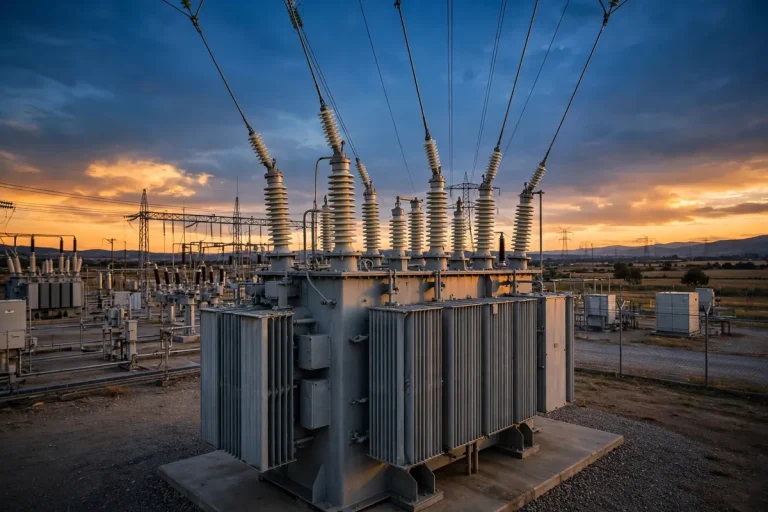
That single fact shapes the whole power system. Power stations generate electricity, and transformers step it up to hundreds of kilovolts for transmission across the country.
High voltage means low current for the same power, because P = V × I. Low current means low heating losses in the cables, because the power lost as heat is P = I²R, and current is squared. Halve the current and the losses fall to a quarter. That is why transmission lines run at such extreme voltages: the cables stay cool and the energy arrives instead of warming the countryside.
Near your home, local transformers step the voltage back down to 230 V, a level that is safe enough for household use and low enough for ordinary appliances. The supply is AC all the way, from generator to socket, because every step of it depends on transformers.
There was once a genuine fight about this. In the late 1800s, Edison backed DC and Westinghouse, with Tesla, backed AC. Edison’s DC system could not step voltage up for transmission, so his power stations had to sit close to their customers and his cables lost energy as heat.
AC won because transformers made long distance transmission cheap. The war of currents ended with AC everywhere, and it has stayed that way for over a century.
DC still has its place, and it is inside your devices. Every phone, laptop, and television runs on DC, so chargers and adapters contain a rectifier, a circuit that converts AC to DC. The little box on a laptop cable holds a transformer and a rectifier together: step the voltage down, then flip the negative halves of the wave positive, then smooth the result into steady DC.
Your house runs on AC. Your electronics run on DC. The adapter is the translator between them.
Common Mistakes to Avoid
These are the slips examiners set traps for, and they all come from the same place: treating an AC number as if it were a DC number.
- Confusing RMS voltage with peak voltage. 230 V is the RMS value, not the peak. The peak is about 325 V.
- Saying the average AC voltage is 230 V. The average over a full cycle is zero, because the two halves cancel. 230 V is the RMS value.
- Using P = V × I with peak values instead of RMS values. Peak voltage times peak current gives twice the average power, which is wrong by a factor of two.
- Mixing up frequency and period. Frequency is f = 1 / T, not T = f. At 50 Hz the period is 20 ms, not 50 ms.
- Thinking AC is stronger than DC rather than just a different way of delivering the same power. A 230 V RMS AC supply heats a resistor exactly like a steady 230 V DC supply.
- Assuming mains is 230 V everywhere. US mains is 120 V RMS at 60 Hz, with a peak of about 170 V, so always check the country before you calculate.
The Formulas Worth Remembering
Five formulas carry this whole topic, and the AC vs DC comparison falls out of them. The sine wave is V(t) = Vpeak sin(2πft). Frequency and period are linked by T = 1 / f, and angular frequency is ω = 2πf. RMS values come from Vrms = Vpeak / √2 and Irms = Ipeak / √2, and average power follows from P = Vrms × Irms, which is the same as P = Vrms² / R.
Mains is AC because transformers only work with changing current, and transformers are what make high voltage transmission efficient. RMS is the number that lets AC and DC be compared fairly, because it is the DC voltage that would heat the same resistor by the same amount. Learn the five formulas, remember that 230 V means RMS, and the rest of the topic is arithmetic.
Frequently Asked Questions
What is the difference between AC and DC current?
Direct current flows in one constant direction at a steady value, like the current from a battery. Alternating current reverses direction repeatedly, following a sine wave, like the current from a mains socket. DC voltage is a single fixed number, while AC voltage is described by peak voltage and RMS voltage. The key practical difference is that only AC voltage can be changed by a transformer, which is why the grid uses AC and electronic devices use DC.
What is RMS voltage, and why is mains electricity quoted as 230 V RMS?
RMS voltage stands for root mean square voltage, and it is the DC equivalent value of an AC supply. It is the steady DC voltage that would deliver exactly the same heating power to a resistor as the AC supply does. UK mains is quoted as 230 V RMS because that single number tells you the heating effect directly. The sine wave peaks at about 325 V, so 230 V describes the power delivered rather than the highest voltage reached.
How do you calculate RMS voltage from peak voltage using Vrms = Vpeak / √2?
Divide the peak voltage by the square root of 2, which is about 1.414. For UK mains, the calculation is Vrms = 325 / √2, giving about 230 V. You can also rearrange the formula to find the peak from the RMS value by multiplying instead: Vpeak = Vrms × √2, so 230 × 1.414 gives a peak of about 325 V. Remember that this simple factor of √2 applies only to a pure sine wave.
What is the frequency of mains electricity, and what is its period T = 1/f?
UK and European mains electricity runs at 50 Hz, which means 50 cycles every second. Its period is T = 1 / f = 1 / 50 = 0.02 seconds, or 20 milliseconds. In the US, mains runs at 60 Hz, giving a period of about 16.7 milliseconds. Because each cycle contains two direction reversals, the current in a UK socket reverses 100 times every second.
Why is mains electricity AC instead of DC?
Mains electricity is AC because transformers only work with changing current. A transformer steps voltage up and down by electromagnetic induction, which needs a changing magnetic field that steady DC cannot provide. Power stations step voltage up to hundreds of kilovolts for transmission, so the current stays low and I²R heating losses in the cables stay small. Local transformers then step it back down to 230 V for homes.
How do you calculate average power in an AC circuit using P = Vrms × Irms?
Multiply the RMS voltage by the RMS current. For a 230 V RMS supply driving a 53 Ω heater, the RMS current is Irms = 230 / 53, about 4.3 A, so the average power is P = 230 × 4.3, about 1,000 W. You can also use P = Vrms² / R, which gives the same answer. Always use RMS values in this formula, never peak values, because peak values would give twice the true average power.