What Is the Compton Effect? Photon Momentum and X-Ray Scattering Explained
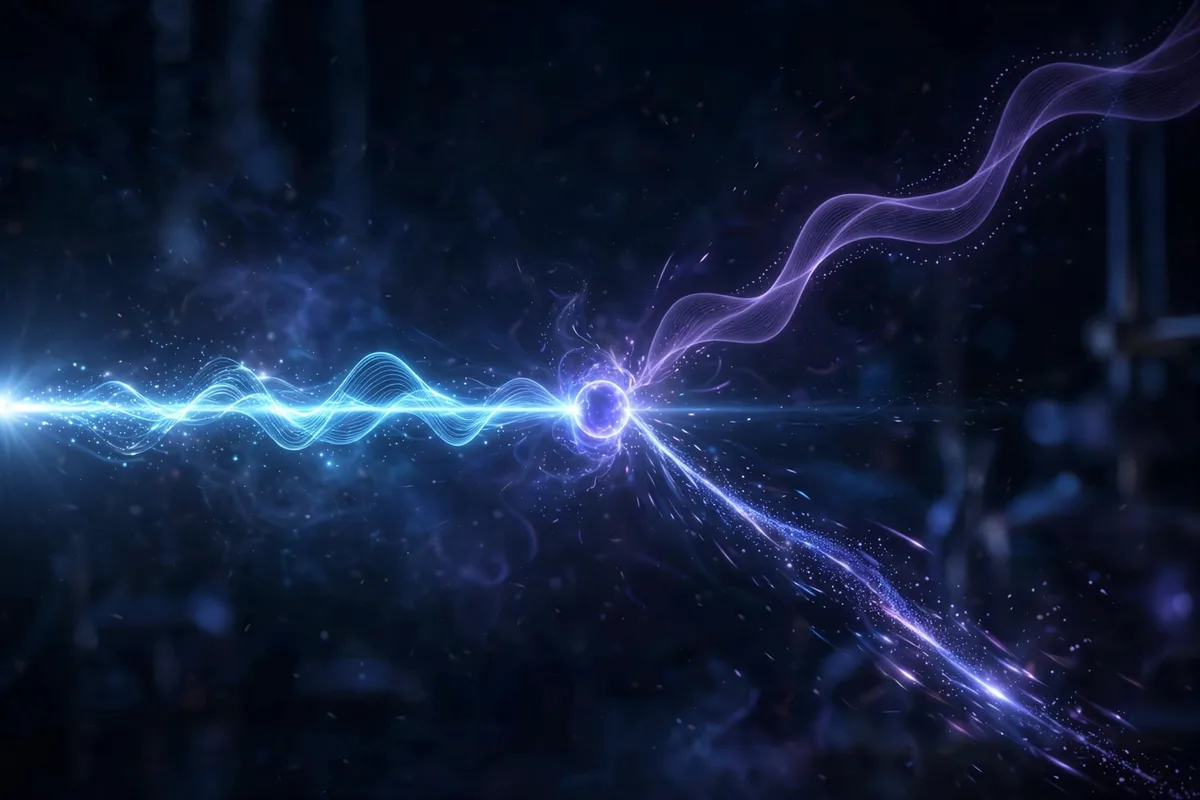
The Compton effect is what happens when an X-ray photon bounces off a loosely bound electron and comes away with a longer wavelength than it had going in. The photon loses a little energy to the electron, so its wavelength grows, and the size of that growth depends on the angle at which it scatters. Arthur Compton measured this in 1923, and the result settled a question that had split physics for decades: light behaves like a stream of particles that carry momentum, not only energy.
That last point is the heart of the whole topic. The photoelectric effect had already shown that light delivers energy in packets. Compton showed that those packets also push. A photon can knock an electron sideways, and the two fly apart obeying the same conservation laws as two billiard balls. This article walks through the failed classical prediction, the momentum of a photon, the wavelength shift formula, two worked examples, and the mistakes students make most often on exam day.
Wave Theory Said the Wavelength Should Stay Put
Before Compton, the standard picture of light was a wave. When a wave scatters off something, it should keep its wavelength. Think of water ripples hitting a post. The ripples on the far side have the same spacing as the ripples coming in.
Classical electromagnetic theory said the same about light hitting an electron. The electron would shake back and forth in the incoming wave and reradiate light at exactly the same frequency. Same frequency means same wavelength. The scattered light should look identical to the incoming light, just travelling in a new direction.
Compton tested that prediction with X-rays and a graphite target. Graphite is mostly carbon, and its outer electrons are loosely bound, so they behave almost like free electrons. He aimed a beam of X-rays of a known wavelength at the graphite and measured the wavelength of the X-rays coming out at different angles. The setup sounds simple, and the result was not.
The scattered X-rays always came back with a longer wavelength than the incoming beam. Worse for the wave picture, the extra length grew with the scattering angle. X-rays scattered straight ahead barely changed at all. X-rays scattered sideways changed by a measurable amount.
X-rays that bounced straight back changed the most. No version of wave theory could explain that pattern. A wave has no way to lose a bit of its wavelength in a collision and lose more when the angle is bigger. The effect was small, a few picometres (pm), but it was real, repeatable, and angle dependent.
This was a genuine crisis. The wave theory of light had explained interference, diffraction and polarisation beautifully. Yet here was a clean experiment it could not touch. Compton’s result pointed in one direction only. Light had to be treated as particles in this experiment, and those particles had to obey the conservation of energy and momentum in a collision.
Photons Carry Momentum Too
A photon has no rest mass. That fact trips up a lot of students, because in everyday physics momentum belongs to things with mass. A moving car has momentum because it has mass and speed. A photon has no mass at all, so how can it push an electron?
The answer comes from special relativity. The full energy momentum relation for any particle is E squared equals (pc) squared plus (m0 c squared) squared, where E is total energy, p is momentum, c is the speed of light, and m0 is rest mass. For a photon, m0 is zero, so the second term vanishes and the relation collapses to E equals pc. Rearranged, that gives p equals E over c. A massless particle can carry momentum as long as it carries energy.
Planck’s relation connects a photon’s energy to its frequency: E equals hf, where h is Planck’s constant and f is frequency. Since frequency and wavelength are linked by f equals c over lambda, the energy becomes E equals hc over lambda. Put that into p equals E over c and the c cancels. The result is the photon momentum formula:
p = h/λ
That one line carries a lot of physics. Momentum is inversely proportional to wavelength. A short wavelength photon carries a bigger punch than a long wavelength photon of the same kind. An X-ray photon, with a wavelength around a tenth of a nanometre, carries far more momentum than a visible light photon, which is why Compton needed X-rays to see the effect. A radio wave photon carries so little momentum that its kick is far below anything a detector could notice.
The photoelectric effect and the Compton effect are the two halves of the particle evidence for light. The photoelectric effect shows that photons carry energy: a photon is absorbed, an electron is ejected, and there is a threshold frequency below which nothing happens. The Compton effect shows that photons carry momentum: a photon scatters, an electron recoils, and the wavelength shift depends on the scattering angle. Energy alone was never enough. Compton supplied the momentum half, and together the two experiments made the particle picture impossible to dismiss.
The Compton Wavelength Shift Formula
Compton explained his result by treating the event as a collision between a photon and a free electron at rest. Two conservation laws do all the work. Conservation of energy says the incoming photon energy equals the scattered photon energy plus the kinetic energy of the recoiling electron.
Conservation of momentum says the same for momentum, treated as a vector, so the directions matter. The electron starts at rest, the photon comes in along one line, and after the collision the photon leaves at angle theta while the electron recoils at some other angle.
Working through the algebra with relativistic energy and momentum gives a strikingly simple result. The change in wavelength, called the Compton shift, is:
Δλ = λ′ − λ = (h/mₑc)(1 − cosθ)
Here λ is the incoming wavelength, λ′ is the scattered wavelength, θ is the scattering angle measured from the direction of the incoming beam, mₑ is the mass of the electron, and h is Planck’s constant. The quantity h over mₑc is called the Compton wavelength of the electron. Its value is:
h/mₑc = 2.43 × 10⁻¹² m = 2.43 pm
That number is a constant of nature for the electron. It does not depend on the X-ray source, the target material, or the intensity of the beam. Every Compton scattering event with an electron uses the same 2.43 pm scale. Only the angle changes the shift.
Three features of the formula deserve attention. First, the shift depends only on the scattering angle and the electron mass. It does not depend on the incoming wavelength. A 0.05 nm X-ray and a 0.20 nm X-ray scattered at the same angle gain exactly the same extra wavelength.
Second, forward scattering at 0 degrees gives no shift at all, because cos 0 degrees equals 1 and the bracket becomes zero. Third, the biggest shift happens at 180 degrees, straight backscatter, where cos 180 degrees equals minus 1 and the bracket becomes 2. The maximum shift is therefore 2 times 2.43 pm, or 4.86 pm.
The table below shows the shift at a few angles. Notice how the numbers grow slowly at first and then faster as the angle opens up.
| Scattering angle θ | 1 − cosθ | Shift Δλ |
|---|---|---|
| 0 degrees | 0 | 0 pm |
| 30 degrees | 0.134 | 0.33 pm |
| 60 degrees | 0.500 | 1.21 pm |
| 90 degrees | 1.000 | 2.43 pm |
| 180 degrees | 2.000 | 4.86 pm |
The 90 degree case is the one exam papers love most. Cos 90 degrees is zero, so the bracket equals 1 and the shift is exactly one Compton wavelength, 2.43 pm. If you remember nothing else about the numbers, remember that. A right angle scatter adds 2.43 pm to the wavelength, whatever the incoming wavelength was.
One more point matters before the examples. The formula assumes the electron is free and initially at rest. In Compton’s graphite target the outer electrons are bound, but their binding energy is only a few electronvolts while the X-ray photon carries thousands of electronvolts. The binding energy is negligible by comparison, so treating the electron as free is a good approximation. If the photon energy were comparable to the binding energy, the simple formula would not apply.
Worked Example 1: Scattered Wavelength at 90 Degrees
An X-ray photon of wavelength 0.0710 nm is scattered through 90 degrees by a free electron at rest. Find the scattered wavelength.
Step 1: Write down what you know. The incident wavelength λ is 0.0710 nm. The scattering angle θ is 90 degrees. The Compton wavelength h over mₑc is 2.43 pm.
Step 2: Find the shift. At 90 degrees, cos 90 degrees equals 0, so 1 minus cosθ equals 1. The shift is therefore Δλ equals 2.43 pm times 1, which is 2.43 pm.
Step 3: Match the units. The incident wavelength is in nanometres and the shift is in picometres. Convert 0.0710 nm into picometres. One nanometre is 1000 pm, so 0.0710 nm equals 71.0 pm.
Step 4: Add the shift to the incident wavelength. The scattered wavelength λ′ equals λ plus Δλ, which is 71.0 pm plus 2.43 pm, giving 73.4 pm.
Step 5: Convert back to nanometres. 73.4 pm equals 0.0734 nm.
Answer: the scattered wavelength is 0.0734 nm.
Check the answer makes sense. The scattered wavelength is longer than the incident wavelength, which is exactly what the Compton effect predicts. The photon lost energy to the electron, so its wavelength grew. The change is about 3.4 percent of the original wavelength, small but well within the reach of an X-ray spectrometer. If your answer had come out shorter than 0.0710 nm, you would know immediately that something went wrong.
Worked Example 2: Scattered Photon Energy and Recoil Electron Energy
An X-ray of wavelength 0.100 nm scatters at 90 degrees. Find (a) the wavelength shift, (b) the scattered photon energy, and (c) the kinetic energy of the recoiling electron.
Step 1: Find the shift. At 90 degrees the shift is one Compton wavelength, so Δλ equals 2.43 pm. Convert that to nanometres: 2.43 pm equals 0.00243 nm.
Step 2: Find the scattered wavelength. Add the shift to the incident wavelength: λ′ equals 0.100 nm plus 0.00243 nm, which is 0.10243 nm.
Step 3: Find the incident photon energy. Use E equals hc over λ. The shortcut hc equals 1240 eV nm makes this quick. E equals 1240 divided by 0.100, which is 12,400 eV. That is the energy the photon brings into the collision.
Step 4: Find the scattered photon energy. Use the same shortcut with the longer wavelength: E′ equals 1240 divided by 0.10243, which is about 12,106 eV. The photon kept most of its energy. It lost only a small fraction.
Step 5: Find the recoil electron kinetic energy. Energy is conserved, so the electron’s kinetic energy K equals the energy the photon lost: K equals E minus E′, which is 12,400 eV minus 12,106 eV, giving about 294 eV.
Answers: (a) the wavelength shift is 2.43 pm, (b) the scattered photon energy is about 12,106 eV, (c) the recoil electron kinetic energy is about 294 eV.
Two things are worth noticing. First, the electron walks away with only 294 eV out of 12,400 eV, barely more than 2 percent. The photon is far heavier in energy terms than the kick it delivers at a right angle.
Second, the fractional energy loss is small even though the wavelength shift is easy to measure. That is why Compton needed precise X-ray spectroscopy rather than a crude energy measurement. The wavelength told the story far more clearly than the energy did.
A useful exam shortcut falls out of this example. At 90 degrees, always start with a shift of 2.43 pm and add it to the incident wavelength before you touch any energy calculation. Students who jump straight to energies often forget the wavelength changed at all. And keep hc equals 1240 eV nm in your memory. It turns every photon energy calculation into one division.
Compton Effect vs Photoelectric Effect
Students mix these two up because both involve photons hitting electrons and both support the particle nature of light. They are different experiments with different outcomes, and examiners love asking for the distinction.
In the photoelectric effect, a photon is absorbed completely by an electron in a metal surface. The electron escapes with kinetic energy equal to the photon energy minus the work function of the metal. There is a threshold frequency.
Below it, no electrons come out, no matter how bright the light is. The photon disappears. The key quantity is energy.
In the Compton effect, a photon is not absorbed. It scatters off a free electron, loses part of its energy, and carries on with a longer wavelength. The electron recoils.
There is no threshold frequency and no work function. The key quantities are momentum and scattering angle. The photon survives the collision, just weaker than before.
The two effects also rule out different classical ideas. The photoelectric effect rules out the wave idea that a dim light should eventually eject electrons if you wait long enough. It does not, because energy arrives in packets and one packet below the threshold cannot do the job.
The Compton effect rules out the wave idea that scattered light must keep its wavelength. It does not, because the photon hands momentum to the electron and pays for it with wavelength. Together they cover both conserved quantities, energy and momentum, and that is why textbooks present them as a pair.
| Feature | Photoelectric effect | Compton effect |
|---|---|---|
| What happens to the photon | Absorbed completely | Scattered with less energy |
| What happens to the electron | Ejected from a metal surface | Recoils as a free electron |
| Key quantity demonstrated | Photon energy, E = hf | Photon momentum, p = h/λ |
| Threshold | Threshold frequency exists | No threshold frequency |
| Angle dependence | None | Shift grows with scattering angle |
| Typical radiation | Ultraviolet and visible light | X-rays and gamma rays |
Compton’s result could not be explained away as some absorption quirk. If the photon were simply absorbed and re-emitted, there would be no reason for the wavelength change to depend smoothly on angle in exactly the way conservation of momentum predicts. The angle dependence was the fingerprint. It matched the collision calculation to within experimental error, and that match is what convinced the sceptics.
Why the Effect Only Shows Up for X-Rays
The Compton shift tops out at 4.86 pm. That is the hard ceiling, twice the Compton wavelength, reached only in a dead straight backscatter. Against an X-ray wavelength of 0.1 nm, which is 100 pm, a shift of 2.43 pm at 90 degrees is about 2.4 percent. A good spectrometer measures that without trouble.
Now run the same numbers for visible light. Green light has a wavelength around 500 nm, which is 500,000 pm. A 2.43 pm shift against that is under 0.001 percent. No instrument of Compton’s era could see it, and even modern spectrometers would struggle to pick it out of the noise.
The effect is still happening for visible light. Every photon that scatters off an electron shifts by the same amount. The shift is just too tiny to matter relative to the wavelength.
That is why textbooks say the Compton effect is an X-ray and gamma ray phenomenon. Visible light follows the same rule. The shift is simply lost in the rounding.
There is a second reason X-rays are needed. The formula treats the electron as free, and that approximation only holds when the photon energy dwarfs the electron binding energy. An X-ray photon carries thousands of electronvolts.
The outer electrons in carbon are bound by a few electronvolts. The photon barely notices the binding. A visible light photon carries about 2 to 3 eV, which is comparable to binding energies, so the free electron approximation falls apart and the clean shift formula does not apply.
Compton scattering matters wherever high energy photons meet matter. In medical imaging, Compton scatter is one reason X-ray images lose contrast, and scanner design has to account for it. In gamma ray detectors, the energy a photon deposits through Compton scattering is how the detector measures the photon’s energy.
In astrophysics, inverse Compton scattering runs the process backwards: a fast electron slams into a low energy photon and boosts it to X-ray or gamma ray energies. That mechanism powers some of the brightest X-ray sources in the sky. The same formula sits underneath all of it, with the angle doing the work.
Common Mistakes
Confusing the wavelength shift with the scattered wavelength. Δλ is the change, not the answer. The scattered wavelength λ′ equals the incident wavelength plus the shift. Forgetting to add the shift is the single most common error in this topic. Always finish by adding.
Measuring the scattering angle from the wrong direction. Theta is measured from the direction of the incoming beam, not from the recoil electron and not from the target surface. Forward scattering means theta equals 0 degrees. Backscatter means theta equals 180 degrees. Get the reference direction wrong and every number after it is wrong.
Plugging degrees into a calculator set to radians. Cos 90 degrees is zero, but cos 90 radians is about minus 0.45. One wrong mode setting wrecks the whole calculation. Check the mode before you start, and sanity check the result. At 90 degrees the bracket should be exactly 1.
Forgetting that the shift is independent of incident wavelength while the fractional energy loss is not. Two X-rays of different wavelengths scattered at the same angle gain the same shift in picometres. But the shorter wavelength photon loses a larger fraction of its energy, because the same 2.43 pm is a bigger slice of a shorter wavelength. Keep those two ideas separate.
Treating the electron as non-relativistic or ignoring that the photon loses energy. The recoil electron can move fast enough that the classical kinetic energy formula, one half mv squared, gives the wrong answer. Use energy conservation with the photon energies instead. The photon always leaves with less energy than it arrived with, so E′ is always smaller than E.
Mixing up the Compton wavelength with the electron’s de Broglie wavelength. The Compton wavelength, 2.43 pm, is a fixed constant built from Planck’s constant, the electron mass and the speed of light. The de Broglie wavelength of an electron depends on how fast that particular electron is moving. They are different quantities with different meanings, and swapping them is an easy way to lose marks.
Expecting a shift for forward scattering. At theta equals 0 degrees the photon carries straight on and the shift is zero. The photon and the electron barely interact in that geometry. If your calculation gives a shift at 0 degrees, go back and check the cos term.
Wrapping Up: The Formulas That Matter
The Compton effect proved that photons carry momentum, and the proof fits on a few lines. Photon momentum is p equals h over λ, which is the same as E over c. The wavelength shift in a scattering event is Δλ equals (h over mₑc) times (1 minus cosθ). The Compton wavelength of the electron, h over mₑc, is 2.43 times 10 to the power minus 12 metres, or 2.43 pm. The largest possible shift is twice that, 4.86 pm, and it happens at 180 degrees in a straight backscatter.
Energy bookkeeping closes the loop. The incident photon energy equals the scattered photon energy plus the kinetic energy of the recoiling electron, E equals E′ plus K. At 90 degrees the shift is exactly one Compton wavelength, the photon keeps most of its energy, and the electron takes a small slice, 294 eV out of 12,400 eV in the example above. The shift is the same in picometres whatever the incoming wavelength, which is why the effect is measurable for X-rays and invisible for visible light.
Compton won the Nobel Prize in Physics in 1927 for this work, four years after the experiment. The prize recognised more than a clever measurement. It recognised the moment the particle nature of light stopped being a hypothesis and became something you could measure with a spectrometer and a pencil. Keep the formulas above, remember the 90 degree shortcut, and the numerical questions in this topic turn into short arithmetic.
Frequently Asked Questions
What is the Compton effect in simple terms?
The Compton effect is the increase in wavelength when an X-ray photon scatters off a loosely bound electron and loses part of its energy to the recoiling electron. Classical wave theory predicted the scattered light would keep the same wavelength, but Arthur Compton’s 1923 experiment showed the wavelength always grows, and the growth increases with the scattering angle. This angle-dependent shift proved that photons carry momentum, not just energy.
What is the Compton wavelength shift formula?
The Compton wavelength shift formula is Δλ = λ′ − λ = (h/mₑc)(1 − cosθ), where λ is the incident wavelength, λ′ is the scattered wavelength, θ is the scattering angle measured from the incident beam, h is Planck’s constant, mₑ is the electron mass, and c is the speed of light. The shift depends only on the angle and the electron mass, never on the incident wavelength or the beam intensity.
What is the Compton wavelength of an electron and why is it 2.43 × 10⁻¹² m?
The Compton wavelength of an electron is h/mₑc = 2.43 × 10⁻¹² m, or 2.43 pm, and it is the natural scale of every Compton wavelength shift. It is built only from Planck’s constant h, the electron mass mₑ, and the speed of light c, so it is the same for every electron and every X-ray source. Each scattering event shifts the wavelength by this value multiplied by (1 − cosθ), reaching at most twice this value.
How does the Compton effect prove that photons have momentum?
The Compton effect proves photons have momentum because the wavelength shift matches exactly what conservation of momentum predicts for a photon-electron collision. Wave theory says scattered light must keep its wavelength, yet Compton’s X-rays came back longer by an amount that grew with the scattering angle. Only a particle-like photon with momentum p = h/λ, colliding and pushing the electron aside, explains that angle-dependent shift.
What is the maximum Compton wavelength shift and at which scattering angle does it occur?
The maximum Compton wavelength shift is 4.86 pm, and it occurs at a scattering angle of 180 degrees, a straight backscatter. At 180 degrees, cosθ equals −1, so (1 − cosθ) equals 2 and the shift becomes 2h/mₑc, twice the electron’s Compton wavelength of 2.43 pm. By contrast, forward scattering at 0 degrees gives no shift at all, and a 90-degree scatter gives exactly 2.43 pm.
How is the Compton effect different from the photoelectric effect?
The Compton effect differs from the photoelectric effect because the photon is scattered, not absorbed, and the key quantity demonstrated is momentum rather than energy. In the photoelectric effect, a photon is absorbed completely, an electron is ejected from a metal surface, and a threshold frequency applies. In the Compton effect, the photon survives with a longer wavelength, the electron recoils, and the shift depends on the scattering angle.