Atomic Spectra: Emission and Absorption Lines Explained
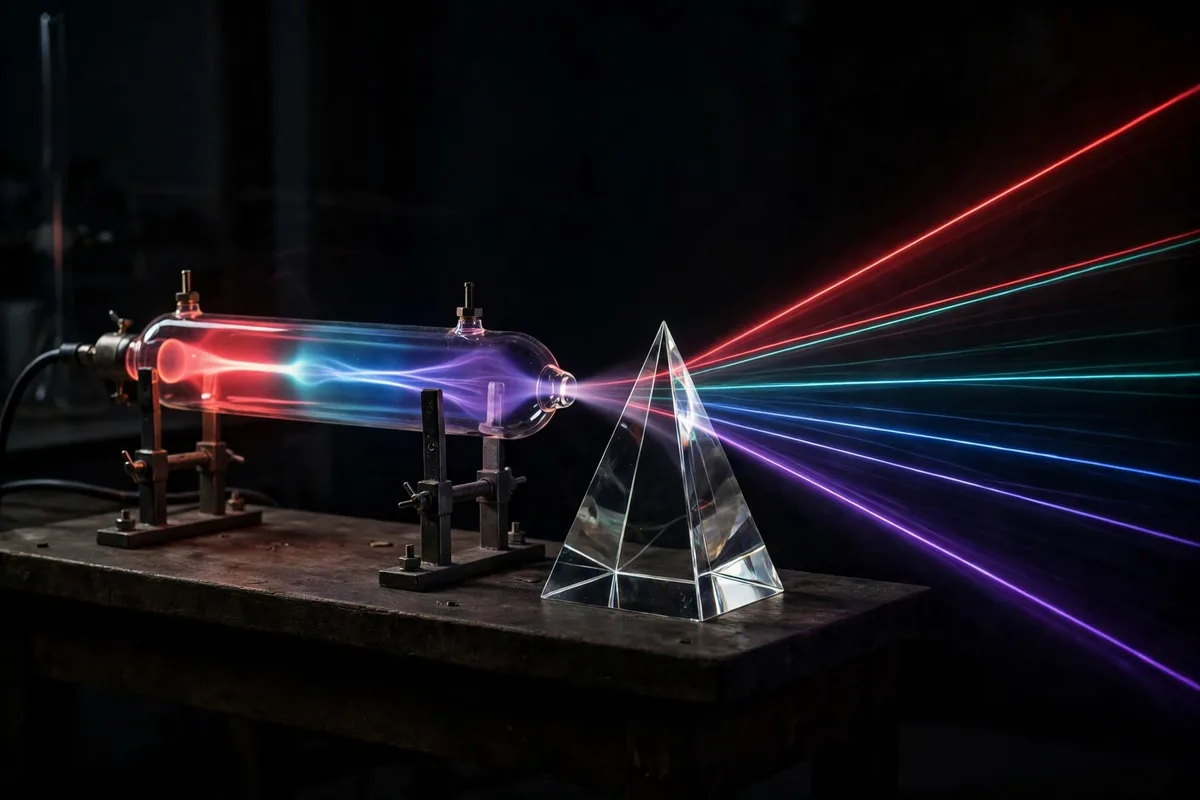
Pass electricity through a tube of hydrogen gas and the gas glows pink. Spread that light through a prism and you will not see a rainbow. You will see four sharp lines: red, blue-green, blue-violet and violet, with darkness between them. That pattern is an atomic spectrum, and it works like a fingerprint for the atom that made it.
Atomic spectra appear because atoms absorb and emit light only at certain wavelengths, and each wavelength matches the energy gap between two energy levels inside the atom. This article explains why the lines appear, how to read them, and how to calculate their wavelengths with the Rydberg formula and the Bohr energy levels.
That pink glow hides a question that bothered physicists for decades. Classical physics said a hot gas should shine at every wavelength, like a glowing filament. It does not. It picks a few.
The answer turned out to be one of the first clues that energy inside an atom comes in fixed steps, and those steps are exactly what this article works through.
What Are Atomic Spectra?
A spectrum is light spread out by wavelength. A prism does the spreading because it bends each wavelength by a slightly different amount. A diffraction grating does the same job more sharply, using thousands of fine slits to separate the colours. Either way, what lands on the screen tells you what the light source is made of and how hot it is.
A continuous spectrum contains every wavelength, blending into an unbroken band of colour. A hot solid, a glowing filament or a dense hot gas gives you one. A line spectrum is the opposite.
It shows light only at a few sharp wavelengths, with gaps of darkness in between. A low-pressure gas gives you one, and each element gives a different set of lines.
No two elements share the same pattern, which is why astronomers can identify the gases in a star they will never touch.
Three rules from Gustav Kirchhoff, written down in the 1860s, organise the whole topic. A hot solid, liquid or dense gas produces a continuous spectrum. A hot, low-pressure gas produces a bright-line spectrum, which is the emission spectrum. A cool gas sitting in front of a continuous source produces a dark-line spectrum, which is the absorption spectrum.
Keep those three cases straight and most exam questions on this topic fall into place.
The reason a gas gives lines instead of a continuous band is that its atoms can only hold certain amounts of energy. An electron in an atom lives on one of a set of allowed energy levels, like rungs on a ladder, and it cannot stand between rungs. When it moves between two rungs, the atom gains or loses exactly the energy of the gap.
That gap fixes the wavelength of the light involved. One gap, one line.
Emission Spectra: Bright Lines on a Dark Background
An emission spectrum forms when atoms give off light. Something has to excite the atoms first. Heat does it, and so does an electric current in a discharge tube. The extra energy pushes electrons up to higher energy levels.
Those levels are unstable, so the electrons fall back down, and each fall releases the extra energy as a single photon, a packet of light.
The photon carries exactly the energy of the gap it fell across. If the electron drops from a level of energy Eupper to a level of energy Elower, the photon energy is E = Eupper − Elower. The same photon obeys the wave relation E = hf = hc/λ, where h is Planck’s constant (6.626 × 10⁻³⁴ J s), f is the frequency, c is the speed of light (3.00 × 10⁸ m/s) and λ is the wavelength. Put the two together and the wavelength follows from the energy gap: a bigger gap means a shorter wavelength and a bluer photon.
Hydrogen in a discharge tube shows four visible lines. The red line at 656 nm comes from an electron falling from the third level to the second. The blue-green line at 486 nm comes from the fourth level to the second. The blue-violet line at 434 nm comes from the fifth level to the second, and the violet line at 410 nm comes from the sixth level to the second.
Every visible line in hydrogen ends on the second level. That family of lines is the Balmer series, and you will meet it again below.
The red line is the brightest of the four. More electrons sit on the third level than on the higher levels, so more of them make the jump down to level two, and each jump gives off one red photon. Brightness in a spectrum is a head count. It tells you how many atoms made that particular jump, not how energetic each photon is.
One more point matters for reading spectra. An excited atom can fall in stages. An electron on level four can drop straight to level two, giving one photon, or it can drop to level three and then to level two, giving two photons of different wavelengths.
The line pattern records every possible route down. That is why a single excited level can produce several lines, and why counting lines needs the rule you will see in the Rydberg section.
Absorption Spectra: Dark Lines on a Bright Background
An absorption spectrum is the same physics seen from the other side. Put a cool gas in front of a source that shines at every wavelength, and the gas takes out exactly the wavelengths it could emit. The light that reaches your eye is a continuous rainbow with thin dark lines cut into it.
Each dark line sits at precisely the same wavelength as a bright line in that element’s emission spectrum, because the same energy gap is involved. The electron goes up instead of down, and the photon is swallowed instead of released.
Absorption is picky. A photon is absorbed only when its energy matches a level gap exactly. A photon with a little too much or a little too little energy passes straight through the gas as if it were not there.
This is why a hydrogen cloud is transparent to most light and opaque at just a few wavelengths. The atom is a lock that opens for a few exact keys and ignores the rest.
In a cool gas, most atoms sit in the ground state, the lowest energy level, labelled n = 1. That is where the electrons spend nearly all their time when nothing is heating them. So absorption in a cool gas starts almost entirely from n = 1. For hydrogen, that means the strong absorption lines belong to the Lyman series, the jumps from n = 1 up to higher levels, and those lines sit in the ultraviolet where your eye cannot see them.
Balmer absorption, the jumps starting from n = 2, needs a gas hot enough to lift a fair number of atoms onto level two first. In the Sun’s atmosphere, hydrogen is hot enough for that, and the Balmer lines show up as dark lines in sunlight.
Those dark lines in sunlight have a name: Fraunhofer lines, after Joseph von Fraunhofer, who mapped them in the early 1800s. He counted hundreds of them before anyone knew what caused them.
Today we know each one is an element in the Sun’s outer layers absorbing its own characteristic wavelengths. The same trick works on distant stars. Match the dark lines to the bright lines measured in a laboratory, and you have read the composition of a star from its light alone. Helium was found this way, in the Sun’s spectrum, before anyone found it on Earth.
The Bohr Model and Quantised Energy Levels
Niels Bohr built a model in 1913 that explained why the lines sit where they do. In his picture, an electron circles the nucleus only on certain allowed orbits, and each orbit has a fixed energy. The word quantised describes exactly that: the energy comes in separate, fixed amounts, never in between. An electron can jump from one allowed energy to another, but it cannot hover halfway.
The lowest level, n = 1, is the ground state. Higher values of n are excited states. For hydrogen, the energy of level n is En = −13.6/n² eV.
The unit eV is the electronvolt, the energy one electron gains crossing a potential difference of one volt. It equals 1.602 × 10⁻¹⁹ J, and it keeps atomic numbers small and readable. The minus sign means the electron is bound to the atom. Zero energy is the point where the electron escapes completely, so every bound level sits below zero.
Run the formula through the first few levels and a pattern shows up. Level one holds −13.6 eV. Level two holds −3.40 eV. Level three holds −1.51 eV.
Level four holds −0.85 eV, and level five holds −0.54 eV.
The levels crowd together as n grows, and they pile up towards zero. That crowding is why the spectral lines in any series also crowd together towards a limit, which is the series limit you will calculate in the second worked example.
| Level n | Energy En (eV) | Gap to the level below (eV) |
|---|---|---|
| 1 (ground state) | −13.6 | n/a |
| 2 | −3.40 | 10.2 |
| 3 | −1.51 | 1.89 |
| 4 | −0.85 | 0.66 |
| 5 | −0.54 | 0.31 |
The number 13.6 eV is the ionisation energy of hydrogen. It is the energy needed to lift an electron from the ground state all the way to zero, which means freeing it from the atom entirely. Give a ground-state hydrogen atom a photon of 13.6 eV or more and the electron leaves. Give it less, and the photon is absorbed only if it matches a gap exactly.
This is the point students most often get wrong, and it is worth stating plainly: an atom cannot take a bite out of a photon. It takes the whole photon or none of it.
To find a photon’s energy from the levels, subtract the lower level from the upper one: Ephoton = Eupper − Elower. The answer must come out positive, because a photon carries positive energy. If your subtraction gives a negative number, you have the two levels the wrong way round. For the red hydrogen line, E3 − E2 = −1.51 − (−3.40) = 1.89 eV, a positive number, and it matches the wavelength of 656 nm exactly.
The Bohr model has limits. It works beautifully for hydrogen and for ions with a single electron, and it fails for atoms with two or more electrons, where the electrons push each other around in ways the model ignores. Modern quantum mechanics replaced the neat orbits with fuzzy clouds of probability. But the energy levels Bohr calculated for hydrogen are correct, and the formula En = −13.6/n² eV is still the one exam questions expect you to use.
The Rydberg Formula and the Hydrogen Series
Johannes Rydberg wrote down the formula for hydrogen wavelengths in the 1880s, before Bohr explained why it works. It takes the two levels involved in a jump and gives you the wavelength directly: 1/λ = R(1/nf² − 1/ni²), where R is the Rydberg constant, 1.097 × 10⁷ m−1. The symbol nf is the final level, the one the electron ends on. The symbol ni is the initial level, the one it starts from.
For emission, the electron falls, so ni is bigger than nf, and the bracket stays positive.
One trap hides in the units. The constant R is in inverse metres, so the wavelength comes out in metres. A visible line gives a number like 6.56 × 10⁻⁷ m, and you convert it to nanometres by multiplying by 109.
Students who forget the conversion end up claiming a wavelength of 0.000000656 of something and lose the mark. Do the conversion as the last step, every time.
Every series in hydrogen is one value of nf, the level all its jumps land on. The Lyman series lands on n = 1 and sits in the ultraviolet. The Balmer series lands on n = 2 and gives the four visible lines plus ultraviolet lines beyond them. The Paschen series lands on n = 3 and sits in the infrared.
Then come Brackett (n = 4), Pfund (n = 5) and Humphreys (n = 6), all deeper in the infrared. One formula, six families, and the only thing that changes is the landing level.
| Series | Final level nf | Region | Shortest wavelength (series limit) |
|---|---|---|---|
| Lyman | 1 | Ultraviolet | 91.2 nm |
| Balmer | 2 | Visible and ultraviolet | 364.6 nm |
| Paschen | 3 | Infrared | 820.4 nm |
| Brackett | 4 | Infrared | 1458 nm |
| Pfund | 5 | Infrared | 2279 nm |
| Humphreys | 6 | Infrared | 3283 nm |
Each series has a shortest wavelength, called the series limit. It comes from the biggest possible jump in that series, the one starting from infinitely far up, where the electron begins free. Set ni to infinity in the Rydberg formula and 1/ni² becomes zero, leaving 1/λlimit = R/nf².
For the Lyman series that gives 91.2 nm. For Balmer it gives 364.6 nm, just past the violet end of the visible range, which is why the Balmer lines crowd together and stop there. No line in a series can be shorter than its limit. If your calculation gives one that is, you have swapped the two levels.
Finally, a counting rule that exam papers love. An electron sitting on level n can fall to any lower level, directly or in stages, and each distinct route gives one line. The number of different emission lines is n(n − 1)/2.
From level four, that is 4 × 3 / 2 = 6 lines: the jumps 4 to 3, 4 to 2, 4 to 1, 3 to 2, 3 to 1 and 2 to 1. From level three it is 3 lines, and from level two it is just one. The rule counts routes, not photons, and it only applies to a single excited atom falling back to the ground state.
Worked Example 1: The Red H-Alpha Line
An electron in a hydrogen atom drops from level n = 3 to level n = 2. Find the wavelength of the light emitted and the energy of the photon. This is the H-alpha line, the red line in the hydrogen spectrum, and it is the single most asked calculation on this topic.
Step 1: name the levels. The electron starts on ni = 3 and finishes on nf = 2. The final level is the smaller one for emission, because the electron falls.
Step 2: put the numbers into the Rydberg formula. 1/λ = R(1/nf² − 1/ni²) = 1.097 × 107 × (1/2² − 1/3²) = 1.097 × 107 × (1/4 − 1/9). The bracket works out to 5/36, which is 0.1389. Multiply: 1.097 × 107 × 0.1389 = 1.524 × 10⁶ m−1.
That is 1/λ, so the wavelength still needs one more step: invert it.
Step 3: invert to get the wavelength. λ = 1 / (1.524 × 10⁶) = 6.56 × 10⁻⁷ m. Convert to nanometres by multiplying by 109: λ = 656 nm. That is red light, at the long wavelength end of the visible spectrum.
Step 4: find the photon energy with E = hc/λ. Use h = 6.626 × 10⁻³⁴ J s and c = 3.00 × 10⁸ m/s. E = (6.626 × 10−34 × 3.00 × 108) / (6.56 × 10⁻⁷) = 1.988 × 10⁻²⁵ / 6.56 × 10−7 = 3.03 × 10⁻¹⁹ J. Convert to electronvolts by dividing by 1.602 × 10⁻¹⁹ J/eV: E = 1.89 eV.
Step 5: check the answer against the energy levels, which is the fastest way to catch a slip. E3 = −13.6/3² = −1.51 eV and E2 = −13.6/2² = −3.40 eV. The gap is E3 − E2 = −1.51 − (−3.40) = 1.89 eV.
Both routes agree, so the wavelength of 656 nm and the energy of 1.89 eV are correct. Two routes to the same number is the habit that saves marks.
Worked Example 2: The Lyman Series Limit
Part A: find the shortest wavelength in the Lyman series, and Part B: decide whether a photon of energy 10.2 eV is absorbed by a hydrogen atom in its ground state. The two parts fit together, because the Lyman series is exactly the set of jumps that start from the ground state.
Step 1: name the levels for the series limit. The Lyman series lands on nf = 1. The shortest wavelength comes from the longest fall, which starts as high as possible. Take ni to infinity, which means the electron begins free and falls all the way to the ground state.
Step 2: put the numbers into the Rydberg formula. 1/λ = R(1/nf² − 1/ni²) = 1.097 × 107 × (1/1² − 1/∞²). The term 1/∞² is zero, so the bracket is simply 1. That leaves 1/λ = 1.097 × 10⁷ m−1.
Step 3: invert and convert. λ = 1 / (1.097 × 10⁷) = 9.12 × 10⁻⁸ m = 91.2 nm. That is deep in the ultraviolet, far beyond what the eye can see. It is also the longest wavelength that can ionise hydrogen from the ground state going the other way, since a photon of 91.2 nm carries exactly 13.6 eV.
No Lyman line can be shorter than 91.2 nm.
Step 4: now test the 10.2 eV photon. Absorption needs a photon whose energy exactly matches a gap from the ground state. The smallest gap up from n = 1 is the jump to n = 2. The levels give it directly: E2 − E1 = −3.40 − (−13.6) = 10.2 eV.
The photon’s energy matches the gap exactly, so yes, it is absorbed.
The electron jumps from n = 1 to n = 2, and the photon disappears.
Step 5: find the wavelength of that absorbed photon as a final check. λ = hc/E = (6.626 × 10−34 × 3.00 × 108) / (10.2 × 1.602 × 10−19) = 1.988 × 10⁻²⁵ / 1.634 × 10−18 = 1.216 × 10⁻⁷ m = 121.6 nm. That is the Lyman alpha line, the longest wavelength in the Lyman series, and it sits in the ultraviolet.
A photon of 11 eV, by contrast, would pass through the atom untouched, because no gap in hydrogen measures 11 eV. And a photon of 10.2 eV cannot ionise the atom, since ionisation from the ground state needs the full 13.6 eV.
Common Mistakes
The first mistake is mixing up the direction. Emission means the electron goes down and light comes out. Absorption means the electron goes up and light goes in. If your answer says an atom emits a photon when its electron jumps to a higher level, stop and swap the direction.
Down gives off, up takes in.
The second mistake is a negative photon energy. Level energies are negative, so subtracting them the wrong way round gives a negative number. A photon cannot carry negative energy.
Always subtract the lower level from the upper one: Ephoton = Eupper − Elower. A negative result means the two levels are the wrong way round, so swap them and subtract again.
The third mistake is swapping nf and ni in the Rydberg formula. The final level nf comes first in the bracket, and for emission it is the smaller number. Put them the other way round and the bracket goes negative, which gives a negative 1/λ, an impossible result. If your 1/λ comes out negative, the two levels are swapped.
The fourth mistake is stopping at 1/λ. The Rydberg formula gives the reciprocal of the wavelength, and the question asks for the wavelength. Invert it. Then convert metres to nanometres, because an answer of 6.56 × 10⁻⁷ m is correct but an examiner expects 656 nm, and a missing conversion is an easy mark to lose.
The fifth mistake is assuming absorption lines can start from any level. In a cool gas nearly every atom sits in the ground state, so absorption starts from n = 1. That is why the absorption spectrum of cool hydrogen shows Lyman lines, not Balmer lines.
Balmer absorption needs a hot gas with atoms already sitting on level two. Read the question for a clue about temperature before choosing the series.
The sixth mistake is applying the Rydberg formula to atoms other than hydrogen. The formula and the energy levels En = −13.6/n² eV belong to hydrogen alone, and to single-electron ions such as He+ with a modified constant. A sodium atom or an iron atom has a far more complicated set of levels, and its spectrum needs measured values, not this formula. If a question hands you a multi-electron atom and the Rydberg formula, one of them is a trap.
The Formulas to Keep
Four formulas carry this whole topic. The photon energy is E = hf = hc/λ. The hydrogen energy levels are En = −13.6/n² eV, with the ground state at −13.6 eV and ionisation at 13.6 eV. The Rydberg formula is 1/λ = R(1/nf² − 1/ni²) with R = 1.097 × 10⁷ m−1.
And the series limit is 1/λlimit = R/nf², reached when the starting level goes to infinity.
Behind the formulas sits one idea, and it explains atomic spectra in a single sentence. Emission and absorption lines of the same element sit at the same wavelengths because they are the same jumps between the same levels, seen in opposite directions. An electron falls and a photon appears, or a photon arrives and an electron climbs. Learn to spot which direction a question describes, and the rest is arithmetic.
Try the next line yourself before you move on. An electron drops from n = 4 to n = 2 in hydrogen. Work it through the Rydberg formula and you should land on 486 nm, the blue-green line, with a photon energy of 2.55 eV. If you get that, the method is yours.
Frequently Asked Questions
What is an atomic spectrum, and why do atoms produce lines instead of a continuous spectrum?
An atomic spectrum is the pattern of light an atom emits or absorbs, spread out by wavelength. Atoms produce lines because their electrons live only on fixed energy levels. A photon appears or disappears only when an electron jumps between two levels, so only the wavelengths matching those exact gaps appear. Hot solids have no such fixed gaps, so they shine at every wavelength and give a continuous spectrum.
What is the difference between an emission spectrum and an absorption spectrum?
An emission spectrum shows bright lines on a dark background, made when excited atoms give off light. An electron falls from a higher energy level to a lower one and releases a photon with energy equal to the gap. An absorption spectrum shows dark lines on a bright background, made when a cool gas in front of a continuous source swallows photons. The electron jumps up by absorbing a photon whose energy exactly matches the gap.
How does the Rydberg formula predict the wavelength of a hydrogen spectral line?
The Rydberg formula gives the wavelength from the two levels in the jump. Use 1/λ = R(1/n_f^2 − 1/n_i^2), with R = 1.097 × 10^7 m^-1, n_f the final level and n_i the initial level. For emission n_i is larger than n_f. Work out 1/λ, invert it to get λ in metres, then multiply by 10^9 to convert to nanometres. For the jump from n = 3 to n = 2 the formula gives 656 nm.
Why are the emission lines and absorption lines of the same element at the same wavelengths?
They sit at the same wavelengths because they are the same jumps between the same energy levels, seen in opposite directions. In emission an electron falls from a higher level to a lower one and releases a photon with energy equal to the gap. In absorption an electron climbs the same gap by swallowing a photon of exactly that energy. Since the gap fixes the wavelength through E = hf = hc/λ, both lines appear at the same wavelength.
What is the Balmer series, and why are its lines visible in the hydrogen spectrum?
The Balmer series is the family of hydrogen lines in which every jump lands on level n = 2. Its lines are visible because the jumps ending on n = 2 give wavelengths in the visible range: 656 nm red, 486 nm blue green, 434 nm blue violet and 410 nm violet. Jumps from higher levels give shorter wavelengths in the ultraviolet. The series limit is 364.6 nm, so no Balmer line is shorter than that.
How do you use the Bohr energy levels E_n = -13.6/n^2 eV to find the energy of a photon in an atomic spectrum?
Find the energy of each level with E_n = −13.6/n^2 eV, then subtract the lower level from the upper one: E_photon = E_upper − E_lower. The result must be positive, since a photon carries positive energy. For the red hydrogen line, E_3 − E_2 = −1.51 − (−3.40) = 1.89 eV. For absorption, do the same subtraction with the upper level first. A negative answer means the two levels are the wrong way round.