λ = h/mv — The De Broglie Wavelength, Derived and Explained
Here is a strange idea that changed physics forever: if light, which we usually think of as a wave, can sometimes behave like a particle, then perhaps a particle, such as an electron, can sometimes behave like a wave. That is exactly what the French physicist Louis de Broglie proposed in 1924, and the idea leads directly to the de Broglie wavelength, a single formula that assigns a wavelength to every moving object. It is one of the most surprising and most useful ideas in modern physics, and it is far easier to understand than it first sounds.
In this article, we will take that idea apart piece by piece. You will learn what the de Broglie wavelength means, what every symbol in its formula stands for, and how the formula can be derived from ideas you may already know about light. Then we will work through two complete numerical examples: one for an electron, where the wavelength turns out to be large enough to matter, and one for a baseball, where it turns out to be so tiny that it can never be observed.
Finally, we will look at the experiments that proved de Broglie right, and at the common mistakes students make when they use this formula in exams.
By the end, you should be able to calculate a de Broglie wavelength with confidence, explain in plain words why tiny particles show wave behaviour while everyday objects do not, and recognise when the simple form of the formula needs to be replaced by a more careful version. No advanced mathematics is needed beyond basic algebra, and every new term will be defined before it is used.
What Is the De Broglie Wavelength?
To understand the de Broglie wavelength, we first need two familiar ideas: wavelength and momentum. A wavelength is the distance between two matching points on a wave, for example from one crest to the next crest. It is usually written with the Greek letter lambda, λ, and it is measured in metres. Momentum, written as p, is a measure of how much motion an object carries. For an object moving at an ordinary speed, momentum is simply its mass multiplied by its velocity, p = mv.
Mass is measured in kilograms, velocity in metres per second, and so momentum has the unit kilogram metre per second, kg·m/s.
Wave-particle duality is the name physicists give to the discovery that light and matter do not fit neatly into just one of the two old categories, wave or particle. Light travels like a wave and shows interference and diffraction, yet it also arrives in packets of energy called photons, which behave in many ways like particles. Before de Broglie, matter seemed to belong firmly on the particle side of the divide. Electrons, protons, and atoms were treated as tiny balls with definite positions and masses.
De Broglie asked a bold question: if waves can act like particles, why should particles not act like waves?
His answer became known as the de Broglie hypothesis. It states that every moving particle has an associated wave, now called a matter wave, and that the wavelength of this wave is connected to the particle’s momentum by a beautifully simple relation. The de Broglie wavelength, λ, is given by λ = h/p, where h is a fundamental constant of nature called the Planck constant, and p is the momentum of the particle. Because momentum at ordinary speeds is mass times velocity, the same formula can be written as λ = h/mv.
The Planck constant, h, has the value 6.626 × 10⁻³⁴ joule seconds, written as 6.626 × 10⁻³⁴ J·s. A joule is the standard unit of energy, and a joule second is simply a joule multiplied by a second. The important thing about the Planck constant is that it is extremely small. That smallness is the reason the wave nature of matter is obvious for electrons but invisible for baseballs, as the worked examples later in this article will show in numbers.
Look closely at the formula λ = h/mv, and notice the inverse relation it describes. Wavelength and momentum sit on opposite sides of the fraction, so when one goes up, the other goes down. A particle with a large momentum has a short de Broglie wavelength, while a particle with a small momentum has a long de Broglie wavelength. Doubling the momentum halves the wavelength. Halving the momentum doubles the wavelength. This single pattern explains a great deal about when wave effects show up and when they do not.
It is worth pausing on what a matter wave actually is, because it is easy to picture it wrongly. A matter wave is not a physical ripple in some invisible material, and an electron is not literally wobbling up and down as it flies through space. In quantum mechanics, the wave associated with a particle describes where the particle is likely to be found, and how its behaviour spreads out over space. The de Broglie wavelength sets the scale of that spread.
When the wavelength is comparable to the size of the obstacles or openings the particle meets, wave effects such as diffraction appear. When the wavelength is vastly smaller than anything the particle meets, the particle behaves, for all practical purposes, like an ordinary particle.
That is the key idea to carry forward. The de Broglie wavelength is not a curiosity tacked onto the end of a textbook chapter. It is the number that tells you whether you need to think about a particle as a wave in a given situation. If the wavelength is similar in size to the structures around the particle, wave behaviour matters. If it is unimaginably smaller, wave behaviour can be safely ignored. The rest of this article turns that idea into a formula you can derive, numbers you can calculate, and experiments you can picture.
Deriving λ = h/mv Step by Step
A derivation is simply a chain of reasoning that shows where a formula comes from, rather than asking you to accept it on trust. The derivation of the de Broglie wavelength starts with light, with a particle that has no mass at all: the photon. A photon is a packet of light energy. It has energy, and it has momentum, even though it has no rest mass. That may sound odd, but it is one of the well-established results of Einstein’s theory of relativity, and it gives us the perfect starting point.
We need two equations about photons. The first relates the energy of a photon to its wavelength. It is E = hc/λ, where E is the energy of the photon, h is the Planck constant, c is the speed of light in a vacuum, which is 3.00 × 10⁸ m/s, and λ is the wavelength of the light. In words, this equation says that shorter-wavelength light carries more energy per photon. Blue light, with a shorter wavelength than red light, has more energetic photons.
The second equation relates the energy of a photon to its momentum. It is E = pc, where E is again the energy, p is the momentum of the photon, and c is the speed of light. This equation comes from relativity, and it applies to particles that travel at the speed of light. Notice that both equations describe the same energy E, the energy of the same photon, so their right-hand sides must be equal to each other.
Setting them equal gives pc = hc/λ. Now we can simplify. The speed of light, c, appears on both sides of the equation, so it cancels out. Dividing both sides by c leaves p = h/λ. Rearranging this to solve for wavelength gives λ = h/p. That is the de Broglie relation in its most general form, and so far it has only been shown for photons.
Here comes de Broglie’s great leap. He proposed that this relation should not be restricted to photons at all. Instead, he suggested, it should apply to every moving particle, including particles with mass such as electrons, protons, neutrons, and atoms. If a particle has momentum p, then it has an associated wavelength λ = h/p. That generalisation, from light to all matter, is the de Broglie hypothesis.
For a particle moving at a speed much lower than the speed of light, momentum is simply p = mv, where m is the mass of the particle and v is its velocity. Substituting this into the general relation gives the familiar form λ = h/mv. This is the version you will use for most school and college problems, and it is the version used in both worked examples in this article.
It is important to remember, though, that it rests on an assumption: that the particle is moving slowly compared with the speed of light, so that the simple momentum formula p = mv is accurate.
When a particle moves at a speed close to the speed of light, the simple momentum formula no longer works. Relativity tells us that momentum grows faster than mv at such speeds, and the correct momentum is p = γmv, where γ, the Greek letter gamma, is the Lorentz factor. The Lorentz factor is a number that is close to 1 at everyday speeds but grows large as the speed approaches the speed of light. It is defined by γ = 1/√(1 − v²/c²). Using this relativistic momentum, the de Broglie wavelength becomes λ = h/(γmv).
In practice, you only need this version when the particle’s speed is a substantial fraction of the speed of light. For the electron in our first worked example, moving at 2.0 × 10⁶ m/s, the speed is less than one percent of the speed of light, so the simple non-relativistic form is perfectly adequate.
There are two more useful forms of the formula that appear often in problems. The first uses kinetic energy instead of velocity. Kinetic energy, written as E or sometimes as K, is the energy an object has because of its motion. For a particle moving at an ordinary speed, kinetic energy is E = (1/2)mv². A little algebra, combining this with p = mv, gives p = √(2mE). Substituting into λ = h/p gives λ = h/√(2mE). This form is handy when a problem tells you a particle’s energy rather than its speed.
The second form is a special case for electrons that have been accelerated through a voltage. When an electron, with charge e, is accelerated from rest through a voltage V, it gains kinetic energy eV, where e is the elementary charge, 1.60 × 10⁻¹⁹ coulombs, and V is measured in volts. Putting E = eV into the energy form gives λ = h/√(2meV), where m is now specifically the mass of the electron.
This accelerating-voltage form lets you find the wavelength of electrons in devices such as electron microscopes and old television tubes directly from the accelerating voltage, without first calculating the speed. It is a favourite of exam setters, so it is worth recognising on sight.
Before moving on, let us summarise the derivation in four steps, because a derivation you can retell is one you truly understand. First, for a photon, energy relates to wavelength by E = hc/λ. Second, for a photon, energy relates to momentum by E = pc. Third, equating the two expressions for energy gives λ = h/p. Fourth, de Broglie generalised this result to all particles, and for slow-moving particles p = mv, giving λ = h/mv. The derivation is short, the generalisation is daring, and the experiments that followed showed that the daring generalisation was correct.
Worked Example 1: De Broglie Wavelength of an Electron
Now we put the formula to work. This first example is the classic one: find the de Broglie wavelength of an electron moving at a speed that is typical inside atoms and simple laboratory equipment. Work through each step slowly, check the units at every stage, and notice how the final answer compares with the size of atoms.
Question: Calculate the de Broglie wavelength of an electron moving at 2.0 × 10⁶ m/s. The mass of an electron is 9.11 × 10⁻³¹ kg.
Step 1: Write down what you know. The mass of the electron is m = 9.11 × 10⁻³¹ kg. Its velocity is v = 2.0 × 10⁶ m/s. The Planck constant is h = 6.626 × 10⁻³⁴ J·s. The formula we need is λ = h/mv. Before calculating, check that the speed is much smaller than the speed of light, 3.00 × 10⁸ m/s, so that the non-relativistic form is valid. Here 2.0 × 10⁶ m/s is less than one percent of the speed of light, so we can safely use λ = h/mv.
Step 2: Calculate the momentum. Momentum is p = mv. Multiply the mass by the velocity: p = (9.11 × 10⁻³¹ kg) × (2.0 × 10⁶ m/s). Multiply the numbers first: 9.11 × 2.0 = 18.22, which we write as 1.822 × 10¹. Then add the powers of ten: −31 + 6 = −25. So p = 1.822 × 10¹ × 10⁻²⁵ kg·m/s, which simplifies to p = 1.82 × 10⁻²⁴ kg·m/s. Keep the unit with the number at every step, because the unit is part of the answer and a powerful check on your working.
Step 3: Divide the Planck constant by the momentum. Now use λ = h/p. Substitute the numbers: λ = (6.626 × 10⁻³⁴ J·s) / (1.82 × 10⁻²⁴ kg·m/s). Divide the numbers: 6.626 / 1.82 = 3.64. Subtract the powers of ten: −34 − (−24) = −10. The units also work out to metres, as they must for a wavelength, because a joule second divided by a kilogram metre per second leaves metres. So λ = 3.64 × 10⁻¹⁰ m.
Step 4: Convert to a more convenient unit and interpret the result. A wavelength of 3.64 × 10⁻¹⁰ m is easier to picture in nanometres. A nanometre, written nm, is one billionth of a metre, 1 nm = 10⁻⁹ m. Dividing 3.64 × 10⁻¹⁰ m by 10⁻⁹ m/nm gives 0.364 nm, which we round to λ ≈ 0.36 nm. So the de Broglie wavelength of this electron is about 0.36 nanometres.
Interpretation: Why does this number matter? Because 0.36 nm is comparable to the spacing between atoms in a crystal, which is typically around 0.1 to 0.3 nm, and to the size of atoms themselves. When a wave meets obstacles or openings that are similar in size to its wavelength, it diffracts, meaning it spreads out and forms a pattern of bright and dark regions. That is exactly what happens when a beam of electrons strikes a crystal: the electrons diffract, just as X-rays do, producing a pattern that can only be explained if electrons behave as waves.
This is why electron diffraction works, and it is one of the strongest pieces of evidence that the de Broglie wavelength is real. If the electron were moving faster, its momentum would be larger and its wavelength shorter; if it were moving slower, its wavelength would be longer. Either way, for electrons at atomic-scale speeds, the wavelength lands right in the range where wave behaviour is visible.
Worked Example 2: De Broglie Wavelength of a Baseball
The second example asks the opposite question: what happens if we apply the same formula to an everyday object? A baseball is enormously more massive than an electron, and even at a fast pitch its speed is modest by atomic standards. The result is one of the most striking numbers in all of introductory physics, and it explains why you have never seen a baseball diffract.
Question: Calculate the de Broglie wavelength of a baseball of mass 0.145 kg moving at 40 m/s.
Step 1: Write down what you know. The mass of the baseball is m = 0.145 kg. Its velocity is v = 40 m/s. The Planck constant is h = 6.626 × 10⁻³⁴ J·s. The formula is λ = h/mv. The speed of 40 m/s is utterly negligible compared with the speed of light, so the non-relativistic form is certainly valid.
Step 2: Calculate the momentum. Momentum is p = mv. Multiply: p = (0.145 kg) × (40 m/s) = 5.8 kg·m/s. Compare this with the electron’s momentum from the previous example, 1.82 × 10⁻²⁴ kg·m/s. The baseball carries roughly 10²⁴ times more momentum than the electron, a factor of a million million million million. Remember the inverse relation in the formula: vastly more momentum must mean a vastly shorter wavelength.
Step 3: Divide the Planck constant by the momentum. Now use λ = h/p: λ = (6.626 × 10⁻³⁴ J·s) / (5.8 kg·m/s). Divide the numbers: 6.626 / 5.8 = 1.14. The powers of ten give 10⁻³⁴, since there is no power of ten in the denominator to subtract. So λ = 1.14 × 10⁻³⁴ m, which we round to λ ≈ 1.14 × 10⁻³⁴ m.
Step 4: Interpret the result. A wavelength of 1.14 × 10⁻³⁴ m is almost beyond imagination. It is about twenty orders of magnitude smaller than the nucleus of an atom, and far smaller than any opening, edge, or crystal spacing that could ever be built to diffract it. For diffraction to be observable, the wavelength must be comparable to the size of the obstacle or opening it passes. No physical structure comes remotely close to 10⁻³⁴ m in size, so the wave behaviour of the baseball is completely undetectable.
For every practical purpose, the baseball behaves as a particle, and classical mechanics describes its flight perfectly.
The two examples together tell the whole story. The formula λ = h/mv applies to everything, from electrons to baseballs to, in principle, you yourself. But because the Planck constant is so tiny, the wavelength only becomes large enough to observe when the momentum is extremely small, which in practice means when the mass is extremely small. That is why wave behaviour is the everyday reality of electrons, protons, neutrons, and atoms, and a complete irrelevance for anything you can hold in your hand. Quantum mechanics does not switch off for large objects; it simply becomes too small to notice.
As a quick sense check, try the formula on yourself some time. Take a person of mass 70 kg walking at 1 m/s. The momentum is 70 kg·m/s, and the wavelength is 6.626 × 10⁻³⁴ / 70, which is about 9.5 × 10⁻³⁶ m. You, too, have a de Broglie wavelength, but you will never diffract through a doorway because of it. The doorway is roughly a metre wide, while your wavelength is more than thirty orders of magnitude smaller. Wave-particle duality is universal, but its visibility is not.
Why the De Broglie Wavelength Matters
De Broglie’s idea might have remained a beautiful speculation if experiments had not confirmed it. Within a few years of his 1924 proposal, two lines of evidence turned the hypothesis into established physics, and a powerful technology grew out of it. Understanding these three points — the diffraction experiment, the explanation of atomic orbits, and the electron microscope — will show you why this formula earns its place in every modern physics course.
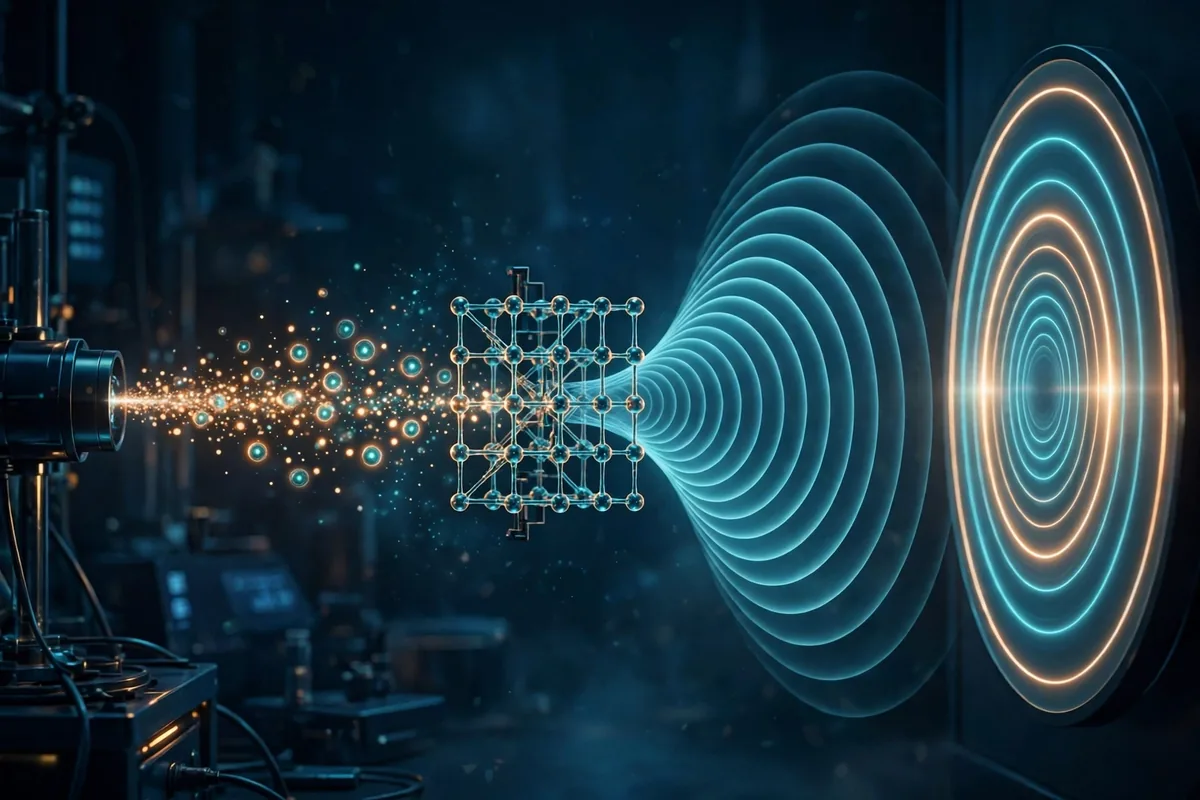
The first piece of evidence came from electron diffraction, demonstrated by Clinton Davisson and Lester Germer in the United States in 1927. They fired a beam of electrons at a nickel crystal and measured how the electrons scattered. If electrons were simply tiny particles, they would have bounced off in a fairly smooth, featureless pattern. Instead, the scattered electrons formed distinct peaks and troughs, a diffraction pattern of exactly the kind produced by waves. Even better, the positions of the peaks matched the wavelengths predicted by λ = h/mv for the electrons’ speeds.
A wave that nobody had expected was behaving precisely as de Broglie had said it would. Davisson shared the Nobel Prize in Physics in 1937 for this work, and de Broglie himself received the Nobel Prize in 1929.
The second point concerns the structure of the atom itself. In 1913, Niels Bohr had proposed that electrons in atoms can only occupy certain allowed orbits, but he had no deep reason for why only those orbits were allowed. De Broglie’s idea supplied the missing reason. Picture the electron’s matter wave travelling around the nucleus in a circular orbit. For the wave to be stable, it must join up smoothly with itself after one full trip around the orbit, like a wave on a circular rope that fits an exact whole number of wavelengths around the loop.
If it does not fit exactly, the wave interferes destructively with itself and cancels out. This standing-wave condition is written as 2πr = nλ, where r is the radius of the orbit, n is a whole number (1, 2, 3, and so on), and λ is the de Broglie wavelength. The circumference of the orbit, 2πr, must equal a whole number of wavelengths. Only orbits satisfying this condition survive, and those are exactly Bohr’s allowed orbits. A rule that had looked arbitrary suddenly had a physical explanation, and the quantum numbers that label atomic energy levels gained a wave interpretation.
The third point is practical: the electron microscope. Ordinary light microscopes are limited by the wavelength of visible light, which is around 500 nm, so they cannot resolve details much smaller than that. Electrons accelerated through a voltage, however, can have de Broglie wavelengths thousands of times shorter, well below one nanometre. Using the accelerating-voltage form, λ = h/√(2meV), a voltage of tens of thousands of volts gives electrons wavelengths of a few picometres, where a picometre is 10⁻¹² m. That is why electron microscopes can image viruses, the fine structure of cells, and even individual atoms in favourable cases.
Every time a scientist studies a specimen with an electron microscope, they are exploiting the de Broglie wavelength directly.
Beyond these three, the de Broglie wavelength underpins much of modern quantum technology and research. Neutron diffraction uses the same principle to study the internal structure of materials, because neutrons, like electrons, have a wavelength set by their momentum. The design of particle accelerators must account for the wavelengths of the particles being collided. And the very idea that matter has a wavelength scale is the starting point for understanding quantum behaviour in semiconductors, lasers, and the tiny transistors inside every computer.
What began as a daring guess about electrons has become a working tool across physics, chemistry, materials science, and engineering.
Common Mistakes
The de Broglie wavelength formula is short, which makes it tempting to use carelessly. Most errors in exam answers come from a small handful of slips, and all of them are easy to avoid once you know what to watch for. Read through this list before you attempt practice problems, and check your own working against it afterwards.
Using the speed of light c in place of the particle’s speed v. This is the single most common mistake. The speed of light appears in the photon derivation, E = hc/λ, but in the final formula λ = h/mv, the v is the velocity of the particle whose wavelength you are calculating, not the speed of light. An electron moving at 2.0 × 10⁶ m/s does not have v = 3.00 × 10⁸ m/s. Putting c into the formula gives a wildly wrong answer and shows the examiner that the derivation has been memorised without being understood.
Always ask: whose speed is this, and what value was I actually given?
Mixing up units. The formula λ = h/mv only gives metres when the mass is in kilograms, the velocity is in metres per second, and the Planck constant is in joule seconds. If a problem gives a mass in grams, convert it to kilograms first by dividing by 1000. If a speed is given in kilometres per hour, convert it to metres per second. And at the end, if you want the answer in nanometres, remember that 1 nm = 10⁻⁹ m, so you divide the metre value by 10⁻⁹.
A missing conversion is the difference between a correct answer and one that is wrong by a factor of a thousand.
Applying λ = h/mv at near-light speeds without the relativistic momentum. The simple form of the formula assumes p = mv, which is only accurate well below the speed of light. For a particle moving at, say, 90 percent of the speed of light, the true momentum is much larger than mv, and the true wavelength is correspondingly shorter. In such cases you must use the relativistic momentum, p = γmv, giving λ = h/(γmv).
If a problem gives a speed as a fraction of c, or a kinetic energy comparable to the particle’s rest energy, that is your signal to think relativistically.
Thinking large objects should show diffraction. Some students calculate a tiny wavelength for a baseball or a person and then wonder why the diffraction pattern is not observed. The answer is in the interpretation step, not the arithmetic. Diffraction is only observable when the wavelength is comparable to the size of the obstacle or opening. A wavelength of 10⁻³⁴ m is not comparable to anything that exists as a physical structure, so the absence of diffraction is exactly what the theory predicts. A tiny calculated wavelength is a correct result, not a sign that something has gone wrong.
Confusing the de Broglie wavelength with the wavelength of light emitted by an atom. These are two different things, and mixing them up leads to confusion. The wavelength of light emitted when an electron jumps between energy levels in an atom is the wavelength of a photon, found from E = hc/λ using the energy difference between the levels. The de Broglie wavelength, by contrast, is the wavelength associated with a moving particle itself, found from λ = h/mv using the particle’s momentum. One describes light leaving an atom; the other describes the wave nature of matter in motion.
Keep the two contexts separate, and you will avoid a whole class of errors.
One final habit will protect you against almost all of these mistakes: always do a quick sense check on your answer. An electron should give a wavelength in the region of 10⁻¹⁰ m, roughly atomic size. A macroscopic object should give something absurdly small, around 10⁻³⁴ m or less. If your electron answer comes out at 10⁻³⁴ m, you have almost certainly used the wrong speed or the wrong mass. If your baseball answer comes out at 10⁻¹⁰ m, you have almost certainly used the electron’s mass by mistake. The numbers themselves tell you whether you are on track.
Conclusion
The de Broglie wavelength is one of those rare ideas that is both simple to state and profound in its consequences. In 1924, Louis de Broglie proposed that every moving particle carries an associated matter wave, and that the wavelength of that wave is determined by the particle’s momentum. The experiments of Davisson and Germer confirmed it, the standing-wave picture explained the allowed orbits of atoms, and the electron microscope turned it into a daily working tool. Whenever you meet a particle whose momentum is small enough, you are meeting a wave as well.
Keep the key formulas together, because they are the whole topic in miniature. The general relation is λ = h/p, where h is the Planck constant, 6.626 × 10⁻³⁴ J·s, and p is momentum. For particles moving well below the speed of light, momentum is p = mv, giving the de Broglie wavelength formula λ = h/mv. When a problem gives kinetic energy instead of speed, use λ = h/√(2mE), and for electrons accelerated through a voltage V, use λ = h/√(2meV).
Finally, remember the standing-wave condition that explains Bohr’s orbits: 2πr = nλ, where the circumference of the orbit must hold a whole number of de Broglie wavelengths.
The worked examples show why these formulas matter in such different ways for different objects. An electron at 2.0 × 10⁶ m/s has a de Broglie wavelength of about 0.36 nm, comparable to the spacing of atoms in a crystal, which is why electron diffraction is a real and observable phenomenon. A baseball of mass 0.145 kg at 40 m/s has a de Broglie wavelength of about 1.14 × 10⁻³⁴ m, far too small to detect, which is why the wave behaviour of everyday objects never shows itself.
The same formula, the same physics, and two answers separated by twenty-four orders of magnitude: that contrast is the de Broglie wavelength in a nutshell, and it is why this small formula deserves its large place in modern physics.
Frequently Asked Questions
What is the de Broglie wavelength in simple terms?
The de Broglie wavelength is the wavelength assigned to every moving particle by the formula λ = h/p, where h is the Planck constant and p is momentum. Proposed by Louis de Broglie in 1924, it treats matter as having wave behaviour: the associated matter wave’s wavelength sets the scale over which wave effects, such as diffraction, can appear. Larger momentum means a shorter wavelength.
How do you calculate the de Broglie wavelength using λ = h/mv?
The de Broglie wavelength is calculated by dividing the Planck constant h = 6.626 × 10⁻³⁴ J·s by the particle’s momentum, using λ = h/mv for speeds well below the speed of light. Insert the mass in kilograms and the velocity in metres per second, giving the wavelength in metres. For a particle of known kinetic energy E, use λ = h/√(2mE) instead.
What is the de Broglie wavelength of an electron moving at 2.0 × 10⁶ m/s?
An electron moving at 2.0 × 10⁶ m/s has a de Broglie wavelength of about 0.36 nm. Its momentum is p = mv = (9.11 × 10⁻³¹ kg)(2.0 × 10⁶ m/s) = 1.82 × 10⁻²⁴ kg·m/s, and λ = h/p = 3.64 × 10⁻¹⁰ m, or 0.36 nm. This wavelength is comparable to the spacing between atoms in a crystal, which is why electron diffraction is observable.
Why is the de Broglie wavelength of everyday objects too small to observe?
The de Broglie wavelength of everyday objects is too small to observe because their momentum is enormous compared with an electron’s. A baseball of mass 0.145 kg at 40 m/s has momentum 5.8 kg·m/s, giving λ = h/mv ≈ 1.14 × 10⁻³⁴ m. Diffraction only appears when the wavelength is comparable to an obstacle’s size, and no physical structure approaches 10⁻³⁴ m.
Does the de Broglie wavelength formula λ = h/mv work for photons as well?
Yes, the formula λ = h/p also applies to photons, and it is where the de Broglie relation begins. For a photon, E = hc/λ and E = pc combine to give λ = h/p, with c cancelling out. De Broglie then generalised this photon result to all matter. For a photon, however, p is not mv, since a photon has no rest mass and travels at the speed of light.
What experiment proved the de Broglie wavelength of electrons is real?
The Davisson–Germer experiment of 1927 proved that the de Broglie wavelength of electrons is real. Davisson and Germer fired electrons at a nickel crystal and observed a diffraction pattern of distinct peaks and troughs, exactly as waves produce. Crucially, the peak positions matched the wavelengths predicted by λ = h/mv for the electrons’ speeds, confirming de Broglie’s 1924 hypothesis.