What Are Electromagnetic Waves? Speed, Spectrum and Properties
A radio broadcast, the heat from a microwave oven, the sunlight warming your face, and the X-ray image taken at a hospital look like completely different things. One carries music, another cooks food, another gives light, and another sees through skin. Yet all four are the same kind of wave. They are all electromagnetic waves, and once you understand a single definition, one speed, and one ordering rule, the whole family falls into place.
In this article, you will learn what electromagnetic waves are, why they all travel at the same speed in empty space, how the electromagnetic spectrum is ordered from radio waves to gamma rays, and how to use the wave-speed formula to find a wavelength or a frequency. Two fully worked examples show every step, including the unit conversions that students most often forget.
What Is an Electromagnetic Wave?
An electromagnetic wave is a travelling disturbance made of two fields that keep each other going: an electric field and a magnetic field. To understand that definition, you need to know what a field is. A field is a region of space in which a force can act. An electric field is the region around an electric charge in which another charge would feel a force. A magnetic field is the region around a magnet, or around a moving charge, in which a magnetic force can act.
In an electromagnetic wave, the electric field and the magnetic field oscillate. To oscillate means to swing back and forth in a regular, repeating pattern. As the electric field changes, it creates a magnetic field. As the magnetic field changes, it creates an electric field. Each field keeps regenerating the other, so the wave travels onwards by itself, carrying energy with it. Nothing material needs to move from place to place for the wave to travel.
Electromagnetic waves are transverse waves. A transverse wave is a wave in which the disturbance is at right angles to the direction in which the wave travels. Imagine a rope tied at one end: if you flick the free end up and down, the wave travels along the rope while the rope itself moves up and down, at right angles to the travel direction.
In an electromagnetic wave, the electric field oscillates in one direction, the magnetic field oscillates at right angles to it, and the wave itself travels at right angles to both. In short, the electric field, the magnetic field, and the direction of travel are all perpendicular to each other.
Electromagnetic waves are created by accelerating charges. An electric charge is a property of particles such as electrons and protons that causes them to attract or repel each other. When a charge speeds up, slows down, or changes direction — in other words, when it accelerates — it produces a changing electric field, and that changing field launches an electromagnetic wave.
This is what happens in a radio transmitter, where electrons are made to oscillate up and down in an aerial, sending out radio waves. It is also what happens in a light bulb, where the hot filament gives energy to charges that radiate light.
Unlike sound waves, electromagnetic waves need no medium. A medium is a substance, such as air, water, or a solid, through which a wave travels. Sound is a vibration of the particles of a medium, so sound cannot travel through empty space. Electromagnetic waves are vibrations of fields, not of particles, so they can travel through a vacuum.
A vacuum is a region of space with no matter in it. That is why sunlight can cross the almost empty space between the Sun and the Earth and still reach us, carrying the energy that warms the planet and powers nearly all life on it.
Key Properties of Electromagnetic Waves
All electromagnetic waves share a set of properties, whatever part of the spectrum they belong to. First, they all carry energy and momentum. Energy is the capacity to do work or cause a change, and momentum is the quantity of motion carried by a moving object or wave. When light falls on a solar panel, it transfers energy that becomes electricity. When sunlight pushes very slightly on a surface, that is the momentum of the light at work, although the push is far too small to feel.
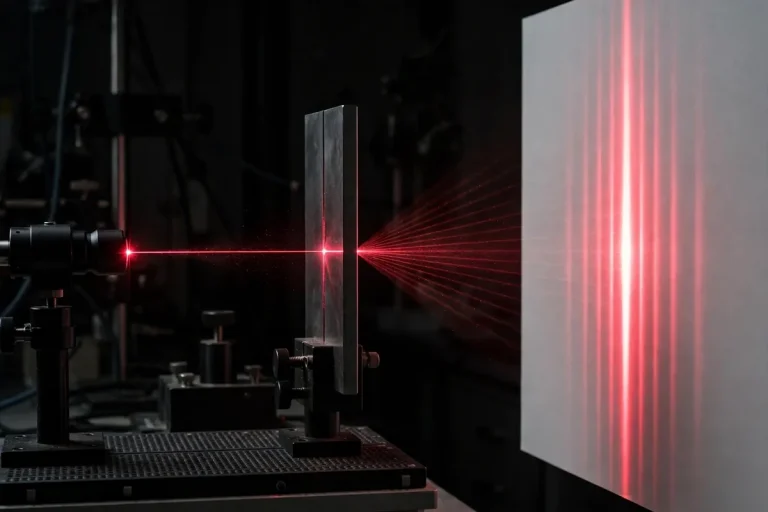
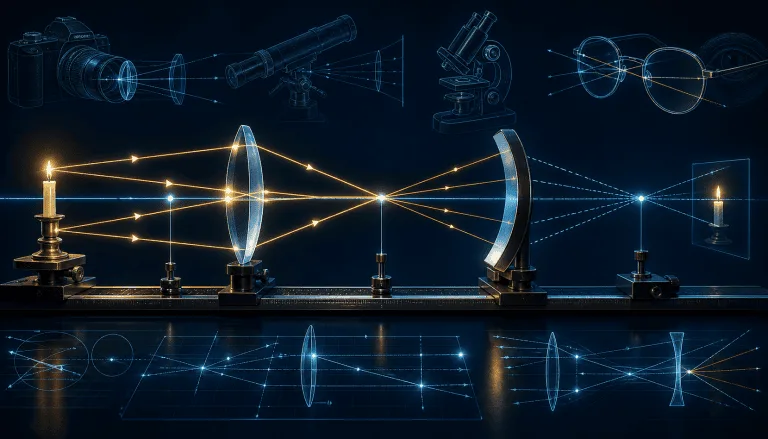
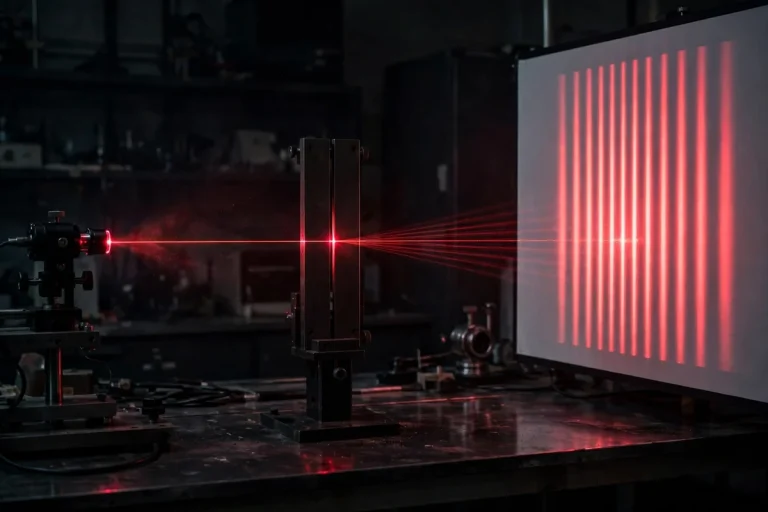
Second, electromagnetic waves can be reflected, refracted, diffracted, and polarised. Reflection is the bouncing of a wave off a surface, as light bounces off a mirror. Refraction is the bending of a wave as it passes from one medium into another, as light bends when it enters water. Diffraction is the spreading of a wave as it passes through a gap or around an edge. Polarisation is the restriction of the oscillations of a transverse wave to a single plane.
Sunglasses that cut glare work by blocking light polarised in one direction while letting light polarised in the other direction through. The fact that electromagnetic waves show all four of these behaviours is strong evidence that they really are waves.
Third, every electromagnetic wave in a vacuum travels at the same speed. That speed is given the symbol c, and its value is about 3.00 × 10⁸ metres per second. The exact value is 299,792,458 metres per second. The next section explains why that speed is so important, and why it never changes for any electromagnetic wave in a vacuum.
Finally, the vacuum speed itself comes from the properties of empty space. Maxwell’s equations, the set of equations that describe electricity and magnetism, predict that the speed of an electromagnetic wave in a vacuum is c = 1/√(μ0ε0), where μ0 is a constant called the permeability of free space and ε0 is a constant called the permittivity of free space.
You do not need to memorise those constants or use this formula in calculations at this level. Its importance is the idea behind it: the speed of light is not an arbitrary number. It follows directly from the laws of electricity and magnetism.
The Speed of Electromagnetic Waves
The speed of electromagnetic waves in a vacuum is one of the most famous numbers in physics: c = 3.00 × 10⁸ m/s. The symbol c stands for the speed of light in a vacuum, and it applies to every part of the electromagnetic spectrum, not just to visible light. Radio waves, microwaves, infrared radiation, visible light, ultraviolet radiation, X-rays, and gamma rays all travel at exactly the same speed in a vacuum. A gamma ray does not outrun a radio wave. They race side by side at c.
That shared speed is tied to two other quantities: frequency and wavelength. Frequency, given the symbol f, is the number of complete oscillations, or cycles, that pass a point each second. It is measured in hertz (Hz), where one hertz means one cycle per second. Wavelength, given the symbol λ (the Greek letter lambda), is the distance between two matching points on neighbouring cycles, such as from one crest to the next crest. A crest is the highest point of a wave. Wavelength is measured in metres.
For any wave, speed, frequency, and wavelength are linked by a simple relationship. In one second, the wave completes f cycles, and each cycle is λ metres long, so the wave travels f × λ metres in that second. That distance per second is the speed of the wave. For electromagnetic waves in a vacuum, this gives the wave-speed equation:
c = fλ
This one equation can be rearranged to find whichever quantity you do not know. Dividing both sides by λ gives frequency in terms of speed and wavelength:
f = c/λ
Dividing both sides by f gives wavelength in terms of speed and frequency:
λ = c/f
These three forms are the same relationship written three ways. In a vacuum, c is fixed, so frequency and wavelength are inversely proportional. Inversely proportional means that when one quantity increases, the other decreases by the same factor. Double the frequency, and the wavelength halves. Halve the frequency, and the wavelength doubles. A high-frequency wave, such as an X-ray, must therefore have a very short wavelength. A low-frequency wave, such as a radio wave, must have a very long wavelength. This inverse relationship is the key to ordering the whole electromagnetic spectrum.
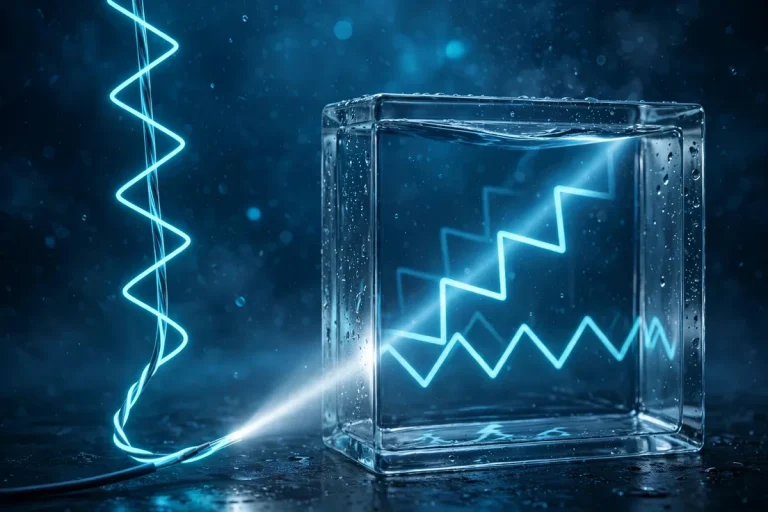
When an electromagnetic wave enters a material such as glass or water, it slows down. Its speed in the material is given by v = c/n, where v is the speed in the material and n is a number called the refractive index of the material. The refractive index is a measure of how much the material slows light down; for glass it is about 1.5, so light travels through glass at roughly two-thirds of its vacuum speed.
Here is the important subtlety: when the wave slows down, its frequency stays exactly the same, but its wavelength shortens. The wave is still oscillating the same number of times per second, but each cycle is squeezed into a shorter distance because the wave is moving more slowly. If you remember only one rule about waves entering a new medium, remember this one: speed and wavelength change, frequency stays fixed.
The Electromagnetic Spectrum, Region by Region
The electromagnetic spectrum is the full range of electromagnetic waves, ordered by frequency and wavelength. It is a continuous range, not a set of separate boxes: the regions blend into each other at their edges. The usual order, from longest wavelength and lowest frequency to shortest wavelength and highest frequency, is: radio waves, microwaves, infrared, visible light, ultraviolet, X-rays, and gamma rays.
As you move along the spectrum from radio waves to gamma rays, the wavelength gets shorter and the frequency gets higher. The energy carried by each wave also rises, because the energy of a single photon increases with frequency. A photon is a single packet, or quantum, of electromagnetic energy.
The relationship is given by E = hf, where E is the energy of one photon, f is the frequency, and h is a constant called Planck’s constant, with the value h = 6.63 × 10⁻³⁴ J s. The unit J s means joule-seconds. A higher frequency therefore means a more energetic photon, which is why the high-frequency end of the spectrum can be dangerous while the low-frequency end is not.
| Region | Approximate wavelength range | Approximate frequency range | Everyday use |
|---|---|---|---|
| Radio waves | Longer than about 0.1 m, up to thousands of metres | Below about 3 × 10⁹ Hz | Radio and television broadcasting, mobile phones |
| Microwaves | About 1 mm to 0.1 m | About 3 × 10⁹ Hz to 3 × 10¹¹ Hz | Cooking food in microwave ovens, satellite communication |
| Infrared | About 700 nm to 1 mm | About 3 × 10¹¹ Hz to 4 × 10¹⁴ Hz | Remote controls, thermal cameras, heating |
| Visible light | About 400 nm to 700 nm | About 4 × 10¹⁴ Hz to 8 × 10¹⁴ Hz | Seeing, photography, optical fibres |
| Ultraviolet | About 10 nm to 400 nm | About 8 × 10¹⁴ Hz to 3 × 10¹⁶ Hz | Detecting forged banknotes, sterilising equipment |
| X-rays | About 0.01 nm to 10 nm | About 3 × 10¹⁶ Hz to 3 × 10¹⁹ Hz | Medical imaging of bones, airport security scanning |
| Gamma rays | Shorter than about 0.01 nm | Above about 3 × 10¹⁹ Hz | Cancer radiotherapy, sterilising medical instruments |
Radio waves have the longest wavelengths and the lowest frequencies in the spectrum. Their wavelengths range from millimetres to thousands of metres, depending on the application. Long radio waves can travel great distances and pass around obstacles, which is why they are used for broadcasting and for communicating with ships and aircraft. Because their photons carry very little energy, radio waves are harmless to the human body at ordinary intensities.
Microwaves are shorter than radio waves, with wavelengths from about a millimetre to about ten centimetres. A microwave oven uses microwaves to make water molecules in food vibrate, and that vibration produces heat. Microwaves are also used for satellite television, mobile phone networks, and radar, which detects objects by bouncing microwaves off them and timing the echo.
Infrared radiation lies just beyond the red end of visible light. Its name means “below red”: infra is Latin for below. Everything warm gives off infrared radiation, which is why thermal cameras can see people in the dark by detecting the heat their bodies radiate. Television remote controls send signals using infrared light-emitting diodes, and infrared heaters warm rooms directly rather than warming the air first.
Visible light is the narrow band of the spectrum that the human eye can detect, from about 400 nm to about 700 nm. The unit nm stands for nanometre, which is one billionth of a metre. Within this band, different wavelengths are seen as different colours. Red light has the longest visible wavelength, around 700 nm, and violet light has the shortest, around 400 nm. Orange, yellow, green, blue, and indigo sit in between, in that order. White light, such as sunlight, is a mixture of all the visible wavelengths together.
Ultraviolet radiation lies just beyond the violet end of visible light. Its name means “beyond violet”. The Sun emits ultraviolet radiation, which is what causes sunburn. In small doses, ultraviolet helps the skin produce vitamin D, but larger doses damage skin cells and increase the risk of skin cancer. Ultraviolet light also makes certain materials fluoresce, which means they absorb the ultraviolet and re-emit visible light — the trick used to check banknotes for security markings.
X-rays have much shorter wavelengths and much higher frequencies than ultraviolet. Because their photons are so energetic, X-rays can pass through soft tissue but are absorbed more strongly by bone, which is why an X-ray image shows bones clearly against softer tissue. The same penetrating power means X-rays must be used carefully: they can damage living cells, so medical X-rays use the lowest dose that gives a useful image, and radiographers stand behind shielding.
Gamma rays have the shortest wavelengths and the highest frequencies of all, and their photons carry the most energy. They are produced by radioactive nuclei and in other high-energy nuclear processes. Gamma rays are the most penetrating radiation in the spectrum and can damage cells and DNA, which makes them dangerous in large doses. That same cell-damaging power is put to medical use in radiotherapy, where carefully aimed gamma rays destroy cancer cells, and in sterilising surgical instruments, where gamma rays kill bacteria without heat.
Notice the pattern running through the whole spectrum. At the radio end, the photons are gentle, the waves are long, and the uses are about communication. At the gamma end, the photons are extremely energetic, the waves are unimaginably short, and the uses are about penetration and power. One family, one speed in a vacuum, ordered by frequency and wavelength — that is the whole story.
Worked Example 1: Wavelength of a Radio Wave
A radio station broadcasts at a frequency of 100 MHz. Calculate the wavelength of the radio waves it transmits. Use c = 3.00 × 10⁸ m/s.
Step 1: Write down what you know and what you need to find. The frequency is f = 100 MHz, the speed is c = 3.00 × 10⁸ m/s, and the unknown is the wavelength λ.
Step 2: Choose the correct rearrangement of the wave-speed equation. Since wavelength is the unknown, use λ = c/f.
Step 3: Convert the frequency into hertz before substituting. The prefix M stands for mega, which means one million, or 106. So 100 MHz = 100 × 106 Hz = 1.00 × 10⁸ Hz. This conversion step is essential: the formula only works if every quantity is in standard units, metres per second, hertz, and metres.
Step 4: Substitute the values into the equation: λ = (3.00 × 10⁸ m/s) / (1.00 × 10⁸ Hz). Dividing the numbers gives 3.00 / 1.00 = 3.00, and dividing the powers of ten gives 108 / 108 = 1. The units also work out: (m/s) / (1/s) = m, because hertz means per second.
Step 5: State the answer with its unit: λ = 3.00 m.
Sanity check: a wavelength of 3.00 metres fits the radio region of the spectrum, where wavelengths are measured in metres rather than nanometres. If you had forgotten the MHz-to-Hz conversion and divided by 100 instead, you would have obtained an absurd wavelength of three million metres — a clear sign that something had gone wrong. A sensible answer in the right region is always worth checking.
Worked Example 2: Frequency of Green Light
Green light has a wavelength of 500 nm. Calculate its frequency. Use c = 3.00 × 10⁸ m/s.
Step 1: Write down what you know and what you need to find. The wavelength is λ = 500 nm, the speed is c = 3.00 × 10⁸ m/s, and the unknown is the frequency f.
Step 2: Choose the correct rearrangement of the wave-speed equation. Since frequency is the unknown, use f = c/λ.
Step 3: Convert the wavelength into metres before substituting. The prefix n stands for nano, which means one billionth, or 10-9. So 500 nm = 500 × 10-9 m = 5.00 × 10⁻⁷ m. Again, this conversion must happen before substitution, not after.
Step 4: Substitute the values into the equation: f = (3.00 × 10⁸ m/s) / (5.00 × 10⁻⁷ m). Dividing the numbers gives 3.00 / 5.00 = 0.600, and dividing the powers of ten gives 108 / 10-7 = 1015. So f = 0.600 × 10¹⁵ Hz, which in standard form is 6.00 × 10¹⁴ Hz. The units work out as (m/s) / m = 1/s, which is hertz.
Step 5: State the answer with its unit: f = 6.00 × 10¹⁴ Hz.
Sanity check: visible light frequencies are of the order of 1014 Hz, and 6.00 × 10¹⁴ Hz sits comfortably inside the visible band, between the frequencies of red light and violet light. Green light sits in the middle of the visible spectrum, so a middle-of-the-band frequency is exactly what you would expect.
Common Mistakes
Confusing speed with frequency is the most common error. In a vacuum, changing the frequency of a wave does not change its speed. It changes the wavelength instead. A gamma ray and a radio wave travel at the same speed; the gamma ray simply packs far more cycles into each metre.
Forgetting unit conversions before substituting into c = fλ is the second classic error. Frequencies given in megahertz (MHz) or gigahertz (GHz) must be converted to hertz, and wavelengths given in nanometres (nm) or centimetres must be converted to metres. Substituting 100 into the formula when you mean 100 MHz, or 500 when you mean 500 nm, gives an answer that is wrong by many orders of magnitude.
Assuming that a higher amplitude means a higher speed is another mistake. Amplitude is the maximum displacement of a wave from its rest position, and for an electromagnetic wave it relates to the brightness or intensity of the wave, not to its speed. A brighter light does not travel faster than a dim light. Both travel at c in a vacuum.
Thinking that all electromagnetic waves are visible light is a misunderstanding of the spectrum. Visible light is only a tiny sliver of the whole range. Most electromagnetic waves are invisible to the human eye, from the radio waves carrying broadcasts to the infrared radiation given off by warm objects.
Believing that gamma rays travel faster than radio waves is wrong for the same reason as the first mistake. In a vacuum, every electromagnetic wave travels at c = 3.00 × 10⁸ m/s, regardless of its frequency, wavelength, or energy. What differs between regions is frequency, wavelength, and photon energy — never the vacuum speed.
Finally, claiming that frequency changes when a wave enters a new medium is incorrect. When light enters glass or water, its speed drops and its wavelength shortens, but its frequency stays fixed. If the frequency changed, the colour of light would change when it entered water, and it does not: a green laser beam stays green underwater.
Conclusion
Electromagnetic waves are oscillating electric and magnetic fields that sustain each other as they travel, need no medium, and carry energy and momentum. Every one of them, from the longest radio wave to the most energetic gamma ray, travels at the same speed in a vacuum, and the whole family is ordered by frequency and wavelength into a single spectrum.
The key formulas to remember are: the vacuum speed c = 3.00 × 10⁸ m/s; the wave-speed equation c = fλ; its rearrangements f = c/λ and λ = c/f; the speed in a medium v = c/n; and the photon energy equation E = hf. Convert your units before you substitute, check that your answer sits in the right region of the spectrum, and remember that frequency stays fixed when a wave enters a new medium while speed and wavelength change.
One wave family, one vacuum speed, ordered by frequency and wavelength: that is the whole of electromagnetic waves in a single sentence, and every calculation in this article follows from it.
Frequently Asked Questions
What are electromagnetic waves, and how are they different from sound waves?
Electromagnetic waves are travelling disturbances of oscillating electric and magnetic fields that regenerate each other, so they need no medium and can cross a vacuum. Sound waves, by contrast, are vibrations of particles in a medium such as air or water, so sound cannot travel through empty space. Electromagnetic waves are also transverse, with both fields perpendicular to the direction of travel.
Why do all electromagnetic waves travel at the same speed c = 3.00 × 10^8 m/s in a vacuum?
All electromagnetic waves travel at c = 3.00 × 10^8 m/s in a vacuum because that speed follows from Maxwell's equations, c = 1/√(μ0ε0), which depends only on the properties of free space, not on the wave. Frequency and wavelength therefore adjust to each other through c = fλ: a higher frequency means a shorter wavelength, while the speed stays fixed for radio waves, visible light, and gamma rays alike.
How do you use the electromagnetic wave formula c = fλ to find wavelength from frequency?
Use the rearranged form λ = c/f, with c = 3.00 × 10^8 m/s, and convert the frequency to hertz first. For a radio station broadcasting at 100 MHz, convert 100 MHz to 1.00 × 10^8 Hz, then divide: λ = (3.00 × 10^8) / (1.00 × 10^8) = 3.00 m. Converting units before substituting is essential, since the formula only works with metres per second, hertz, and metres.
What is the electromagnetic spectrum, and what order do its regions run in?
The electromagnetic spectrum is the full continuous range of electromagnetic waves, ordered by frequency and wavelength from longest wavelength and lowest frequency to shortest wavelength and highest frequency. The order is radio waves, microwaves, infrared, visible light, ultraviolet, X-rays, and gamma rays. As you move along that order, wavelength shortens, frequency rises, and photon energy increases through E = hf.
Why are gamma rays from the electromagnetic spectrum more dangerous than radio waves?
Gamma rays are more dangerous than radio waves because their photons carry far more energy. Photon energy rises with frequency through E = hf, so a gamma ray, with a frequency above about 3 × 10^19 Hz, carries vastly more energy per photon than a radio wave. That energy can penetrate tissue and damage cells and DNA, whereas low-energy radio-wave photons at ordinary intensities are harmless to the human body.
Does the frequency of an electromagnetic wave change when it enters glass or water?
No, the frequency of an electromagnetic wave stays exactly the same when it enters glass, water, or any other material. The wave slows down according to v = c/n, where n is the refractive index, and its wavelength shortens to match the slower speed. Because the frequency is unchanged, the colour of light does not change either: a green laser beam stays green underwater.