What Is Diffraction? Single Slit, Gratings and d sin θ = nλ
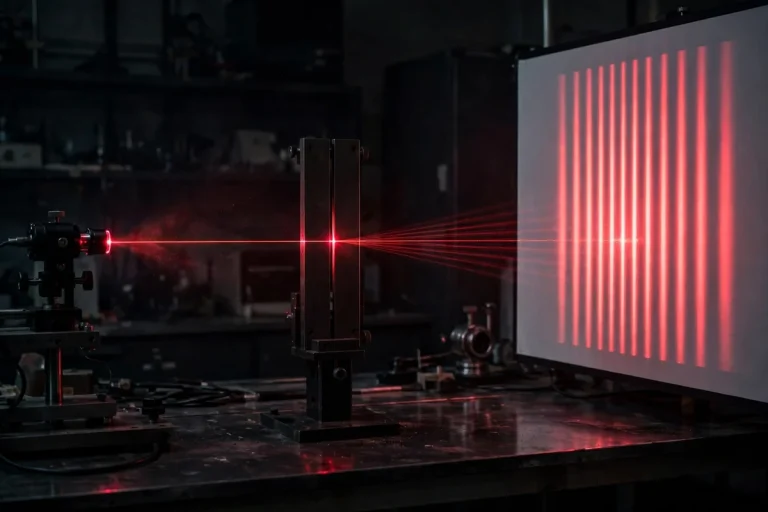
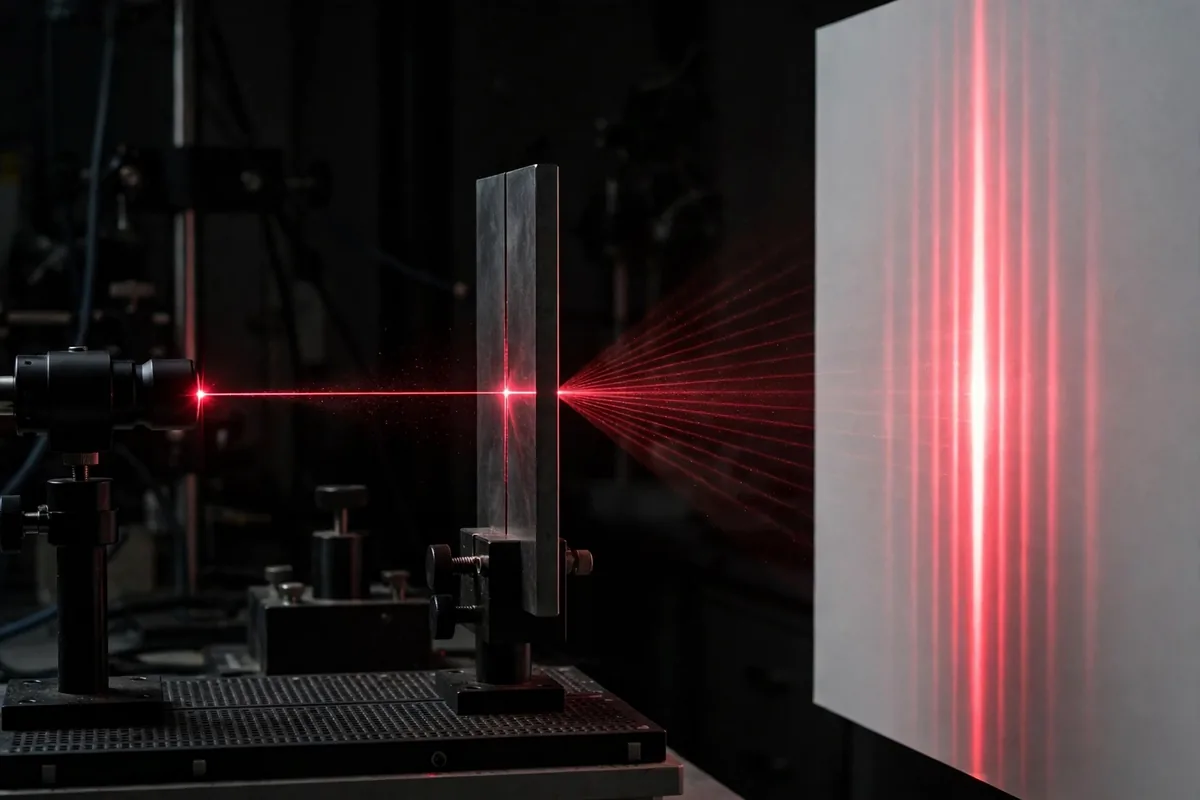
Shine a laser through a narrow slit and something surprising happens. You might expect the light to pass straight through and make a thin bright line on the screen, no wider than the slit itself. Instead, the bright spot spreads out. The narrower you make the slit, the wider the bright spot becomes. This is not a fault in your equipment. It is diffraction, and it is one of the clearest proofs that light travels as a wave.
Understanding what is diffraction opens the door to two of the most useful formulas in wave physics: the single-slit minima formula and the diffraction grating equation. In this article, you will learn what diffraction means in plain English, why a single slit produces its famous pattern of bright and dark bands, how a diffraction grating produces sharp, bright spectra, and how to use both formulas in exam-style problems.
Two fully worked examples are included, so you can see every step, including the unit conversions that catch so many students out.
What Is Diffraction, in Simple Terms
Diffraction is the spreading of waves as they pass through an aperture or around an obstacle. An aperture is simply an opening, such as a gap, a slit, or a hole. An obstacle is any object that blocks part of a wave. When a wave meets either one, it does not simply stop at the edges. It bends and spreads into the region behind the opening or obstacle, the region that simple straight-line thinking would call the shadow.
Diffraction happens to all waves. Light waves diffract, sound waves diffract, and water waves diffract. You hear diffraction every day without noticing it: sound from a room reaches you around a doorway because sound waves spread out after passing through the doorway. The effect is only noticeable, however, when the gap or obstacle is about the same size as the wavelength of the wave. The wavelength is the distance between one wave crest and the next identical crest.
That size condition explains why diffraction is easy to see with sound but needs special equipment for light. Sound waves in air have wavelengths of centimetres to metres, roughly the size of doorways and furniture.
Light waves have wavelengths of only a few hundred nanometres. A nanometre is one billionth of a metre. A doorway is far too large, compared with the wavelength of light, for any noticeable spreading to occur. But a slit a fraction of a millimetre wide is close enough to the wavelength of light for diffraction to become obvious.
Huygens’ Principle: Why Waves Spread
The explanation for diffraction comes from Huygens’ principle. This principle states that every point on a wavefront acts as a source of secondary wavelets. A wavefront is a surface joining all the points of a wave that are vibrating in step with each other. A wavelet is a tiny circular wave spreading out from one of those points.
When a wave passes through a narrow slit, only a small part of the wavefront gets through. The points within that small part each send out wavelets, and those wavelets spread out in all directions, including sideways into what would otherwise be shadow.
Where wavelets meet in step, they reinforce each other and produce brightness. Where they meet out of step, they cancel each other and produce darkness. This reinforcement and cancellation is called interference, and it is what creates the pattern of bright and dark bands on the screen.
Longer wavelengths spread more than shorter wavelengths. A wave with a longer wavelength bends further around an edge and spreads wider through a gap. That is why red light, which has a longer wavelength than blue light, diffracts more than blue light. Hold that idea in mind, because it explains why gratings split white light into a spectrum, with red on the outside.
Diffraction, Refraction and Interference: Do Not Mix Them Up
Students often confuse three words that sound similar but describe different things. Diffraction is the spreading of a wave through a gap or around an edge. Refraction is the bending of a wave when it passes from one medium into another, such as from air into glass, because its speed changes.
Interference is what happens when two or more waves meet and combine, reinforcing or cancelling each other. Diffraction patterns are produced by interference between wavelets, but diffraction itself is the spreading, not the combining. Keeping these three definitions separate will save marks.
Single Slit Diffraction
Single slit diffraction is the pattern produced when light passes through one narrow slit. Imagine shining a laser at a single slit and looking at the screen beyond it. You do not see a single thin line. You see a wide, bright band in the centre, called the central maximum. On either side of it are dimmer bright bands, called secondary maxima, separated by dark bands called minima.
A maximum is a bright fringe, where light arrives in step. A minimum is a dark fringe, where light cancels out.
The central maximum is the brightest part of the pattern, and it is twice as wide as the other maxima. This is because the central maximum stretches from the first minimum on one side to the first minimum on the other side, while each secondary maximum is squeezed between two neighbouring minima. The secondary maxima get dimmer the further they are from the centre, because less light energy reaches those angles.
The Single-Slit Minima Formula
The positions of the dark fringes are given by the single-slit minima formula:
a sin θ = mλ
Here, a is the width of the slit, measured in metres. The symbol θ (theta) is the angle between the straight-ahead direction and the direction of the minimum you are looking at. The symbol λ (lambda) is the wavelength of the light, also in metres. The symbol m is an integer: 1, 2, 3, and so on, counting the minima outwards from the centre. The first minimum on either side has m = 1, the second has m = 2, and so on.
One point causes more lost marks than any other: m = 0 is NOT a minimum. When m = 0, the formula gives sin θ = 0, which means θ = 0, the straight-ahead direction. That is the centre of the bright central maximum, not a dark fringe. The minima begin at m = 1. If you ever find yourself writing down a “zeroth minimum,” stop and correct it.
The formula also tells you how the pattern changes. If the slit width a gets smaller, sin θ gets larger for the same m, so the minima move further out and the pattern spreads wider. This is exactly the surprising laser demonstration from the introduction: a narrower slit gives a wider pattern. If the wavelength λ gets larger, sin θ also gets larger, so the pattern spreads wider too. Red light therefore gives a wider pattern than blue light through the same slit.
The Small-Angle Approximation
In most school and college experiments, the angles involved are very small, and the screen is far from the slit compared with the width of the pattern.
In that case, a useful simplification called the small-angle approximation applies. For small angles measured in radians, sin θ is approximately equal to tan θ, and both are approximately equal to y divided by L, where y is the distance from the centre of the pattern to the fringe on the screen, and L is the distance from the slit to the screen.
Using this approximation, the position of the mth minimum from the centre of the pattern is:
y = mλL / a
This form of the formula is very handy in the laboratory, because y and L are distances you can measure directly with a ruler, while θ is an angle you would have to calculate. Remember that this version only works when the angles are small. For large angles, you must go back to a sin θ = mλ and use the sine function properly.
The Width of the Central Maximum
The central maximum stretches from the first minimum on one side (m = 1) to the first minimum on the other side (m = 1). Each of those minima sits at a distance y = λL / a from the centre. Adding the two sides together gives the total width W of the central maximum:
W = 2λL / a
This formula is worth memorising because it appears so often in questions. It shows, in one line, that the central maximum gets wider when the wavelength increases or the screen moves further away, and narrower when the slit gets wider. It also shows why the central maximum is twice as wide as the gap between neighbouring minima elsewhere in the pattern: it spans two first-minimum distances, one on each side.
Worked Example 1: First Minimum of a Single Slit
A red laser of wavelength 650 nm shines through a single slit of width 0.10 mm. Find the angle to the first minimum. Then find the width of the central maximum on a screen 2.0 m from the slit.
Step 1: Convert Everything to Metres
Before touching the formula, convert all lengths to metres, the standard unit in physics. The wavelength is 650 nm. One nanometre is 10⁻⁹ metres, so 650 nm = 650 × 10⁻⁹ m = 6.50 × 10⁻⁷ m. The slit width is 0.10 mm. One millimetre is 10⁻³ metres, so 0.10 mm = 0.10 × 10⁻³ m = 1.0 × 10⁻⁴ m. Mixing nanometres and millimetres in the same calculation is a classic source of errors, so always convert first.
Step 2: Apply the Minima Formula
For the first minimum, m = 1. The formula a sin θ = mλ becomes:
sin θ = λ / a = (650 × 10⁻⁹) / (0.10 × 10⁻³) = 6.5 × 10⁻³
Taking the inverse sine gives θ ≈ 0.37 degrees. The angle is small, as expected for a single-slit pattern. If you had used m = 0 here, you would have got θ = 0, which is the centre of the bright maximum, not a dark fringe. That is why remembering that minima start at m = 1 matters.
Step 3: Find the Central Maximum Width
Now use the central maximum width formula with L = 2.0 m:
W = 2λL / a = 2 × (650 × 10⁻⁹) × 2.0 / (0.10 × 10⁻³) = 0.026 m
So the central maximum is about 2.6 cm wide. Notice how wide that is compared with the slit itself: the slit is only 0.10 mm wide, but the central bright band on the screen is 260 times wider. That dramatic spreading is diffraction in action, and it is the number your experiment should roughly confirm if you try it in the laboratory.
Diffraction Gratings and d sin θ = nλ
A diffraction grating is a plate containing thousands of equally spaced parallel slits, called lines. A typical school grating might have 300 or 600 lines per millimetre. Light passing through a grating is diffracted by every slit, and the waves from all the slits interfere with each other. The result is very different from the single-slit pattern, and much more useful.
The key quantity for a grating is the grating spacing, d. This is the distance between the centres of two neighbouring slits. It is not the width of one slit. If a grating has N lines per metre, then the spacing is:
d = 1 / N
The unit conversion here is the classic trap. Gratings are usually sold with their lines per millimetre printed on them, but the formula needs lines per metre. A grating with 600 lines per mm has 600 × 1000 = 600,000 lines per metre. Only then can you calculate d. Forgetting this factor of 1000 is one of the most common errors in grating questions, so write the conversion down explicitly every time.
Why Gratings Beat a Single Slit
A single slit produces broad, dim bands. A grating produces sharp, bright, narrow maxima. The reason is the number of slits involved. With thousands of slits contributing, the waves reinforce each other only at very precise angles, and cancel almost everywhere else. The bright fringes are therefore narrow and intense, and the dark regions between them are wide and truly dark. This sharpness is what makes gratings so valuable for measuring wavelengths accurately.
The Grating Equation
The positions of the bright maxima produced by a grating are given by the grating equation:
d sin θ = nλ
Here, d is the grating spacing, θ is the angle to the maximum, λ is the wavelength, and n is the order of the maximum. The order is an integer: 0, 1, 2, 3, and so on. The zeroth order, n = 0, is the straight-ahead bright maximum in the centre. The first-order maxima, n = 1, appear on both sides of the centre, then the second-order maxima, n = 2, further out, and so on.
Notice the crucial difference from the single-slit formula. The single-slit formula a sin θ = mλ gives the positions of MINIMA, the dark fringes. The grating equation d sin θ = nλ gives the positions of MAXIMA, the bright fringes. The two formulas look almost identical, but they describe opposite things. Swapping them is the single most common diffraction error, so always ask yourself first: am I looking for a dark fringe from one slit, or a bright fringe from a grating?
Maximum Number of Orders
There is a limit to how many orders a grating can produce. The sine of an angle can never be larger than 1, because sin θ = 1 corresponds to θ = 90 degrees, light travelling sideways along the grating. From the grating equation, sin θ = nλ / d, so nλ / d must be less than or equal to 1. In other words, the order n must satisfy:
n < d / λ
To find the maximum number of orders visible on each side of the centre, calculate d / λ and take the largest whole number smaller than it. If d / λ = 2.83, for example, then orders n = 1 and n = 2 are visible on each side, but n = 3 is not, because it would require sin θ greater than 1, which is impossible. Always round down, never up, when finding maximum orders.
White Light and Spectra
When white light passes through a grating, each wavelength diffracts at its own angle, because the grating equation links angle to wavelength. Red light, with its longer wavelength, diffracts furthest from the centre. Blue and violet light, with shorter wavelengths, stay closest to the centre. The result is that each order appears as a spectrum, a rainbow band, rather than a single bright line. Only the zeroth order stays white, because all wavelengths travel straight ahead at θ = 0.
This splitting of light by wavelength is the basis of the spectrometer, an instrument that measures the wavelengths present in a light source. Spectrometers are used to identify the chemical elements in stars from their starlight, to analyse atomic spectra in the laboratory, and to measure wavelengths with great precision. The same physics explains the rainbow colours you see on a CD or DVD: the closely spaced tracks on the disc act as a reflection grating, splitting white light into its colours.
Worked Example 2: First-Order Angle and Maximum Orders for a Grating
A diffraction grating has 600 lines per mm. It is illuminated with sodium light of wavelength 589 nm. Find the angle of the first-order maximum. Then find the maximum number of orders visible on each side of the centre.
Step 1: Convert Lines per mm to Lines per Metre
The grating has 600 lines per mm. There are 1000 mm in a metre, so the number of lines per metre is N = 600 × 1000 = 600,000 lines per metre. This conversion is the step students most often skip, and skipping it throws every later number out by a factor of 1000.
Step 2: Find the Grating Spacing d
The grating spacing is d = 1 / N = 1 / 600,000 = 1.67 × 10⁻⁶ m. In other words, neighbouring slits are about 1.67 micrometres apart. A micrometre is one millionth of a metre. This tiny spacing is why gratings diffract light through large, easily measurable angles, unlike a single slit, where the angles are fractions of a degree.
Step 3: Apply the Grating Equation
For the first-order maximum, n = 1. The grating equation d sin θ = nλ gives:
sin θ = λ / d = (589 × 10⁻⁹) / (1.67 × 10⁻⁶) = 0.353
Taking the inverse sine gives θ ≈ 20.7 degrees. Compare this with the single-slit example, where the first minimum sat at just 0.37 degrees. Grating angles are much larger and much easier to measure, which is another reason gratings are preferred for accurate wavelength measurements.
Step 4: Find the Maximum Number of Orders
The maximum order must satisfy n < d / λ. Calculating:
d / λ = (1.67 × 10⁻⁶) / (589 × 10⁻⁹) = 2.83
The largest whole number smaller than 2.83 is 2. So the second order is the highest order visible, and 2 orders are visible on each side of the centre, plus the zeroth order in the middle. The third order would require sin θ = 3 × 589 × 10⁻⁹ / 1.67 × 10⁻⁶ = 1.06, which is greater than 1 and therefore impossible. Checking that sin θ does not exceed 1 is a quick way to confirm your answer makes physical sense.
Common Mistakes
Diffraction questions are very predictable in what they test, and the same errors appear again and again. Watch out for these:
- Using a sin θ = mλ for maxima: the single-slit formula gives MINIMA, while the grating formula gives MAXIMA. Swapping them is the most common error of all.
- Forgetting to convert lines per mm to lines per metre before finding the grating spacing d. A grating labelled 600 lines per mm has 600,000 lines per metre.
- Mixing up slit width a and grating spacing d: a is the width of a single slit, while d is the distance between adjacent slits in a grating. They are different quantities with different formulas.
- Using m = 0 as a single-slit minimum: m = 0 is the centre of the bright central maximum. Single-slit minima start at m = 1.
- Leaving angles in the wrong mode on a calculator, or forgetting that sin θ cannot exceed 1 when finding maximum orders. If your calculation gives sin θ greater than 1, that order does not exist.
- Confusing diffraction with refraction: diffraction needs no change of medium, only a gap or an edge. Refraction happens when a wave enters a different medium and changes speed.
- Mixing units: nanometres, millimetres and metres in the same calculation will wreck an otherwise perfect method. Convert everything to metres first.
Conclusion: What Is Diffraction, in One Summary
Diffraction is the spreading of waves as they pass through a gap or around an obstacle, and it becomes noticeable when the gap or obstacle is about the same size as the wavelength. That simple idea, explained by Huygens’ principle, produces the single-slit pattern and the sharp spectra of a grating, and it proves that light behaves as a wave. Keep these key formulas together, and most diffraction questions become straightforward:
- Single-slit minima: a sin θ = mλ, where m = 1, 2, 3, and m = 0 is the centre of the bright maximum, not a minimum.
- Diffraction grating maxima: d sin θ = nλ, where n = 0, 1, 2 is the order of the maximum.
- Grating spacing: d = 1 / N, where N is the number of lines per metre.
- Central maximum width: W = 2λL / a.
- Small angles: sin θ ≈ tan θ ≈ y / L, so fringe position y = mλL / a.
The habit that ties all of this together is method, not memory: convert units to metres first, decide whether you need a minimum or a maximum, choose the right formula, and check that sin θ never exceeds 1. Do that, and the counterintuitive laser demo from the start of this article stops being a surprise and becomes a calculation you can do with confidence.
Frequently Asked Questions
What is diffraction, and why does light spread out after passing through a narrow slit?
Diffraction is the spreading of waves as they pass through an aperture or around an obstacle. Light spreads after a narrow slit because, by Huygens' principle, every point in the slit acts as a source of secondary wavelets that travel sideways into the shadow region. The effect is noticeable when the gap is about the same size as the wavelength, so a narrower slit produces a wider pattern.
What is the single slit diffraction formula a sin θ = mλ, and what does each symbol mean?
The single-slit minima formula is a sin θ = mλ, giving the positions of the dark fringes in a single-slit diffraction pattern. Here a is the slit width in metres, θ is the angle to the minimum, λ is the wavelength in metres, and m = 1, 2, 3 counts the minima outwards from the centre. Note that m = 0 is not a minimum; it is the centre of the bright central maximum.
How do you use the diffraction grating equation d sin θ = nλ to find the angle of a maximum?
Use d sin θ = nλ by first finding the grating spacing d = 1/N, where N is the number of lines per metre. Then rearrange to sin θ = nλ/d, insert the wavelength λ and the order n, and take the inverse sine to find θ. For example, the article's 600 lines per mm grating gives d = 1.67 × 10⁻⁶ m, and sodium light (589 nm) gives a first-order angle of about 20.7 degrees.
Why does a diffraction grating produce sharper and brighter maxima than a single slit?
A diffraction grating produces sharper and brighter maxima than a single slit because it has thousands of equally spaced slits instead of one. Waves from all those slits reinforce each other only at very precise angles given by d sin θ = nλ, and cancel almost everywhere else. The result is narrow, intense bright fringes separated by wide, truly dark regions, ideal for measuring wavelengths accurately.
How do you find the maximum number of orders produced by a diffraction grating using d sin θ = nλ?
Calculate d/λ and take the largest whole number smaller than it, because sin θ cannot exceed 1. Since d sin θ = nλ gives sin θ = nλ/d, any order requiring sin θ greater than 1 cannot exist. For the article's grating, d/λ = 2.83, so the highest visible order is n = 2, meaning 2 orders appear on each side of the centre plus the zeroth order.
Why does red light diffract more than blue light through a diffraction grating?
Red light diffracts more than blue light because it has a longer wavelength, and longer wavelengths spread more through a gap or grating. In the grating equation d sin θ = nλ, a larger λ gives a larger sin θ for the same order n, so red maxima sit further from the centre than blue maxima. This is why each grating order appears as a spectrum, with red furthest out.