How Does Light Get Polarised? Malus’s Law Explained
On a bright day, sunlight bouncing off a wet road or the surface of a lake can be almost blinding. Put on a pair of polarised sunglasses, and the glare fades dramatically, even though you can still see everything else clearly. Something about those lenses is doing far more than simply darkening the world. They are changing the light itself, in a very particular way.
That change is called polarisation, and the rule that predicts exactly how much light survives it is called Malus’s law. Ordinary light, such as sunlight or the light from a lamp, vibrates in every direction at once. A polariser is a filter that lets through only the part of the light that vibrates in one chosen direction, and blocks the rest. Once you understand that simple idea, Malus’s law stops looking like a formula to memorise and starts looking like common sense written in maths.
In this article, you will learn what polarised light actually means, how a polariser turns ordinary light into polarised light, and how to use Malus’s law to calculate the intensity of light that comes out the other side. You will also work through two fully worked examples, step by step, and learn the mistakes that catch students out most often in exams.
What polarised light actually means
To understand polarisation, you first need to picture light as a wave. A wave is a disturbance that travels through space, carrying energy from one place to another. Light is a particular kind of wave called an electromagnetic wave. That means it is made up of two fields that oscillate, or vibrate back and forth, as the wave travels: an electric field and a magnetic field.
When physicists talk about polarisation, they are talking about the direction of the electric field. The direction of polarisation of a light wave is defined as the direction in which its electric field vibrates. This is a convention, agreed by physicists everywhere, and it is worth fixing in your mind now: polarisation direction means electric field direction.
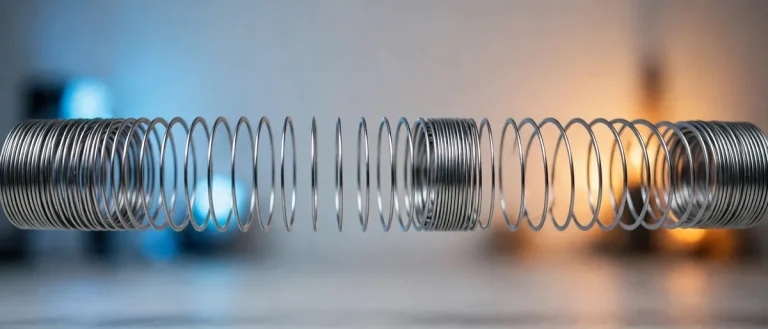
Light is also a transverse wave. In a transverse wave, the vibrations happen at right angles to the direction in which the wave is travelling. Imagine a rope tied at one end and shaken up and down at the other. The wave travels along the rope, but each part of the rope moves up and down, at right angles to the rope itself. Light behaves in a similar way: as it travels forward, its electric field vibrates from side to side, perpendicular to the direction of travel.
This sideways vibration is the key to everything that follows. Because the vibration is perpendicular to the direction of travel, there are many different planes in which it can happen. Picture the beam of light coming towards you, like an arrow pointing straight at your face. The electric field could vibrate up and down, side to side, diagonally, or in any other direction in the plane across the beam. All of these directions are perpendicular to the beam, and all of them are possible.
Ordinary, unpolarised light vibrates in all of these planes at once. The word unpolarised means that the light has no single preferred direction of vibration. At any instant, different waves in the beam are vibrating in different directions, and over a short time the beam as a whole contains vibrations in every direction across the beam. Sunlight is unpolarised. So is the light from an ordinary lamp, a candle flame, or a glowing filament. Nothing in those sources lines the vibrations up in one direction.
Polarised light is the opposite. In polarised light, the electric field vibrates in one plane only. Every wave in the beam vibrates in the same direction, across the beam. If the light is polarised vertically, for example, its electric field vibrates up and down and in no other direction. If it is polarised horizontally, the electric field vibrates from side to side only. The beam still travels in the same direction, and it still carries energy, but its vibrations have been tidied into a single plane.
There is one more point that examiners love to test, so it is worth stating plainly: only transverse waves can be polarised. The reason follows directly from what you have just read. Polarisation is about choosing one direction of vibration across the wave, and that choice only makes sense when the vibrations are across the wave in the first place. In a longitudinal wave, such as a sound wave, the vibrations happen along the direction of travel, not across it, so there is no set of sideways directions to choose between. Sound waves therefore cannot be polarised, but light waves can.
So far, this is all description. The natural next question is a practical one: if ordinary light vibrates in every direction, how can anything turn it into light that vibrates in only one direction? The answer is a device called a polariser, and understanding what it does is the heart of this topic.
How a polariser turns unpolarised light into polarised light
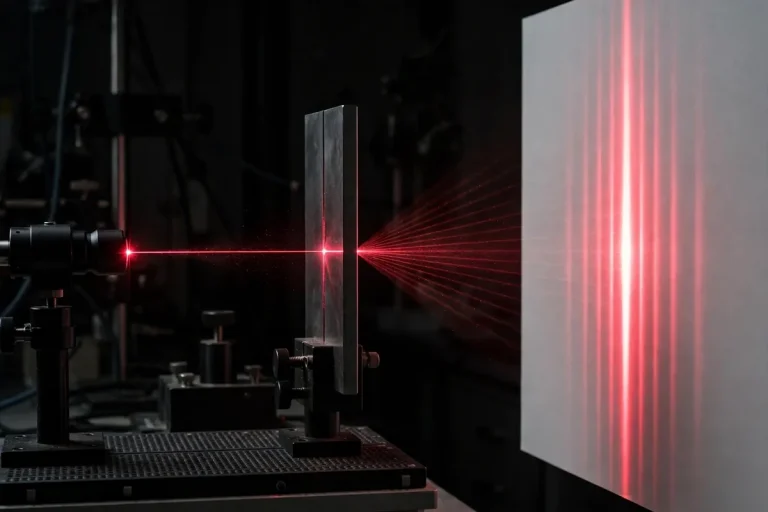
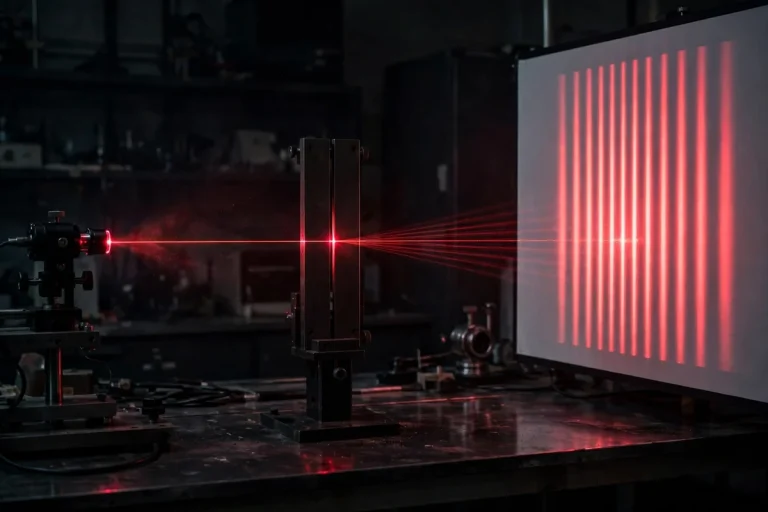
A polariser is a filter that passes light vibrating in one particular direction and absorbs the rest. The most familiar example is the material sold under the trade name Polaroid, used in polarised sunglasses and camera filters. You can think of a polariser as a kind of gate with a single permitted direction, called its transmission axis. The transmission axis is the direction of vibration that the polariser lets through. Light whose electric field vibrates along the transmission axis passes through the filter. Light vibrating in other directions does not get through in full.
It helps to picture the transmission axis as the direction of a set of parallel slits. A wave vibrating parallel to the slits slips through, while a wave vibrating at right angles to the slits is blocked. A real polariser does not literally contain slits, but the picture captures the essential behaviour: one direction is passed, the perpendicular direction is absorbed, and directions in between are passed only in part. How large that part is depends on the angle, and that is exactly what Malus’s law will quantify in the next section.
Now, what happens when unpolarised light falls on a single polariser? The beam contains vibrations in every direction across it, in roughly equal amounts. The polariser passes the component of each vibration that lies along its transmission axis and absorbs the rest. When you add up all the directions, the result is a beautifully simple rule: unpolarised light passing through one ideal polariser always halves in intensity.
Intensity is a measure of how much energy the light carries each second onto each square metre of surface, and it is measured in watts per square metre, written W/m². The symbol I0 is commonly used for the intensity of the light falling on the polariser, and I for the intensity of the light that comes out. For unpolarised light through one ideal polariser, the rule is:
I = I0/2
In words, the transmitted intensity is exactly half the incident intensity, whatever the orientation of the polariser. Turn the polariser so its transmission axis is vertical, and half the light gets through. Turn it horizontal, and still half gets through. Turn it to any diagonal angle, and the answer is still half. This surprises many students at first, but it makes sense once you remember that unpolarised light contains equal amounts of vibration in every direction. Whichever direction you choose as your transmission axis, you are always selecting the same fraction of the total: one half.
The reason for the one-half is worth understanding, because it explains the shape of Malus’s law too. For a single wave vibrating at an angle to the transmission axis, only the component of its electric field along the axis gets through, and intensity depends on the square of that component, as you will see shortly. Averaged over all possible angles, that squared component works out to exactly one half of the original. That is why the factor of one half appears, and why it does not depend on the orientation of the filter.
The light that emerges from the polariser is no longer unpolarised. It is now polarised, and its direction of polarisation is along the transmission axis of the polariser. The polariser has not created new light or changed the direction of travel. It has simply selected one direction of vibration and discarded the rest. From this point on, the beam behaves differently from unpolarised light, because it now has a single, definite polarisation direction. That difference matters enormously when the beam meets a second filter.
That second filter has a special name in this context: the analyser. An analyser is simply another polariser, used to test or examine light that is already polarised. The first polariser creates polarised light; the analyser is placed after it, and the amount of light that gets through the analyser depends on the angle between the two filters. It is for this second filter, acting on light that is already polarised, that Malus’s law proper applies. Confusing these two stages — the first polariser acting on unpolarised light, and the analyser acting on polarised light — is the single most common source of errors in this topic, so keep them clearly separate in your mind.
Malus’s law stated and derived in words
Malus’s law is named after Étienne-Louis Malus, a French physicist who studied polarised light in the early nineteenth century. It states the intensity of polarised light transmitted through a polariser, in terms of the angle between the light’s polarisation direction and the polariser’s transmission axis.
Suppose plane-polarised light of intensity I0 falls on a polariser, which here plays the role of the analyser. Let θ (the Greek letter theta) be the angle between the incoming light’s direction of polarisation and the transmission axis of the polariser. Then the transmitted intensity I is given by Malus’s law:
I = I0 cos²θ
Every symbol in this equation has a clear meaning, and you should be able to state each one in an exam. I is the intensity of the light transmitted through the polariser, in W/m². I0 is the intensity of the polarised light incident on the polariser, also in W/m². θ is the angle between the polarisation direction of the incoming light and the transmission axis of the polariser. The symbol cos means cosine, a trigonometric function, and cos²θ means the square of the cosine of θ: first find cos θ, then square the result.
Notice carefully what θ is, and what it is not. It is not the angle between the beam and the polariser, and it is not the angle at which the light strikes the surface. The light is normally assumed to strike the polariser head-on, travelling perpendicular to the filter. θ is measured in the plane across the beam: it is the angle between two directions in that plane, namely the direction in which the incoming light vibrates and the direction the polariser lets through. If those two directions line up, θ is zero. If they are at right angles, θ is 90 degrees.
Why does the formula involve cos²θ rather than simply cos θ? The derivation, explained in words, is short and elegant, and understanding it will help you remember the formula far better than rote memorisation. Start with the electric field. Let E0 be the amplitude of the electric field of the incoming polarised wave. Amplitude here means the maximum strength of the vibrating electric field. When this wave meets the polariser, only the component of the electric field parallel to the transmission axis gets through. Resolving the field into components, just as you would resolve a force into components along two directions, gives a transmitted amplitude of:
E = E0 cos θ
When θ is zero, the field is fully aligned with the transmission axis, cos 0° is 1, and the full amplitude gets through. When θ is 90 degrees, the field vibrates at right angles to the axis, cos 90° is 0, and nothing gets through. At intermediate angles, a fraction cos θ of the amplitude survives.
The final step is the link between amplitude and intensity. The intensity of a wave is proportional to the square of its amplitude. This is a general wave result: doubling the amplitude of a wave quadruples the energy it carries, because energy depends on the square of the disturbance. Applying that rule here, the transmitted intensity is proportional to the square of the transmitted amplitude, so it is proportional to (E0 cos θ)², which is E0² cos²θ. Since the incident intensity I0 is proportional to E0², the transmitted intensity becomes I = I0 cos²θ. That is the whole derivation: resolve the field, giving cos θ, then square it because intensity goes as amplitude squared, giving cos²θ.
The special cases of Malus’s law are worth learning, because they appear constantly in quick questions. When θ = 0°, the polarisation direction is parallel to the transmission axis, cos 0° = 1, cos²0° = 1, and the full intensity is transmitted: I = I0. When θ = 45°, cos 45° is approximately 0.707, squaring gives 0.5, and half the intensity is transmitted: I = I0/2. When θ = 90°, the polarisation direction is perpendicular to the transmission axis, cos 90° = 0, and nothing is transmitted: I = 0. This last case is called crossed polarisers: two polarisers with their transmission axes at right angles to each other block the light completely, at least in the ideal case.
It is also useful to know the value at 30 degrees and 60 degrees, since these angles appear in many textbook problems. Cos 30° is approximately 0.866, and squaring gives 0.75, so three quarters of the intensity is transmitted. Cos 60° is 0.5, and squaring gives 0.25, so one quarter of the intensity is transmitted. Notice the symmetry: the result at 60 degrees is one minus the result at 30 degrees, because cos 60° equals sin 30°, and the two cases swap the transmitted and absorbed fractions. A small table of these values is a handy thing to keep in your notes:
| Angle θ | cos θ | cos²θ | Transmitted intensity I |
|---|---|---|---|
| 0° | 1 | 1 | I0 (full transmission) |
| 30° | 0.866 | 0.75 | 0.75 I0 |
| 45° | 0.707 | 0.5 | I0/2 (half transmission) |
| 60° | 0.5 | 0.25 | I0/4 |
| 90° | 0 | 0 | 0 (crossed polarisers) |
Sometimes an exam question works backwards: you are given the incident and transmitted intensities and asked to find the angle of the polariser. For that, you need the inverse form of Malus’s law. Starting from I = I0 cos²θ, divide both sides by I0 to get I/I0 = cos²θ, then take the square root to get cos θ = √(I/I0), and finally take the inverse cosine to get:
θ = arccos(√(I/I0))
Here arccos means inverse cosine, the angle whose cosine is the given number, and √ means square root. For example, if the transmitted intensity is half the incident intensity, so I/I0 = 0.5, then √(0.5) is approximately 0.707, and arccos(0.707) is 45°, as you would expect from the table above. The inverse form is simply Malus’s law rearranged, and there is no need to memorise it separately if you can rearrange the original equation confidently.
With the law stated, derived, and tabulated, it is time to use it. The two worked examples that follow cover the two situations you will meet most often: a single analyser acting on already-polarised light, and a two-filter chain starting from unpolarised light.
Worked example 1: polarised light through an analyser at 30 degrees
Plane-polarised light of intensity 12 W/m² falls on an analyser whose transmission axis is at 30° to the polarisation direction of the light. Calculate the intensity of the transmitted light, and state the polarisation direction of the transmitted light.
Step 1: Identify what is given and what is asked for. The incident light is already plane-polarised, so Malus’s law applies directly. The incident intensity is I0 = 12 W/m². The angle between the polarisation direction and the transmission axis is θ = 30°. We need the transmitted intensity I.
Step 2: Write down Malus’s law. The law is I = I0 cos²θ. This is the correct formula here because the light falling on the analyser is already polarised. There is no halving step, because the light is not unpolarised.
Step 3: Find cos 30° and square it. Cos 30° = 0.866 (to three significant figures). Squaring this value gives cos²30° = 0.866² = 0.75. You may also know the exact value: cos 30° = √3/2, and squaring gives 3/4, which is 0.75. Either route gives the same result, and the exact fraction 3/4 makes the arithmetic particularly clean.
Step 4: Substitute the numbers into Malus’s law. I = 12 W/m² × 0.75 = 9 W/m². The transmitted intensity is therefore 9 W/m².
Step 5: State the polarisation direction of the transmitted light. The light that emerges from the analyser is polarised along the transmission axis of the analyser. Its vibrations are now aligned with the analyser’s axis, which is at 30° to the original polarisation direction. Each polariser, in other words, re-polarises the light along its own axis, and this is why a chain of polarisers can rotate the plane of polarisation step by step.
As a quick sense check, the answer should be less than 12 W/m² but more than half of it, because 30° is less than 45°, so more than half the intensity should survive. Nine is three quarters of twelve, which fits that expectation nicely. If you had accidentally used cos θ instead of cos²θ, you would have got 12 × 0.866 = 10.4 W/m², which is wrong — a useful reminder of why the square matters.
Worked example 2: unpolarised light through two polarisers at 60 degrees
Unpolarised light of intensity I0 passes through a polariser and then through an analyser whose transmission axis is at 60° to the transmission axis of the first polariser. Calculate the final transmitted intensity in terms of I0. Also check what happens if the analyser is crossed with the first polariser, at 90°.
Step 1: Deal with the first polariser. The light falling on the first polariser is unpolarised, so Malus’s law does not apply directly here. Instead, use the halving rule from earlier: unpolarised light through one ideal polariser always halves in intensity. After the first polariser, the intensity is I1 = I0/2. The light is now polarised along the transmission axis of the first polariser.
Step 2: Deal with the analyser using Malus’s law. The light falling on the analyser is now polarised, so Malus’s law applies. The angle between the light’s polarisation direction (the first polariser’s axis) and the analyser’s transmission axis is θ = 60°. Malus’s law gives the final intensity I = I1 cos²θ.
Step 3: Find cos²60°. Cos 60° = 0.5. Squaring gives cos²60° = 0.5² = 0.25. Only one quarter of the light reaching the analyser gets through it.
Step 4: Combine the two steps. The final intensity is I = (I0/2) × 0.25 = I0/8. In other words, one eighth of the original unpolarised intensity emerges from the pair of polarisers. If you prefer percentages, that is 12.5 percent of the original intensity.
Step 5: Stress the point that students most often get wrong. The first step was halving, not Malus’s law. If you had applied Malus’s law directly to the unpolarised light, you would have needed an angle θ, but unpolarised light has no single polarisation direction, so there is no angle to put into the formula. The halving rule is the correct treatment for the first polariser, and Malus’s law takes over only once the light has a definite polarisation direction.
Step 6: The crossed-polariser check. If the analyser is rotated to 90° to the first polariser, so the two transmission axes are perpendicular, then θ = 90°, cos 90° = 0, and cos²90° = 0. The final intensity is I = (I0/2) × 0 = 0. No light at all emerges from the crossed pair, in the ideal case. This is a striking result: two filters that each transmit half the light on their own transmit nothing at all when crossed. It is also a memorable check on your understanding — if a calculation for crossed polarisers gives anything other than zero, something has gone wrong.
Finally, a short note on a famous surprise that follows from this example. Suppose you have two crossed polarisers, which transmit nothing, and you insert a third polariser between them at an intermediate angle, say 45° to each. Light now gets through. The middle polariser takes the light polarised by the first filter and re-polarises it along its own axis at 45°, so some of it can then pass the final analyser, which is at 45° to the middle polariser rather than 90° to the original direction.
Working through the steps, the first polariser halves the intensity to I0/2, the middle polariser at 45° halves it again to I0/4, and the final analyser at 45° halves it once more to I0/8. So inserting an extra filter, which you might expect to block even more light, actually lets one eighth of the original intensity through where before there was none.
The explanation is that each polariser resets the polarisation direction to its own axis, so the final analyser no longer faces light polarised at 90° to it. It is a beautiful demonstration that polarisers select a direction rather than simply dimming light by a fixed amount.
Common mistakes
Malus’s law is short, but it is easy to misuse. The following mistakes appear again and again in student work, and avoiding them will save you marks.
First, applying Malus’s law directly to unpolarised light instead of halving first. Malus’s law applies only to light that is already polarised. If the incident light is unpolarised, the first step is always I = I0/2, and Malus’s law is used only for subsequent polarisers. Ask yourself at the start of every question: is the light falling on this filter polarised or unpolarised? That one question determines which rule to use.
Second, using cos θ instead of cos²θ. The transmitted amplitude involves cos θ, but intensity involves the square of the amplitude, so the intensity formula must contain cos²θ. Forgetting the square overestimates the transmitted intensity at every angle except 0° and 90°, where the two forms happen to agree.
Third, measuring θ from the wrong reference. θ is the angle between the incoming polarisation direction and the transmission axis of the polariser. It is not the angle between the beam and the polariser, and it is not the angle between the transmission axis and the direction of travel. If a question gives you an angle measured from some other reference, you may need to work out the angle between the two directions in the plane across the beam before using the formula.
Fourth, assuming crossed polarisers transmit half the light. It is tempting to think that a second filter always halves the intensity again, by analogy with the first polariser. But the first polariser halves unpolarised light for a different reason, the averaging over all directions. For polarised light through a crossed analyser, θ = 90° and Malus’s law gives exactly zero, not half.
Fifth, forgetting that real polarisers are not ideal. The formulas in this article describe ideal polarisers, which transmit all light vibrating along their axis and absorb everything else. Real polarisers absorb a small amount of even the in-axis light, and transmit a tiny amount of the perpendicular component, so measured intensities sit slightly below the ideal predictions. In exam questions, unless you are told otherwise, use the ideal formulas; but in a laboratory, expect your readings to come in a little low, and do not be puzzled when they do.
Finally, a smaller but common slip: forgetting to square the cosine when using the inverse form. The inverse form is θ = arccos(√(I/I0)), with a square root inside the inverse cosine, precisely because the original law contains a square. If you write θ = arccos(I/I0) instead, you will get the wrong angle. Rearranging carefully, one step at a time, avoids this error.
Conclusion
Polarised light is light whose electric field vibrates in a single plane, and a polariser produces it by passing only the component of vibration along its transmission axis. Malus’s law then tells you exactly how much intensity survives when polarised light meets a further polariser. To recap, the key formulas of this article are as follows. Unpolarised light through one polariser: I = I0/2. Polarised light through an analyser, which is Malus’s law itself: I = I0 cos²θ. And the inverse form, for finding an angle from measured intensities: θ = arccos(√(I/I0)).
The one-sentence takeaway is this: a polariser does not dim light by a fixed fraction — it keeps only the component vibrating along its axis, and Malus’s law tells you exactly how much that is. Keep the distinction between the halving rule for unpolarised light and Malus’s law for polarised light clear, remember to square the cosine, and measure θ between the polarisation direction and the transmission axis, and you will be able to handle any polariser question an exam can put in front of you.
Frequently Asked Questions
What is Malus's law, and what does each symbol in I = I0 cos²θ mean?
Malus's law states that polarised light of intensity I0 passing through a polariser emerges with intensity I = I0 cos²θ. Here, I is the transmitted intensity, I0 is the incident polarised intensity, and θ is the angle between the incoming polarisation direction and the polariser's transmission axis. The cosine is squared because intensity is proportional to the square of the electric field amplitude.
Why does unpolarised light lose exactly half its intensity through a polariser instead of following Malus's law directly?
Unpolarised light loses half its intensity because it vibrates equally in every direction across the beam, so no single polarisation angle θ exists to put into Malus's law. The polariser passes only the component of each vibration along its transmission axis and absorbs the rest. Averaged over all directions, the squared component equals one half, giving I = I0/2 whatever the polariser's orientation.
What happens to polarised light passing through crossed polarisers according to Malus's law?
Crossed polarisers transmit no light at all in the ideal case. When the analyser's transmission axis is at 90° to the incoming polarisation direction, θ = 90°, cos 90° = 0, and Malus's law gives I = I0 cos²90° = 0. Each filter alone would transmit half the original unpolarised light, but crossed together they block it completely because the polarised light vibrates perpendicular to the analyser's axis.
How do you use Malus's law to work out the angle of a polariser from the transmitted intensity?
You rearrange Malus's law into its inverse form, θ = arccos(√(I/I0)). First divide the transmitted intensity I by the incident polarised intensity I0, then take the square root, and finally take the inverse cosine of the result. For example, if I/I0 = 0.5, then √(0.5) is about 0.707, and arccos(0.707) = 45°, matching the article's table of special cases.
Does Malus's law apply to unpolarised light, or only to light that is already polarised?
Malus's law applies only to light that is already polarised. It describes polarised light meeting an analyser, where θ is the angle between the light's polarisation direction and the transmission axis. Unpolarised light has no single polarisation direction, so it must first pass through a polariser, which halves its intensity to I0/2; only then can Malus's law be applied to any further polariser.
Why does putting a third polariser between two crossed polarisers let some polarised light through under Malus's law?
A third polariser between crossed polarisers lets light through because each polariser re-polarises the light along its own transmission axis. Inserted at 45° to each crossed filter, the middle polariser passes half the light from the first, and the final analyser, now at 45° rather than 90° to the light's polarisation, passes half again. The result is I0/8 transmitted where crossed polarisers alone transmitted nothing.