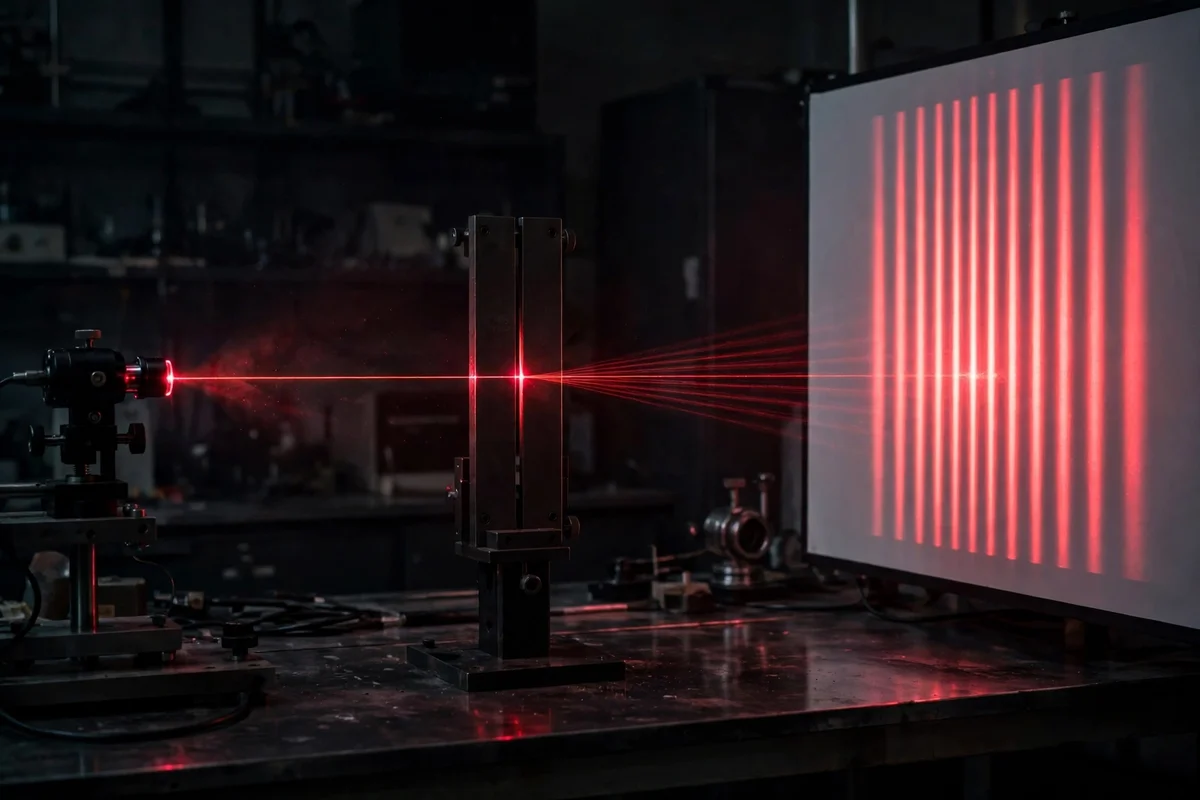
Young’s Double Slit Experiment: Proof That Light Is a Wave
In 1801, Thomas Young shone light through two narrow slits and got a result that should have been impossible. If light were a stream of tiny particles, the screen behind the slits would show two bright stripes, one behind each slit. Young saw something else entirely: a row of alternating bright and dark bands stretching across the screen.
That pattern has only one explanation. Waves from the two slits overlap, add up in some places, and cancel in others. Young’s double slit experiment proved that light behaves as a wave, and it ended a debate that had run for two hundred years.
This article walks through the setup Young used, the geometry behind the pattern, the fringe width formula, and two worked examples you can copy into your own revision notes. Every term gets defined before it is used, and every formula comes with the reason it works.
Two Hundred Years of Arguing About Light
Long before Young, two famous physicists had taken opposite sides. Christiaan Huygens argued in 1678 that light travels as a wave, spreading out like ripples on water.
Isaac Newton argued that light travels as a stream of tiny particles, which he called corpuscles. Newton’s version won the argument for the next century. His reputation was enormous, and his particle model explained reflection and refraction neatly enough that few people questioned it.
The wave model had a problem nobody could solve at the time. Waves bend around corners.
Light, as far as anyone could see, travels in straight lines and casts sharp shadows. If light were a wave, why did it not spread around every obstacle the way sound does? Huygens had no good answer, and the question sat unanswered for a hundred years.
Young found a way to test the two models against each other. He set up a simple arrangement. First, sunlight passed through a single narrow slit.
That slit acted as a single point source, so the light leaving it had one steady phase. Then that light reached a card with two narrow parallel slits cut into it, placed very close together. A screen stood some distance behind the card.
The single slit mattered more than it looks. Interference needs two sources that stay in step with each other, and physicists call such sources coherent. Coherent means the two sources keep a constant phase difference over time.
Ordinary light from two separate bulbs is not coherent, because each bulb emits light in short random bursts. Light from one slit, split into two by the double slit, stays in step because both halves come from the same source. Without that first slit, Young would have seen nothing but a blur.
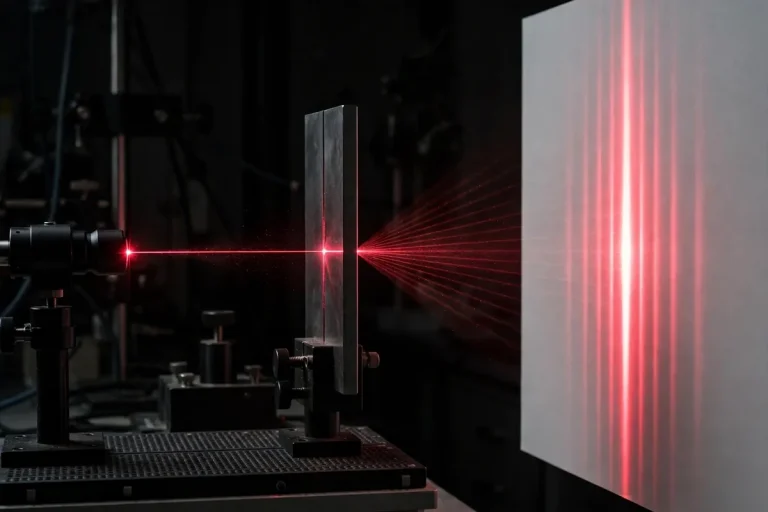
What appeared on the screen settled the argument. Instead of two bright stripes, Young saw a whole series of bright and dark bands, evenly spaced, fading gently toward the edges. Particles cannot do that.
A particle either hits the screen or it does not, and two slits would give two piles of hits. Only waves produce a pattern of places where they reinforce each other and places where they cancel out. Young published the result in 1801, and the particle model of light never fully recovered.
One detail is worth noting because students often miss it. A single slit on its own gives no interference pattern. Light passing through one slit spreads out by diffraction, which is the bending of a wave as it passes an opening, and it forms one broad bright patch with faint edges.
You need two slits, two coherent sources, before the bright and dark bands appear. The single slit in Young’s setup exists only to make the light coherent. The double slit does the interfering.
Why Two Slits Make Bands Instead of Two Stripes
Picture the two slits as two tiny sources of waves, side by side, sending out wave trains that spread and overlap on their way to the screen. At any point on the screen, the light arriving from the two slits has travelled slightly different distances. That difference in distance is called the path difference, and it decides whether the two waves add up or wipe each other out.
Call the distance between the two slits d, and call the angle between the straight ahead direction and the point on the screen theta. Then the path difference, written as the Greek letter delta, is:
delta = d sin theta
That is the core geometry of the whole experiment. One slit sits a little further from a given point on the screen than the other slit, and the extra distance is d sin theta. Everything else follows from asking what that extra distance does to the two waves when they meet.
When the path difference equals a whole number of wavelengths, the two waves arrive in step. Crest meets crest, trough meets trough, and the waves reinforce each other. That is constructive interference, and it produces a bright fringe, which is one of the bright bands on the screen. The condition is:
delta = n lambda (bright fringe)
Here lambda is the wavelength of the light, and n is a whole number: 0, 1, 2, 3, and so on. Physicists call n the order of the fringe. The central bright band, straight ahead, is the zeroth order fringe, n = 0, because the path difference there is zero and the two waves arrive exactly together.
When the path difference equals a half wavelength, or one and a half, or two and a half, the two waves arrive exactly out of step. Crest meets trough, and the waves cancel each other. That is destructive interference, and it produces a dark fringe. The condition is:
delta = (n + 1/2) lambda (dark fringe)
So the screen shows bright bands wherever the path difference is a whole number of wavelengths, and dark bands wherever it is a half number of wavelengths. Between them, the brightness rises and falls smoothly.
The intensity at any point follows the formula I = 4 I0 cos squared (phi / 2), where I0 is the intensity from one slit alone and phi is the phase difference between the two waves. At the centre of a bright fringe the intensity reaches four times the intensity of one slit, not two, because the amplitudes add before the intensity is squared. At the centre of a dark fringe the intensity drops to zero.
In practice, nobody measures angles on the screen. They measure distances.
Let D be the distance from the slits to the screen, and let y be the distance from the central maximum to a fringe on the screen. For the small angles used in this experiment, sin theta is very close to tan theta, and tan theta equals y / D. That turns the path difference formula into a formula for fringe positions:
y = n lambda D / d (bright fringes)
y = (n + 1/2) lambda D / d (dark fringes)
The central maximum sits at y = 0, which is n = 0. The first bright fringe on either side sits at n = 1, the second at n = 2, and so on.
The dark fringes sit halfway between the bright ones. That even spacing is the signature of the pattern, and it is also what makes the experiment useful as a measuring tool. If you can measure the positions of the fringes, you can work backwards and find the wavelength of the light, which is exactly what the second worked example below does.
A real pattern is not perfectly uniform all the way across. Each slit is itself a narrow opening, so each one also diffracts the light and spreads it into a broad envelope with a bright centre that fades outward. The interference bands sit inside that envelope, so the fringes near the centre look brightest and the ones further out look dimmer.
Textbooks often draw the pattern as even stripes for simplicity, but in a real laboratory the outer fringes fade. That fading does not change the positions of the fringes or the fringe width formula. It only changes how bright they look.
Fringe Width: One Formula, Three Levers
The distance between two neighbouring bright fringes, or between two neighbouring dark fringes, is called the fringe width, written as the Greek letter beta. It is the same for every fringe in the pattern. Subtract the position of one bright fringe from the position of the next, using y = n lambda D / d, and the n cancels out:
beta = lambda D / d
That one line is the most useful formula in Young’s double slit experiment, and it is the one exam questions ask for most often. It says the fringe width depends on three things, and each one pulls in a clear direction. A longer wavelength gives wider fringes.
A screen placed further away gives wider fringes. Slits placed further apart give narrower fringes. Change any one of the three, and the pattern stretches or squeezes in a way you can predict before you touch the apparatus.
Colour makes the effect easy to see. Red light has a wavelength around 650 nanometres, while blue light sits around 450 nanometres. Run the experiment with a red laser and then with a blue laser, keeping the slits and the screen in the same place, and the red pattern spreads out wider.
The ratio is simple: the fringe width scales directly with wavelength, so red fringes are roughly one and a half times as wide as blue ones. That is why exam questions love asking what happens when the colour changes. The answer is always a direct proportion, never a guess.
White light tells a different story again. White light contains every visible wavelength at once, and each wavelength makes its own set of fringes with its own width. At the centre, where n = 0, every wavelength has a bright fringe at exactly the same place, so the central maximum stays white.
Move outward, and the colours separate. The red fringes spread further than the blue ones, so the edges of the pattern show coloured bands, violet nearest the centre and red furthest out. Students who expect white light to give the same clean pattern as a laser get a surprise the first time they see it, but the physics is the same. Each wavelength is simply obeying beta = lambda D / d on its own.
The medium matters too. If the whole experiment is carried out in a medium with refractive index mu, such as water, the wavelength of the light inside that medium shrinks to lambda / mu. The fringe width shrinks by the same factor:
beta in a medium = beta / mu
Water has a refractive index of about 1.33, so fringes formed under water are about three quarters as wide as the same fringes in air. That variation shows up in exam questions regularly, and it follows straight from the wavelength change. Nothing else in the setup needs to change.
One more practical point. The formula beta = lambda D / d only holds when the screen sits far from the slits compared with the slit separation, which is the usual laboratory arrangement.
In that case the small angle approximation holds, the fringes stay evenly spaced, and the formula is accurate. If the screen were pushed very close to the slits, the approximation would break down and the fringe spacing would stop being uniform. Real experiments keep D much larger than d, often by a factor of thousands, so the simple formula is the one that matters.
Worked Example 1: Fringe Spacing From a Red Laser
A laser of wavelength 633 nm shines through two slits 0.50 mm apart onto a screen 2.5 m away. Find the fringe spacing.
Start by writing down what you know, and convert every length to metres before you touch the formula. Mixing units is the single most common error in this topic, and converting first removes it entirely.
Step 1: list the given values. Wavelength lambda = 633 nm. Slit separation d = 0.50 mm. Screen distance D = 2.5 m.
Step 2: convert to metres. One nanometre is 10 to the power of minus 9 metres, so lambda = 633 x 10 to the power of minus 9 m, which is 6.33 x 10 to the power of minus 7 m. One millimetre is 10 to the power of minus 3 metres, so d = 0.50 x 10 to the power of minus 3 m, which is 5.0 x 10 to the power of minus 4 m. D is already in metres at 2.5 m.
Step 3: write the fringe width formula. beta = lambda D / d.
Step 4: substitute the numbers. beta = (6.33 x 10 to the power of minus 7 m) x (2.5 m) / (5.0 x 10 to the power of minus 4 m).
Step 5: work out the numbers first. 6.33 x 2.5 = 15.825.
Then 15.825 / 5.0 = 3.165. Now the powers of ten: 10 to the power of minus 7 divided by 10 to the power of minus 4 gives 10 to the power of minus 3. So beta = 3.165 x 10 to the power of minus 3 m.
Step 6: convert the answer into a sensible unit. 3.165 x 10 to the power of minus 3 m equals 3.165 mm, which rounds to 3.2 mm.
Neighbouring bright fringes sit 3.2 mm apart on the screen, which is wide enough to measure with an ordinary ruler. That is why a red laser and a two and a half metre throw make such a good classroom demonstration. The fringes are big enough to see clearly and to measure without special equipment.
Worked Example 2: Measuring a Wavelength From the Fringes
The third bright fringe sits 12 mm from the central maximum. The slits are 0.25 mm apart and the screen is 1.5 m away. Find the wavelength of the light.
This example runs the formula backwards. Instead of starting from a known wavelength, you start from a measured fringe position and work out the wavelength. That is how Young himself could have measured the wavelength of light, and it is still how the measurement is done in school laboratories today.
Step 1: list the given values. Distance of the fringe from the centre y = 12 mm.
Order of the fringe n = 3, because it is the third bright fringe. Slit separation d = 0.25 mm. Screen distance D = 1.5 m.
Step 2: convert the lengths to metres. y = 12 mm = 12 x 10 to the power of minus 3 m, which is 1.2 x 10 to the power of minus 2 m. d = 0.25 mm = 0.25 x 10 to the power of minus 3 m, which is 2.5 x 10 to the power of minus 4 m. D is already 1.5 m.
Step 3: start from the bright fringe position formula. y = n lambda D / d. Rearrange it to solve for lambda. Multiply both sides by d and divide both sides by n D, which gives lambda = y d / (n D).
Step 4: substitute the numbers. lambda = (1.2 x 10 to the power of minus 2 m) x (2.5 x 10 to the power of minus 4 m) / (3 x 1.5 m).
Step 5: work out the numbers first. 1.2 x 2.5 = 3.0. The denominator is 3 x 1.5 = 4.5.
So 3.0 / 4.5 = 0.667. Now the powers of ten: 10 to the power of minus 2 times 10 to the power of minus 4 gives 10 to the power of minus 6. So lambda = 0.667 x 10 to the power of minus 6 m, which is 6.67 x 10 to the power of minus 7 m.
Step 6: convert the answer into nanometres. 6.67 x 10 to the power of minus 7 m equals 667 nm. Now check that the answer makes sense.
Visible light runs from about 400 nm for violet to about 700 nm for red. A wavelength of 667 nm sits near the red end of that range, so the answer is plausible for visible light. If the calculation had given 6.67 nm or 6670 nm, something would have gone wrong with the units, because neither value belongs to visible light. That quick range check catches most unit errors before they reach the answer line.
Common Mistakes That Cost Marks
The first mistake is confusing the slit separation d with the screen distance D. The two letters look alike in a hurry, and swapping them wrecks the answer. Keep them straight by remembering what each one measures.
Lowercase d is the tiny gap between the two slits, measured in fractions of a millimetre. Capital D is the long throw from the slits to the screen, measured in metres. They differ by a factor of thousands, so a swap is easy to spot if you check the size of your answer.
The second mistake is using the fringe width formula for a single fringe position. Beta = lambda D / d gives the gap between two neighbouring fringes.
It does not give the distance from the centre to one fringe. That distance needs the order number n, so use y = n lambda D / d instead. If a question says “the third bright fringe”, the n = 3 belongs in the calculation, and beta alone cannot answer it.
The third mistake is forgetting to convert millimetres and nanometres to metres before dividing. Wavelengths arrive in nanometres, slit separations in millimetres, and fringe positions in millimetres, while the screen distance arrives in metres. Put them all into metres first, every time, and the powers of ten take care of themselves. A wavelength left in nanometres gives an answer a billion times too large, and no examiner gives partial credit for a fringe width wider than the room.
The fourth mistake is counting the central maximum as the first fringe instead of the zeroth. The central bright band is n = 0.
The first bright fringe on either side is n = 1. Students who start counting at the centre and call it the first fringe end up one order out, and their fringe position comes out wrong by a whole fringe width. Count from the centre, but call the centre zero.
The fifth mistake is expecting white light to give the same pattern as a laser. A laser gives one wavelength, so it gives one clean set of evenly spaced fringes. White light gives every wavelength at once, so only the central fringe stays white.
The rest of the pattern spreads into coloured bands. The formula still applies, but it applies separately to each wavelength. If a question switches the light source from a laser to white light, the pattern changes shape even though the apparatus stays exactly the same.
What Young’s Double Slit Experiment Leaves You With
Young’s double slit experiment settled the nature of light with a pattern on a screen. Two slits, one source of coherent light, and a row of bright and dark bands that particles could never produce. The formulas behind that pattern are few, and they are worth keeping in one place.
Path difference: delta = d sin theta. Bright fringes appear where the path difference is a whole number of wavelengths: delta = n lambda.
Dark fringes appear where it is a half number of wavelengths: delta = (n + 1/2) lambda. Fringe positions on the screen follow y = n lambda D / d for bright fringes and y = (n + 1/2) lambda D / d for dark fringes. Fringe width, the gap between neighbouring fringes, is beta = lambda D / d, and in a medium of refractive index mu it becomes beta / mu.
Those five lines carry the whole experiment. They explain why the pattern forms, where each band sits, how wide the bands are, and how to measure a wavelength from them.
And they carry the conclusion that made the experiment famous. Only waves interfere. The pattern exists, so light is a wave.
Frequently Asked Questions
What does Young's double-slit experiment prove about the nature of light?
It proves that light behaves as a wave. When light from one coherent source passes through two narrow slits, the two wave trains overlap and produce a row of alternating bright and dark fringes on the screen. A stream of particles could only produce two bright stripes, one behind each slit. Only waves interfere, reinforcing in some places and cancelling in others, so the pattern itself is the proof that light is a wave.
What is the fringe width formula in Young's double-slit experiment?
The fringe width is beta = lambda D / d, where lambda is the wavelength of the light, D is the distance from the slits to the screen, and d is the separation between the two slits. Beta is the distance between two neighbouring bright fringes, or between two neighbouring dark fringes, and it is the same for every fringe in the pattern. That value comes from the fringe positions y = n lambda D / d.
Why do bright fringes appear in Young's double-slit experiment when the path difference is n lambda?
Bright fringes appear because the two waves arrive in step and reinforce each other. When the path difference delta = d sin theta equals a whole number of wavelengths, delta = n lambda, crest meets crest and trough meets trough. This is constructive interference, and the intensity at the centre of a bright fringe reaches 4 I0, four times the intensity from one slit alone. The central bright band, straight ahead, is the zeroth order fringe, n = 0.
Why do dark fringes appear in Young's double-slit experiment when the path difference is (n + 1/2) lambda?
Dark fringes appear because the two waves arrive exactly out of step and cancel each other. When the path difference delta = d sin theta equals a half number of wavelengths, delta = (n + 1/2) lambda, crest meets trough. This is destructive interference, and the intensity at the centre of a dark fringe drops to zero. Dark fringes sit halfway between the bright fringes, at positions y = (n + 1/2) lambda D / d.
How does the fringe width beta = lambda D / d change if the slit separation d is doubled?
Doubling the slit separation d halves the fringe width beta. In the formula beta = lambda D / d, the slit separation sits in the denominator, so doubling d while keeping the wavelength lambda and the screen distance D unchanged cuts beta to half its original value. The fringes move closer together and the whole pattern squeezes, which is why slits placed further apart give narrower fringes.
How can Young's double-slit experiment be used to measure the wavelength of light?
It measures wavelength by working the fringe position formula backwards. Measure the distance y from the central maximum to a bright fringe of known order n, along with the slit separation d and the screen distance D. Then use y = n lambda D / d rearranged as lambda = y d / (n D). In the example, the third bright fringe at 12 mm gives lambda = 667 nm, which sits near the red end of the visible range.