What Are Standing Waves? Nodes, Antinodes and Resonance Explained
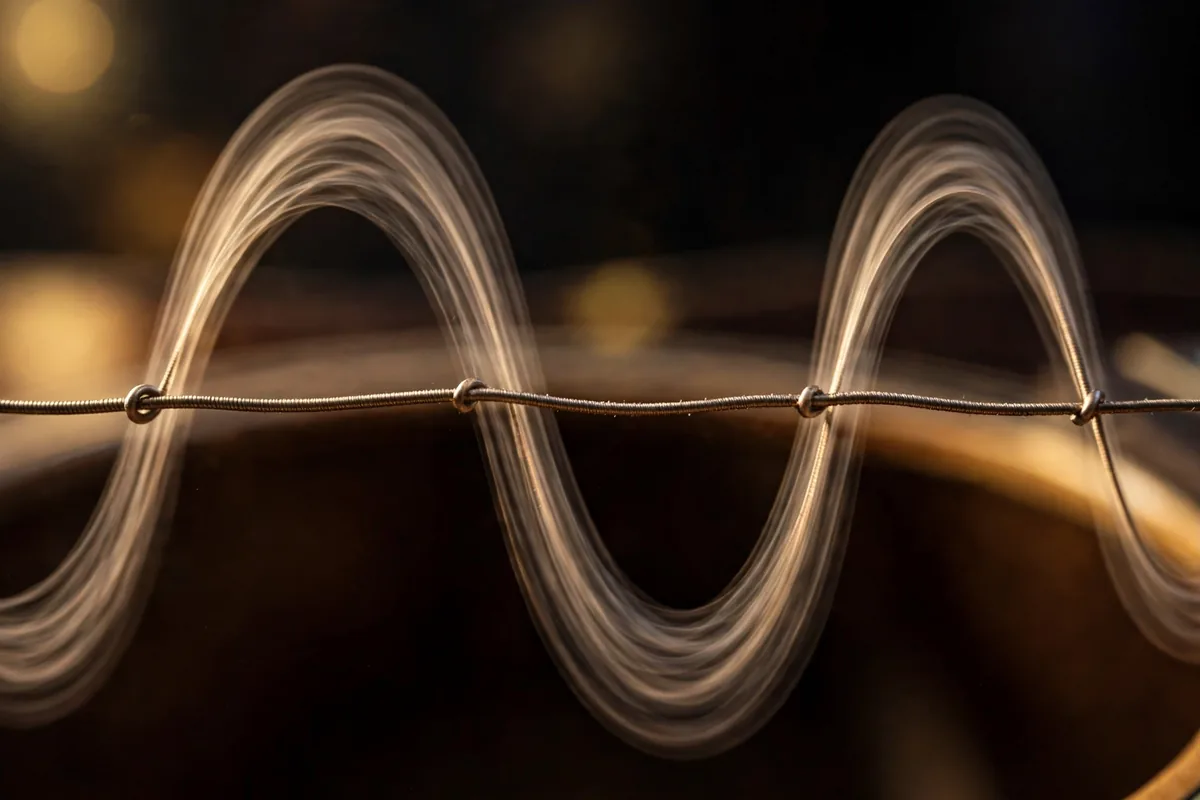
Pluck a guitar string and watch it closely. Instead of a ripple running from one end to the other, the string seems to vibrate in a fixed shape, with some points swinging widely and others staying perfectly still. That frozen-looking pattern is one of the most striking sights in wave physics, and it is called a standing wave.
Standing waves appear on musical instruments, in organ pipes, in microwave ovens, and even in the vibrations of bridges and buildings. In this article you will learn exactly how standing waves form, what nodes and antinodes are, where they sit, and how to calculate the allowed frequencies for strings and pipes.
Before we go further, let us define the key idea in plain language. A standing wave is a vibration pattern that stays in one place in a medium, with fixed points of no motion and fixed points of maximum motion. It is formed when two identical waves travel in opposite directions through the same medium and add together. The waves themselves are still moving, but their combined pattern does not travel.
That is why it is called “standing”: the pattern stands still even though the energy is in motion underneath it.
How a standing wave forms
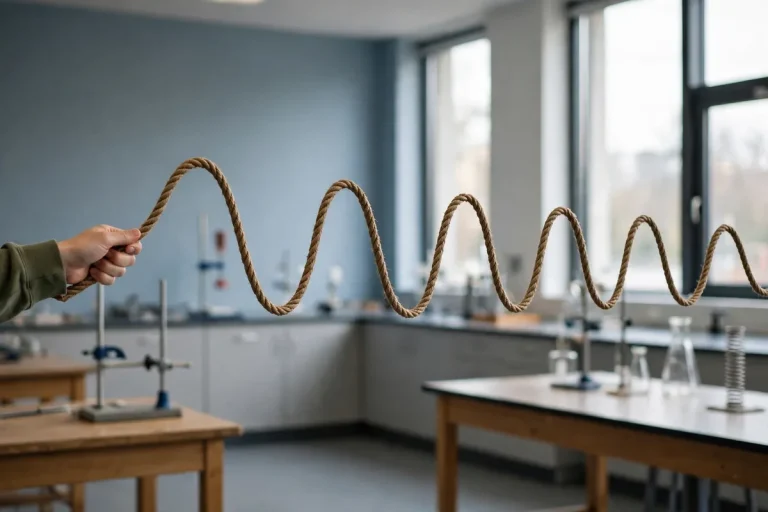
To understand a standing wave, start with an ordinary travelling wave. A travelling wave is a disturbance that moves through a medium, carrying energy from one place to another. When you shake one end of a rope, a wave travels along the rope. If the other end of the rope is fixed to a wall, the wave reflects back towards you.
Now two waves occupy the same rope at the same time: the original wave going out and the reflected wave coming back.
When two waves meet in the same medium, their displacements add together. This adding of waves is called superposition. Superposition is the rule that the total displacement of the medium at any point is simply the sum of the displacements that each wave would produce on its own.
For two identical waves of amplitude A travelling in opposite directions, the mathematics of superposition gives a beautifully simple result for the displacement y at position x and time t:
y(x, t) = 2A sin(kx) cos(ωt)
Let us unpack this equation, because every symbol in it has a clear physical meaning. The symbol A is the amplitude of each travelling wave, meaning the maximum displacement of a single wave from its rest position. The symbol k is the wave number, defined as k = 2π/λ, where λ (the Greek letter lambda) is the wavelength.
The symbol ω (omega) is the angular frequency, defined as ω = 2πf, where f is the frequency of the wave. The position x is measured along the medium, and t is the time.
The equation tells us something remarkable. The displacement separates into two parts: a part that depends only on position, sin(kx), and a part that depends only on time, cos(ωt). Every point of the medium oscillates up and down in time according to cos(ωt), but the size of its swing is set by sin(kx), which never changes with time. In other words, each point vibrates in place with its own fixed amplitude.
No point ever hands its motion on to a neighbour in the way a travelling wave does. The pattern of large and small swings is frozen in space, and only the up-and-down motion changes with time. That is the whole secret of a standing wave.
Reflection is what supplies the returning wave, and the type of reflection matters. When a wave hits a fixed end, such as a string tied to a rigid support, it reflects back inverted, that is, upside down. When a wave hits a free end, such as a string attached to a light ring that can slide freely, it reflects back without inversion.
In both cases a returning wave is created, and the outgoing and returning waves superpose to form the standing pattern. On a guitar string, the wave reflects at the bridge and the nut, so the string is bounded at both ends. In a pipe, sound waves reflect at the ends of the pipe. Wherever a wave is trapped between two reflecting boundaries, standing waves can form.
It is worth pausing on one common source of confusion. The standing wave pattern does not travel, but the two waves that make it up certainly do. Energy is still moving back and forth between the two travelling waves. The pattern only looks still because the two waves cancel and reinforce each other in exactly the same places at all times.
If you could watch just one of the two waves on its own, you would see it travelling normally.
Nodes and antinodes
The most important features of a standing wave are its nodes and antinodes. A node is a point on a standing wave that has zero displacement at all times. It never moves. A node is not a point that vibrates with a small amplitude; it is a point that does not vibrate at all. Nodes occur wherever the two travelling waves always cancel each other exactly, so the medium at that point is never displaced.
From the standing wave equation, nodes occur where sin(kx) equals zero. That happens when kx = 0, π, 2π, 3π, and so on. Since k = 2π/λ, these positions work out to:
x = nλ/2, for n = 0, 1, 2, 3, …
This means the first node sits at x = 0, the next at x = λ/2, the next at λ, then 3λ/2, and so on. The distance between any two neighbouring nodes is therefore exactly half a wavelength, λ/2. This is one of the most useful facts in the whole topic, and it is worth memorising: adjacent nodes are always λ/2 apart.
An antinode is a point on a standing wave that vibrates with maximum amplitude. At an antinode, the two travelling waves always reinforce each other, so the point swings with amplitude 2A, twice the amplitude of either travelling wave alone. Antinodes occur where sin(kx) equals plus or minus one, which happens halfway between neighbouring nodes.
So antinodes also sit λ/2 apart from each other, and each antinode lies exactly λ/4 from the nodes on either side of it. The pattern along the medium is therefore a regular alternation: node, antinode, node, antinode, node, and so on, with a spacing of λ/4 between each neighbouring node and antinode.
Between two neighbouring nodes, the medium bulges out as a single loop. Physicists sometimes call the region between two adjacent nodes a loop or a segment. Every point inside one loop vibrates in phase with every other point in that loop, meaning they all move up together and down together. Points in neighbouring loops vibrate in opposite phase: when one loop moves up, the next loop moves down.
This is why a standing wave on a string looks like a chain of humps that alternately swell up and down.
There is one more distinction that matters when we come to sound waves in pipes. On a string, we watch the displacement of the string itself, so nodes are points of zero displacement. In a sound wave travelling through air in a pipe, the air particles also have displacements, but the pressure of the air varies too, and the two are out of step with each other.
A displacement node, where the air particles do not move, is a pressure antinode, where the pressure variation is greatest. Conversely, a displacement antinode, where the air particles swing most widely, is a pressure node, where the pressure hardly varies. Exam questions sometimes test exactly this swap, so it is worth being explicit: displacement nodes and pressure nodes are in opposite places.
In this article, unless stated otherwise, “node” means a displacement node.
Resonance and the allowed frequencies
Not every frequency can produce a standing wave on a given string or in a given pipe. This is where the idea of resonance enters. Resonance is the large-amplitude response of a system when it is driven at one of its natural frequencies. A natural frequency is a frequency at which the system vibrates freely on its own, without any outside push.
When you drive a system at a natural frequency, each push arrives at just the right moment to add energy to the vibration, and the amplitude builds up to a large value. When you drive it at any other frequency, the pushes arrive out of step, energy does not build up, and the response stays small.
Think of pushing a child on a swing. If you push in rhythm with the swing’s natural back-and-forth motion, the swing goes higher and higher with little effort. If you push at random times, sometimes helping and sometimes hindering, the swing never builds up much height. A string or a column of air behaves the same way.
The standing wave patterns we have described are the natural modes of vibration of the system, and each one has its own natural frequency.
Only certain wavelengths can fit the boundary conditions of the system. A boundary condition is a rule that the vibration must obey at an end of the medium: a fixed end must be a node, because the end cannot move, while a free or open end must be an antinode, because the end is free to move most.
A standing wave pattern is only possible if its nodes and antinodes land exactly on the boundaries in the required way. Wavelengths that do not fit are simply not allowed, and no standing wave forms at those frequencies. The allowed frequencies are therefore a ladder of specific values, not a continuous range.
Throughout all of this, one equation connects the wave speed, frequency and wavelength:
v = fλ
Here v is the speed of the wave in the medium, f is its frequency, and λ is its wavelength. If you know any two of these, you can find the third. This equation is the workhorse of every standing wave calculation, and we will use it in both worked examples below.
Standing waves on a string fixed at both ends
Consider a string of length L fixed at both ends, like a guitar string. Both ends are fixed, so both ends must be nodes. The simplest pattern that satisfies this has a single loop: a node at each end and one antinode in the middle. This is the fundamental mode, also called the first harmonic.
Its wavelength is twice the length of the string, because the string holds exactly half a wavelength: λ1 = 2L.
The next pattern has two loops, with an extra node in the middle of the string. Its wavelength is λ2 = L. The next has three loops, with wavelength λ3 = 2L/3. The general rule for the wavelength of the nth pattern is:
λn = 2L/n, for n = 1, 2, 3, …
Using v = fλ, the frequency of the nth pattern is:
fn = nv/(2L) = nf1, for n = 1, 2, 3, …
Here f1 = v/(2L) is the fundamental frequency, the lowest frequency at which the string resonates. Each allowed frequency is a whole-number multiple of the fundamental. These allowed frequencies are called harmonics. The first harmonic is the fundamental itself. The second harmonic has twice the fundamental frequency, the third harmonic three times, and so on.
Musicians also use the word overtone. An overtone is any harmonic above the fundamental. The first overtone is the second harmonic, the second overtone is the third harmonic, and so on. This numbering difference is one of the most common exam traps in the topic: the first overtone is not the first harmonic. If a question asks for the first overtone, you need n = 2 for a string, not n = 1.
For a string, the wave speed itself depends on the tension in the string and on how heavy the string is. The formula is:
v = √(T/μ)
Here T is the tension in the string, measured in newtons, and μ (the Greek letter mu) is the mass per unit length of the string, measured in kilograms per metre. Tightening a guitar string increases T and therefore raises the wave speed and the pitch. Using a heavier string increases μ and lowers the pitch. This is why guitarists tune by adjusting tension, and why bass strings are thicker than treble strings.
Standing waves in pipes — open and closed
Sound waves in pipes follow the same ideas, but the boundary conditions depend on whether each end of the pipe is open or closed. A closed end of a pipe is like a fixed end of a string: the air cannot move through the wall, so the closed end must be a displacement node.
An open end of a pipe is like a free end: the air is free to move, so the open end must be a displacement antinode. (In practice the antinode sits very slightly beyond the open end, an effect called the end correction, but standard school and college treatments place it at the end, and we do the same here.)
A pipe open at both ends behaves exactly like a string fixed at both ends. Both ends are antinodes, and the pipe holds a whole number of half-wavelengths. Its allowed frequencies are therefore the same as for the string:
fn = nv/(2L), for n = 1, 2, 3, …
All harmonics are allowed: the fundamental, the second harmonic, the third, and so on. A flute is a good example of a pipe that is effectively open at both ends, and its rich sound comes from this full ladder of harmonics.
A pipe closed at one end is different. One end must be a node and the other end must be an antinode, so the pipe must hold an odd number of quarter-wavelengths. The simplest pattern holds just one quarter-wavelength, so λ1 = 4L. The next pattern holds three quarter-wavelengths, so λ3 = 4L/3. The general rules are:
λn = 4L/n and fn = nv/(4L), for odd n = 1, 3, 5, … only
Only the odd harmonics are allowed. There is no second harmonic, no fourth harmonic, and no other even harmonic in a pipe closed at one end. A clarinet is the classic example: it behaves like a pipe closed at one end, because the reed end acts as a closed end, and its sound is dominated by odd harmonics, which gives it its distinctive hollow tone compared with the flute.
Notice the practical consequence. For the same length and the same speed of sound, a closed pipe sounds a note an octave lower than an open pipe, because its fundamental frequency is v/(4L) rather than v/(2L). This is one reason why closed pipes are used to produce low notes from short instruments.
Worked example 1 — a string fixed at both ends
A string of length 0.60 m is fixed at both ends. Waves travel along the string at a speed of 240 m/s. Find (a) the fundamental frequency, (b) the wavelength and frequency of the third harmonic, and (c) the positions of the nodes in the third-harmonic pattern.
Solution
Step 1: Write down what is given. Length L = 0.60 m. Wave speed v = 240 m/s. The string is fixed at both ends, so we use the string formulas λn = 2L/n and fn = nv/(2L).
Step 2: Find the fundamental frequency. The fundamental corresponds to n = 1, so f1 = v/(2L) = 240/(2 × 0.60) = 240/1.20 = 200 Hz. The fundamental frequency is 200 Hz.
Step 3: Find the third harmonic frequency. The third harmonic corresponds to n = 3, so f3 = 3f1 = 3 × 200 = 600 Hz. Alternatively, f3 = 3v/(2L) = (3 × 240)/1.20 = 720/1.20 = 600 Hz. Both routes agree, as they must.
Step 4: Find the third harmonic wavelength. Using λ3 = 2L/3 = (2 × 0.60)/3 = 1.20/3 = 0.40 m. As a check, v = fλ gives 600 × 0.40 = 240 m/s, which matches the given wave speed.
Step 5: Find the node positions. Nodes are spaced λ/2 apart, and for a string fixed at both ends there is a node at each end. With λ3 = 0.40 m, the node spacing is λ/2 = 0.20 m. Measuring from one end, the nodes sit at x = 0 m, 0.20 m, 0.40 m and 0.60 m.
There are four nodes in total, which makes sense: the third harmonic has three loops, and three loops need four nodes to bound them, including the two ends.
Answers: (a) Fundamental frequency = 200 Hz. (b) Third harmonic: wavelength = 0.40 m, frequency = 600 Hz. (c) Nodes at 0 m, 0.20 m, 0.40 m and 0.60 m from one end.
Worked example 2 — a pipe closed at one end
A pipe of length 0.85 m is closed at one end. The speed of sound in air is 340 m/s. Find (a) the fundamental frequency and (b) the frequency of the first overtone. Explain (c) why there is no second harmonic.
Solution
Step 1: Write down what is given. Length L = 0.85 m. Speed of sound v = 340 m/s. The pipe is closed at one end, so we must use the closed-pipe formulas λn = 4L/n and fn = nv/(4L) with odd values of n only.
Step 2: Find the fundamental frequency. The fundamental corresponds to n = 1, so f1 = v/(4L) = 340/(4 × 0.85) = 340/3.40 = 100 Hz. The fundamental frequency is 100 Hz.
Step 3: Find the frequency of the first overtone. The first overtone is the next allowed harmonic above the fundamental. For a closed pipe, the allowed values of n are 1, 3, 5, and so on, so the next one after n = 1 is n = 3. Therefore the first overtone is the third harmonic: f3 = 3f1 = 3 × 100 = 300 Hz.
Alternatively, f3 = 3v/(4L) = (3 × 340)/3.40 = 1020/3.40 = 300 Hz. Note the trap here: if you had mistakenly used n = 2, you would have got 200 Hz, which is not an allowed frequency for this pipe at all.
Step 4: Explain why there is no second harmonic. A second harmonic would mean n = 2, giving λ = 4L/2 = 2L = 1.70 m. But a closed pipe must hold an odd number of quarter-wavelengths, because it needs a node at the closed end and an antinode at the open end.
A wavelength of 1.70 m would fit exactly two quarter-wavelengths into the pipe, which would put a node at both ends or an antinode at both ends, not the required node-plus-antinode combination. In other words, the n = 2 pattern cannot satisfy the boundary conditions at both ends at once, so it cannot exist as a standing wave in this pipe.
Only odd values of n give patterns with a node at the closed end and an antinode at the open end.
Answers: (a) Fundamental frequency = 100 Hz. (b) First overtone (third harmonic) = 300 Hz. (c) There is no second harmonic because even values of n cannot satisfy the node-at-the-closed-end and antinode-at-the-open-end boundary conditions.
Common mistakes
Standing waves cause a handful of predictable mistakes, and knowing them in advance is half the battle in an exam. Work through this list and check that you are not making any of these errors.
- Confusing a node with an antinode. A node is a point of zero displacement at all times. An antinode is a point of maximum displacement, with amplitude 2A. If a question asks where the string is still, it wants a node, not an antinode.
- Thinking the standing wave itself travels along the medium. The pattern does not travel. The two waves that superpose to form it do travel, in opposite directions, but their combined pattern stays fixed in place.
- Calling the first overtone the first harmonic. The first harmonic is the fundamental. The first overtone is the second harmonic on a string or an open pipe, and the third harmonic in a closed pipe. Always translate “overtone” into “harmonic” before choosing n.
- Using the 2L formula for a closed pipe, or the 4L formula for a string. The 2L family (fn = nv/(2L)) belongs to strings fixed at both ends and pipes open at both ends. The 4L family (fn = nv/(4L), odd n only) belongs to pipes closed at one end. Mixing them up is the single most common formula error in this topic.
- Assuming resonance happens at any driving frequency. Resonance only happens when the driving frequency matches a natural frequency of the system. At other frequencies the response stays small, however hard you drive it.
- Swapping displacement nodes and pressure nodes in pipes. A displacement node in a pipe is a pressure antinode, and a displacement antinode is a pressure node. Read the question carefully to see which kind of node it is asking about.
- Assuming nodes move or vibrate with small amplitude. Nodes do not vibrate at all. A point that vibrates with small amplitude is simply a point near a node, not a node itself.
Conclusion
Standing waves are the fixed vibration patterns formed when two identical waves travelling in opposite directions superpose. Their nodes are points of zero displacement at all times, spaced λ/2 apart, and their antinodes are points of maximum amplitude 2A, sitting midway between the nodes. Resonance picks out only the frequencies whose wavelengths fit the boundary conditions of the system, and those allowed frequencies form the harmonic ladder.
The key formulas to carry away are as follows. The standing wave itself is described by y(x, t) = 2A sin(kx) cos(ωt). Neighbouring nodes are separated by λ/2. For a string fixed at both ends, and for a pipe open at both ends, the allowed frequencies are fn = nv/(2L) for n = 1, 2, 3, and so on.
For a pipe closed at one end, the allowed frequencies are fn = nv/(4L) for odd n = 1, 3, 5, and so on only. For a string, the wave speed is v = √(T/μ). And everywhere, the wave speed, frequency and wavelength are tied together by v = fλ. Learn which formula belongs to which boundary condition, keep harmonics and overtones straight, and you have mastered standing waves.
Frequently Asked Questions
What is a standing wave, and how is it different from a travelling wave?
A standing wave is a vibration pattern that stays in one place, formed when two identical waves travelling in opposite directions superpose, while a travelling wave moves through a medium carrying energy from place to place. The two travelling waves still move, but their combined pattern does not travel: from y(x, t) = 2A sin(kx) cos(ωt), each point vibrates in place with a fixed amplitude set by sin(kx), so the pattern looks frozen.
What are nodes and antinodes in a standing wave?
A node is a point on a standing wave that has zero displacement at all times, while an antinode is a point that vibrates with maximum amplitude 2A. Nodes occur where sin(kx) equals zero, at positions x = nλ/2 for n = 0, 1, 2, 3, and so on. Antinodes sit midway between neighbouring nodes, also λ/2 apart, with each antinode λ/4 from the nodes on either side, giving the regular node–antinode–node pattern.
Why are standing wave nodes always half a wavelength apart?
Standing wave nodes are always half a wavelength apart because nodes occur where sin(kx) equals zero, and those positions are x = nλ/2 for n = 0, 1, 2, 3, and so on. Successive values of n differ by one, so the distance between neighbouring nodes is (n + 1)λ/2 − nλ/2 = λ/2. Antinodes follow the same spacing, sitting halfway between nodes, so the whole pattern repeats every half wavelength along the medium.
What is resonance in a standing wave, and why does it only happen at certain frequencies?
Resonance is the large-amplitude response of a system when it is driven at one of its natural frequencies. It only happens at certain frequencies because only wavelengths that fit the boundary conditions can form a standing wave: a fixed or closed end must be a node, and a free or open end must be an antinode. At other frequencies the pushes arrive out of step, energy does not build up, and the response stays small.
What is the standing wave frequency formula fn = nv/(2L) for a string fixed at both ends?
The formula fn = nv/(2L) gives the allowed frequencies of a string of length L fixed at both ends, where v is the wave speed, v = √(T/μ), and n = 1, 2, 3, and so on. Both ends must be nodes, so the string holds a whole number of half-wavelengths, λn = 2L/n, and combining this with v = fλ gives fn = nf1, where the fundamental frequency is f1 = v/(2L).
Why does a closed pipe only support odd harmonics of its standing wave frequencies?
A closed pipe only supports odd harmonics because it must have a displacement node at the closed end and a displacement antinode at the open end, so it holds an odd number of quarter-wavelengths. That gives λn = 4L/n and fn = nv/(4L) for odd n = 1, 3, 5, and so on only. Even values of n would put a node at both ends or an antinode at both ends, which cannot satisfy both boundary conditions at once.