What Is the Wave Equation? Amplitude, Frequency and Period Explained
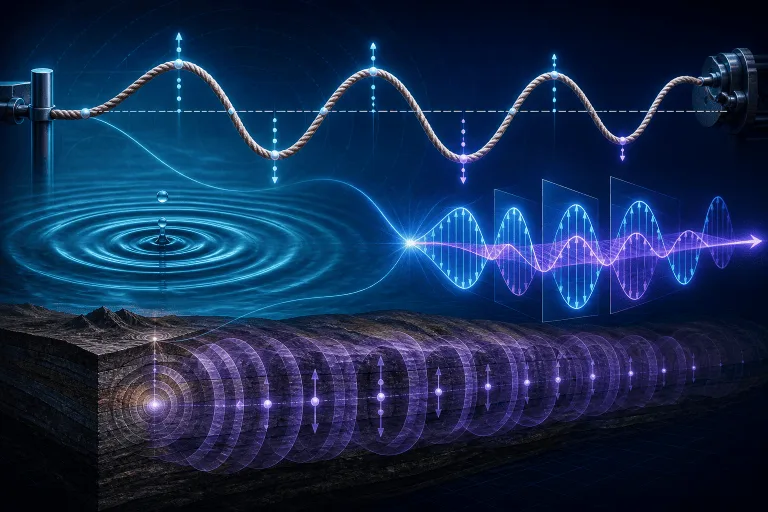
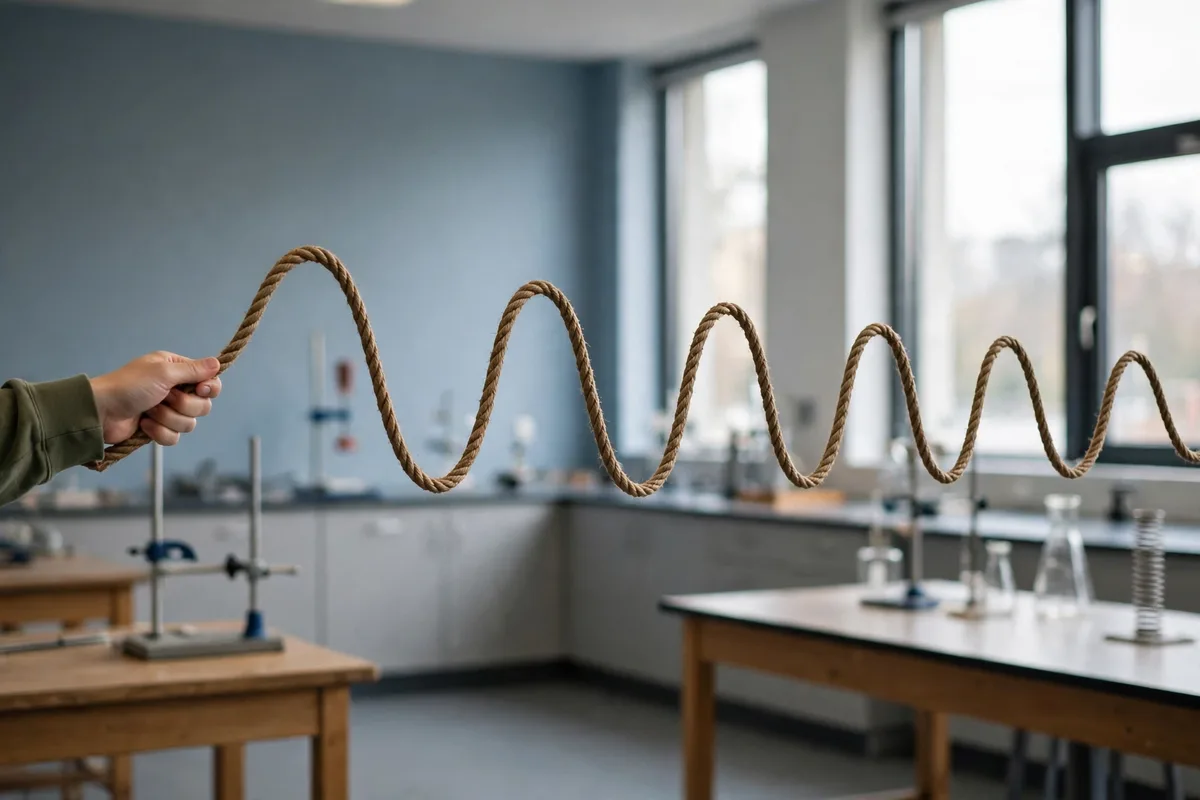
Picture a long rope tied to a fence at one end. You hold the other end and give it a single sharp flick. A hump runs away from your hand, down the rope, toward the fence. It keeps its shape as it travels.
Now flick your hand up and down in a steady rhythm and a train of humps rolls down the rope, one after another, evenly spaced.
That picture holds almost everything the wave equation is about. The wave equation is the single formula that describes a travelling wave like that rope wave, and it answers four questions at once. How tall is each hump? How often does a new hump pass a fixed point? How long does one full hump take? How fast does the whole pattern move?
One equation carries all four answers, and this article takes it apart piece by piece so you can read it the way you read a sentence.
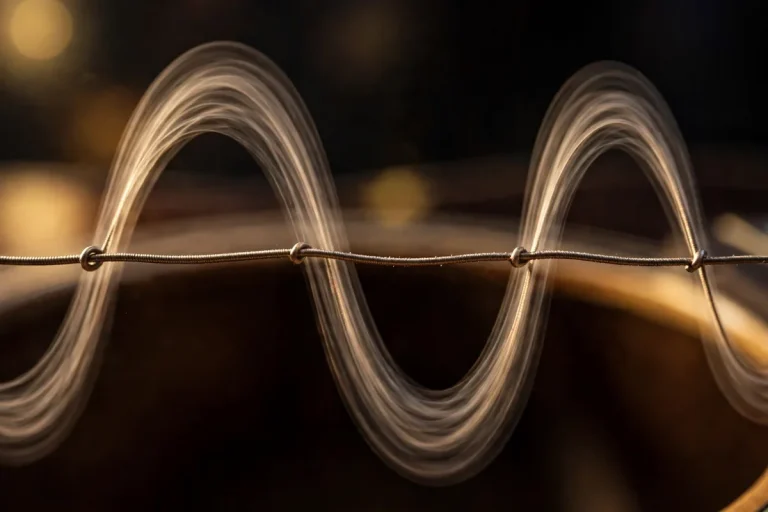
The wave equation matters because waves are everywhere in physics. Sound in air, light in space, ripples on water, and vibrations on a guitar string all obey the same mathematics. Learn to read this one equation and you have a tool you can reuse in every one of those topics.
What the wave equation actually says
Start with the two forms students meet most often. The first is the full wave equation for a wave travelling along a string or a rope:
y(x, t) = A sin(kx − ωt)
The second is the speed relation that sits inside it:
v = fλ
Take the first form slowly. The letter y stands for displacement. It tells you how far a single point of the rope has moved away from its resting position at a given place and time.
If the rope is lying still, y is zero everywhere. When the wave passes, y rises and falls as the rope moves up and down.
The letter x stands for position along the rope. Pick a point on the rope and x tells you where it is. The letter t stands for time.
Together, x and t pin down one moment at one place, and y(x, t) gives the height of the rope at that exact moment and place. That is the whole job of the equation: feed in a place and a time, get out a height.
A sine wave is the natural shape for this job. A sine curve repeats itself smoothly, rising to a peak, falling through zero to a trough, and coming back to where it started.
A rope flicked in a steady rhythm makes exactly that shape, and so does a sound wave in air and a light wave in space. The sine function earns its place here. It is the mathematical shape of anything that repeats in a smooth, regular cycle.
There is one more form of the wave equation you may meet in advanced work, and it helps to know about it now so it does not confuse you later. Physicists sometimes write the wave equation as a partial differential equation:
∂²y/∂t² = v² ∂²y/∂x²
This says something simple in fancy language. The way the rope accelerates at a point depends on how curved the rope is at that point. The sine wave we are studying is one solution to this deeper equation.
You do not need to solve it for this article. Just know that when a textbook says “the wave equation” without any symbols, it may mean this form, while in school physics it usually means y(x, t) = A sin(kx − ωt).
With that cleared up, the rest of the article works through the symbols inside the sine form, one at a time.
Amplitude: how tall is the wave?
Amplitude is the letter A in the wave equation. It is the maximum displacement of a point from its equilibrium position. Equilibrium is the resting position, the straight line the rope lies along when nothing disturbs it.
Amplitude is the height of a crest above that line, or the depth of a trough below it. Both are the same distance, A.
Amplitude is measured in metres. A rope wave with an amplitude of 0.04 m rises 4 cm above the midline at its highest point and sinks 4 cm below the midline at its lowest point. The total distance from the top of a crest to the bottom of a trough is 2A, which is 8 cm for this wave.
That distinction trips up a lot of students, so it is worth stating plainly. Amplitude is measured from the midline to a crest. Crest to trough is twice the amplitude.
What does amplitude do? It sets how much energy the wave carries. The energy of a wave is proportional to the square of its amplitude. Double the amplitude and the wave carries four times the energy.
This is why a louder sound has a bigger amplitude. The air particles swing further from their resting positions, and more energy reaches your ear. A brighter light wave, in the same way, has a larger amplitude in its electric field.
What amplitude does not do is just as important. Changing the amplitude does not change the wave speed, the frequency, or the wavelength. Flick the rope harder and the humps get taller, but they still travel at the same speed and still arrive at the same rate.
The speed of a wave on a rope is set by the tension in the rope and the mass of the rope, not by how hard you flick it. Amplitude is a property of how the wave was made, while speed is a property of the medium it travels through.
One more thing to notice: the amplitude appears in the equation as a multiplier in front of the sine. The sine part only ever goes between −1 and 1, so the biggest value y can reach is A, and the smallest is −A. That is why A is called the amplitude. It scales the whole wave up or down.
Frequency and period: how often, and how long
Frequency and period describe the same repeating motion from two opposite directions. Frequency counts how many cycles happen each second. Period measures how long a single cycle takes. They are reciprocals of each other, and you will use both constantly.
Frequency has the symbol f and is measured in hertz, written Hz. One hertz means one cycle per second. A sound wave with a frequency of 680 Hz completes 680 full cycles every second.
A wave with a frequency of 20 Hz completes 20 cycles per second. The higher the frequency, the more cycles squeeze into each second, and the closer together the crests sit on the rope.
Period has the symbol T and is measured in seconds. It is the time taken for one complete cycle. If you watch one point on the rope, the period is the time between the moment a crest passes that point and the moment the next crest passes it. A period of 0.05 s means a crest passes your chosen point every twentieth of a second.
The two are linked by a pair of simple formulas:
T = 1/f
f = 1/T
If the frequency is 20 Hz, the period is 1/20 = 0.05 s. If the period is 0.00147 s, the frequency is about 680 Hz. Use whichever form suits the numbers you have.
Students sometimes reach for the wrong one under exam pressure, so check the units. Frequency comes out in hertz, which is cycles per second, while period comes out in seconds.
There is a third quantity in this family, angular frequency, written with the Greek letter omega:
ω = 2πf = 2π/T
Angular frequency is measured in radians per second. It counts the same repeating motion in radians instead of cycles. One full cycle is 2π radians, so a wave that completes f cycles per second sweeps through 2πf radians per second.
The wave equation uses ω instead of f because the sine function works in radians. When you see ω inside y(x, t) = A sin(kx − ωt), read it as the frequency expressed in the units the sine function wants.
Here is a small point that saves confusion later. Frequency is set by the source of the wave. If you flick the rope 20 times a second, the wave has a frequency of 20 Hz, and nothing the rope does will change that.
Wave speed, by contrast, is set by the medium. When a wave moves from one medium to another, its frequency stays the same while its speed and wavelength change. Keep that distinction in mind and several exam questions become straightforward.
Wavelength, wave number and wave speed
Wavelength is the distance covered by one complete cycle of the wave. Its symbol is the Greek letter lambda, λ, and it is measured in metres. On the rope, the wavelength is the distance from one crest to the next crest, or from one trough to the next trough. Any two matching points on neighbouring cycles are one wavelength apart.
Wavelength and period are partners. Period is the time for one cycle, wavelength is the distance of one cycle. If you know how fast the wave travels and how long one cycle takes, you can find the distance it covers in that time. That gives the relation:
λ = vT
Wave number is the quantity students meet least often but find most confusing, so it deserves a plain explanation. Wave number has the symbol k and is measured in radians per metre. It counts how many radians of the sine cycle fit into one metre of the rope, in the same way that angular frequency counts how many radians fit into one second. Its formula is:
k = 2π/λ
A short wavelength means a large wave number, because more cycles squeeze into each metre. A long wavelength means a small wave number. If the wavelength is 1.0 m, the wave number is 2π/1.0 = 2π rad/m. If the wavelength is 0.5 m, the wave number is 2π/0.5 = 4π rad/m.
Wave speed ties everything together. The speed relation is:
v = fλ
This says the wave travels one wavelength in one period, so its speed is wavelength divided by period, which is the same as frequency times wavelength. The formula rearranges easily.
If you need the wavelength, use λ = v/f. If you need the frequency, use f = v/λ. If you need the speed, use v = fλ. In each case, check the units: metres per second for speed, hertz for frequency, metres for wavelength. A unit that does not fit is a sign that the wrong formula was picked.
Wave speed depends on the medium, not on the wave. Sound travels at about 340 m/s in air at room temperature, but at about 1500 m/s in water.
Light travels at about 3.0 × 10⁸ m/s in a vacuum. A wave on a rope speeds up when the rope is pulled tighter. None of these speeds depends on the amplitude or on how the wave was started.
Reading the full equation symbol by symbol
Now put the pieces together. The full wave equation, including a phase constant, is:
y(x, t) = A sin(kx − ωt + φ)
Read it from the outside in. The letter y is the displacement you want. The letter A sets how tall the wave gets. The sine function gives the repeating shape.
Inside the sine, kx tracks where you are along the wave and ωt tracks how much time has passed. The phase constant φ, pronounced “fee”, is a small shift that lets the wave start at a point other than zero. Many school problems set φ to zero, so you can often ignore it, but it is there when the wave does not start at the midline.
The term kx is called the spatial part. As x grows, kx grows, and the sine moves through its cycle. Move one wavelength along the rope and kx increases by 2π, which brings the sine back to the same value. That is exactly what a wavelength means: the distance after which the wave repeats itself.
The term ωt is called the temporal part. As time passes, ωt grows, and the sine moves through its cycle in time. Wait one period and ωt increases by 2π, which brings the sine back to the same value. That is exactly what a period means: the time after which the wave repeats itself.
The minus sign between kx and ωt tells you the wave travels in the positive x direction, away from the source. If the sign were a plus, y(x, t) = A sin(kx + ωt), the wave would travel in the negative x direction, back toward the source. You do not need to prove this. Just remember that the sign of ωt picks the direction of travel.
Changing each symbol changes the wave in a visible way. Increase A and the wave gets taller without changing its spacing or its speed. Increase k and the crests pack closer together, because the wavelength has shrunk. Increase ω and the wave cycles faster in time, because the frequency has risen.
This is the real payoff of the wave equation. Each symbol is a separate control, and you can see what each control does by looking at the wave.
One useful check comes from the speed relation hidden inside the equation. Wave speed also equals angular frequency divided by wave number:
v = ω/k
This is the same speed as v = fλ, written in the language of the full equation. You can use either form, and checking one against the other is a good way to catch arithmetic slips.
Worked example 1: wavelength and period of a sound wave
A sound wave travels at 340 m/s with a frequency of 680 Hz. Find its wavelength and its period.
Step 1: Pick the formula for wavelength. The wave speed formula is v = fλ, so rearranged for wavelength it becomes λ = v/f. The numbers given are speed and frequency, and the unknown is wavelength, so this is the right form.
Step 2: Substitute the numbers. λ = 340/680 = 0.50 m. The wavelength is half a metre. That means the crests of this sound wave are 0.50 m apart in the air.
Step 3: Find the period. Period and frequency are reciprocals, so T = 1/f = 1/680 = 0.00147 s. That is 1.47 milliseconds. Each cycle of the sound wave lasts about one and a half thousandths of a second.
Step 4: Check the answer. The relation λ = vT should give the same wavelength. Multiply 340 × 0.00147 and you get 0.4998, which is 0.50 m to two significant figures. The two routes agree, so the answer is consistent.
Answer: wavelength 0.50 m, period 0.00147 s (1.47 ms).
Worked example 2: reading a wave equation
A wave on a string is described by y(x, t) = 0.04 sin(2πx − 40πt), with y and x in metres and t in seconds. Read off the amplitude, wave number, angular frequency, wavelength, frequency, period and wave speed.
Step 1: Compare the given equation with the standard form y = A sin(kx − ωt). Matching the two term by term gives A = 0.04 m, k = 2π rad/m and ω = 40π rad/s. The amplitude is 0.04 m, so the string rises 4 cm above its resting position at each crest.
Step 2: Find the wavelength from the wave number. The formula is λ = 2π/k. Substitute k = 2π to get λ = 2π/2π = 1.0 m. One full cycle of this wave stretches over one metre of string.
Step 3: Find the frequency from the angular frequency. The formula is f = ω/2π. Substitute ω = 40π to get f = 40π/2π = 20 Hz. The string completes 20 cycles every second.
Step 4: Find the period from the frequency. The formula is T = 1/f. Substitute f = 20 to get T = 1/20 = 0.05 s. Each cycle lasts five hundredths of a second.
Step 5: Find the wave speed. Use v = fλ = 20 × 1.0 = 20 m/s. Check it against the other form, v = ω/k = 40π/2π = 20 m/s. Both routes give 20 m/s, so the answer is consistent.
Answer: amplitude 0.04 m, wave number 2π rad/m, angular frequency 40π rad/s, wavelength 1.0 m, frequency 20 Hz, period 0.05 s, wave speed 20 m/s.
Worked example 2 shows the standard method for these questions. Match the given equation against y = A sin(kx − ωt), read off A, k and ω directly, then use λ = 2π/k, f = ω/2π, T = 1/f and v = fλ to find everything else. The same five steps work for any wave equation written in sine form.
Common mistakes
The wave equation is a small topic with a few traps that catch students again and again. Here are the ones to watch for.
First, measuring amplitude from crest to trough. Amplitude is the distance from the equilibrium position to a crest, not the distance from a crest to a trough. Crest to trough is 2A. If a graph shows a crest at +0.04 m and a trough at −0.04 m, the amplitude is 0.04 m, not 0.08 m.
Second, mixing up frequency f and angular frequency ω. Frequency is measured in cycles per second, hertz, while angular frequency is measured in radians per second. They differ by a factor of 2π.
If a question gives ω = 40π rad/s and asks for the frequency, divide by 2π to get 20 Hz. Using 40π as the frequency would be wrong by a factor of about 6.28.
Third, using period where frequency belongs in v = fλ. The speed formula needs frequency, not period. If you are given the period, convert it first with f = 1/T, then use v = fλ. Alternatively use the form v = λ/T, which is the same relation written with period instead of frequency.
Fourth, thinking a bigger amplitude means a faster wave. It does not. Amplitude changes the energy of the wave, not its speed.
A tall wave and a short wave on the same rope travel at the same speed. Wave speed is set by the medium, by the tension and mass of the rope or by the properties of the air or water.
Fifth, reading wavelength off a displacement-time graph. A graph of displacement against time gives the period, because the horizontal axis is time. A graph of displacement against distance gives the wavelength, because the horizontal axis is distance. Check the label on the horizontal axis before deciding which quantity you have measured.
Sixth, forgetting that frequency is set by the source while wave speed is set by the medium. When a wave crosses from one medium into another, its frequency stays the same and its wavelength changes to match the new speed. A sound wave entering water keeps its frequency and gains a longer wavelength because sound travels faster in water.
Conclusion: six formulas to carry with you
The wave equation looks crowded at first, but it is only six formulas working together. Learn them as a set and the rest follows.
The wave equation formula is y(x, t) = A sin(kx − ωt). It gives the displacement y at any position x and any time t, with A as the amplitude, k as the wave number and ω as the angular frequency.
Wave speed is v = fλ. It connects speed, frequency and wavelength, and it rearranges into λ = v/f and f = v/λ for whichever quantity is unknown.
Period and frequency are reciprocals: T = 1/f and f = 1/T. Period is the time for one cycle in seconds, frequency is the cycles per second in hertz.
Angular frequency is ω = 2πf = 2π/T, measured in radians per second. It is the form of frequency that the sine function uses.
Wave number is k = 2π/λ, measured in radians per metre. It tells you how many radians of the wave fit into one metre.
Wavelength and period are linked by λ = vT. The wave covers one wavelength in one period.
Amplitude is the maximum displacement from equilibrium, measured in metres from the midline to a crest. It sets the energy of the wave, which grows with the square of the amplitude, and it never changes the speed, frequency or wavelength.
Amplitude, frequency and period are the three quantities that describe any wave. Frequency is the cycles per second, set by the source. Period is the seconds per cycle. Wavelength is the distance of one cycle, set by the speed of the medium and the frequency. Hold those meanings in mind and the wave equation stops being a string of symbols and becomes a description of a wave you can picture.
Frequently Asked Questions
What is the wave equation y = A sin(kx − ωt)?
The wave equation y(x, t) = A sin(kx − ωt) gives the displacement y of a point on a wave at any position x and any time t. A is the amplitude, k is the wave number, and ω is the angular frequency. The sine function makes y repeat in a smooth cycle, rising to a crest, falling through zero to a trough, and returning to its start. It gives the wave height at that place and time.
How do you find the amplitude in the wave equation?
You find the amplitude by reading off A, the number multiplying the sine in y(x, t) = A sin(kx − ωt). In the example y(x, t) = 0.04 sin(2πx − 40πt), the amplitude is 0.04 m, so the string rises 4 cm above its resting position at each crest. Amplitude is the maximum displacement from equilibrium, measured from the midline to a crest in metres. Do not measure crest to trough, because that distance is 2A, twice the amplitude.
How are frequency and period related in the wave equation?
Frequency and period are reciprocals, linked by T = 1/f and f = 1/T. Frequency f counts the cycles per second, measured in hertz, while period T is the time for one complete cycle, measured in seconds. A wave of frequency 20 Hz has a period of 1/20 = 0.05 s, and a wave with a period of 0.00147 s has a frequency of about 680 Hz. So ω = 2πf = 2π/T in radians per second.
What is the difference between frequency f and angular frequency ω in the wave equation?
Frequency f counts cycles per second and is measured in hertz, while angular frequency ω counts radians per second. They differ by a factor of 2π, since ω = 2πf. The wave equation uses ω because the sine function works in radians, so ω is the frequency expressed in the units the sine wants. For example, ω = 40π rad/s gives f = ω/2π = 20 Hz, which is much smaller than 40π.
How do you use v = fλ to find the wavelength of a wave?
Rearrange v = fλ to λ = v/f, then divide the wave speed by the frequency. For a sound wave travelling at 340 m/s with a frequency of 680 Hz, λ = 340/680 = 0.50 m. Check the result with λ = vT, using T = 1/f: 340 × 0.00147 gives 0.50 m again. Always check the units too: speed in metres per second divided by frequency in hertz leaves metres, the unit of wavelength.
Does changing the amplitude of a wave change its frequency or its period?
No, changing the amplitude does not change the frequency, the period, or the wave speed. A harder flick of the rope makes taller humps, but they still travel at the same speed and still arrive at the same rate. Amplitude only changes how much energy the wave carries, since energy is proportional to A², so doubling the amplitude gives four times the energy. Wave speed is set by the medium, and frequency is set by the source.