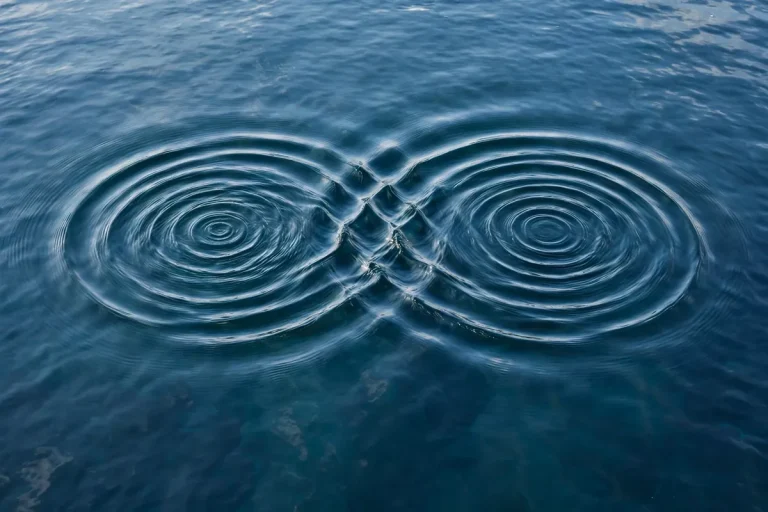
Thin Film Interference: Soap Bubbles, Oil Slicks and Anti-Reflection Coatings
Blow a soap bubble on a sunny afternoon and watch it for a few seconds. Bands of pink, green and gold slide across its surface, shifting as the bubble thins, and there is no pigment anywhere in the soap to explain them. The colours are made by light itself.
Thin film interference happens when light reflects off the top and bottom surfaces of a film so thin that its thickness is close to the wavelength of light, and the two reflected waves overlap and either strengthen or cancel each other. One thickness picks out green, a slightly different thickness picks out red, and the bubble paints itself with whatever the physics allows.
This article starts with that bubble and builds the whole idea from it. You will learn why a film reflects some colours and swallows others, why a reflected wave can flip upside down, and how the same physics is used to stop camera lenses from glaring. By the end you will be able to work out which colour a film of a given thickness will reflect, and how thick an anti-reflection coating needs to be.
What Is Thin Film Interference?
Thin film interference is what happens when light meets a layer of transparent material whose thickness is comparable to the wavelength of visible light, roughly a few hundred nanometres. A soap bubble wall is a good example. So is the thin layer of oil floating on a puddle after rain. Light falling on the film does not simply bounce off the top surface. Some of it reflects from the top surface, and some of it passes into the film, reflects from the bottom surface, and comes back out again.
That gives you two reflected rays travelling in the same direction, one from the top of the film and one from the bottom. Because both rays come from the same incoming wave, they are coherent, which means they keep a steady phase relationship with each other. When two coherent waves overlap, they interfere. If their crests line up, they add together and the reflected light is bright.
If a crest of one meets a trough of the other, they cancel and the reflected light is dim or absent altogether. This is superposition, the same principle that sits behind every interference pattern in physics, but here the stage is a film thinner than a human hair.
The ray that goes inside the film travels further than the ray that reflects from the top. At normal incidence, when the light comes straight down onto the film, the extra distance is twice the film thickness, written as 2t, because the ray goes down through the film and back up again. That extra path is the first thing that decides whether the two rays arrive in step or out of step.
There is a second effect to account for. Light slows down inside a material, so its wavelength inside the film is shorter than its wavelength in air. If the wavelength in air is λ and the refractive index of the film is n, the wavelength inside the film is λ/n. The number of wavelengths that fit into the extra path is therefore 2t divided by λ/n, which is the same as 2nt/λ.
Physicists usually talk about the optical path difference instead, which is 2nt at normal incidence. The optical path difference is the quantity that decides the interference, because it measures the extra journey in units of the wavelength in air.
Only very thin films show these colours. A thick sheet of glass also reflects light from both surfaces, but the path difference is thousands of wavelengths, and it changes with the tiniest change in angle or thickness. The colours from different wavelengths then pile on top of each other and wash out to plain white.
A film only a few wavelengths thick keeps the effect clean, because the path difference is small enough that a change in thickness of a hundred nanometres or so moves the interference from one colour to the next. That is why you see colours in a soap bubble and not in a window pane.
The Phase Change on Reflection, the Rule That Decides Everything
The path difference alone does not tell you whether the reflected light will be bright or dark. Reflection itself can change the wave, and this is the point where most students go wrong. When light reflects from a surface backed by a material with a higher refractive index, the reflected wave flips over. Its crests become troughs and its troughs become crests.
The flip is a phase change of 180 degrees, which is pi radians, equivalent to half a wavelength. When light reflects from a surface backed by a material with a lower refractive index, nothing of the sort happens. The wave comes back unchanged.
Light that passes through a surface, transmitted light, never flips at all. Transmission keeps the phase exactly as it was. Only reflection can flip a wave, and only reflection from a higher index medium does it.
Take a soap film in air. The top surface is air meeting soap, and soap has the higher index, so the wave reflected from the top flips. The bottom surface is soap meeting air, and air has the lower index, so the wave reflected from the bottom does not flip. A soap film therefore has exactly one phase reversal. An oil slick on water works the same way.
The top surface is air meeting oil, so that reflection flips, and the bottom surface is oil meeting water, where water has the lower index than oil, so that reflection does not flip. One reversal again.
With exactly one phase reversal, the conditions for reflected light are as follows. Reflected light is constructive, bright, when the optical path difference satisfies 2nt = (m + 1/2)λ, where m = 0, 1, 2, and so on. Reflected light is destructive, dark, when 2nt = mλ.
The extra half wavelength in the bright condition comes from the single flip, which already puts the two waves half a wavelength out of step before the path difference is counted. The path difference then has to add another half wavelength to bring them back into step.
Now consider a film with zero phase reversals, or two. That happens, for example, when the medium above the film has a lower index than the film and the medium below has a higher index, so both reflections flip, or when the medium above has a higher index than the film and the medium below has a lower index, so neither flips. In those cases the two conditions swap places.
Constructive reflection happens when 2nt = mλ, and destructive reflection happens when 2nt = (m + 1/2)λ. The rule is simple to state and easy to forget under exam pressure. Count the flips first. One flip means the bright condition carries the half. Zero flips or two flips means the bright condition is the plain whole number.
Transmitted light always takes the opposite condition to reflected light. Energy has to go somewhere, so a wavelength that is bright in reflection is dark in transmission, and a wavelength that is dark in reflection is bright in transmission. If you look at a soap bubble by reflected light you see one set of colours, and if you could look through it at the transmitted light you would see the complementary set. The two views are negatives of each other.
Why Soap Bubbles and Oil Slicks Show Colours
White sunlight contains every colour of the visible spectrum at once. When it falls on a soap film, each wavelength is tested against the same thickness by the interference conditions. At a given thickness, one wavelength may satisfy the bright condition while its neighbours do not. That wavelength is reflected strongly and the eye sees its colour. A slightly different thickness favours a different wavelength, and the eye sees a different colour. The film acts like a filter that picks out colours according to its thickness.
A real bubble is never one uniform thickness. Gravity pulls the soap solution downwards, so the top of the bubble thins while the bottom stays thicker. Air currents stretch it, and the film flows. The result is a patchwork of thicknesses, and each patch shows the colour that its own thickness selects.
As the bubble thins, the colours sweep through the spectrum in a regular order, because the bright condition for each wavelength is met at a new thickness as the old one passes. Watch a bubble for ten seconds and you can see the sequence run.
The most striking moment comes just before the bubble pops. At the very top, the film becomes extremely thin, far thinner than a wavelength of light. The optical path difference 2nt drops towards zero, and the condition 2nt = 0 satisfies the destructive condition with m = 0. The single phase flip does the rest.
The two reflected waves arrive exactly out of step and cancel completely, so the top of the bubble goes dark. That black patch is the warning sign that the film is about to break. It is destructive interference at near zero thickness, and it is one of the cleanest demonstrations of the phase flip in all of physics.
An oil slick on a wet road works the same way, with one difference. The oil spreads into a layer of uneven thickness, thick in the middle and feather thin at the edges. Each band of thickness reflects its own colour, so you see the familiar rainbow swirls.
Where the oil is thinnest, at the outer edge of the slick, the colours run through violet and blue, and where it is thickest the colours run through red and orange. The pattern is a map of the oil thickness, drawn in colour by interference.
Anti-Reflection Coatings
The same physics that paints a soap bubble can be put to work to remove reflections. Camera lenses, eyeglasses and solar panels all suffer from light bouncing off their surfaces, and every reflection is light lost. An anti-reflection coating is a thin film applied to the surface, designed so that the light reflected from the top of the coating cancels the light reflected from the bottom. The two reflections interfere destructively and the surface stops glaring.
The design starts with the destructive condition. The coating is meant to cancel reflection at one chosen design wavelength, usually in the middle of the visible spectrum around 550 nm, where the eye is most sensitive. The coating has two phase reversals, one at each surface, and the two flips cancel each other, so the destructive condition is 2nt = (m + 1/2)λ.
At m = 0 this gives the quarter wavelength rule, and the minimum coating thickness is t = λ/(4n). That quarter wavelength thickness makes the round trip through the coating equal to half a wavelength, so the two reflected waves arrive half a wavelength out of step and cancel.
The coating material matters as much as its thickness. With the coating index between the index of air and the index of glass, both reflections flip, and that two flip situation is precisely what makes the quarter wavelength coating anti-reflective. A film with a coating index above the index of glass would have one flip, and a quarter wavelength layer of that film would enhance reflection instead of cancelling it.
Magnesium fluoride is the standard choice. Its refractive index is 1.38, which sits neatly between air at 1.00 and typical glass at 1.52. A magnesium fluoride coating on a glass lens therefore has exactly two phase reversals, and the quarter wavelength rule applies cleanly.
One coating can only be perfect for one wavelength. A coating designed for green light at 550 nm will not cancel blue or red light completely, because the quarter wavelength thickness is wrong for those wavelengths. That is why coated lenses often show a faint purple or green tint when you tilt them in the light. The leftover reflections are the colours the coating was not designed for.
Expensive lenses stack several coatings, each tuned to a different wavelength, to push the reflection down across the whole spectrum. The principle is the same in every layer. Each layer is a thin film, and each layer is tuned so its reflections cancel.
The applications go well beyond cameras. Eyeglasses use anti-reflection coatings so that other people can see the wearer’s eyes instead of a glare. Solar panels use them so that more sunlight enters the panel instead of bouncing off. Telescope lenses and microscope objectives use them for the same reason. Every one of these devices is a soap bubble with a job to do.
Worked Example 1: Minimum Thickness of a Soap Film for Bright Green Light
A soap film with refractive index n = 1.33 sits in air and is lit by green light of wavelength λ = 550 nm at normal incidence. Find the smallest nonzero thickness that reflects green light brightly.
Step 1. Count the phase reversals. The top reflection is air to soap, and soap has the higher index, so that wave flips. The bottom reflection is soap to air, and air has the lower index, so that wave does not flip. There is exactly one phase reversal.
Step 2. Choose the right condition. With one reversal, constructive reflection needs 2nt = (m + 1/2)λ, where m = 0, 1, 2, and so on.
Step 3. Take the smallest value of m. The smallest nonzero thickness comes from m = 0, which gives 2nt = λ/2, and so t = λ/(4n).
Step 4. Put the numbers in. The wavelength λ is 550 nm and the refractive index n is 1.33, so t = 550 / (4 × 1.33) = 550 / 5.32 = 103 nm. The smallest thickness that reflects green brightly is 103 nm.
Step 5. Find the next bright thickness. Take m = 1 in the same condition. Then 2nt = 3λ/2, so t = 3λ/(4n) = 3 × 550 / (4 × 1.33) = 1650 / 5.32 = 310 nm. A film 310 nm thick also reflects green brightly, and so does every thickness in the series 103 nm, 310 nm, 517 nm, and so on, adding 207 nm each time.
A film thinner than 103 nm cannot reflect green brightly at all, which is why the thinnest part of a bubble shows the colours of the shortest wavelengths first.
Worked Example 2: Designing an Anti-Reflection Coating
A magnesium fluoride coating with refractive index n = 1.38 is applied to a glass lens with refractive index 1.52. The coating is designed for green light of wavelength λ = 550 nm at normal incidence. Find the minimum coating thickness.
Step 1. Check the refractive indices. Air has n = 1.00, the coating has n = 1.38, and the glass has n = 1.52. The coating index sits between air and glass, so the top reflection flips, because the coating index is higher than air, and the bottom reflection also flips, because glass has the higher index. There are two phase reversals, and the two flips cancel each other.
Step 2. Choose the condition. The coating is meant to cancel reflection, and with two reversals the destructive condition for reflected light is 2nt = (m + 1/2)λ. At m = 0 this gives 2nt = λ/2, so the minimum coating thickness is t = λ/(4n).
Step 3. Put the numbers in. The wavelength λ is 550 nm and the coating index n is 1.38, so t = 550 / (4 × 1.38) = 550 / 5.52 = 100 nm. The minimum coating thickness is 100 nm.
Step 4. Verify the cancellation. The round trip through the coating is 2t = 200 nm, and the optical path difference is 2nt = 2 × 1.38 × 100 = 276 nm. That is half of 550 nm, so the path adds half a wavelength of delay. The two phase flips cancel each other, so the λ/2 optical path difference puts the two reflected waves half a wavelength out of step and they cancel at the design wavelength. The reflection of green light is removed.
Step 5. Check what happens to blue light. Take blue light with λ = 450 nm on the same 100 nm coating. The optical path difference is still 2nt = 276 nm. With two flips, blue light would cancel completely only if 2nt were a half odd multiple of its wavelength, 2nt = (m + 1/2)λ. At m = 0 that target is (0 + 1/2) × 450 = 225 nm, while the actual optical path difference is 276 nm.
The ratio 276 / 450 = 0.61 sits between the half odd multiples of 0.5 and 1.5, so the blue light is only partly cancelled and some blue reflects. This is why a coating tuned for green leaves a faint blue or purple sheen on the lens. The coating is perfect at its design wavelength and imperfect everywhere else.
Common Mistakes
- Forgetting the phase flip and swapping the bright and dark conditions. In a soap film the bright condition is 2nt = (m + 1/2)λ, and the dark condition is 2nt = mλ. Using the conditions the wrong way round is the single most common error in this topic.
- Using the wavelength in air instead of the wavelength inside the film. The wavelength inside the film is λ/n, so the path difference must be written as 2nt, not 2t. Leaving out the refractive index gives an answer that is wrong by the factor n.
- Applying 2nt = mλ as the constructive condition for reflected light in a soap film. That formula gives destructive reflection for a soap film, because of the single phase reversal. It is the constructive condition only when there are zero or two reversals.
- Thinking the film thickness must equal a whole wavelength for a bright reflection. A quarter wavelength of optical thickness is enough for a coating, because the round trip doubles it to half a wavelength, and the two flips cancel each other, so that path difference alone does the cancelling. The minimum bright thickness for a soap film is λ/(4n), not λ.
- Assuming transmitted and reflected light have the same bright and dark conditions. They are always opposite. A wavelength that is bright in reflection is dark in transmission, and the two views are complementary.
- Forgetting that the conditions above assume near normal incidence. At an oblique angle the path through the film is longer and the formulas need an angle term. For exam questions at normal incidence the simple forms are correct, but they do not apply unchanged to light striking the film at a steep angle.
Conclusion
Thin film interference turns an invisible difference in thickness into colour. Two reflected waves, one from each surface of the film, interfere according to the optical path difference between them, and the phase change on reflection decides which condition gives brightness and which gives darkness.
Four formulas carry the whole topic. The wavelength inside the film is λ/n. The optical path difference at normal incidence is 2nt. With exactly one phase reversal, constructive reflection happens when 2nt = (m + 1/2)λ and destructive reflection happens when 2nt = mλ, where m = 0, 1, 2, and so on. An anti-reflection coating has two phase reversals, so its destructive condition is 2nt = (m + 1/2)λ, and at m = 0 this gives the minimum thickness t = λ/(4n).
With those four formulas and the habit of counting phase reversals before choosing a condition, you can predict the colour of any soap film, explain why an oil slick shows its rainbow, work out why a bubble goes dark just before it pops, and design a coating that makes a lens stop glaring. The soap bubble is the whole subject, floating in the air.
Frequently Asked Questions
Why do soap bubbles show colours in thin film interference?
Soap bubbles show colours because white sunlight contains every visible wavelength, and each wavelength is tested against the film thickness by the interference conditions. At any given thickness, the wavelength that satisfies the constructive condition 2nt = (m + 1/2)λ is reflected strongly while others are not. Because gravity makes the film uneven, different patches pick out different colours, so the bubble shows a shifting rainbow.
What is the thin film interference formula 2nt = (m + 1/2)λ for constructive reflection?
The formula gives the condition for bright reflected light from a film with exactly one phase reversal, such as a soap film in air. Here t is the film thickness, n is its refractive index, λ is the wavelength in air, and m is 0, 1, 2, and so on. When the optical path difference 2nt equals a half odd multiple of λ, the two reflected waves arrive in step and add together, so that wavelength reflects brightly.
Why does a soap bubble go dark just before it pops in thin film interference?
Just before it pops, the top of the bubble thins to almost nothing, so the optical path difference 2nt falls to nearly zero. With exactly one phase reversal, the destructive condition is 2nt = mλ, and zero satisfies it with m = 0. The single phase flip puts the two reflected waves half a wavelength out of step, so at near zero thickness they cancel. The dark patch is destructive interference, and it warns the film is about to break.
How thick must an antireflection coating be for thin film interference to cancel reflections?
An antireflection coating must be at least t = λ/(4n) thick, where λ is the design wavelength and n is the coating index. Both reflections flip, one at each surface, so the two flips cancel each other. At this thickness the optical path difference is 2nt = λ/2, which puts the two reflected waves half a wavelength out of step, so they cancel. For green light at 550 nm on magnesium fluoride with n = 1.38, that is 100 nm.
Why does an oil slick show different colours at different thicknesses in thin film interference?
An oil slick spreads into a layer of uneven thickness, thick in the middle and feather thin at the edges. Each thickness satisfies the constructive condition 2nt = (m + 1/2)λ for a different wavelength, so each band of oil reflects its own colour strongly while other wavelengths cancel. The pattern of rainbow swirls is therefore a map of the oil thickness, with violet and blue at the thinnest edges and red and orange where the oil is thickest.
What is the phase change on reflection in thin film interference, and when does it happen?
The phase change on reflection is a flip of the wave by 180 degrees, equal to half a wavelength. It happens when light reflects from a surface backed by a material with a higher refractive index than the one the light is travelling in. Reflection from a lower index medium causes no flip, and transmitted light never flips. A soap film in air and an oil slick on water both have exactly one flip, at the top surface only.