n₁sinθ₁ = n₂sinθ₂ — Snell’s Law, Derived and Explained
Put a straw in a glass of water and look at it from the side. The straw appears to bend sharply at the surface of the water, even though you know it is perfectly straight. The same effect makes a swimming pool look shallower than it really is, and makes a pencil in a glass seem broken in two. This everyday illusion is refraction, and Snell’s law is the equation that predicts exactly how much the light bends.
In this article, you will learn what refraction is, what the refractive index means, and how to use Snell’s law in a calculation. You will also see where Snell’s law comes from, work through two fully solved examples, and learn the most common mistakes students make with it, so you can avoid them in an exam. By the end, one short equation will let you predict the path of a ray of light as it crosses from one material into another.
What refraction is
Refraction is the bending of light when it passes from one transparent material into another. Light travels at different speeds in different materials. It travels fastest in a vacuum, slightly slower in air, slower still in water, and slower again in glass. When a ray of light crosses the boundary between two materials, its speed changes, and that change of speed causes its direction to change as well.
Before going further, it is worth defining the words that every refraction diagram uses, because exam questions depend on them. A ray is a straight line that shows the direction in which light travels. The incident ray is the ray that arrives at the boundary. The refracted ray is the ray that continues into the second material after crossing the boundary. The boundary itself is the surface where the two materials meet.
The normal is an imaginary line drawn at right angles to the boundary, at the exact point where the ray meets it. The normal is not a ray of light. It is a reference line, drawn only so that angles can be measured clearly. The angle of incidence is the angle between the incident ray and the normal. It is usually given the symbol θ₁, pronounced theta-one. The angle of refraction is the angle between the refracted ray and the normal, given the symbol θ₂.
Here is the single most important habit in this whole topic: every angle in refraction is measured from the normal, never from the surface. If a question says that light strikes a surface at 40 degrees, that 40 degrees is measured from the normal unless the question says otherwise. Measuring from the surface instead is the most common source of wrong answers, and it is easy to avoid once you know to look for the normal first.
It also helps to picture what happens at the boundary. Imagine a line of people marching in step across a field and then onto a sandy beach. If they reach the sand at an angle, the people who reach the sand first slow down first, while the rest of the line is still moving quickly on the firm ground. The line swings round. Light behaves in a similar way: one side of a wavefront slows down before the other, and the whole wavefront changes direction. This picture will matter again when we derive Snell’s law.
Refraction happens at every boundary between transparent materials, but the amount of bending depends on the two materials involved. That is why we need a number that describes each material. That number is the refractive index, and it is the subject of the next section.
The refractive index
The refractive index of a material, given the symbol n, tells us how much light slows down in that material compared with a vacuum. It is defined by the equation:
n = c / v
In this equation, c is the speed of light in a vacuum, which is approximately 3.00 × 10⁸ metres per second. The symbol v is the speed of light in the material in question. Both speeds are measured in the same units, so the refractive index has no units. It is just a number.
Because light travels fastest in a vacuum, the speed v in any material is always less than c. Dividing a larger number by a smaller number always gives an answer greater than one. That is why the refractive index is never less than 1. A vacuum has a refractive index of exactly 1. Air is very close to a vacuum for this purpose, with a refractive index of about 1.00, so in school and college problems air is usually treated as having n = 1.00.
A higher refractive index means slower light and stronger bending. Water, with a refractive index of about 1.33, slows light more than air does. Glass, at about 1.50, slows it more again. Diamond, at about 2.42, slows light a great deal, which is part of why diamonds behave so strikingly with light. A material with a higher refractive index than another is called optically denser. Note that optically denser does not mean physically heavier or more solid. It means only that light travels more slowly in it. A material with a lower refractive index is called optically less dense.
| Material | Refractive index (n) | What it means |
|---|---|---|
| Air | about 1.00 | Light travels almost as fast as in a vacuum. |
| Water | about 1.33 | Light travels noticeably more slowly than in air. |
| Glass | about 1.50 | Light travels more slowly than in water. |
| Diamond | about 2.42 | Light travels much more slowly, and bends strongly. |
One more fact about the refractive index is worth knowing. When light enters a new material, its speed changes and its wavelength changes, but its frequency stays the same. Frequency is the number of waves passing a point each second, and it is set by the source of the light, not by the material the light happens to be travelling through. Since speed equals frequency multiplied by wavelength, a drop in speed with a fixed frequency must mean a shorter wavelength. This is why the colour of light does not change when it enters water or glass, even though its speed and wavelength do: colour is determined by frequency.
With the refractive index defined, we can now state the law that links the two angles and the two refractive indices at a boundary.
Snell’s law stated and explained
Snell’s law is named after the Dutch scientist Willebrord Snellius, who described this relationship in the seventeenth century. It states that, for light crossing the boundary between two materials, the product of the refractive index and the sine of the angle is the same on both sides of the boundary. In symbols:
n₁ sin θ₁ = n₂ sin θ₂
Let us define every symbol. The symbol n₁ is the refractive index of the first material, the one the light starts in. The symbol θ₁ is the angle of incidence, measured from the normal in the first material. The symbol n₂ is the refractive index of the second material, the one the light enters. The symbol θ₂ is the angle of refraction, measured from the normal in the second material. The function sin means sine, a ratio from trigonometry that you can find on a scientific calculator. For an angle of 0 degrees, sin 0° = 0. For an angle of 90 degrees, sin 90° = 1.
Snell’s law is useful because it lets you work out an unknown angle if you know the other three quantities. If you know both refractive indices and the angle of incidence, you can rearrange the equation to find the angle of refraction. If you know the two angles and one refractive index, you can find the other refractive index. The worked examples later in this article show the most common arrangement: finding the angle of refraction.
The direction of bending follows a simple rule. When light enters an optically denser material, so that n₂ is greater than n₁, the ray bends towards the normal. That means the angle of refraction is smaller than the angle of incidence. When light enters an optically less dense material, so that n₂ is less than n₁, the ray bends away from the normal. That means the angle of refraction is larger than the angle of incidence.
There is one special case. When light strikes the boundary head-on, at normal incidence, the angle of incidence θ₁ is 0 degrees. Since sin 0° = 0, Snell’s law gives n₂ sin θ₂ = 0, so θ₂ is also 0 degrees. The ray passes straight through without bending, although it does change speed. A ray that hits a boundary along the normal never bends, no matter what the two materials are.
It is also worth noting what Snell’s law does not say. It does not say that the angle itself stays the same, and it does not say that the ray bends by a fixed number of degrees. The bending depends on the ratio of the two refractive indices and on the angle of incidence. A ray entering water at a small angle bends only a little, while the same ray entering at a large angle bends much more. Snell’s law, not a rule of thumb, is what gives the exact answer.
Deriving Snell’s law from wavefronts
A law is easier to remember when you can see where it comes from. The derivation below uses the wavefront picture, sometimes called the Huygens picture, named after the Dutch physicist Christiaan Huygens. It is short, and each step follows from the one before it. No new physics is introduced; the only ideas used are that light travels as waves, that wavefronts are lines joining points on waves that are in step, and that the wave speed changes at the boundary.
Step 1: Picture a wavefront approaching the boundary. Imagine a straight wavefront in the first material, travelling towards the boundary at an angle. One end of the wavefront reaches the boundary before the other end does, because the wavefront is tilted relative to the boundary.
Step 2: Let the first end wait. While the second end is still travelling through the first material at speed v₁, the first end has already entered the second material, where it travels at the new speed v₂. If the second material is denser, v₂ is smaller than v₁, so the first end covers less distance in the same time.
Step 3: Compare the two distances. In a given time t, the end still in the first material travels a distance v₁ × t, while the end in the second material travels a distance v₂ × t. The wavefront is a straight line joining these two ends, so it must tilt. The amount of tilt depends on the ratio of the two distances, which is v₁ / v₂.
Step 4: Bring in the angles. Geometry shows that the sine of the angle of incidence is related to the distance travelled in the first material, and the sine of the angle of refraction is related to the distance travelled in the second material, in such a way that sin θ₁ / sin θ₂ = v₁ / v₂. This is the key geometric result, and it comes directly from the two right-angled triangles formed by the wavefront and the boundary.
Step 5: Replace speeds with refractive indices. From the definition n = c / v, we know that v₁ = c / n₁ and v₂ = c / n₂. Therefore the ratio v₁ / v₂ equals n₂ / n₁, because the c cancels. Substituting this into the result of step 4 gives sin θ₁ / sin θ₂ = n₂ / n₁.
Step 6: Rearrange. Multiplying both sides of sin θ₁ / sin θ₂ = n₂ / n₁ by n₁ and by sin θ₂ gives n₁ sin θ₁ = n₂ sin θ₂, which is Snell’s law.
There is also a second route to the same result, called the least-time or Fermat route, after the French mathematician Pierre de Fermat. Fermat proposed that light travelling between two points takes the path that requires the least time. If you work out, using calculus, which path through the boundary gives the shortest travel time, you arrive at exactly the same equation, n₁ sin θ₁ = n₂ sin θ₂. The two derivations agree, which is reassuring: the wave picture and the least-time principle describe the same physics. For most exam purposes, the wavefront derivation above is the one to learn, because it can be explained in words and a simple diagram without calculus.
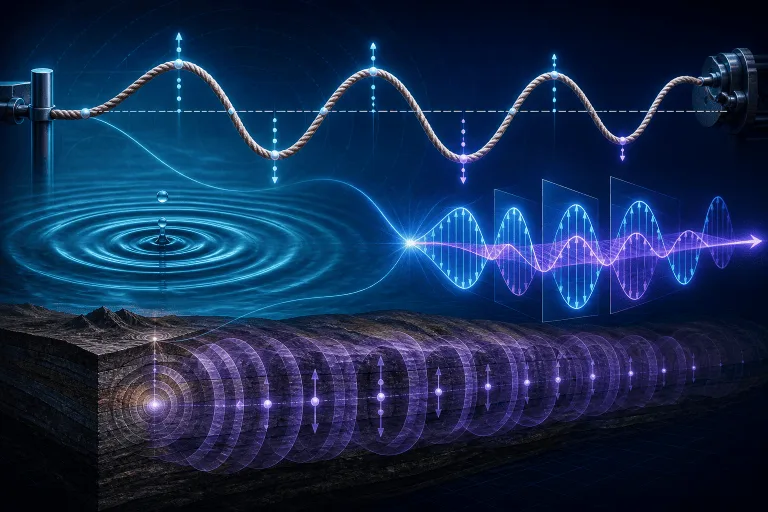
The important lesson of the derivation is that refraction is not a mystery added on top of wave behaviour. It is a direct consequence of a wave changing speed. Whenever a wave crosses into a medium where it travels at a different speed, and it arrives at an angle, it must change direction. The same reasoning explains why water waves bend as they approach a beach and why sound waves bend in air of varying temperature.
Worked example 1: finding the angle of refraction
Light travels from air into water at an angle of incidence of 40 degrees. Find the angle of refraction. The refractive index of air is 1.00 and the refractive index of water is 1.33.
Step 1: Write down what you know. The first medium is air, so n₁ = 1.00. The second medium is water, so n₂ = 1.33. The angle of incidence is θ₁ = 40 degrees. The unknown is θ₂, the angle of refraction.
Step 2: Write down Snell’s law. The equation is n₁ sin θ₁ = n₂ sin θ₂.
Step 3: Rearrange for sin θ₂. Dividing both sides by n₂ gives sin θ₂ = (n₁ sin θ₁) / n₂.
Step 4: Substitute the numbers. This gives sin θ₂ = (1.00 × sin 40°) / 1.33. The sine of 40 degrees is approximately 0.643. Multiplying by 1.00 leaves 0.643, and dividing by 1.33 gives approximately 0.483. So sin θ₂ ≈ 0.483.
Step 5: Take the inverse sine. The angle whose sine is 0.483 is found with the inverse sine function, written sin⁻¹ on a calculator. This gives θ₂ = sin⁻¹(0.483) ≈ 28.9 degrees.
Step 6: Check the answer makes sense. Water is optically denser than air, since 1.33 is greater than 1.00, so the ray should bend towards the normal. The angle of refraction, 28.9 degrees, is indeed smaller than the angle of incidence, 40 degrees. The answer is sensible, and it is the final answer: the angle of refraction is approximately 28.9 degrees.
Notice the method, because it is the same every time. Write down the four quantities, rearrange Snell’s law for the unknown, substitute carefully, and remember the inverse sine step. Students who stop at sin θ₂ = 0.483 and write down 0.483 degrees have done most of the work correctly and then thrown the mark away. Always take the inverse sine when you are solving for an angle.
Worked example 2: critical angle and total internal reflection
Light inside glass meets the boundary with air. The refractive index of the glass is 1.52 and the refractive index of air is 1.00. Find the critical angle for the glass-to-air boundary, and explain what happens to rays striking the boundary at 30 degrees and at 50 degrees.
First, a definition. The critical angle, given the symbol θc, is the angle of incidence in the denser material for which the angle of refraction is exactly 90 degrees. At 90 degrees, the refracted ray runs along the boundary itself, just grazing the surface. If the angle of incidence is increased beyond the critical angle, there is no refracted ray at all. Instead, all the light is reflected back inside the denser material. This is called total internal reflection.
Step 1: Write down what you know. The first medium is glass, so n₁ = 1.52. The second medium is air, so n₂ = 1.00. At the critical angle, the angle of refraction θ₂ is 90 degrees, and sin 90° = 1.
Step 2: Apply Snell’s law with θ₂ = 90 degrees. The equation n₁ sin θ₁ = n₂ sin θ₂ becomes n₁ sin θc = n₂ × 1, since θ₁ is now the critical angle θc.
Step 3: Rearrange for sin θc. Dividing both sides by n₁ gives sin θc = n₂ / n₁.
Step 4: Substitute the numbers. This gives sin θc = 1.00 / 1.52 ≈ 0.658.
Step 5: Take the inverse sine. This gives θc = sin⁻¹(0.658) ≈ 41.1 degrees. The critical angle for this glass-to-air boundary is therefore approximately 41.1 degrees.
Step 6: Apply the result to the two rays. Total internal reflection happens only when two conditions are both met: the light is travelling from a denser material to a less dense material, so n₁ is greater than n₂, and the angle of incidence is greater than the critical angle, so θ₁ is greater than θc. Both conditions concern the ray in the glass heading towards air, so we check them for each ray.
A ray striking the boundary at 30 degrees has an angle of incidence smaller than the critical angle of 41.1 degrees. It refracts out into the air, bending away from the normal, because air is less dense than glass. A ray striking the boundary at 50 degrees has an angle of incidence greater than the critical angle. It cannot refract out, so it is totally internally reflected back into the glass, obeying the ordinary law of reflection at the boundary. Note that a ray at exactly the critical angle, 41.1 degrees, would emerge grazing along the surface, but in practice the interesting cases are below and above it.
It is important to remember that total internal reflection can only happen when light travels from a denser material into a less dense one. Light travelling from air into glass can never be totally internally reflected, because the refracted angle is always smaller than the incident angle and never reaches 90 degrees. If a question asks about total internal reflection for light entering a denser material, the answer is that it does not happen, however large the angle of incidence is.
Where Snell’s law shows up
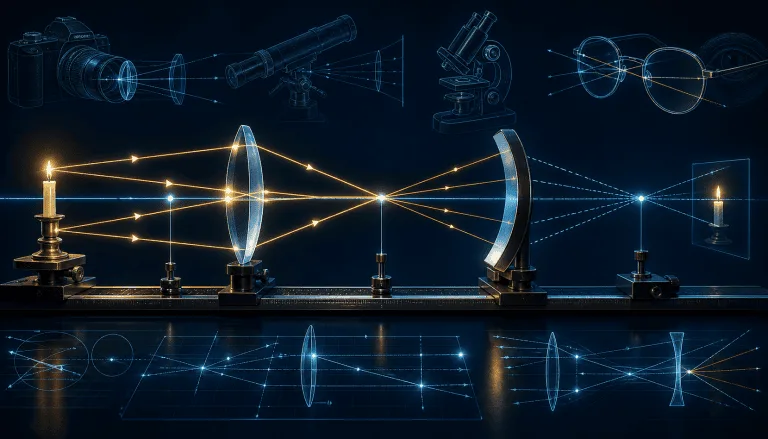
Snell’s law is not just an exam topic. It shapes many devices and everyday sights. Lenses in glasses, cameras and microscopes are shaped so that refraction at their curved surfaces bends light to a focus, and their design starts with Snell’s law applied at each surface. Prisms bend light by refraction at two surfaces, and because the refractive index depends slightly on colour, a prism also splits white light into a spectrum.
Fibre optics carry signals as pulses of light trapped inside thin glass fibres by total internal reflection. Because the light never escapes through the sides of the fibre, it can travel for kilometres with very little loss, which is why fibre optic cables carry internet and telephone signals around the world. A mirage on a hot road is also refraction: layers of hot air near the road have a lower refractive index than the cooler air above, so light from the sky bends upwards into the eye and the road appears to shimmer with water that is not there.
The apparent depth of water is another everyday case. Light from an object under water refracts away from the normal as it leaves the water, so to an observer above, the object appears higher, and therefore shallower, than it really is. This is why a pool looks shallower than it is and why spearing a fish from above the water is harder than it looks. Finally, diamonds sparkle because their very high refractive index gives a small critical angle, so light entering a well-cut diamond is totally internally reflected several times inside the stone before escaping, producing the flashes of brilliance that make diamonds prized as gems.
Common mistakes
Most lost marks in Snell’s law questions come from a small set of repeated errors. Here they are, with the fix for each.
- Measuring angles from the surface instead of the normal. Always find the normal first and measure from it. If a question gives the angle to the surface, subtract it from 90 degrees to get the angle to the normal before using Snell’s law.
- Swapping n₁ and n₂, or θ₁ and θ₂. The subscript 1 always belongs to the medium the light starts in, and the subscript 2 always belongs to the medium it enters. Write down which medium is which before substituting numbers.
- Forgetting inverse sine in the final step. Snell’s law gives you sin θ₂, not θ₂. You must press the inverse sine button to get the angle itself. Check that your answer is in degrees and is smaller than 90 degrees for a refracted ray.
- Expecting total internal reflection when light enters a denser medium. Total internal reflection only happens from denser to less dense, and only above the critical angle. Light entering a denser medium always refracts, even at large angles of incidence.
- Using a calculator in radian mode for degree angles. Check that your calculator shows degrees before you start. An answer worked out in radians will look wildly wrong and will cost the mark.
- Assuming the ray bends when it hits the boundary head-on. At normal incidence, the angle of incidence is 0 degrees and the ray passes straight through without bending, whatever the two materials are. Only its speed changes.
If you avoid these six mistakes, check that your bending direction makes sense, and always take the inverse sine when solving for an angle, your Snell’s law calculations will be reliable.
Conclusion
Snell’s law turns the familiar sight of a bent straw into a precise, predictable calculation. Refraction happens because light changes speed when it enters a new material, and the refractive index n = c / v tells us how much it slows down. Snell’s law, n₁ sin θ₁ = n₂ sin θ₂, links the two refractive indices and the two angles at any boundary, with every angle measured from the normal. Light bends towards the normal when entering a denser material and away from the normal when entering a less dense one, and it does not bend at all at normal incidence.
The key formulas to carry away are: Snell’s law, n₁ sin θ₁ = n₂ sin θ₂; the refractive index, n = c / v; and the critical angle, sin θc = n₂ / n₁, valid when n₁ is greater than n₂. Total internal reflection happens when n₁ is greater than n₂ and θ₁ is greater than θc. With these formulas, the wavefront derivation behind them, and the two worked examples as a template, you can state Snell’s law, derive it, and use it confidently in any refraction problem.
Frequently Asked Questions
What is Snell’s law in simple words?
Snell’s law says that when light crosses a boundary between two materials, the product of the refractive index and the sine of the angle, measured from the normal, stays the same on both sides, giving n₁ sin θ₁ = n₂ sin θ₂. The subscripts 1 and 2 mark the first and second materials, and the law predicts exactly how much the ray bends at the boundary.
How do I use the Snell’s law formula to find the angle of refraction?
To find the angle of refraction, rearrange Snell’s law to sin θ₂ = (n₁ sin θ₁) / n₂, then take the inverse sine of the result. First write down n₁, n₂ and the angle of incidence θ₁, all measured from the normal, and substitute them carefully. For example, light entering water from air at 40 degrees gives sin θ₂ ≈ 0.483, so θ₂ ≈ 28.9 degrees.
What is the refractive index in Snell’s law, and why is it never less than 1?
The refractive index n is defined by n = c / v, where c is the speed of light in a vacuum and v is the speed in the material. It tells how much light slows down in that material, with a higher n meaning slower light and stronger bending. It is never less than 1 because light travels fastest in a vacuum, so v is always less than c.
Why does refraction bend light toward the normal in a denser medium according to Snell’s law?
Light bends toward the normal in a denser medium because it slows down on entering it, so the wavefront tilts toward the normal. In Snell’s law, n₁ sin θ₁ = n₂ sin θ₂, a larger n₂ forces sin θ₂ to be smaller than sin θ₁, so θ₂ is smaller than θ₁. That smaller angle to the normal is exactly what bending toward the normal means.
How is the critical angle derived from Snell’s law?
The critical angle θc is found by setting the angle of refraction to 90 degrees in Snell’s law, since sin 90° = 1. This gives n₁ sin θc = n₂, which rearranges to sin θc = n₂ / n₁, valid when n₁ is greater than n₂. For glass with n₁ = 1.52 meeting air with n₂ = 1.00, sin θc ≈ 0.658, so θc ≈ 41.1 degrees.
When does Snell’s law predict total internal reflection instead of refraction?
Snell’s law predicts total internal reflection only when light travels from a denser material to a less dense one, so n₁ is greater than n₂, and the angle of incidence exceeds the critical angle, so θ₁ is greater than θc. Then no refracted ray exists, and all the light reflects back inside the denser material. For glass to air, a ray at 50 degrees is totally internally reflected, while one at 30 degrees refracts out.