Wave-Particle Duality: Why Light and Matter Are Both Waves and Particles
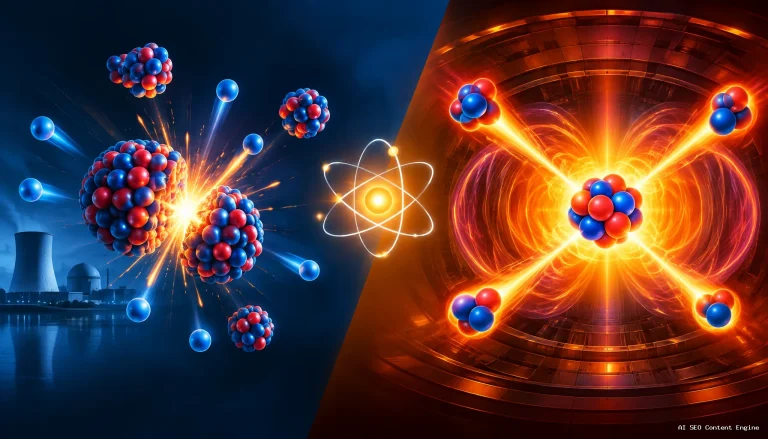
Wave-particle duality is the idea that light and matter behave as both waves and particles, and the experiment decides which side you see. That sounds like a riddle, and physicists treated it as one for a long time. Light makes interference patterns, which only waves can do. Yet the same light knocks electrons out of metal in a way only a stream of tiny bullets should.
Electrons pull the same trick in reverse. They arrive at a detector as single sharp dots, then pile up into a wavy interference pattern. That is the puzzle.
This article works through it step by step. It gives you the definitions, the three formulas that matter, and two worked examples you can copy in an exam.
What Wave-Particle Duality Actually Means
A wave is a disturbance that spreads out and carries energy from one place to another without carrying matter along with it. Think of ripples crossing a pond.
A particle is a small lump of stuff with a definite position and a definite momentum. Think of a marble. Classical physics kept those two boxes separate, and for everyday life that works fine. Ripples do not bounce off each other like marbles, and marbles do not pass through each other and interfere.
Light refused to stay in either box. Maxwell’s equations in the 1860s described light as an electromagnetic wave, and the double slit experiment backed that up.
Then the photoelectric effect showed light behaving like a stream of particles. Neither description was wrong. Each one just described a different experiment.
Niels Bohr gave this a name in 1928, the complementarity principle, which says that wave and particle are two complementary descriptions of the same object and that one experiment shows you one side at a time, never both at once. You do not catch light being a wave and a particle in the same measurement. You catch it being one or the other, depending on what you ask it to do.
A useful rule of thumb runs through the whole topic. Light travels like a wave and interacts like a particle. It spreads, bends and interferes on its way somewhere, then arrives and hands over its energy in one sharp packet.
Electrons follow the same rule. They travel as waves and arrive as particles.
Keep that sentence in your head and most exam questions about this topic start to make sense.
The Double Slit: Light Acting Like a Wave
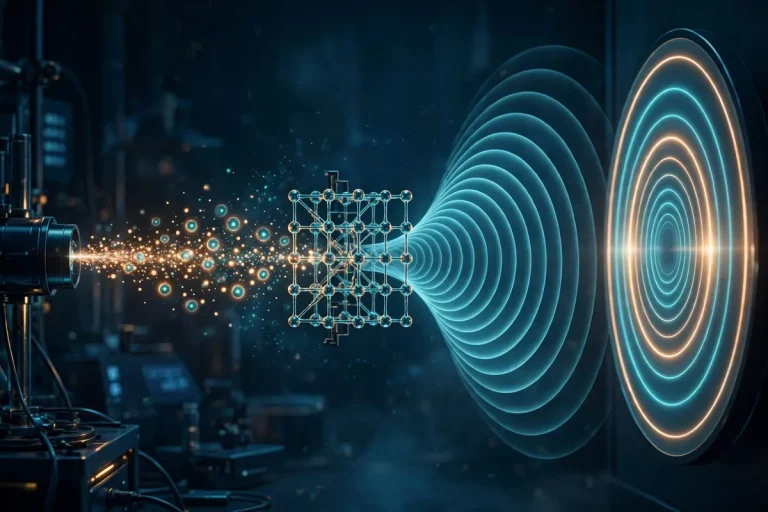
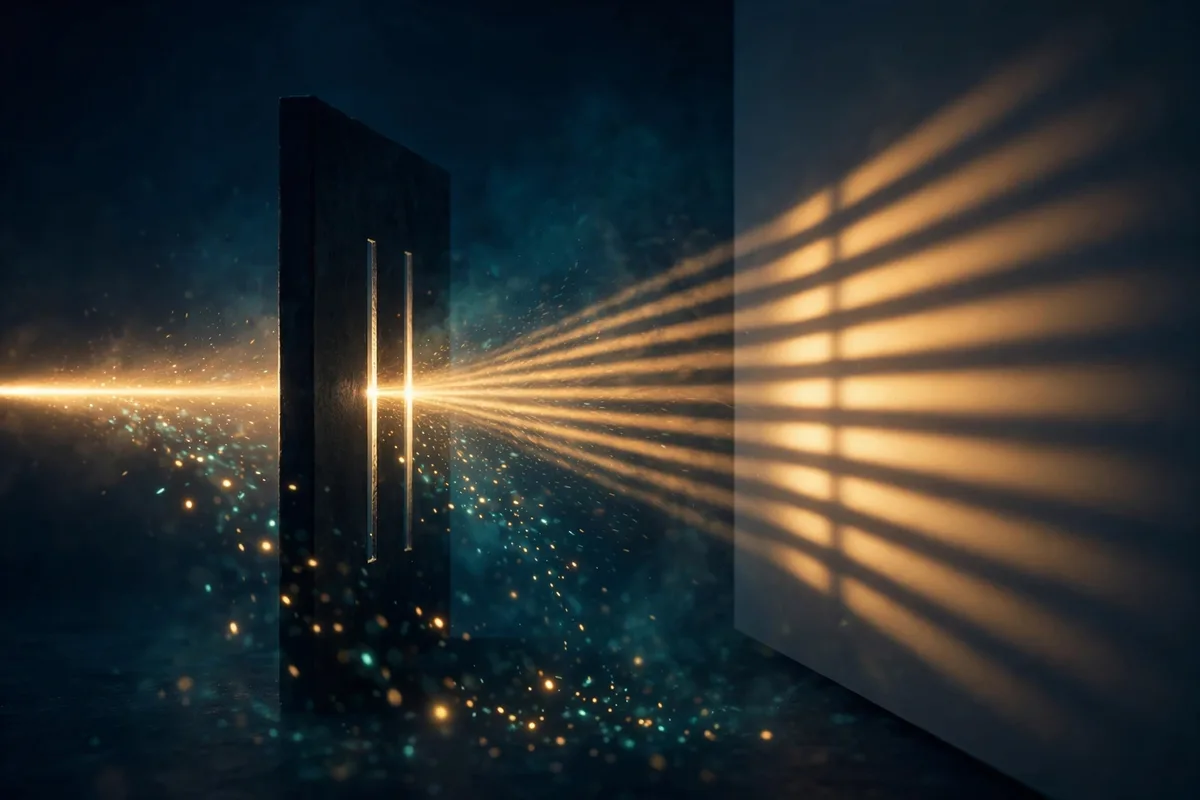
Thomas Young shone light through two narrow slits in 1801 and looked at the screen behind them. He did not see two bright bars. He saw a pattern of bright and dark stripes called fringes.
The bright stripes are places where the waves from the two slits arrive in step and add up. The dark stripes are places where they arrive out of step and cancel out. That adding and cancelling has a name, interference, and only waves do it. Particles cannot cancel each other out.
The positions of the bright fringes follow a simple rule. For two slits a distance d apart, a bright fringe appears at an angle θ when:
d sin θ = nλ
Here λ is the wavelength of the light, and n is a whole number: 0, 1, 2, and so on. The middle fringe is n = 0. The next bright fringe out on each side is n = 1, then n = 2.
Measure the fringe spacing and the slit separation, and you can work out the wavelength of the light. That is exactly how Young measured the wavelength of light, centuries before anyone could see an atom.
The result gets stranger when you turn the light down. Send photons through the slits one at a time, so slowly that only one photon is inside the apparatus at any moment. Each photon lands on the screen as a single dot, like a particle hit.
But wait long enough and the dots build up into the same striped interference pattern. Each photon somehow passes through the apparatus as a wave and lands as a particle.
The pattern is statistical. One photon tells you almost nothing. Ten thousand photons spell out the wave behaviour clearly.
There is one more twist, and it catches students out. If you set up a detector to find out which slit each photon went through, the interference pattern vanishes. The stripes go away and you get two plain blobs instead.
Knowing the path forces the particle picture, and the wave picture goes with it. That is complementarity in action, not a fault in the equipment.
When Light Knocks Electrons Loose
The photoelectric effect is the experiment that forced physicists to take the particle picture seriously. Shine light on a clean metal surface in a vacuum and electrons fly off. Heinrich Hertz noticed the effect in 1887. The details did not fit the wave picture at all.
First, electrons only come off if the light is above a certain frequency. Shine dim red light on the metal for an hour and nothing happens. Shine faint ultraviolet light on it and electrons pop off at once.
A wave picture says the opposite should happen. A brighter wave carries more energy, so given enough time it should knock an electron loose whatever its frequency. It does not.
The wave picture fails here.
Second, the electrons come off instantly, with no delay while the metal soaks up energy. Third, making the light brighter gives you more electrons, but not faster ones. The maximum kinetic energy of the electrons depends on frequency, not brightness.
Einstein explained all of this in 1905. Light comes in packets called photons. A photon is a single quantum of light energy, and its energy depends only on its frequency:
E = hf
Here E is the photon energy in joules, f is the frequency in hertz, and h is Planck’s constant, 6.63 × 10⁻³⁴ J·s. One photon gives all its energy to one electron in one hit. A high frequency photon carries a big packet. A low frequency photon carries a small one, and if that packet is too small to free an electron, no amount of extra photons will help.
That is why brightness changes the number of electrons but not their energy. Brighter light means more photons, so more electrons get hit. The energy of each hit still depends on frequency alone.
Einstein’s photoelectric equation puts numbers on the idea:
hf = Φ + KEmax
The photon energy hf splits into two parts. Φ is the work function, the minimum energy needed to pull an electron out of the metal surface. It is a property of the metal, measured in joules or electronvolts.
Whatever energy is left over becomes the maximum kinetic energy of the freed electron, KEmax. If hf is smaller than Φ, the electron stays put and nothing is emitted.
That gives a threshold frequency, the lowest frequency that can eject an electron:
f0 = Φ / h
Below f0, no electrons come off, however bright the light. Above f0, the extra energy shows up as kinetic energy. The graph of KEmax against frequency is a straight line with gradient h and an intercept at f0, and measuring that gradient was one of the first ways physicists pinned down Planck’s constant.
Compton scattering gave the particle picture a second witness. In 1923 Arthur Compton fired X-rays at electrons and found the X-rays bounced off and lost energy, exactly like billiard balls colliding. The scattered X-rays also had a longer wavelength than the incoming ones.
A pure wave spreading through space has no single lump of energy to hand over in a collision, so it cannot lose energy the way a particle does. The photon picture predicted the wavelength shift precisely, and the experiment matched.
Electrons Have Wavelengths Too
In 1924 Louis de Broglie turned the whole idea around and asked a question nobody had asked before: if light waves can act like particles, can particles act like waves? His answer was yes, and he gave the wavelength a formula:
λ = h / mv = h / p
Here λ is the de Broglie wavelength, h is Planck’s constant, m is the mass of the particle, v is its speed, and p = mv is its momentum. Every moving object has a wavelength, and the only question that matters in practice is whether that wavelength is big enough for any experiment to notice.
Planck’s constant is tiny, 6.63 × 10⁻³⁴ J·s, and it sits on top of the fraction. For an everyday object the mass and speed in the bottom of the fraction are enormous by comparison, so the wavelength comes out absurdly small.
A baseball in flight has a wavelength around 10−34 m. The smallest features in nature are atomic nuclei, about 10−15 m across. The baseball’s wavelength is about a billion billion times smaller than that. No slit, crystal or detector can show interference on that scale.
Everyday objects have wavelengths too. Their wavelengths are just far too small to measure. That is why wave-particle duality never shows up in daily life.
Electrons are a different story. An electron is light, about 9.11 × 10⁻³¹ kg, so its wavelength at ordinary speeds lands in the same range as the spacing between atoms in a crystal, roughly 10−10 m. Crystals can act as diffraction gratings for electrons, and that gives a test.
In 1927 Davisson and Germer fired electrons at a nickel crystal and watched where they scattered. The electrons formed a diffraction pattern, with peaks and troughs at the angles the de Broglie wavelength predicted. Matter waves were real, measured, and matching the formula.
Electron microscopes are the practical payoff. A light microscope cannot resolve details smaller than the wavelength of the light it uses, roughly 500 nm for visible light. Electrons accelerated through a high voltage have wavelengths thousands of times shorter, so an electron microscope can resolve details down to about 0.1 nm.
That is sharp enough to image individual atoms. The machine works because electrons behave as waves. The image on its screen is built from particles hitting a detector, one by one, which is the same dual behaviour as the single photon double slit.
Worked Example 1: Photon Energy from Frequency
Ultraviolet light of frequency 1.5 × 10¹⁵ Hz strikes a metal surface. The metal has a work function of 4.0 eV. Find the energy of one photon in joules and in electronvolts, and decide whether it can eject an electron. If it can, find the maximum kinetic energy of the ejected electron.
Step 1: write down what you know. Frequency f = 1.5 × 10¹⁵ Hz. Planck’s constant h = 6.63 × 10⁻³⁴ J·s. Work function Φ = 4.0 eV.
You need the photon energy E = hf.
Step 2: find the energy in joules. Multiply Planck’s constant by the frequency:
E = hf = (6.63 × 10⁻³⁴ J·s) × (1.5 × 10¹⁵ Hz) = 9.95 × 10⁻¹⁹ J
Step 3: convert joules to electronvolts. One electronvolt is the energy an electron gains crossing a potential difference of 1 volt, and 1 eV = 1.60 × 10⁻¹⁹ J. Divide the energy in joules by that number:
E = 9.95 × 10⁻¹⁹ J ÷ 1.60 × 10⁻¹⁹ J/eV = 6.22 eV
Step 4: compare with the work function. The photon carries 6.22 eV and the metal needs 4.0 eV to free an electron. The photon energy is bigger, so yes, an electron is ejected. If the photon energy had been below 4.0 eV, nothing would come off, no matter how bright the light was.
Step 5: find the maximum kinetic energy. Use Einstein’s equation hf = Φ + KEmax, rearranged:
KEmax = hf − Φ = 6.22 eV − 4.0 eV = 2.22 eV
In joules that is 2.22 eV × 1.60 × 10−19 J/eV = 3.55 × 10⁻¹⁹ J. So each photon carries 9.95 × 10⁻¹⁹ J (6.22 eV), it ejects an electron, and the fastest electrons leave with 2.22 eV of kinetic energy. Note that 2.22 eV is the maximum. Most electrons lose some energy on the way out and leave more slowly.
Worked Example 2: The de Broglie Wavelength of an Electron
An electron moves at 5.0 × 10⁶ m/s. Find its de Broglie wavelength, compare it with the spacing between atoms in a crystal, and explain why electrons diffract off crystals while a baseball does not.
Step 1: write down what you know. Electron mass m = 9.11 × 10⁻³¹ kg. Speed v = 5.0 × 10⁶ m/s. Planck’s constant h = 6.63 × 10⁻³⁴ J·s.
You need λ = h / mv.
Step 2: find the momentum. Momentum p = mv:
p = (9.11 × 10⁻³¹ kg) × (5.0 × 10⁶ m/s) = 4.56 × 10⁻²⁴ kg·m/s
Step 3: find the wavelength. Divide Planck’s constant by the momentum:
λ = h / p = 6.63 × 10⁻³⁴ J·s ÷ 4.56 × 10⁻²⁴ kg·m/s = 1.46 × 10⁻¹⁰ m
That is 0.146 nm. The spacing between atoms in a typical crystal is around 0.1 to 0.3 nm, which is the same order of magnitude.
For diffraction to show up, the wavelength has to be roughly the same size as the gaps it passes through. The electron’s wavelength matches the atomic spacing, so the crystal diffracts the electron beam and a pattern appears. That is exactly what Davisson and Germer measured.
Step 4: run the same calculation for a baseball to see the contrast. Take a baseball of mass 0.145 kg thrown at 40 m/s. Its momentum is 0.145 kg × 40 m/s = 5.8 kg·m/s. Its de Broglie wavelength is:
λ = 6.63 × 10⁻³⁴ J·s ÷ 5.8 kg·m/s = 1.1 × 10⁻³⁴ m
That wavelength is about a trillion trillion times smaller than an atom. There is no grating in the universe fine enough to diffract it, and no detector sensitive enough to measure it.
The baseball does have a wavelength, but it might as well not. Electrons diffract because they are light and fast enough for their wavelength to reach atomic scales. Baseballs do not because their mass pushes the wavelength far below anything measurable.
Common Mistakes Students Make
These are the errors that turn up again and again in exam scripts on this topic. Check your own work against them.
- Thinking light switches back and forth in time. Wave-particle duality does not mean light is a wave on Mondays and a particle on Tuesdays. It means one object has both descriptions, and the experiment picks which one shows up. The two pictures never appear in the same measurement.
- Giving the photon a mass and plugging it into λ = h/mv. A photon has no rest mass, so mv is meaningless for it. Use E = hf for photons and λ = h/mv only for particles with mass, like electrons.
- Using c = fλ for a matter wave. The wave equation c = fλ applies to light travelling at speed c. An electron’s de Broglie wavelength comes from λ = h/mv, and the electron moves far slower than light. Mixing the two equations gives nonsense answers.
- Thinking brighter light gives photoelectrons more kinetic energy. Brightness sets the number of photons, so it sets the number of electrons ejected. The kinetic energy of each electron depends on the frequency of the light, not on how bright it is.
- Assuming the double slit pattern disappears because the slits are too wide. A wider slit changes the fringe spacing, but the pattern only vanishes when which-path information is available. If you can tell which slit each particle went through, interference is destroyed. That is a fact about measurement, not about slit width.
- Treating the de Broglie wavelength of a person or a ball as measurable. The formula gives a wavelength for everything, but for everyday masses it comes out around 10−34 m. That is far below any atomic scale, so no experiment can detect it. Saying a baseball diffracts is technically following the formula and physically meaningless.
The Formulas to Keep
Wave-particle duality stops feeling strange once you have the formulas in front of you. Light travels as a wave and arrives as a particle. Matter does the same thing in reverse, and the numbers tell you when each side matters.
Photon energy: E = hf. Photoelectric effect: hf = Φ + KEmax, with threshold frequency f0 = Φ / h. De Broglie wavelength: λ = h / mv = h / p. Double slit bright fringes: d sin θ = nλ.
Three habits will carry you through exam questions on this topic. First, match the formula to the object: E = hf for photons, λ = h/mv for massive particles. Second, check the threshold before you calculate kinetic energy in a photoelectric question. If hf is below Φ, the answer is zero electrons, not a negative energy.
Third, compare the wavelength with the size of the obstacle before you claim diffraction happens. A wavelength only diffracts when it meets something about its own size.
The takeaway fits in one line. Wave and particle are two descriptions of one reality, not two different things, and wave-particle duality is the name physicists gave to that fact.
Frequently Asked Questions
What is wave-particle duality in simple terms?
Wave-particle duality means that light and matter behave as both waves and particles, and the experiment decides which side you see. Light travels like a wave, spreading and interfering, but arrives like a particle, handing over its energy in one sharp packet called a photon. Electrons do the same in reverse: they travel as waves and arrive as single dots. Bohr's complementarity principle says one experiment shows one side at a time, never both at once.
How does the double slit experiment show wave-particle duality for electrons?
The double slit experiment shows wave-particle duality because single electrons arrive as individual dots yet build up an interference pattern over time. Each electron lands like a particle, but thousands of dots form the bright and dark fringes that only waves can make by interference. The bright fringes follow d sin θ = nλ. If a detector reveals which slit each electron passed through, the pattern vanishes and only two plain blobs remain.
How does the photoelectric effect prove the wave-particle duality of light?
The photoelectric effect proves the particle side of light because electrons are only ejected when the light's frequency is above a threshold, however bright it is. A wave picture predicts that brighter light should eventually knock electrons loose, but dim red light never does while faint ultraviolet light works at once. Einstein explained this with photons: each photon carries energy E = hf and gives it all to one electron in a single hit.
What is the photon energy formula E = hf, and what does each symbol mean?
The photon energy formula is E = hf, where E is the energy of one photon in joules, f is the frequency in hertz, and h is Planck's constant, 6.63 × 10⁻³⁴ J·s. A higher frequency means a more energetic photon, which is why ultraviolet light can eject electrons while red light cannot. Einstein's photoelectric equation, hf = Φ + KE max, then splits that photon energy between the work function Φ and the electron's maximum kinetic energy.
What is the de Broglie wavelength formula λ = h/mv, and how do you use it?
The de Broglie wavelength formula is λ = h/mv = h/p, where λ is the wavelength, h is Planck's constant, m is the particle's mass, v is its speed, and p = mv is its momentum. To use it, find the momentum first, then divide Planck's constant by that momentum. For an electron moving at 5.0 × 10⁶ m/s, the formula gives 1.46 × 10⁻¹⁰ m, about the same as atomic spacing in a crystal, so electrons diffract off crystals.
Why does wave-particle duality not show up for everyday objects like a baseball?
Wave-particle duality does not show up for everyday objects because their de Broglie wavelengths are far too small to detect. A baseball in flight has a wavelength around 10⁻³⁴ m, about a billion billion times smaller than an atomic nucleus, so no slit, crystal or detector can show interference on that scale. The wavelength only becomes measurable for very light, fast particles like electrons, whose wavelengths reach atomic scales.