Neutrinos Explained: Ghost Particles, IceCube, and the 2026 Nobel Prize
Right now, as you read this sentence, trillions of tiny particles are streaming through your body. They pass through your skin, your muscles, your bones, your phone, the floor beneath you — and they keep going straight through the entire Earth as if none of it existed. They are neutrinos: the most abundant matter particles in the universe, and also the most elusive. Physicists call them “ghost particles,” and for almost a century they have slipped through every net science has cast for them.
On October 6, 2026, the Royal Swedish Academy of Sciences announced that the Nobel Prize in Physics would be awarded to Francis Halzen of the University of Wisconsin–Madison, “for decisive contributions to the IceCube Neutrino Observatory and the discovery of high-energy neutrinos of astrophysical origin.” After decades of work, humanity finally built a trap big enough to catch ghosts — a cubic kilometer of Antarctic ice wired with thousands of light sensors. This article explains what neutrinos are, why they are so hard to detect, how IceCube works, and why this Nobel Prize matters.
What Is a Neutrino?
So, what are neutrinos? A neutrino is a fundamental particle — one of the basic building blocks of matter described by the Standard Model of particle physics. Like electrons and quarks, neutrinos cannot be broken down into anything smaller as far as we know.
Neutrinos come in three “flavors”: the electron neutrino, the muon neutrino, and the tau neutrino, each associated with its heavier charged cousin (the electron, muon, and tau particles). They are electrically neutral, which means they ignore electric and magnetic fields entirely. And they have a mind-bogglingly small mass — so small that for decades physicists assumed it was exactly zero. We now know neutrinos do have mass, but it is at least a million times smaller than the mass of an electron.
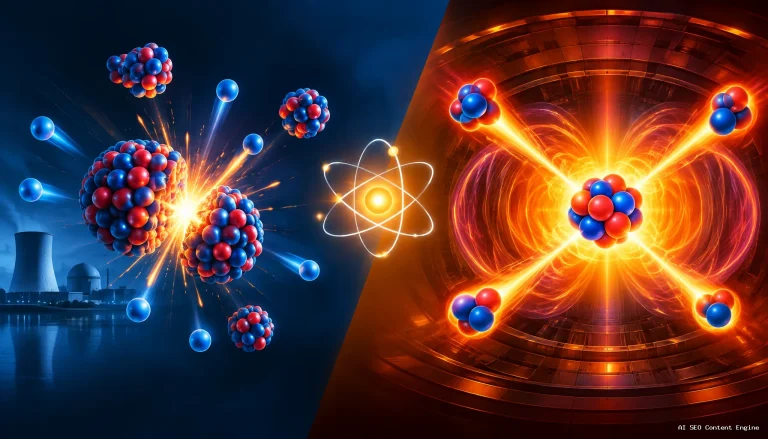
Where do neutrinos come from? Almost everywhere. The Sun pours them out in staggering numbers as a byproduct of nuclear fusion in its core. Nuclear reactors on Earth produce them. Cosmic rays smashing into our atmosphere create showers of them. Dying stars, supernovae, and the violent cores of distant galaxies fire off neutrinos with enormously higher energies. In fact, the very first seconds of the universe itself filled the cosmos with a background sea of neutrinos that is still out there today, stretched thin by 13.8 billion years of cosmic expansion.
Because they are so light, so numerous, and so unwilling to interact, neutrinos shape the universe in quiet ways — carrying energy out of exploding stars, influencing how elements are forged, and streaming across the cosmos almost entirely undisturbed since the Big Bang.
Why Do Physicists Call Them “Ghost Particles”?
The nickname comes from a single staggering fact: neutrinos interact with ordinary matter almost never. While most particles feel the electromagnetic force or the strong nuclear force, neutrinos feel only the weak nuclear force (and gravity, which is far too feeble to matter at particle scales). The weak force, true to its name, barely ever does anything. A typical neutrino could travel through a wall of lead a light-year thick without hitting a single atom.
This ghostliness was predicted before it was ever observed. In 1930, the physicist Wolfgang Pauli proposed an invisible particle to rescue a troubling experiment: in beta decay, some energy seemed to vanish. Rather than accept that energy conservation was broken, Pauli suggested an undetected particle was carrying the missing energy away. He himself doubted it would ever be found, reportedly saying he had “done a terrible thing” by proposing a particle that could not be detected.
It took 26 years. In 1956, Frederick Reines and Clyde Cowan finally detected neutrinos streaming from a nuclear reactor in South Carolina, using a tank of water rigged with detectors — an achievement that eventually earned Reines a Nobel Prize. Even then, catching a handful of neutrinos required a reactor producing them in astronomical numbers and a detector watching patiently for the rarest of collisions.
How Do You Catch a Particle That Barely Exists?
If a neutrino almost never interacts, how do you detect one at all? The answer is a beautiful piece of physics called Cherenkov radiation, and a strategy best summarized as: build something enormous, and wait.
On the extraordinarily rare occasion that a neutrino does collide with an atom, the collision produces fast-moving charged particles. When such a particle races through a transparent medium like water or ice faster than light travels in that medium, it emits a cone of faint blue light — Cherenkov radiation, the optical equivalent of a sonic boom. That flash of blue light is the fingerprint of the invisible visitor.
But “rare” here means spectacularly rare. To catch a useful number of neutrinos, you need two things: a gigantic volume of transparent material for them to collide in, and thousands of exquisitely sensitive light detectors watching for the flashes. You cannot build a detector the size of a mountain out of anything affordable — unless nature has already built it for you.
That is exactly what Francis Halzen realized. In 1988, he proposed a wild idea: use the Antarctic ice sheet itself as the detector. The ice at the South Pole is some of the clearest, purest solid material on Earth, kilometers thick, dark, and silent. Drill deep holes with hot water, lower strings of light sensors into them, let the water refreeze, and you have a particle detector a kilometer across — for the price of the sensors and the drilling.
IceCube: A Telescope Built Out of Ice
Turning that 1988 sketch into reality took more than two decades and an international collaboration of over 450 scientists and engineers from 58 institutions in 14 countries, led by the University of Wisconsin–Madison. A smaller prototype called AMANDA was completed in 2000 and proved the concept worked, but it was not large enough for the job. The full observatory, IceCube, was completed at the end of 2010.
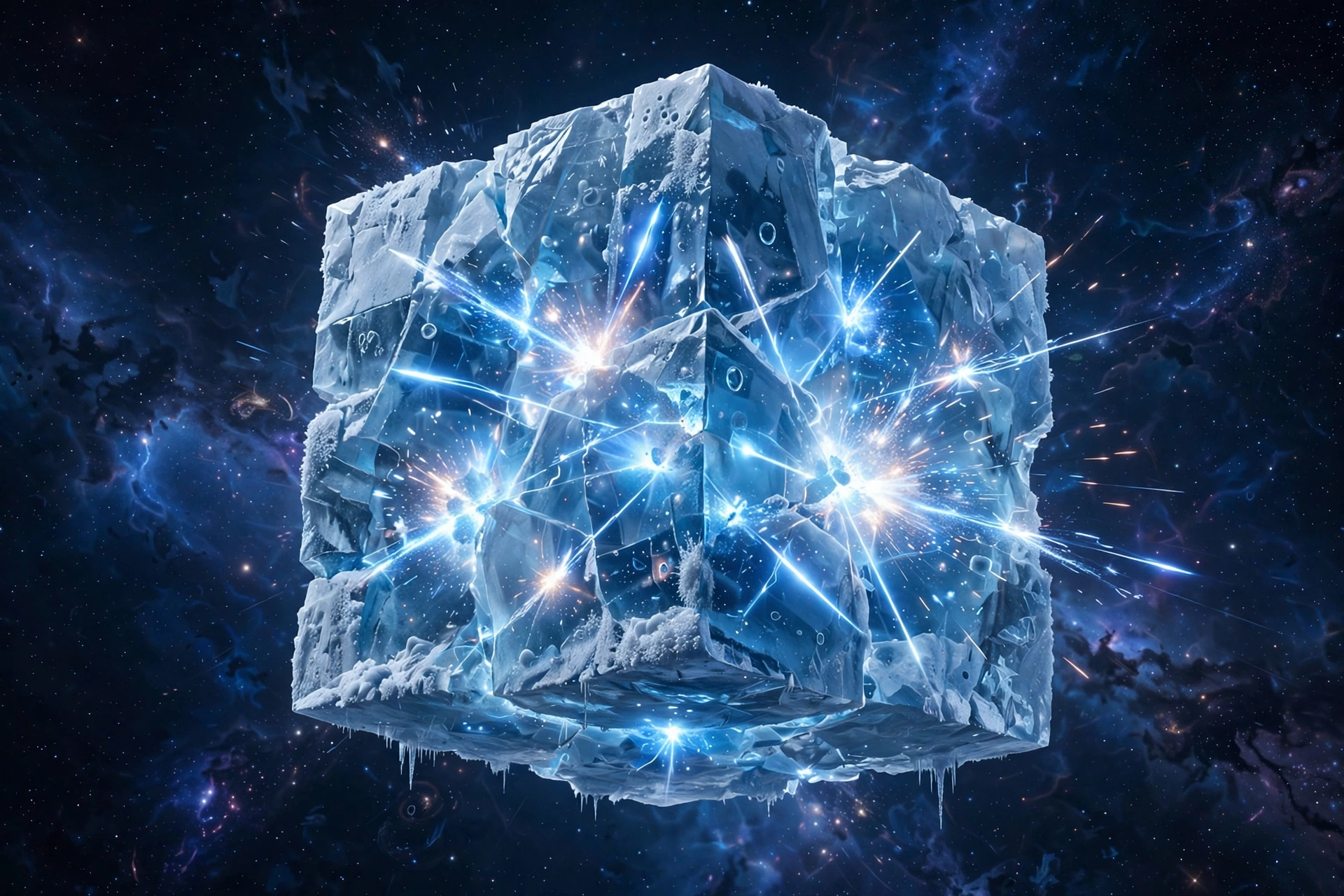
The numbers are hard to grasp. IceCube instruments a full cubic kilometer of Antarctic ice — a billion tons of it. Into that ice go 86 vertical strings of sensors, each carrying 60 digital optical modules, for a total of 5,160 light detectors. The strings hang in holes melted with hot water and reach about 2.5 kilometers (8,200 feet) beneath the surface, deep enough that the ice is shielded from cosmic-ray noise and clear enough for faint light to travel.
Here is how it works. A neutrino — perhaps one born billions of years ago in a distant galaxy — streaks down through the Earth and, against all odds, collides with an atomic nucleus in the ice. The collision hurls charged particles outward at near light speed, and they shed Cherenkov light as they go. The sensors record the arrival times of that blue glow with nanosecond precision, and from the pattern, physicists reconstruct the neutrino’s direction and energy, tracing its path back across the sky to its source.
Most of the neutrinos IceCube sees come from the Sun or Earth’s atmosphere. But buried in the data is something far more precious: a thin rain of extraordinarily energetic neutrinos arriving from deep space — particles carrying a million times more energy than anything our best particle accelerators can produce.
Messages from the Distant Universe
In 2013, the IceCube collaboration announced the first solid evidence of high-energy neutrinos arriving from beyond our solar system — 28 events with energies far above anything the atmosphere could explain, including two landmark detections nicknamed “Bert” and “Ernie.” For the first time, humanity had a working neutrino telescope pointed at the cosmos.
Then came the breakthrough that turned neutrino astronomy from a promise into a science. In September 2017, IceCube caught an exceptionally energetic neutrino and broadcast its arrival direction to telescopes around the world within seconds. Astronomers slewed their instruments to that patch of sky and found a blazar — a supermassive black hole firing a jet of particles almost directly at Earth — flaring in gamma rays at exactly the right place and time. The galaxy, catalogued as TXS 0506+056, sits about 4 billion light-years away. A single ghost particle had pointed the finger at one of the most violent objects in the universe.
That 2017 event, confirmed and published in 2018, marked the birth of true “multimessenger astronomy”: studying the same cosmic object simultaneously with light, gravitational waves, and now neutrinos. Light can be blocked by dust and gas; charged cosmic rays are bent by magnetic fields into uselessness. Neutrinos alone travel in perfectly straight lines from the most extreme environments in existence, carrying uncorrupted information about processes no telescope could ever see directly — the insides of exploding stars, the jets of devouring black holes, the engines of cosmic rays.
Why Francis Halzen Won the 2026 Nobel Prize
The Nobel Committee’s choice honors not a single eureka moment but what its chair, Mark Pearce, called Halzen’s “tenacity and vision.” Halzen is 82, Belgian-born, and has spent nearly four decades insisting that a cubic kilometer of Antarctic ice could become humanity’s window onto the high-energy universe. Colleagues describe a scientist who refused to let the idea die through years of skepticism, funding battles, and brutal South Pole logistics.
Announcing the prize in Stockholm on October 6, 2026, Pearce called neutrinos “ghost-like messengers from the cosmos,” saying Halzen’s work provides “a way of bringing us information about distant cosmic sources which we’re unable to acquire in other ways” and that his leadership “paved the way for a new kind of astronomy.” The prize carries 12 million Swedish kronor — roughly $1.2 million. Speaking to the committee by telephone from Italy shortly after the announcement, Halzen admitted, “It was a great surprise and I obviously didn’t expect it.”
The award also recognizes something larger than one observatory: the validation of an entirely new way of observing the universe. For four hundred years, astronomy meant collecting light. In the last decade, it has grown to include gravitational waves — and now, thanks to IceCube, ghost particles too.
What Comes Next
IceCube is still watching, and its successor is already on the drawing board. Plans for IceCube-Gen2 would expand the observatory to roughly ten times its current volume, with new optical sensors and a radio array to catch even more energetic neutrinos. Each generation sees fainter, more distant sources — and every new source is a laboratory for physics under conditions we could never reproduce on Earth.
The deeper lesson of the 2026 Nobel Prize may be about scientific patience. Halzen sketched the idea in 1988. The first prototype proved itself in 2000. The full detector switched on at the end of 2010. The first cosmic neutrinos arrived in the data in 2013. The blazar breakthrough came in 2017–2018. And the Nobel Prize followed in 2026 — thirty-eight years after a sketch on paper. Some ghosts are worth a lifetime of chasing.
Frequently Asked Questions
What is a neutrino?
A neutrino is a fundamental, electrically neutral particle with an extraordinarily tiny mass. Trillions of them pass through your body every second, yet they almost never interact with matter because they feel only the weak nuclear force. They are produced by the Sun, nuclear reactors, supernovae, and the most violent objects in the distant universe.
Why are neutrinos called ghost particles?
Because they interact with ordinary matter so rarely that they pass straight through planets, stars, and people as if nothing were there. A typical neutrino could fly through a light-year of lead without hitting an atom — hence the nickname “ghost particles.”
How does the IceCube Neutrino Observatory work?
IceCube uses a cubic kilometer of Antarctic ice as its detector. More than 5,000 light sensors hang on 86 strings buried about 2.5 kilometers deep. When a rare neutrino collides with an ice molecule, it creates fast charged particles that emit a faint blue flash called Cherenkov radiation, which the sensors record to reconstruct the neutrino’s direction and energy.
Why did Francis Halzen win the 2026 Nobel Prize in Physics?
Halzen won for his decisive contributions to the IceCube Neutrino Observatory and the discovery of high-energy neutrinos from deep space. He proposed using Antarctic ice as a neutrino detector in 1988 and led the decades-long international effort that turned the idea into the world’s first neutrino telescope, opening a new kind of astronomy.
Can neutrinos pass through the Earth?
Yes. Because they interact so weakly, most neutrinos travel straight through the entire Earth without stopping. In fact, IceCube routinely detects neutrinos arriving from below — particles that entered on the far side of the planet and exited through the Antarctic ice into the detector.
Why do neutrinos matter for astronomy?
Unlike light, neutrinos are not blocked by dust and gas, and unlike charged cosmic rays, they are not deflected by magnetic fields. They travel in straight lines from the universe’s most extreme environments — exploding stars, feeding black holes, distant galaxies — carrying information about cosmic processes that no other messenger can deliver.