
Understanding E = mc²: The Intricacies of Mass-Energy Equivalence
Albert Einstein’s iconic equation, E = mc², encapsulates one of the most profound principles in physics: the mass-energy equivalence. This elegant formula has not only transformed our understanding of the universe but also revolutionized fields ranging from quantum mechanics to cosmology. But what exactly does this equation mean, and how was it derived? In this article, we delve into E = mc² — Mass-Energy Equivalence, Derived and Explained, offering a clear and accessible breakdown of its scientific underpinnings.
The journey to comprehending E = mc² begins with the realization that mass and energy are not distinct entities but rather interchangeable forms of the same fundamental quantity. This groundbreaking concept suggests that a small amount of mass can be converted into a significant amount of energy, a principle that is evident in phenomena such as nuclear reactions.
The Origin and Meaning of E = mc²
The equation E = mc², formulated by Albert Einstein in 1905, stands as a cornerstone of modern physics. This deceptively simple formula reveals the profound relationship between mass and energy, encapsulating the idea that they are two sides of the same coin. To truly appreciate the significance of this equation, it is essential to understand its historical context and the revolutionary impact it has had on science and technology.
The Historical Context
At the dawn of the 20th century, physics was undergoing a transformation. The classical mechanics established by Sir Isaac Newton were being challenged by new discoveries. It was during this period of scientific upheaval that Einstein introduced his theory of special relativity, of which E = mc² is a pivotal component. This theory fundamentally changed the way we understand the concepts of time, space, and energy.
Decoding E = mc²
- E stands for energy, which can be considered as the capacity to do work.
- m represents mass, a measure of the amount of matter in an object.
- c is the speed of light in a vacuum, approximately 299,792,458 meters per second, a constant that plays a critical role in the equation.
The equation implies that energy (E) and mass (m) are interchangeable; they are related by the square of the speed of light (c²), a large number that signifies even a small amount of mass can be converted into a significant amount of energy. This insight forms the basis of mass-energy equivalence.
Implications and Applications
The realization that mass can be converted into energy has had far-reaching implications. It explains the energy produced in nuclear reactions, where tiny amounts of mass are transformed into enormous energy releases. This principle is the driving force behind both the sun’s life-giving energy and the destructive power of atomic weapons.
Beyond these practical applications, E = mc² has also influenced theoretical physics, providing a foundation for further exploration into the realms of quantum mechanics and cosmology. The equation’s implications continue to be a subject of research and discovery, as scientists seek to unlock the mysteries of the universe.
In conclusion, E = mc² is not merely a formula but a profound statement about the nature of reality. Its origin lies in a period of scientific revolution, and its meaning has reshaped our understanding of the universe, illustrating the intrinsic link between mass and energy.
Unpacking the Formula: Variables and Components
To truly appreciate the depth of Einstein’s mass-energy equivalence, it is crucial to break down its iconic formula, E = mc², and understand each component’s role and significance. This equation is deceptively simple, yet it encapsulates a profound relationship between mass and energy.
The Variables Explained
- E (Energy): In the context of the equation, E represents the energy of an object. It is measured in joules (J) in the International System of Units (SI). This component highlights the concept that energy is not just a standalone entity but is intrinsically linked to mass.
- m (Mass): The variable m stands for mass, measured in kilograms (kg). In Einstein’s equation, mass is not merely the amount of matter in an object but is also a form of energy. This reinterpretation of mass shifts our understanding from a purely physical attribute to a dynamic source of potential energy.
- c (Speed of Light): The constant c denotes the speed of light in a vacuum, approximately 299,792,458 meters per second (m/s). The inclusion of c² (the speed of light squared) in the equation is critical, as it illustrates just how much energy is contained within a small amount of mass. The vast magnitude of c² demonstrates why even a minuscule mass can convert to an enormous amount of energy.
Understanding the Components
Each component of the formula plays a pivotal role in conveying the principle of mass-energy equivalence:
- Energy-Mass Interchangeability: The equation asserts that mass and energy are two sides of the same coin. This interchangeability means that mass can be converted into energy and vice versa, a principle that underpins processes such as nuclear fusion and fission.
- Significance of c²: The squaring of the speed of light serves to emphasize the enormous amount of energy potential within mass. This aspect of the equation is key to understanding why nuclear reactions release such a significant amount of energy compared to chemical reactions.
By dissecting the formula’s components, we gain insight into the profound implications of mass-energy equivalence, a concept that not only revolutionized physics but also reshaped our comprehension of the universe itself. Whether applied to the vast energy outputs of stars or the intricate workings of atomic structure, E = mc² continues to be a cornerstone of modern scientific thought.
How Did Einstein Derive E = mc²?
Albert Einstein’s derivation of the mass-energy equivalence formula, E = mc², was a pivotal moment in theoretical physics, fundamentally altering our grasp of energy and matter. The equation emerged from Einstein’s work on the special theory of relativity, published in 1905, which itself was a groundbreaking re-examination of the mechanics of objects moving at high velocities.
The Foundations of Relativity
Einstein’s journey began with the realization that the laws of physics are the same for all observers, regardless of their constant velocity relative to one another—a principle known as the principle of relativity. Alongside this, Einstein postulated that the speed of light in a vacuum is constant and does not vary with the motion of the observer or the source of the light. These two postulates laid the groundwork for a radical new framework in physics.
Exploring Mass and Energy
Einstein’s insights into the relationship between mass and energy were largely mathematical. By examining how energy and momentum interact at high velocities, he identified that the energy of an object increases with its speed, and that this energy can be equated to a measure of mass. Here’s a simplified breakdown of how Einstein reached this conclusion:
- **Energy and Light:** Einstein considered the behavior of light and its energy, as light consists of quanta of energy (later called photons) without mass but with momentum.
- **Conservation Laws:** He utilized the conservation of energy and momentum principles, which are foundational in physics, to analyze systems moving at relativistic speeds.
- **Mathematical Formulation:** Through mathematical derivations involving Lorentz transformations, Einstein expressed the energy of a moving object in terms of its rest mass and its velocity.
- **The Role of c²:** The constant c², the square of the speed of light, emerged naturally from the equations, acting as a conversion factor between units of mass and energy.
The resulting formula, E = mc², encapsulates the profound insight that mass itself embodies a vast amount of energy. This principle is not only theoretical but has tangible applications, such as in nuclear energy and understanding cosmic phenomena.
Implications and Applications
The derivation of this equation demonstrated that even a small amount of mass could be converted into a large amount of energy, explaining the tremendous energy released in nuclear reactions. This understanding led to the development of technologies such as nuclear power and had implications for fields ranging from astrophysics to quantum mechanics.
In summary, Einstein’s derivation of mass-energy equivalence was a monumental achievement, establishing a new paradigm in the way we understand the universe. His work continues to influence modern science, serving as a foundational principle in our ongoing exploration of the cosmos.
Real-World Applications of Mass-Energy Equivalence
The concept of mass-energy equivalence, encapsulated in the equation E = mc², has far-reaching implications beyond theoretical physics. Its applications permeate various aspects of modern technology and scientific exploration, profoundly impacting our daily lives and our understanding of the universe.
Nuclear Energy
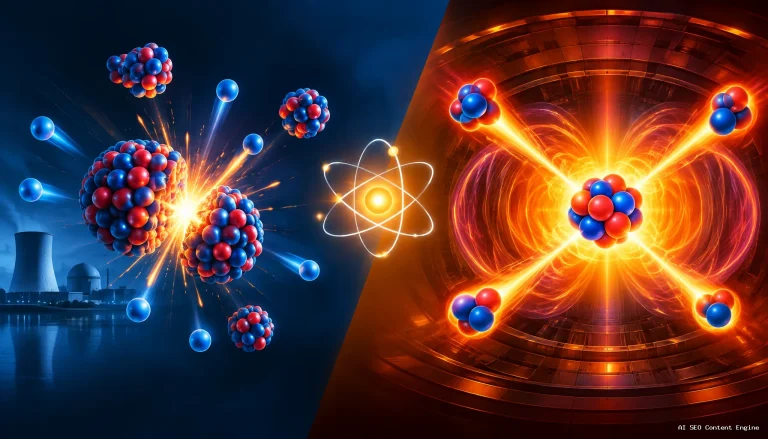
One of the most significant applications of mass-energy equivalence is in the field of nuclear energy. In nuclear reactions, such as fission and fusion, a small amount of mass is converted into a tremendous amount of energy. This principle forms the basis of nuclear power plants that generate electricity and the development of nuclear weapons. The energy harnessed from nuclear fission, where heavy atomic nuclei split, and fusion, where light nuclei merge, exemplifies how mass can be transformed into usable energy, providing a potent energy source to meet global demands.
Astrophysics and Cosmology
In astrophysics, mass-energy equivalence helps scientists understand the life cycle of stars, particularly in the processes of stellar evolution and supernovae. When a star exhausts its nuclear fuel, the balance between gravitational forces and energy output shifts, leading to phenomena such as the collapse of massive stars into black holes or neutron stars. The intense energy released in these cosmic events validates the equation, offering insights into the fundamental workings of the universe.
Medical Applications
Mass-energy equivalence is also pivotal in medical technologies. In positron emission tomography (PET) scans, a form of nuclear medicine, the principle is used to detect metabolic processes in the body. Radioactive isotopes emit positrons, which annihilate with electrons, converting mass into energy in the form of gamma rays. These emissions are then detected to create detailed images of organs and tissues, aiding in the diagnosis and monitoring of diseases such as cancer.
Particle Physics
The realm of particle physics heavily relies on mass-energy equivalence to explore the subatomic world. In particle accelerators, such as the Large Hadron Collider, particles are accelerated to near-light speeds, increasing their mass and energy. Collisions at these high energies allow physicists to probe the fundamental structure of matter, discover new particles, and test the predictions of quantum mechanics and relativity.
In conclusion, the applications of mass-energy equivalence extend across diverse scientific and technological domains. From powering cities to unraveling the mysteries of the cosmos, the equation E = mc² not only bridges concepts of mass and energy but also serves as a cornerstone for innovation and discovery, continually shaping our understanding of the physical world.
Impact on Modern Physics and Technology
The profound implications of the mass-energy equivalence principle, epitomized by Einstein’s famous equation, extend far beyond theoretical physics, catalyzing technological advancements and reshaping modern scientific paradigms.
Revolutionizing Energy Production
The equation underscores the potential of converting mass into vast amounts of energy, a concept that has been pivotal in the development of nuclear power. Nuclear reactors harness this principle by initiating nuclear fission, where the nucleus of an atom splits into smaller parts, releasing energy. This clean and efficient energy source powers cities and offers an alternative to fossil fuels, contributing to global efforts to mitigate climate change.
Advancements in Medical Technology
In the medical field, mass-energy equivalence plays a crucial role in diagnostic and therapeutic technologies. For instance, in positron emission tomography (PET) scans, the annihilation of positrons and electrons releases energy in the form of gamma rays, which are detected to produce detailed images of the body’s internal structures. This application is vital for early detection and treatment planning of various diseases, including cancer.
Exploration of the Subatomic World
In particle physics, mass-energy equivalence is essential for understanding the behavior of particles at high energies. Particle accelerators, such as the Large Hadron Collider, operate by accelerating particles to velocities approaching the speed of light, thereby increasing their mass and energy. These experiments allow scientists to explore the fundamental forces of the universe, test the predictions of the Standard Model, and search for new, undiscovered particles.
Influence on Cosmology
The equation also has profound implications in cosmology, offering insights into the behavior of the universe at the largest scales. The conversion of mass to energy is a key process in stellar life cycles, enabling stars to shine and contribute to the cosmic energy budget. Furthermore, understanding mass-energy interactions helps cosmologists investigate phenomena such as black holes and the Big Bang, providing a deeper understanding of the universe’s origins and evolution.
In summary, the mass-energy equivalence principle is not just a theoretical construct but a practical framework that continues to drive innovation and exploration across multiple fields. Its impact on modern physics and technology is a testament to the enduring legacy of Einstein’s insights, continually inspiring new generations of scientists and engineers to push the boundaries of what is possible.
Common Misunderstandings and Clarifications
Despite being one of the most famous equations in the world, Einstein’s mass-energy equivalence formula often encounters a variety of misconceptions. Understanding these misunderstandings is crucial for appreciating the true implications and applications of this groundbreaking concept.
Misinterpretation of the Equation’s Scope
A common misconception is that E = mc² only applies to nuclear reactions or atomic bombs. While it’s true that the equation describes the enormous energy released in nuclear reactions, its implications extend far beyond. The principle is universal, applying to any process where mass can be converted into energy and vice versa, from the fusion reactions in the sun to the metabolic processes in your body.
Confusion About Mass “Loss”
Another frequent misunderstanding involves the idea of “mass loss.” People often think mass just vanishes when converted to energy. In reality, mass is not lost; it is transformed into energy. This transformation maintains the conservation of energy and mass in a closed system, a cornerstone of Einstein’s theory.
Speed of Light as a Constant
Some may question why the speed of light (c) is a critical component of the equation. The speed of light is not just a constant but a fundamental limit of the universe, representing the maximum speed at which information or matter can travel. It serves as a conversion factor between mass and energy, underscoring the profound relationship between these two entities.
Misconception of Mass-Energy Equivalence Class
There is sometimes confusion surrounding the term “mass-energy equivalence class.” This doesn’t refer to a different equation or principle but rather describes the set of states or systems that adhere to the same mass-energy relation defined by Einstein’s formula. It emphasizes the universality and invariance of the mass-energy relationship across different physical contexts.
Overlooking Relativistic Effects
Many overlook that E = mc² is a simplification of more comprehensive relativistic equations. The full equation accounts for momentum and energy in a moving system, which becomes significant at speeds approaching that of light. This simplifies to E = mc² when the object is at rest, indicating the rest energy of a mass.
Clarifying these misunderstandings helps deepen our appreciation of Einstein’s insights and their application across various scientific fields. The mass-energy equivalence principle is not just a simple formula but a gateway to understanding the fundamental interconnections of the universe.
Conclusion
Albert Einstein’s groundbreaking equation, E = mc², transformed our understanding of the universe by establishing the profound relationship between mass and energy. This mass-energy equivalence principle reveals that mass can be converted into energy and vice versa, highlighting the dynamic nature of matter and energy. Through deep exploration into the derivation and implications of this equation, we see its central role in technological advancements and theoretical physics. From nuclear power to cosmological phenomena, E = mc² continues to illuminate the pathways of scientific discovery, underscoring the unity of the physical world.
Frequently Asked Questions
What is meant by the equivalence of mass and energy?
The equivalence of mass and energy, as expressed in the equation E = mc², means that mass can be converted into energy and energy into mass. This principle shows that mass and energy are two forms of the same thing; they can be transformed into one another, demonstrating the fluidity of these concepts in the physical realm.
Is it scientifically proven that energy cannot be destroyed?
Yes, it is scientifically proven that energy cannot be destroyed. This is articulated in the law of conservation of energy, which states that energy can neither be created nor destroyed but can only change forms. E = mc² further supports this by showing the interchangeability between mass and energy, reinforcing the concept of energy conservation.
Which equation represents mass-energy equivalence?
The equation that represents mass-energy equivalence is E = mc². In this equation, E stands for energy, m represents mass, and c² denotes the square of the speed of light in a vacuum. This concise formula encapsulates the direct relationship between mass and energy.
How is E = mc² derived?
E = mc² is derived from Einstein’s theory of special relativity. The derivation involves understanding how the laws of physics are the same for all non-accelerating observers and how the speed of light is constant in a vacuum. Through mathematical formulations and thought experiments, such as the energy-momentum relation, Einstein demonstrated that the energy of a body at rest is equal to its mass times the speed of light squared, thus arriving at the famous equation.