What Is Quantum Tunnelling? How Particles Pass Through Barriers
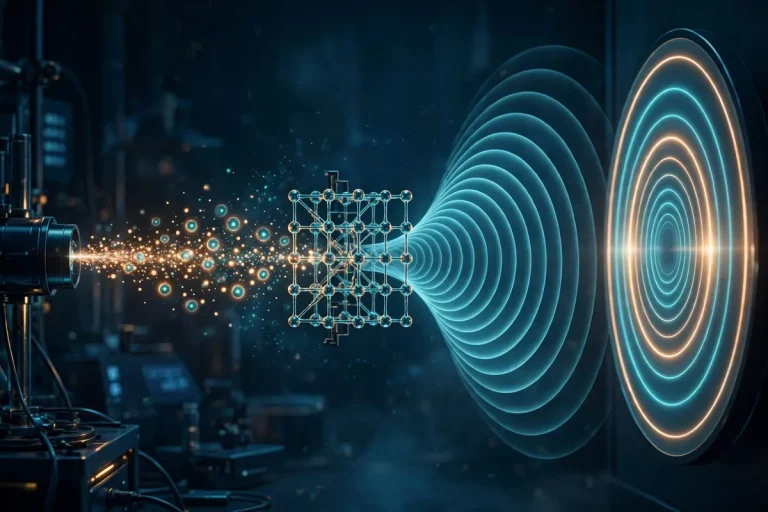
Quantum tunnelling is a particle appearing on the far side of an energy barrier it classically could not cross. Picture a ball rolling toward a hill. If the ball lacks the energy to reach the top, it rolls back down. It never appears on the far slope.
An electron facing the same situation behaves differently. Sometimes it turns up on the other side of the barrier, carrying exactly the energy it started with. That is quantum tunnelling, and it is one of the strangest predictions of quantum mechanics that experiments confirm every day.
This article explains the idea in plain language, then gives you the formula that predicts how often tunnelling happens. You will work through two full calculations, one for an electron and one for a proton, and you will see why the same barrier that barely slows an electron stops a proton completely. The last sections cover where tunnelling shows up in the real world, from the decay of atomic nuclei to the microscope that images single atoms, and the mistakes students most often make with it.
The Classical Rule, and Why Quantum Particles Break It
In classical physics, a particle carries a total energy E, split between kinetic energy, the energy of motion, and potential energy, the energy of position. A barrier is a region where the potential energy V0 sits higher than the particle’s total energy. The rule is simple.
If E is smaller than V0, the particle cannot enter the region at all, because its kinetic energy there would have to be negative, and negative kinetic energy has no meaning. The particle reflects. End of story.
Quantum mechanics rewrites the story because particles are also waves. Louis de Broglie proposed in 1924 that every moving particle carries a wavelength, given by λ = h/p, where h is Planck’s constant and p is the particle’s momentum. Experiments soon confirmed it. Electrons fired at a crystal diffract, just as light does.
A particle is described by a wavefunction, written ψ, a mathematical wave that spreads through space and has no sharp edge.
The wavefunction gives probabilities. The square of its size at a point, |ψ|², tells you the probability of finding the particle there. A wavefunction can therefore be nonzero in places a classical particle could never reach.
That single fact is the whole secret of tunnelling. The particle does not climb the barrier. Its wavefunction leaks through it, and a small part of that wave reappears on the far side.
Keep this picture in mind as the maths arrives. Everything that follows is a way of measuring how much of the wave survives the trip through the wall.
What Happens Inside the Barrier
Physicists model the simplest case as a rectangular barrier. The potential energy jumps to V0 at the left edge, stays flat for a width a, then drops back to zero at the right edge. The particle approaches from the left with energy E below V0. The Schrödinger equation, the central equation of quantum mechanics, describes the wavefunction in each of the three regions: before the barrier, inside it, and after it.
To the left of the barrier the wavefunction oscillates, as a travelling wave should. Inside the barrier something different happens. At the wall the wavefunction starts decaying exponentially with distance, ψ ∝ e^(−κx), where x measures how far into the barrier you have gone and κ, the decay constant, sets how fast the wave shrinks.
The decay constant is κ = √(2m(V0 − E))/ħ. Here m is the particle mass, V0 − E is the energy shortfall, and ħ is the reduced Planck constant, Planck’s constant divided by 2π. Two things drive κ up.
A heavier particle decays faster. A bigger shortfall, a taller barrier relative to the particle’s energy, also decays faster. A light particle with energy close to the top of the barrier has a small κ, so its wavefunction survives further into the wall.
At the far edge the wavefunction starts oscillating again, as a free particle wave, but with a much smaller amplitude than the incoming wave. Amplitude squared means probability, so the smaller amplitude on the far side means a smaller chance of finding the particle there. That chance is what the next section calculates.
One warning before you go further. The wavefunction inside the barrier is a probability amplitude, not a path. Asking which route the particle took through the wall, or how long it spent inside, has no clean classical answer.
The theory predicts the probability of emerging on the far side, and that prediction matches experiment. Treat the decaying wave as a calculation tool, not as a little ball burrowing through solid matter.
The Quantum Tunnelling Probability Formula
The number that matters is the transmission coefficient, written T. It is the ratio of the probability flow that gets through the barrier to the probability flow that arrives at it. If 1000 electrons hit the barrier and 24 emerge on the far side, T is 0.024.
The rest reflect, and the reflection coefficient R is simply R = 1 − T. Nothing is absorbed. Every particle either tunnels or reflects.
For a rectangular barrier the exact result is T = 1 / (1 + V0² sinh²(κa) / (4E(V0 − E))). The sinh is the hyperbolic sine, a function that grows steeply once its argument passes 1. Do not let the formula scare you. Its message is simple. Everything inside it depends on κa, the decay constant times the barrier width, and κa sits inside an exponential.
When the barrier is thick, meaning κa is much greater than 1, the formula simplifies to the thick barrier approximation T ≈ 16(E/V0)(1 − E/V0) e^(−2κa). Use this version only when κa is large.
The factor in front, 16(E/V0)(1 − E/V0), is a number of order one. The exponential does all the real work. Each extra bit of width multiplies T by another factor of e^(−2κ), so T falls fast.
The table below sums up how T responds when you change one thing at a time.
| Change | Effect on κ | Effect on T |
|---|---|---|
| Barrier width a increases | No change | Falls exponentially |
| Barrier height V0 increases | Increases | Falls sharply |
| Particle energy E increases | Decreases | Rises |
| Particle mass m increases | Increases | Falls very sharply |
Notice what the formula leaves out. The particle’s energy stays E throughout. Tunnelling adds no energy and takes none away. The particle emerges on the far side with the same energy it had before the barrier, which is exactly why the process respects conservation of energy.
Notice something else too. The dependence on width is exponential, not linear. Doubling the width multiplies T by e^(−2κa) a second time, which can shrink it by orders of magnitude. That sensitivity is why tunnelling is a nanoscale phenomenon and why the scanning tunnelling microscope, covered later, can resolve single atoms.
Worked Example 1: An Electron Crossing a Nanoscale Barrier
Time to put numbers in. An electron with energy E = 1 eV approaches a rectangular barrier of height V0 = 2 eV and width a = 0.5 nm. How likely is it to tunnel through?
Step 1: find the energy shortfall. V0 − E = 2 eV − 1 eV = 1 eV. Convert electron volts to joules, because the formula needs SI units. 1 eV = 1.602 × 10⁻¹⁹ J, so V0 − E = 1.602 × 10⁻¹⁹ J.
Step 2: calculate the decay constant. κ = √(2m(V0 − E))/ħ. The electron mass is m = 9.11 × 10⁻³¹ kg and the reduced Planck constant is ħ = 1.055 × 10⁻³⁴ J s. Inside the square root: 2 × 9.11 × 10⁻³¹ kg × 1.602 × 10⁻¹⁹ J = 2.92 × 10⁻⁴⁹. Taking the square root gives 5.40 × 10⁻²⁵. Divide by ħ: κ = 5.40 × 10⁻²⁵ / 1.055 × 10⁻³⁴ = 5.12 × 10⁹ m⁻¹.
Step 3: multiply by the barrier width. a = 0.5 nm = 0.5 × 10⁻⁹ m, so κa = 5.12 × 10⁹ × 0.5 × 10⁻⁹ = 2.56. This number is larger than 1, but not much larger, so the exact formula is the safer choice here.
Step 4: put κa into the exact transmission formula. First sinh(2.56) ≈ 6.43, so sinh²(2.56) ≈ 41.3. The fraction V0² / (4E(V0 − E)) is 2² / (4 × 1 × 1) = 1, using electron volts throughout since the units cancel. So T = 1 / (1 + 41.3) = 1 / 42.3 ≈ 0.024.
Step 5: interpret the answer. T ≈ 0.024, or about 2.4 percent. Roughly 1 electron in 42 gets through the barrier. The other 41 reflect. That is a small chance for one electron, but fire a stream of electrons at the barrier and a steady trickle emerges on the far side.
As a check, the thick barrier approximation gives T ≈ 16(E/V0)(1 − E/V0) e^(−2κa) = 16 × 0.5 × 0.5 × e^(−5.12) = 4 × 0.00598 ≈ 0.024. The two formulas agree to within about one percent, which tells you the approximation is already decent at κa = 2.56, though the exact form is still the one to trust.
Worked Example 2: The Same Barrier, a Proton Instead
Now keep everything the same, E = 1 eV, V0 = 2 eV, a = 0.5 nm, but replace the electron with a proton. The proton mass is 1.67 × 10⁻²⁷ kg, about 1836 times the electron mass. What happens to T?
Look at the decay constant first. κ = √(2m(V0 − E))/ħ contains the square root of the mass, so κ grows by a factor of √1836 ≈ 43. That gives κ ≈ 43 × 5.12 × 10⁹ = 2.20 × 10¹¹ m⁻¹, and κa ≈ 43 × 2.56 ≈ 110.
Now κa is much greater than 1, so the thick barrier approximation is the right tool. T ≈ 16(E/V0)(1 − E/V0) e^(−2κa) = 4 × e^(−220). The exponential e^(−220) is about 10⁻⁹⁶, so T comes out at roughly 10⁻⁹⁵.
That number is effectively zero. Fire protons at this barrier for the age of the universe and you would still expect none to get through. The barrier barely slowed the electron, yet it stops the proton completely. Mass enters through a square root inside an exponential, so a factor of 1836 in mass becomes a factor of 10⁹³ in probability.
This is the lesson to carry into exams. Tunnelling is a light particle phenomenon. Electrons tunnel readily.
Alpha particles, four times heavier than a proton, tunnel only because the barriers inside nuclei are extremely thin. Baseballs and people never tunnel in any practical sense. The maths does not forbid it. The probability is simply so small that the universe is not old enough for it to happen once.
Where Quantum Tunnelling Shows Up in the Real World
Tunnelling drives processes in nature and in technology you use every day. Four examples show the range.
Alpha decay
An alpha particle inside a heavy nucleus sits in a deep potential well. The strong nuclear force holds it in, but the electric repulsion between protons pushes it out, leaving a barrier of finite width. The alpha particle has too little energy to climb over that barrier, so classically it would stay trapped forever. It escapes by tunnelling.
The Gamow factor, named after George Gamow, describes how the decay rate depends on the barrier. Small changes in barrier width or height produce enormous changes in half life. Polonium-212 decays with a half life near 0.3 microseconds. Uranium-238, with a slightly different barrier, has a half life near 4.5 billion years. Same mechanism, wildly different rates, all because the tunnelling probability is exponential in the barrier.
The scanning tunnelling microscope
In a scanning tunnelling microscope a sharp metal tip hovers about a nanometre above a surface, with a small voltage between tip and surface. Classically no current can flow across the vacuum gap. Electrons tunnel across it instead, and the current follows I ∝ e^(−2κd), where d is the tip to surface distance.
Move the tip 0.1 nm further away and the current drops by roughly a factor of ten. That extreme sensitivity is the whole trick. As the tip scans across the surface, the current rises and falls with the height of individual atoms, and a computer turns those changes into an image. The microscope maps single atoms because the tunnelling current is exponential in distance.
Fusion in the Sun
The Sun fuses hydrogen into helium at a core temperature near 15 million kelvin. That sounds hot, and it is, but the average proton still carries far too little energy to climb the electric repulsion barrier between two protons. Classical physics says fusion should barely happen.
Tunnelling says a small fraction of proton pairs get through anyway, and that small fraction powers a star. Without quantum tunnelling the Sun would shine far more faintly, if at all.
Tunnel diodes and flash memory
Engineers also put tunnelling to work. A tunnel diode uses a thin barrier that electrons cross by tunnelling, and it can switch faster than an ordinary diode. Flash memory stores each bit as charge trapped on a floating gate, and writing or erasing a bit means pushing electrons through a thin oxide layer by tunnelling. The storage in your phone relies on quantum tunnelling every time it saves a photo.
Common mistakes
Students lose marks on tunnelling for a handful of repeatable reasons. Here they are, so you can avoid them.
- Confusing tunnelling with going over the barrier, or with gaining energy. Energy is conserved. The particle emerges with the same energy E it had before the barrier. Nothing is added and nothing is taken away.
- Thinking the particle digs through the barrier or travels inside it like a classical object. The wavefunction decays inside the barrier, but that is a statement about probability, not a journey through solid matter.
- Treating T as the value of the wavefunction at one point. T is a ratio of transmitted probability flow to incident probability flow. The wavefunction amplitude on the far side matters only through that ratio.
- Using the thick barrier approximation when κa is small. The approximation T ≈ 16(E/V0)(1 − E/V0) e^(−2κa) needs κa much greater than 1. For thin barriers, use the exact formula.
- Forgetting that tunnelling needs a barrier of finite width. An infinitely wide barrier gives T = 0, because the wavefunction decays to nothing before it can re-emerge. Width is the whole effect.
Conclusion
Four formulas carry the whole topic. The decay constant is κ = √(2m(V0 − E))/ħ. The transmission probability, in the thick barrier limit, is T ≈ 16(E/V0)(1 − E/V0) e^(−2κa). Everything that reflects is R = 1 − T. And the tunnelling current in a scanning tunnelling microscope follows I ∝ e^(−2κd).
Quantum tunnelling is a particle appearing on the far side of an energy barrier it classically could not cross, with a probability that falls exponentially with barrier width and with the square root of the particle mass. Work the two examples yourself with different numbers and watch how fast T moves. That feeling for the exponential is the real lesson of this article.
Frequently Asked Questions
What is quantum tunnelling in simple terms?
Quantum tunnelling is a particle appearing on the far side of an energy barrier it classically could not cross. Because a particle is also a wave, described by a wavefunction ψ, the wave leaks through the barrier and re-emerges on the far side with a smaller amplitude. The particle does not climb over the barrier or dig through it. Instead, there is a small probability, given by the transmission coefficient T, of finding it on the other side.
Does quantum tunnelling violate the conservation of energy?
No, quantum tunnelling does not violate the conservation of energy. The particle emerges on the far side with exactly the same total energy E it had before the barrier, so nothing is gained and nothing is lost. Inside the barrier the wavefunction decays as ψ ∝ e^(−κx), but that describes probability, not a loss of energy. The transmission coefficient T only measures the transmitted probability flow, while R = 1 − T accounts for the rest.
How is the quantum tunnelling probability calculated?
The quantum tunnelling probability is the transmission coefficient T, the ratio of the probability flow that gets through the barrier to the flow that arrives at it. For a rectangular barrier of height V0 and width a, the exact formula is T = 1 / (1 + V0² sinh²(κa) / (4E(V0 − E))), where κ = √(2m(V0 − E))/ħ. When κa is much greater than 1, the thick-barrier approximation T ≈ 16(E/V0)(1 − E/V0) e^(−2κa) is used instead.
Why does the quantum tunnelling probability fall so fast when the barrier gets wider?
The tunnelling probability falls fast because it depends exponentially on the barrier width, not linearly. Inside the barrier the wavefunction decays as ψ ∝ e^(−κx), so every extra bit of width multiplies the transmission coefficient T by another factor of e^(−2κ). In the thick-barrier approximation, T ≈ 16(E/V0)(1 − E/V0) e^(−2κa), doubling the width squares the exponential factor. That is why a barrier only a fraction of a nanometre wider can shrink T by orders of magnitude.
Can a human tunnel through a wall by quantum tunnelling?
Practically no: the probability is so small that it never happens. The transmission coefficient T falls exponentially with the square root of the particle mass, because κ = √(2m(V0 − E))/ħ. The article's worked example shows a proton tunnelling with T of roughly 10⁻⁹⁵ through a 0.5 nm barrier, effectively zero. A human is far heavier and a wall is far wider, so the probability is smaller still, and the universe is not old enough for it to happen once.
How does quantum tunnelling explain alpha decay and the scanning tunnelling microscope?
In alpha decay, an alpha particle trapped inside a nucleus escapes by tunnelling through the finite-width barrier created by nuclear attraction and electric repulsion. The Gamow factor shows that small barrier changes produce huge changes in half-life, from 0.3 microseconds for polonium-212 to 4.5 billion years for uranium-238. In a scanning tunnelling microscope, electrons tunnel across a gap, and the current follows I ∝ e^(−2κd), so moving the tip 0.1 nm changes the current tenfold and maps single atoms.