
Understanding Transverse Waves: Diagrams, Properties, and Examples
Have you ever marveled at the ripples on a pond or the mesmerizing patterns of light waves? These captivating phenomena are examples of transverse waves, a fundamental concept that reveals the intricacies of our universe. But what exactly is a transverse wave? In this comprehensive guide, we’ll explore the fascinating world of transverse waves, complete with detailed diagrams, essential properties, and real-world examples that will illuminate your understanding. Whether you’re a curious learner or a seasoned science enthusiast, this article will unravel the mysteries of transverse waves and enhance your appreciation of their role in nature and technology.
What Is a Transverse Wave?
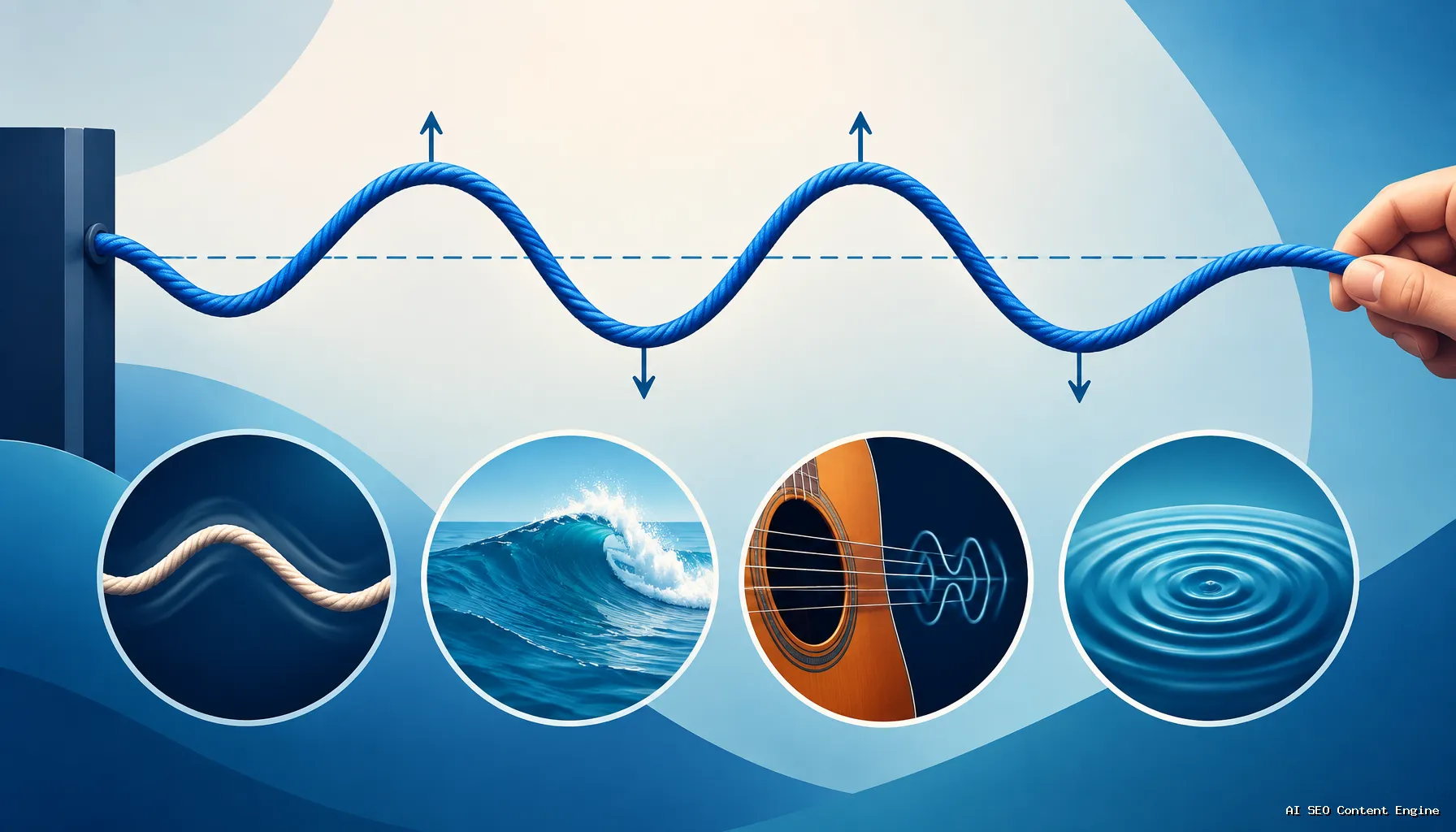
At its core, a transverse wave is a type of wave where the particles of the medium move perpendicular to the direction of the wave’s propagation. This perpendicular movement is what distinguishes transverse waves from other wave types, such as longitudinal waves, where particle motion is parallel to the wave direction. To grasp the concept of a transverse wave, imagine the ripples that form on the surface of water when a stone is dropped. The water molecules move up and down, creating peaks and troughs, while the wave travels outward in a circular pattern.
Characteristics of Transverse Waves
- Crest and Trough: Transverse waves have distinct crests (the highest points) and troughs (the lowest points). These features are essential in identifying and analyzing the wave patterns.
- Amplitude: The amplitude of a transverse wave refers to the maximum displacement of the medium’s particles from their rest position. It is a measure of the wave’s energy and intensity.
- Wavelength: The distance between two consecutive crests or troughs is known as the wavelength. It is a critical parameter in determining the wave’s frequency and speed.
Transverse Wave Properties
Transverse waves exhibit several unique properties that make them vital in various scientific and technological applications:
- Polarization: Unlike longitudinal waves, transverse waves can be polarized. This means their vibrations can be confined to a single plane, a property extensively used in optics and communication technologies.
- Interference and Diffraction: Transverse waves can interfere with each other, leading to constructive or destructive interference patterns. They can also bend around obstacles, a phenomenon known as diffraction.
- Reflection and Refraction: When transverse waves encounter a boundary, they can reflect back into the original medium or refract into a new medium, altering their speed and direction.
Transverse vs Longitudinal Waves
Understanding the distinction between transverse and longitudinal waves is crucial. While transverse waves involve perpendicular particle motion, longitudinal waves feature parallel motion. This difference leads to varied behaviors and applications. For instance, sound waves in air are longitudinal, while electromagnetic waves, like light, are transverse.
In summary, transverse waves are a fundamental type of wave characterized by perpendicular particle motion, crests and troughs, and properties such as polarization and diffraction. These characteristics not only define their behavior but also enhance their utility in fields ranging from telecommunications to physics. As we delve deeper into the world of transverse waves, we will explore their diagrams, properties, and examples, further illuminating their significance in science and technology.
Key Properties of Transverse Waves
Transverse waves exhibit a variety of distinctive properties that contribute to their unique behavior and wide range of applications. Understanding these properties is essential for grasping how transverse waves operate and interact with different media. Below are the key properties of transverse waves:
Particle Motion
In transverse waves, the motion of the particles is perpendicular to the direction of wave propagation. This perpendicular movement leads to the formation of peaks known as crests and valleys called troughs. This characteristic distinguishes them significantly from longitudinal waves, where particle movement is parallel to wave direction.
Amplitude
The amplitude of a transverse wave refers to the maximum displacement of a particle from its rest position. Amplitude is a critical factor in determining the energy of the wave; the greater the amplitude, the more energy the wave carries. This property is often represented in wave diagrams to illustrate the wave’s intensity.
Wavelength
The wavelength in transverse waves is the distance between two consecutive crests or troughs. It is a fundamental measure used to describe the wave’s size and is inversely related to frequency. The wavelength is crucial in differentiating between various types of transverse waves, such as visible light and other electromagnetic spectrums.
Frequency and Period
Frequency describes the number of wave cycles that pass a given point per unit time, typically measured in hertz (Hz). The period is the inverse of frequency and represents the time it takes for one complete wave cycle. These properties are essential in applications ranging from radio broadcasting to seismic wave analysis.
Speed
The speed of a transverse wave is determined by the medium through which it travels and is calculated as the product of its frequency and wavelength. This property is vital for understanding how waves propagate through different environments, such as air, water, or a vacuum.
Polarization
One of the unique properties of transverse waves is their ability to be polarized. Polarization refers to the orientation of the oscillations perpendicular to the direction of energy transfer. This property is not observed in longitudinal waves and is particularly useful in fields like optics and telecommunications, where polarized waves can reduce glare or enhance signal clarity.
Diffraction and Interference
Transverse waves can exhibit diffraction, a phenomenon where waves bend around obstacles or spread out after passing through narrow openings. Additionally, they can interfere with each other, leading to constructive or destructive interference patterns. These behaviors are crucial in understanding wave interactions in various scientific and engineering applications.
Overall, the properties of transverse waves such as amplitude, wavelength, frequency, and polarization are fundamental in distinguishing them from other wave types. They play a pivotal role in numerous technological and scientific domains, illustrating the significance of transverse wave properties in both theoretical and practical contexts.
Diagrams of Transverse Waves
Understanding transverse waves can be greatly enhanced through the use of diagrams. These visual representations help illustrate the wave’s properties and behaviors, highlighting the oscillations that occur perpendicular to the direction of energy transfer. Diagrams are vital tools for visualizing the unique characteristics of transverse waves and distinguishing them from longitudinal waves.
Components of a Transverse Wave Diagram
- Crest: The highest point of the wave. In a diagram, crests are typically shown as peaks that rise above the rest position.
- Trough: The lowest point of the wave, appearing as valleys below the rest position.
- Amplitude: The vertical distance from the rest position to a crest or trough. It represents the wave’s energy and is a key element in transverse wave properties.
- Wavelength: The horizontal distance between two consecutive crests or troughs. It helps define the wave’s spatial period and is crucial in wave diagrams.
- Rest Position: The central axis of the wave where the medium would be if there were no wave. It is the baseline from which crests and troughs are measured.
Interpreting Transverse Wave Diagrams
To interpret transverse wave diagrams effectively, one must recognize how these components relate to the wave’s behavior:
- Wave Direction: In diagrams, this is often indicated by an arrow showing the direction of energy transfer.
- Perpendicular Oscillations: The oscillations move up and down relative to the direction of wave propagation, a key feature distinguishing transverse from longitudinal waves.
- Phase Relationships: Diagrams can also depict phase differences between waves, crucial for understanding interference patterns.
Practical Applications of Transverse Wave Diagrams
In various fields, diagrams of transverse waves are employed for numerous applications, such as:
- Optics: Visualizing polarized light waves to design better lenses and filters.
- Telecommunications: Analyzing wave propagation to enhance signal clarity and reduce interference.
- Education: Teaching fundamental wave concepts and transverse wave examples to students.
Overall, transverse wave diagrams are indispensable in both scientific research and practical applications, providing a clear and concise way to convey complex wave properties and behaviors. These diagrams not only facilitate a deeper understanding of transverse wave definition and properties but also underscore their importance in technological advancements.
Real-World Examples of Transverse Waves
Transverse waves are ubiquitous in various natural and technological contexts. Understanding these waves is essential for grasping their applications and significance in diverse fields. Below, we explore several real-world examples that illustrate the concept of transverse waves:
1. Light Waves
Perhaps the most familiar example of transverse waves is light waves. As electromagnetic waves, light waves are transverse, meaning the oscillations of the electric and magnetic fields are perpendicular to the direction of wave propagation. This property is crucial in optics, where understanding light as a transverse wave helps in the design and functioning of lenses, mirrors, and other optical devices. The transverse nature of light also allows for the phenomenon of polarization, a key concept in many technological applications.
2. Water Waves
When you observe waves on the surface of the ocean or a lake, you are witnessing transverse waves. In these waves, the water particles move in a circular motion, with the motion being perpendicular to the direction of wave travel. This results in the characteristic crest and trough pattern. Understanding the transverse wave properties of water waves is vital for fields such as marine engineering and disaster management, especially in predicting and mitigating the effects of phenomena like tsunamis.
3. Seismic S-Waves
Seismic waves generated by earthquakes include both longitudinal and transverse waves. The S-waves, or secondary waves, are transverse in nature. They move the ground perpendicular to the direction of wave propagation, causing much of the shaking felt during an earthquake. Analyzing these transverse wave examples helps seismologists understand the interior structure of the Earth and improve earthquake-resistant designs in civil engineering.
4. Vibrations on a Guitar String
When a guitar string is plucked, it vibrates, creating transverse waves along the string. These vibrations produce sound waves in the air, which are longitudinal. However, the transverse wave on the string itself is crucial for generating the musical notes. The study of these wave diagrams and vibrations is fundamental in fields like acoustics and musical instrument design, helping enhance sound quality and performance.
5. Electromagnetic Waves
Beyond visible light, the entire electromagnetic spectrum consists of transverse waves, including radio waves, microwaves, X-rays, and gamma rays. Each type of wave has specific applications, from medical imaging with X-rays to communication technologies using radio waves. The transverse wave definition here underpins the functionality and development of numerous technologies that rely on electromagnetic wave propagation.
These examples not only demonstrate the diversity and importance of transverse waves but also highlight their distinct characteristics compared to longitudinal waves. By understanding transverse wave properties and their applications, we gain insights into fundamental natural phenomena and technological innovations.
Comparison with Longitudinal Waves
To fully appreciate the transverse wave properties and their applications, it is essential to compare them with longitudinal waves. Although both are fundamental types of waves, they differ significantly in terms of their characteristics, propagation, and applications.
Nature of Motion
- Transverse Waves: In transverse waves, the particles of the medium move perpendicular to the direction of wave propagation. This means if the wave is moving horizontally, the particles move up and down or side to side. A classic example is a wave on a string, where the oscillation occurs at right angles to the motion of the wave.
- Longitudinal Waves: Conversely, in longitudinal waves, particles of the medium move parallel to the direction of wave propagation. This is typically seen in sound waves, where particles compress and rarefy in the same direction that the wave travels.
Medium Requirements
- Transverse Waves: These waves generally require a medium that can support shear stress, such as solids. This is why electromagnetic waves, which can travel through a vacuum, are an exception as they do not require a material medium.
- Longitudinal Waves: These can propagate through solids, liquids, and gases. The ability of sound waves to travel through air is a prime example of longitudinal waves at work.
Wave Diagrams
Understanding wave diagrams is crucial in visualizing these differences:
- Transverse Wave Diagrams: Typically depict crests and troughs, showing the maximum and minimum displacement of the medium particles from their rest position.
- Longitudinal Wave Diagrams: Highlight areas of compression and rarefaction, indicating regions where particles are closest together and farthest apart, respectively.
Applications and Examples
- Transverse Wave Examples: As previously discussed, include light waves, radio waves, and waves on strings. These have applications in optics, communication, and music.
- Longitudinal Wave Examples: Primarily sound waves, which are essential in communication, music, and various audio technologies.
The comparison between transverse vs longitudinal waves reveals not only their structural differences but also their diverse roles in both natural phenomena and technological applications. By exploring these characteristics, we gain a deeper understanding of wave dynamics and their impact on multiple facets of science and industry.
Frequently Asked Questions About Transverse Waves
What is the Definition of a Transverse Wave?
A transverse wave is a type of wave where the particle displacement is perpendicular to the direction of wave propagation. This means that the oscillations move in a direction that is at a right angle to the movement of the wave itself.
What Are the Key Properties of Transverse Waves?
- Amplitude: The maximum displacement of points on a wave, which is perpendicular to the direction of the wave.
- Wavelength: The distance between two consecutive crests or troughs.
- Frequency: The number of waves that pass a given point per second.
- Speed: Determined by the medium through which the wave is traveling.
- Polarization: Unique to transverse waves, referring to the orientation of oscillations.
How Do Transverse Waves Differ from Longitudinal Waves?
The primary distinction lies in the direction of particle motion relative to wave propagation. In transverse waves, particles move perpendicular to the wave direction, while in longitudinal waves, particles move parallel. This fundamental difference results in unique characteristics and applications for each wave type.
Can You Provide Some Examples of Transverse Waves?
Certainly! Common examples of transverse waves include:
- Light waves, which are electromagnetic and do not require a medium.
- Water waves, visible on the surface of bodies of water.
- Waves on a string, such as those seen in musical instruments.
How Are Transverse Waves Depicted in Diagrams?
In wave diagrams, transverse waves are typically shown with crests and troughs. These diagrams help visualize the amplitude and wavelength, providing a clear representation of how the wave oscillates perpendicular to its direction of travel.
What Are Some Real-World Applications of Transverse Waves?
Transverse waves play crucial roles in various fields:
- Optics: Light waves enable vision and the functioning of lenses and optical devices.
- Communication: Radio waves, a type of electromagnetic wave, are used in broadcasting and wireless communications.
- Music: Vibrations in strings produce sound in instruments like guitars and violins.
Conclusion
Transverse waves play a crucial role in various scientific and practical applications, from understanding the basic properties of light and electromagnetic waves to their utilization in modern technologies like fiber optics and seismology. By comprehending the characteristics and behavior of transverse waves, we can better appreciate the complexities of the natural world and harness these phenomena in innovative ways. Whether used in the analysis of light waves, the study of seismic activities, or in communication technologies, transverse waves remain a fundamental concept in physics and engineering.
Frequently Asked Questions
What are the properties of a transverse wave?
Transverse waves are characterized by oscillations that are perpendicular to the direction of the wave’s travel. Key properties include amplitude, wavelength, frequency, and speed. These waves can travel through solid media but not through fluids like gases and liquids.
What is a diagram of a transverse wave?
A diagram of a transverse wave typically depicts a sinusoidal curve, illustrating crests (the highest points) and troughs (the lowest points). The horizontal axis represents the direction of wave propagation, while the vertical axis shows the displacement of the medium.
What are 10 examples of transverse waves?
Examples of transverse waves include:
- Light waves
- Radio waves
- Microwaves
- X-rays
- Gamma rays
- Infrared waves
- Ultraviolet waves
- Seismic S-waves
- Water waves in the ocean
- Vibrations on a stringed instrument
What are the 5 wave properties?
The five fundamental properties of waves include:
- Amplitude: the maximum displacement of points on a wave, which relates to the energy carried by the wave.
- Wavelength: the distance between two consecutive crests or troughs.
- Frequency: the number of wave cycles that pass a point per unit of time.
- Speed: the rate at which the wave propagates through a medium.
- Phase: the position of a point in time on a waveform cycle, often measured in degrees or radians.