Nuclear Fission vs Fusion: Understanding E = mc², Binding Energy, and Their Mechanisms
Ever wondered what powers the sun or how nuclear plants generate immense energy? The answers lie in the intriguing world of nuclear fission and fusion. These two processes, often confused yet fundamentally distinct, are at the heart of nuclear physics and energy production. But how do they work, and what role does Einstein’s famous equation, E = mc², play in their mechanisms? In this article, we unravel the mysteries of nuclear fission vs fusion — E = mc², binding energy, and how they work, offering insights into the immense forces that bind our universe together.
Understanding the differences between fission and fusion is crucial not only for science enthusiasts but also for anyone curious about the future of clean energy. Fission, the process behind nuclear reactors, and fusion, the process that powers stars, both rely on the principles of binding energy and mass-energy equivalence. As we dive into this fascinating topic, we’ll explore how these processes transform mass into energy, shaping both our world and the distant cosmos.
Join us on this educational journey as we demystify the complex concepts of nuclear physics, making them accessible and engaging for everyone. Whether you’re a student, an aspiring scientist, or simply someone with a thirst for knowledge, this exploration of nuclear fission vs fusion promises to enlighten and inspire.
Understanding Nuclear Fission and Fusion
The concepts of nuclear fission and fusion are central to nuclear physics, each representing unique processes by which atomic nuclei release energy. These nuclear reactions are not only pivotal for energy generation but also provide a deeper understanding of the universe’s fundamental forces. Let’s delve into the mechanisms of fission and fusion and discover how they relate to concepts like Einstein’s equation and binding energy.
Nuclear Fission: Splitting the Atom
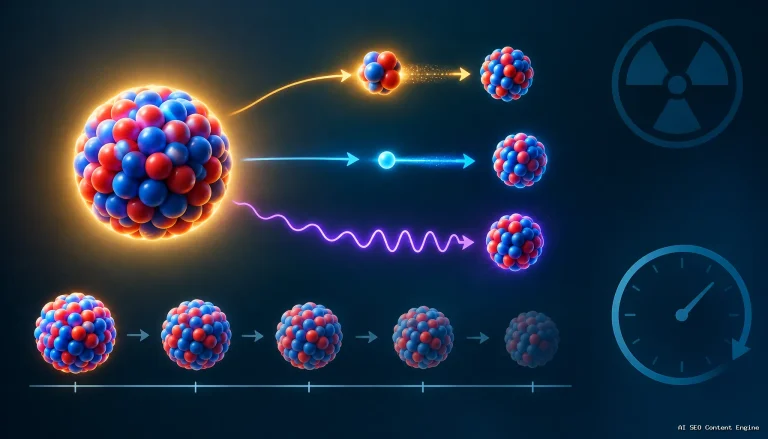
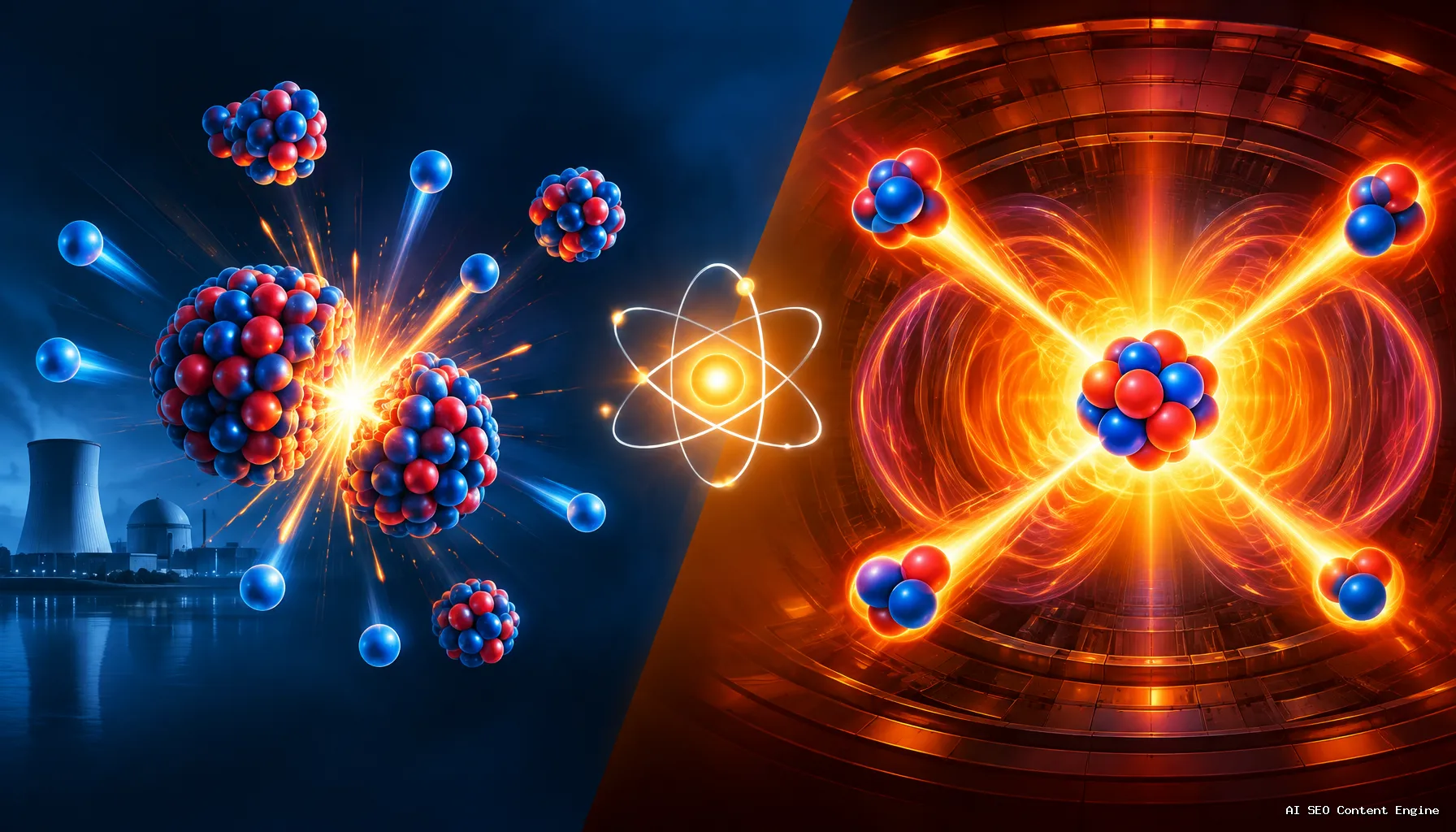
Nuclear fission occurs when the nucleus of a heavy atom, such as uranium-235 or plutonium-239, splits into two smaller nuclei along with a few neutrons and a large amount of energy. This process can be initiated by the absorption of a neutron.
- Energy Release: The mass of the resulting products is slightly less than the original mass of the atom. This mass defect is converted into energy according to Einstein’s equation, E = mc².
- Chain Reaction: The emitted neutrons may trigger further fission reactions, leading to a self-sustaining chain reaction. This principle is exploited in nuclear reactors to produce energy.
- Nuclear Stability: Fission tends to occur in isotopes with large, unstable nuclei. The process reduces the atomic number, leading to more stable isotopes.
Nuclear Fusion: Fusing Light Elements
Nuclear fusion is the process by which two light atomic nuclei combine to form a heavier nucleus. This reaction powers stars, including our sun, and holds potential for clean energy production on Earth.
- Energy Release: Fusion releases energy when light nuclei, such as those of hydrogen isotopes, overcome their electrostatic repulsion and merge. The binding energy of the resultant nucleus is greater than that of the initial nuclei, releasing the surplus energy.
- Mass Defect: Similar to fission, fusion results in a mass defect which is converted into energy. This is why fusion reactions have the potential to release immense amounts of energy.
- Nuclear Stability: Fusion leads to the formation of more stable nuclei, explaining why it occurs naturally in stars where extreme temperature and pressure conditions exist.
The Role of Binding Energy and Mass-Energy Equivalence
Both fission and fusion are governed by the principles of binding energy and mass-energy equivalence:
- Binding Energy: The energy required to hold a nucleus together. Higher binding energy per nucleon means a more stable nucleus. Fusion increases the binding energy per nucleon in resulting nuclei, thus releasing energy.
- Mass-Energy Equivalence: Einstein’s E = mc² illustrates how mass can be converted into energy, a fundamental principle in both fission and fusion reactions.
In summary, while nuclear fission and fusion both release energy through the transformation of atomic nuclei, they do so via different mechanisms and conditions. Understanding these processes not only illuminates the workings of nuclear power plants and stars but also paves the way for future advancements in clean energy solutions.
The Role of E = mc² in Nuclear Reactions
Albert Einstein’s iconic equation, E = mc², plays a crucial role in understanding the energy release in nuclear reactions. This equation succinctly conveys that energy (E) and mass (m) are interchangeable; they are different forms of the same thing, linked through the speed of light squared (c²). This relationship is fundamental in both nuclear fission and fusion reactions, as it explains how small amounts of mass can be converted into vast quantities of energy.
Mass Defect and Energy Release
In nuclear reactions, the concept of mass defect is pivotal. When a nucleus undergoes fission or fusion, the total mass of the resulting products is slightly less than the mass of the original reactants. This “missing” mass, known as the mass defect, is not lost but rather converted into energy, as described by E = mc². This conversion accounts for the tremendous energy release observed in nuclear reactions.
- Nuclear Fission: In fission, a heavy nucleus splits into two or more smaller nuclei, along with a few neutrons and a considerable amount of energy. The mass of the resultant particles is less than the original mass, and this mass difference is released as energy.
- Nuclear Fusion: Conversely, in fusion, light nuclei combine to form a heavier nucleus. The mass of the resulting nucleus is slightly less than the sum of the original nuclei, with the mass defect again being converted into energy.
Einstein’s Equation and Nuclear Stability
The principle of mass-energy equivalence is also intricately linked to nuclear stability. A nucleus’s stability can be assessed by its binding energy per nucleon — the higher this energy, the more stable the nucleus. In fusion, nuclei join to form a more stable nucleus with a higher binding energy per nucleon, thus releasing energy. In fission, the process results in nuclei that are more stable than the original heavy nucleus.
In conclusion, Einstein’s E = mc² is not merely an abstract equation but a practical tool for explaining the energy dynamics within nuclear reactions. It provides a framework for understanding how a small mass can unleash vast amounts of energy, underpinning the operations of nuclear power plants and the energy processes of stars. As such, it remains a cornerstone of nuclear physics and energy research.
What is Binding Energy and Why is it Important?
Binding energy is a crucial concept in nuclear physics, playing a pivotal role in understanding nuclear reactions and the energy they release. It is the energy required to disassemble a nucleus into its individual protons and neutrons. Conversely, it is also the energy released when a nucleus is formed from these particles. This makes binding energy fundamental to both nuclear fission and fusion processes.
The Role of Binding Energy in Nuclear Reactions
In the context of nuclear reactions, binding energy helps explain why some reactions release energy while others require it. The binding energy per nucleon is a key indicator of nuclear stability:
- Nuclear Stability: A nucleus with a high binding energy per nucleon is more stable. This means it requires more energy to break it apart, and therefore, it is less likely to undergo spontaneous fission.
- Energy Release: During both fission and fusion, the products formed have a higher binding energy per nucleon compared to the reactants. This difference in binding energy accounts for the energy release observed in these processes.
Understanding Mass Defect and Binding Energy
The concept of mass defect is closely tied to binding energy. When a nucleus forms, the total mass of the individual protons and neutrons is greater than the mass of the nucleus itself. This ‘missing mass’ is known as the mass defect, and according to Einstein’s equation, E = mc², it is converted into binding energy. This relationship highlights how a small mass defect can result in a significant energy release, underscoring the power of nuclear reactions.
Significance in Nuclear Physics
Binding energy is not just a theoretical construct but a practical measure that influences the design and operation of nuclear power plants. It is central to understanding how nuclear reactions can be harnessed for energy production:
- Power Generation: In nuclear power plants, the binding energy released during fission is converted into electrical energy, providing a significant portion of the world’s energy supply.
- Astrophysical Processes: Binding energy is also fundamental in astrophysical processes, such as the fusion reactions powering stars, including our sun.
In summary, binding energy is essential to the field of nuclear physics. It explains the energy release in nuclear reactions, informs us about nuclear stability, and connects deeply with the principles of mass-energy equivalence. Understanding binding energy not only enhances our grasp of nuclear processes but also empowers technological advancements in energy production and beyond.
How Fission and Fusion Work: A Comparative Analysis
Having explored the concept of binding energy and its significance in nuclear physics, it’s essential to delve into the mechanics of nuclear fission and fusion, two fundamental processes that illustrate the practical applications of these principles. Both processes are central to the field of nuclear reactions, as they release immense amounts of energy by converting mass into energy, as described by Einstein’s equation, E = mc².
Nuclear Fission
Nuclear fission involves the splitting of a heavy atomic nucleus into two smaller nuclei, along with a few neutrons and a significant release of energy. This process is typically initiated when a heavy nucleus, such as uranium-235 or plutonium-239, absorbs a neutron. Here’s a step-by-step breakdown of how fission works:
- Neutron Absorption: A neutron collides with a heavy nucleus, causing it to become unstable.
- Nucleus Splitting: The unstable nucleus splits into two smaller nuclei, known as fission fragments.
- Release of Neutrons: Additional neutrons are expelled, which can initiate further fission reactions, leading to a chain reaction.
- Energy Release: The difference in binding energy between the original nucleus and the fission fragments results in a large release of energy, primarily in the form of kinetic energy and radiation.
This energy release is due to the mass defect, where the total mass of the fission products and neutrons is less than the original mass of the heavy nucleus and neutron.
Nuclear Fusion
In contrast, nuclear fusion involves the combination of two light atomic nuclei to form a heavier nucleus, accompanied by energy release. Fusion is the process that powers stars, including our sun, and has the potential to provide a nearly limitless source of clean energy. Here’s how fusion operates:
- High Temperature and Pressure: Fusion requires extremely high temperatures and pressures to overcome the electrostatic repulsion between positively charged nuclei.
- Nucleus Combination: Under these conditions, light nuclei such as hydrogen isotopes (deuterium and tritium) collide with enough energy to fuse together.
- Formation of Helium: The fusion of these nuclei results in the formation of a heavier nucleus, typically helium, along with the release of a neutron.
- Energy Release: The binding energy of the resulting nucleus is greater than that of the original nuclei, leading to a release of energy due to the mass defect.
Fusion yields more energy per reaction than fission, but achieving and maintaining the conditions necessary for controlled fusion on Earth remains a significant scientific and engineering challenge.
Comparative Insights
While both fission and fusion result in energy release, they operate under fundamentally different principles and conditions:
- Fuel Availability: Fission relies on heavy isotopes like uranium, which are finite, whereas fusion utilizes abundant light isotopes like hydrogen.
- Nuclear Stability: Fission involves breaking apart unstable heavy nuclei, while fusion combines stable light nuclei to achieve greater nuclear stability.
- Energy Efficiency: Fusion offers a higher energy output per reaction but is more challenging to achieve and sustain compared to fission.
Understanding these processes and their differences is crucial for advancing nuclear technology and optimizing energy production methods.
Energy Outputs: Fission vs. Fusion
The energy outputs from nuclear fission and fusion are pivotal to understanding their potential as energy sources. Both processes transform mass into energy, a concept encapsulated by Einstein’s equation, E = mc². However, the mechanisms through which they release energy and their resultant outputs differ significantly.
Fission Energy Output
Nuclear fission involves the splitting of heavy atomic nuclei, such as uranium-235 or plutonium-239. When these nuclei absorb a neutron, they become unstable and divide into smaller nuclei, releasing a substantial amount of energy. This energy release is attributed to the mass defect—the difference in mass between the reactants and products, which is converted into energy:
- The fission of one uranium-235 nucleus releases approximately 200 MeV (million electron volts) of energy.
- Energy is produced in the form of kinetic energy of the fission fragments, gamma radiation, and kinetic energy of emitted neutrons.
- This process is self-sustaining in a nuclear reactor through a chain reaction, where emitted neutrons induce further fission reactions.
Fusion Energy Output
Nuclear fusion, on the other hand, involves the combination of light nuclei, such as isotopes of hydrogen (deuterium and tritium), to form a heavier nucleus like helium. Fusion reactions release energy because the resulting nucleus has a higher binding energy, contributing to nuclear stability.
- The fusion of deuterium and tritium releases about 17.6 MeV of energy per reaction.
- Although individual fusion reactions release less energy than fission, the energy per unit mass of fuel is substantially higher.
- Fusion requires extremely high temperatures and pressures to overcome the electrostatic repulsion between positively charged nuclei, making it challenging to achieve on Earth.
Comparative Analysis of Energy Release
**Energy Density:** Fusion provides a greater energy density than fission, meaning that it can produce more energy from a smaller amount of fuel. This characteristic makes fusion an attractive long-term energy source despite its current technological challenges.
**Environmental Impact:** Fusion produces significantly less radioactive waste than fission, which primarily generates long-lived radioactive isotopes. However, the difficulty in maintaining the necessary conditions for fusion remains a major hurdle.
In summary, both nuclear fission and fusion offer substantial energy outputs, but their application is determined by their distinct operational requirements and technological constraints. Understanding these nuances is essential for harnessing their full potential in energy production.
Challenges and Innovations in Fusion Technology
The pursuit of nuclear fusion as a practical energy source has been ongoing for decades, driven by its potential to deliver virtually limitless clean energy. However, several challenges must be overcome to make fusion technology viable. Below, we explore these challenges and the innovative approaches being taken to address them.
Key Challenges in Fusion Technology
- Extreme Conditions: Achieving the necessary conditions for fusion on Earth requires temperatures exceeding those at the sun’s core, approximately 150 million degrees Celsius. This necessitates advanced containment methods to manage such extreme heat.
- Plasma Confinement: Containing plasma, a hot, electrically charged gas, is crucial. Current methods like magnetic confinement using tokamaks and inertial confinement face issues such as instability and energy loss.
- Energy Input vs. Output: One of the primary challenges is achieving a net positive energy output, where the energy produced by fusion exceeds the energy required to initiate and sustain the reaction.
- Material Durability: Materials used in fusion reactors must withstand intense neutron bombardment and high temperatures, which can lead to degradation over time.
Innovations Driving Fusion Forward
- Advanced Magnetic Confinement: Innovations in magnetic confinement, such as the development of high-temperature superconductors, are enhancing the efficiency of tokamak designs. This improvement helps in maintaining plasma stability, crucial for sustained fusion reactions.
- Inertial Confinement Techniques: Laser technology advancements are being used to improve inertial confinement fusion. Experiments at facilities like the National Ignition Facility are working towards achieving ignition—a self-sustaining fusion reaction.
- Hybrid Approaches: Combining aspects of both magnetic and inertial confinement is being explored to optimize the strengths of each method while minimizing their weaknesses.
- Innovative Reactor Designs: Concepts such as the stellarator are being revisited and refined to offer alternative pathways to stable plasma confinement with less complex requirements for achieving sustained reactions.
These innovations represent the forefront of fusion research, aiming to harness the immense energy potential of nuclear reactions as described by Einstein’s equation, E = mc². By addressing the mass defect and increasing nuclear stability through controlled reactions, fusion holds promise as a sustainable energy source for the future.
Environmental Impact: Waste Management in Fission and Fusion
The environmental impact of nuclear fission and fusion is a critical aspect of their viability as energy sources. While both processes involve nuclear reactions with significant energy release as described by Einstein’s equation, E = mc², their byproducts and waste management challenges differ significantly.
Nuclear Fission Waste Management
Nuclear fission, the process of splitting a heavy nucleus into smaller nuclei, results in the production of radioactive waste. This waste is a significant concern due to its long-term environmental impact and challenges in management:
- High-Level Waste (HLW): Primarily composed of spent nuclear fuel, HLW is highly radioactive and requires careful handling and storage. It remains hazardous for thousands of years, necessitating secure containment solutions such as deep geological repositories.
- Intermediate-Level Waste (ILW): This type of waste, although less radioactive than HLW, still requires shielding and specialized disposal methods.
- Low-Level Waste (LLW): Generated from reactor operations and maintenance, LLW is less hazardous and can often be disposed of with conventional waste management techniques.
- Radioactive Decay and Storage: The long-lived isotopes present in fission waste require extended periods of isolation from the environment, posing ongoing challenges for waste management strategies.
The mass defect and nuclear stability involved in fission contribute to the formation of these radioactive byproducts, necessitating extensive research into improved waste management solutions to mitigate potential environmental hazards.
Nuclear Fusion Waste Management
In contrast, nuclear fusion, where light nuclei combine to form a heavier nucleus, presents a more favorable waste profile:
- Limited Radioactive Waste: Fusion reactions primarily involve isotopes of hydrogen, resulting in minimal radioactive waste compared to fission. The primary byproduct, helium, is non-toxic and inert.
- Tritium Management: Tritium, a radioactive isotope of hydrogen used in some fusion reactions, poses a potential environmental challenge. However, it has a relatively short half-life and can be managed with appropriate containment and recycling techniques.
- Structural Activation: Neutron activation of reactor materials can produce some radioactive waste, but this is significantly less problematic than fission waste and decays to safe levels over a shorter period.
The potential of fusion to produce sustainable energy with minimal environmental impact makes it a highly attractive option. By addressing the challenges of tritium management and structural activation, fusion can provide a cleaner alternative to current nuclear energy technologies.
As innovations in fusion technology continue to evolve, the environmental benefits of reduced radioactive waste highlight the promise of fusion as a key solution for sustainable energy production, contributing to nuclear stability and minimizing the ecological footprint of nuclear power generation.
Conclusion
Nuclear fission and fusion are two powerful processes that have fundamentally shaped our understanding of energy. While fission involves splitting heavy atomic nuclei to release energy, fusion combines light nuclei, offering a cleaner and potentially more abundant energy source. Both processes are governed by Einstein’s mass-energy equivalence principle, E = mc², which explains how even small amounts of mass can be converted into vast amounts of energy. The concept of binding energy further elucidates the stability and energy release associated with these nuclear reactions. As research advances, particularly in fusion technology, we inch closer to unlocking a sustainable and nearly limitless energy future. Understanding these processes not only underscores the potential of nuclear energy but also highlights the intricate balance of science and innovation required to harness it safely.
Frequently Asked Questions
What is the holy grail of energy?
The “holy grail of energy” refers to nuclear fusion. Fusion promises a nearly limitless supply of energy with minimal environmental impact, as it produces little to no greenhouse gases and generates less radioactive waste compared to fission. Achieving controlled and sustained nuclear fusion could revolutionize global energy production.
What does Elon Musk say about fusion energy?
Elon Musk has expressed skepticism about the immediate feasibility of fusion energy as a practical power source. He emphasizes the importance of transitioning to renewable energy sources such as solar and wind in the near term, while acknowledging that fusion could play a significant role in the future if technological hurdles are overcome.
Did Oppenheimer use fusion or fission?
J. Robert Oppenheimer, often referred to as the “father of the atomic bomb,” was primarily involved with nuclear fission in the development of the first atomic bombs during the Manhattan Project. These bombs utilized fission reactions to unleash their destructive power.
Is Chernobyl fission or fusion?
The Chernobyl disaster involved a nuclear fission reactor. The accident occurred in 1986 at the Chernobyl Nuclear Power Plant in Ukraine, resulting from a catastrophic failure during a safety test that led to an uncontrolled fission chain reaction and subsequent explosion.