F = Gm1m2/r2: Newton’s Law of Universal Gravitation Explained
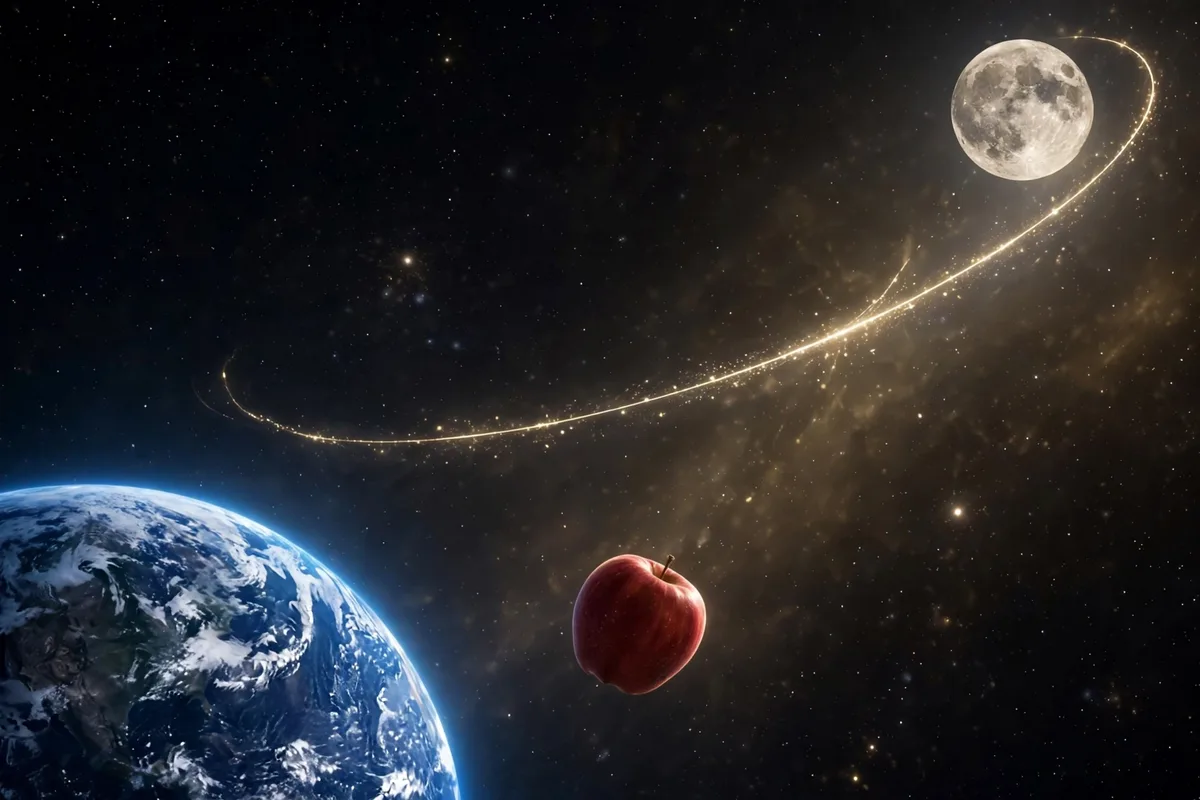
The same force that drops an apple also holds the Moon in orbit. Newton’s law of universal gravitation says that every mass in the universe pulls on every other mass, and it gives one formula for that pull. In the 1660s Newton asked a question that looks simple once someone asks it. The Moon circles Earth instead of flying off in a straight line, so something must pull it inward all the time.
He guessed that the something was the same gravity that pulls an apple to the ground, acting over a much larger distance. This article states the law, takes the formula apart piece by piece, shows where the number G came from, and works through the calculations students meet in exams: the pull between Earth and the Moon, the pull between two people, and the value of g on Earth’s surface.
What Newton’s law of universal gravitation says
The law says that every particle of matter in the universe attracts every other particle. The pull grows with the masses involved and shrinks with the distance between them. Newton wrote the idea as one equation, and that equation still sits at the centre of every first course in gravitation.
F = Gm1m2/r2
In plain text the formula reads F = Gm1m2/r2, where the 1 and 2 mark the two masses. Every worked example in this article starts from this one gravitational force formula, so it is worth learning what each symbol means before doing any numbers.
| Symbol | Meaning | Unit |
|---|---|---|
| F | Size of the gravitational force between the two masses | newtons (N) |
| G | Universal gravitational constant | N·m2/kg2 |
| m1 | Mass of the first object | kilograms (kg) |
| m2 | Mass of the second object | kilograms (kg) |
| r | Distance between the centres of the two masses | metres (m) |
G equals 6.674 × 10⁻¹¹ N·m2/kg2. The number looks strange because it is tiny, and the units look strange because they have to balance the equation. Multiply G by two masses in kilograms and divide by a distance squared in square metres, and the units come out in newtons. Physicists have checked that the constant is the same for lead spheres in a laboratory and for planets in orbit, which is why the law carries the word universal.
Each symbol in the formula pulls its own weight. Double one mass and the force doubles. Double both masses and the force grows four times.
The force answers to each mass separately, which is why the formula multiplies them instead of adding them. Change the distance and the effect is stronger still, as the next section shows.
The formula above gives the size of the force. The direction needs one more piece of information. The force on each mass points straight toward the other mass, along the line that joins their centres.
In vector form, physicists write the force on the first mass as F = −(Gm1m2/r2) r̂, where r̂ is a unit vector pointing from the second mass toward the first. The minus sign carries the whole meaning: the force pulls inward, never pushes outward.
Students sometimes mix this law up with g = GM/r2. The two formulas connect, but they answer different questions.
F = Gm1m2/r2 gives the gravitational force between two masses. g = GM/r2 gives the acceleration that one mass, usually a planet, produces at a distance r from its centre. The second formula comes from the first by dividing by the smaller mass, and a worked example later in this article shows that step.
Why the pull weakens so fast with distance
Double the distance and the force drops to a quarter. Triple it and the force drops to a ninth. Halve the distance and the force grows four times. This is the inverse square law, and it follows from the r2 in the bottom of the formula.
A light bulb in a dark room shows the same pattern. The same light spreads over a sphere, and the sphere grows with the square of its radius, so the light on each patch falls as 1/r2. Gravity spreads the same way.
This inverse-square law of gravity is the reason distance dominates every gravitation problem: moving apart a little costs a lot of force.
| Distance | Force |
|---|---|
| r | F |
| 2r | F/4 |
| 3r | F/9 |
| 4r | F/16 |
| 10r | F/100 |
Exam questions love this pattern because it tests understanding rather than arithmetic. If a question asks what happens to the force when the distance doubles, the answer is a quarter, and no calculator is needed. The same table works in reverse: bring two masses to half their separation and the force grows four times.
Gravity only pulls. No mass has ever pushed another mass away by gravity, and no experiment has found a material that blocks it.
Two masses attract each other along the line that joins their centres, and the pull on each one is equal in size and opposite in direction. Your body pulls on Earth with exactly the same force that Earth pulls on you. Earth wins the visible contest because its mass is enormously larger, so the same force gives Earth almost no acceleration and gives you 9.8 m/s2.
The formula treats each mass as if it sat at a single point. That works exactly for point masses, and it also works for any sphere, or any object with spherical symmetry, as long as you measure r from the centre.
Newton proved this with the shell theorem: a uniform spherical shell pulls an outside object exactly as if all its mass sat at its centre. Planets and stars are close enough to spheres that the same rule applies. Inside a shell the net pull cancels to zero, a result that surprises most students the first time they meet it.
The constant G is so small that ordinary masses produce forces too tiny to notice. Two people standing a metre apart pull on each other with a force of about three ten-millionths of a newton, far below anything human senses can detect. Friction with the floor is billions of times stronger. Gravity only shows its strength when at least one mass is enormous, like a planet or a star.
The Moon clue and the Cavendish experiment
Newton tested his idea against the Moon before he trusted it. The Moon sits about 60 Earth radii away. If gravity weakens as 1/r2, then at that distance the pull should be 1/3600 of its value at Earth’s surface. Surface gravity is 9.8 m/s2, so the Moon should accelerate toward Earth at about 0.0027 m/s2.
The Moon’s orbit gives the same number: its speed and its distance from Earth imply a centripetal acceleration of about 0.0027 m/s2. Two different routes, one number. That match turned a guess about apples into a law about the universe.
Newton never knew the value of G. He could compare forces, but he could not measure the absolute strength of gravity, because no one had weighed one known mass against another with enough precision. A century later, in 1797 and 1798, Henry Cavendish measured it with a torsion balance.
He hung a light rod with two small lead spheres from a thin wire, placed two large lead spheres nearby, and watched the wire twist by a tiny angle as gravity pulled the small spheres toward the large ones. A mirror on the wire and a beam of light magnified the twist enough to read it. The experiment gave the first reliable value for the density of Earth, and from that value physicists could work out G.
The measurement waited a century because the effect is so small. The gravitational pull between Cavendish’s lead spheres was weaker than the weight of a grain of sand, and the wire twisted by an angle too small to see with the eye. The mirror and light beam turned that tiny twist into a spot of light moving across a scale, which is the trick that made the measurement possible at all. Modern versions of the experiment still use the same idea, and they still need to shut out draughts, vibrations and stray electric charges.
With G known, physicists could weigh Earth for the first time. Rearranging g = GM/R2 gives M = gR2/G. Put in g = 9.8 m/s2, R = 6.37 × 10⁶ m and G = 6.674 × 10⁻¹¹ N·m2/kg2, and the mass of Earth comes out at about 5.97 × 1024 kg. Cavendish called his apparatus a way of weighing the world, and the phrase stuck because that is exactly what it did.
Worked example 1: the force between Earth and the Moon
Question: calculate the gravitational force between Earth and the Moon.
- Mass of Earth, m1 = 5.97 × 1024 kg
- Mass of the Moon, m2 = 7.34 × 10²² kg
- Distance between their centres, r = 3.84 × 10⁸ m
- G = 6.674 × 10⁻¹¹ N·m2/kg2
Step 1: write the formula. F = Gm1m2/r2.
Step 2: put the numbers in. F = (6.674 × 10⁻¹¹)(5.97 × 1024)(7.34 × 10²²) / (3.84 × 10⁸)2.
Step 3: work the top first. (6.674 × 10⁻¹¹)(5.97 × 1024) = 3.98 × 10¹⁴. Multiply by the Moon’s mass: 3.98 × 1014 × 7.34 × 1022 = 2.92 × 1037.
Step 4: square the distance. (3.84 × 10⁸)2 = 1.47 × 10¹⁷ m2.
Step 5: divide. F = 2.92 × 1037 / 1.47 × 1017 = 1.98 × 10²⁰ N.
Answer: about 1.98 × 10²⁰ N, an enormous force. The number looks huge, and it is, but the Moon is also huge, so the acceleration it produces is small. Divide the force by the Moon’s mass and the result is 0.0027 m/s2, the same centripetal acceleration from the previous section.
This same force bends the Moon’s path into a circle. Without it, the Moon would fly off in a straight line.
A quick check keeps the answer honest. The force is positive, the units are newtons, and the size sits in the range you would expect for two bodies as massive as Earth and the Moon. If your answer comes out near 1020 N, you are in the right region. If it comes out far smaller, you probably forgot to square the distance or mixed up an exponent, and those are the first two places to look.
Worked example 2: two people, and a planet’s surface gravity
Two people standing a metre apart
Question: two people of mass 70 kg each stand 1 m apart. Calculate the gravitational force between them.
Step 1: write the formula. F = Gm1m2/r2.
Step 2: put the numbers in. F = (6.674 × 10⁻¹¹)(70)(70) / (1)2.
Step 3: multiply the top. 70 × 70 = 4900, and 6.674 × 10−11 × 4900 = 3.27 × 10⁻⁷ N.
Answer: about 3.3 × 10⁻⁷ N. Compare that with the weight of one of the people, about 686 N. Gravity between two people is roughly two billion times weaker than the pull of Earth on one of them. That is why no one has ever felt pulled toward a classmate.
Deriving g at Earth’s surface
Now use the same law to find g, the acceleration due to gravity at Earth’s surface. Start with the force on a small mass m at Earth’s surface: F = GMm/R2, where M is Earth’s mass and R is Earth’s radius. Newton’s second law says F = mg, so mg = GMm/R2. Cancel m from both sides and g = GM/R2.
Put in G = 6.674 × 10⁻¹¹ N·m2/kg2, M = 5.97 × 1024 kg and R = 6.37 × 10⁶ m. The top gives 3.98 × 10¹⁴. The bottom gives (6.37 × 10⁶)2 = 4.06 × 10¹³. Divide, and g = 9.81 m/s2, which rounds to the familiar 9.8 m/s2.
This is the link between the two formulas. F = Gm1m2/r2 is the general law for any two masses. g = GM/r2 is what it becomes when one mass is a planet and you ask for the acceleration it produces. The same substitution works for the Moon, Mars, or any other body, as long as you use that body’s mass and radius.
Common mistakes
Seven mistakes turn up again and again in exam scripts. Watch for them before you hand in a calculation.
- Confusing G with g. G is a universal constant, 6.674 × 10⁻¹¹ N·m2/kg2, the same everywhere. g is an acceleration, about 9.8 m/s2 near Earth’s surface, and it changes with distance from Earth’s centre and from planet to planet.
- Measuring r from surface to surface. The formula needs the distance between centres. For two planets that is the distance between their centres, not the gap between their surfaces.
- Forgetting to square r. The force falls as 1/r2, not 1/r. Doubling the distance quarters the force, and a student who divides by r instead of r2 gets the wrong answer by a factor of r itself.
- Using the wrong mass in the numerator. Both masses belong in the product m1m2. Swapping in a third mass, or using the same mass twice, gives a different problem from the one asked.
- Thinking the heavier object pulls harder. The forces are an equal and opposite pair. Earth pulls on the Moon with the same force the Moon pulls on Earth. The heavier body accelerates less, which is why the effect looks one-sided.
- Treating gravity as repulsive or as a contact force. Gravity only attracts, and it acts across empty space. Two masses pull on each other without touching, which is what makes orbits possible.
- Mixing up F = Gm1m2/r2 with g = GM/r2. The first gives a force in newtons between two masses. The second gives an acceleration in m/s2 produced by one mass at a distance r. Check the units of your answer: newtons means you wanted the force formula, m/s2 means you wanted the field formula.
Conclusion: the formulas to remember
Newton’s law of universal gravitation reduces a universe of falling apples and circling moons to one equation. F = Gm1m2/r2 says that every mass attracts every other mass, the pull grows with the product of the masses, and it weakens as the square of the distance.
G, the universal gravitational constant, is 6.674 × 10⁻¹¹ N·m2/kg2. The force always attracts, always points along the line joining the centres, and always comes as an equal and opposite pair. The same law gives g = GM/r2 at a planet’s surface, which is how the familiar 9.8 m/s2 comes out of the universal formula.
The next step is to try it yourself. Pick two masses and a distance, work through the substitution, and watch the units come out in newtons. Once the numbers behave, the law stops looking like a formula to memorise and starts looking like a description of how the universe holds together.
Frequently Asked Questions
What does Newton’s law of universal gravitation state in words?
Newton’s law of universal gravitation states that every mass attracts every other mass in the universe. The force of attraction is directly proportional to the product of the two masses and inversely proportional to the square of the distance between their centres. The force always acts along the line joining the two masses, pulling each one toward the other. It applies to apples, planets, stars, and every other mass in the universe.
What does each symbol in F = Gm1m2/r2 mean?
In F = Gm1m2/r2, F is the size of the gravitational force between the two masses, measured in newtons. G is the universal gravitational constant. The symbols m1 and m2 are the masses of the two objects, each measured in kilograms. The symbol r is the distance between the centres of the two masses, measured in metres. The force grows when either mass grows and falls when r grows, because r is squared in the denominator.
What is the value of the universal gravitational constant G in Newton’s law of gravitation?
The universal gravitational constant G equals 6.674 × 10⁻¹¹ N·m²/kg². It is the same everywhere in the universe, for lead spheres in a laboratory and for planets in orbit. G is tiny, which is why the gravitational force between everyday objects is far too small to notice. Physicists first measured it with the Cavendish torsion balance experiment, about a century after Newton stated the law. Once G was known, the mass of Earth could be calculated.
Why is the gravitational force in Newton’s law of gravitation always attractive and never repulsive?
The gravitational force is always attractive because mass only ever pulls other mass toward itself. No mass or material has been found that pushes another mass away by gravity, and no material blocks it. The force on each mass points toward the other mass, along the line joining their centres, so it can only pull inward, never push outward. Gravity acts across empty space without contact. That is why the Moon stays in orbit around Earth.
How does the gravitational force in F = Gm1m2/r2 change when the distance between the masses doubles?
When the distance between the two masses doubles, the gravitational force falls to one quarter of its original value. This happens because the force follows the inverse square law: F is proportional to 1/r², so doubling r makes the denominator four times larger. Tripling the distance cuts the force to one ninth, and halving the distance makes the force four times stronger. Exam questions test this pattern often, because the answer needs understanding of the formula rather than a calculator.
How is Newton’s law of universal gravitation different from g = GM/r²?
Newton’s law of universal gravitation gives the force between two masses, while g = GM/r² gives the acceleration produced by one mass at a distance r from its centre. The first formula, F = Gm1m2/r2, needs both masses and gives an answer in newtons. The second formula comes from the first by dividing by the smaller mass, and it gives an answer in metres per second squared. Near Earth’s surface, g = GM/r² gives 9.8 m/s², the familiar surface gravity.