Kepler’s Laws of Planetary Motion Explained with Worked Examples
Kepler’s laws of planetary motion describe how planets travel around the Sun. A planet follows an elliptical path, sweeps out equal areas in equal times, and takes longer to complete an orbit the farther it sits from the Sun. Three short rules cover all of it, and this article works through each one in plain language, with the formulas and two fully worked calculations you can copy for homework and exams.
Johannes Kepler published the first two laws in 1609 and the third in 1619. He worked from decades of naked eye observations recorded by the Danish astronomer Tycho Brahe, and he did it all before Newton explained why planets behave this way. Kepler had no telescope of his own and no theory of gravity to lean on. He had tables of numbers, and he fitted shapes to them until the shapes stopped arguing back.
Who Was Kepler and What Did He Discover?
Kepler inherited Brahe’s observations after Brahe died in 1601. The data covered Mars in particular, and Mars refused to fit a circular orbit no matter how Kepler adjusted the numbers. He spent years on that one planet. The breakthrough came when he tried an ellipse instead of a circle, and suddenly the positions matched to within the accuracy of the observations.
That result overturned about two thousand years of thinking. Greek astronomers had treated the circle as the perfect shape for heavenly motion, and Copernicus had kept circles in his Sun centred model. Kepler showed that nature did not care about that preference. Planets move on ellipses, they change speed along the way, and the timing of their orbits follows a strict pattern tied to their distance from the Sun.
Kepler’s three laws answer one question: how do planets actually move? The first law describes the shape of the path. The second law describes the speed along that path. The third law ties the time of one full orbit to the size of the orbit. Keep that split in mind and the three laws stop blurring into each other.
Kepler’s First Law: Orbits Are Ellipses
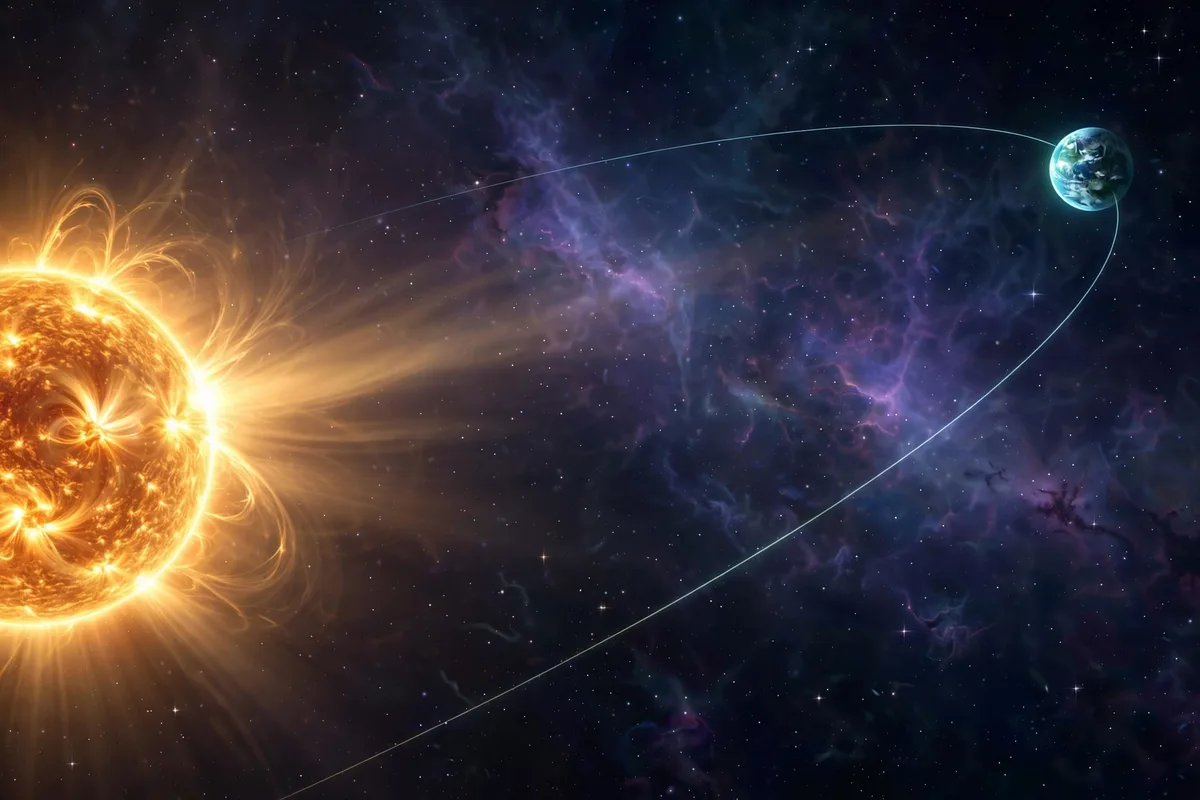
Kepler’s first law says that every planet moves in an elliptical orbit with the Sun at one focus of the ellipse. An ellipse looks like a stretched circle. It has two focal points, called foci, and the Sun sits at one of them. Nothing sits at the other focus. It is just a point in empty space that defines the shape.
Two numbers describe any elliptical orbit. The semi-major axis, written as a, is half the longest distance across the ellipse. Think of it as the average distance of the planet from the Sun, measured in a specific way. The eccentricity, written as e, measures how stretched the ellipse is. An eccentricity of zero gives a perfect circle. A value close to one gives a long thin ellipse.
Most planets have small eccentricities, so their orbits look nearly circular at a glance. Earth has an eccentricity of about 0.017, which makes its orbit almost a circle. Mercury has the largest eccentricity of any planet in our solar system at about 0.206, and its orbit shows a visible stretch. Comets can reach eccentricities near 0.9 or higher, which is why their paths look so different from planetary orbits.
The distance from the Sun to the planet changes along the orbit. The closest point is called perihelion, and the farthest point is called aphelion. Earth reaches perihelion in early January at about 147 million kilometres from the Sun, and aphelion in early July at about 152 million kilometres. That difference of about 5 million kilometres sounds large, and it is, but it amounts to only a few percent of the total distance.
The orbit equation gives the distance r at any angle theta around the orbit:
r = a(1-e²)/(1+e cos θ)
Here theta is the angle measured from perihelion, and e is the eccentricity. When theta equals zero, the planet sits at perihelion and the formula gives r = a(1-e), the shortest distance. When theta equals 180 degrees, the planet sits at aphelion and the formula gives r = a(1+e), the longest distance. A circle is the special case where e equals zero, and then r equals a at every angle, which is exactly what a circle means.
Students often picture the Sun at the centre of the ellipse. The Sun sits at one focus, off centre, and that offset is what makes the planet’s distance change through the year. The offset grows with eccentricity, so a comet with high eccentricity spends most of its time far from the Sun and rushes past it quickly at perihelion.
Kepler’s Second Law: Equal Areas in Equal Times
Kepler’s second law says that a line joining a planet to the Sun sweeps out equal areas in equal intervals of time. Picture a line from the Sun to the planet, like a clock hand. As the planet moves, that line sweeps across a wedge of space. Kepler found that the wedge covers the same area in one month as it covers in any other month, no matter where the planet sits in its orbit.
The consequence follows straight from the geometry. Near perihelion the planet sits close to the Sun, so the line is short, and the planet must move fast to sweep out the same area. Near aphelion the line is long, so the planet can move slowly and still sweep the same area. A planet speeds up as it approaches the Sun and slows down as it moves away.
Earth shows this in real numbers. Earth moves fastest in early January, near perihelion, at about 30.3 kilometres per second. It moves slowest in early July, near aphelion, at about 29.3 kilometres per second. The change is only about 3 percent, so you would never feel it, but precise measurements pick it up, and it matches the equal areas rule exactly.
The deeper reason is conservation of angular momentum. Gravity pulls straight toward the Sun, so it exerts no turning force on the planet about the Sun. With no turning force, the planet’s angular momentum stays constant, and constant angular momentum is the same statement as equal areas in equal times. Kepler discovered the pattern from data. Newton later supplied the reason.
The rate at which area gets swept out has a name, areal velocity, and it stays constant for any orbit under gravity:
dA/dt = L/2m
Here dA/dt is the area swept per unit time, L is the angular momentum of the planet about the Sun, and m is the mass of the planet. The formula says the same thing as the law in words. Since L and m do not change during the orbit, the swept area per second never changes either.
Comets give the most dramatic example. A comet near the Sun can cross a huge stretch of sky in weeks, then spend years crawling through the outer solar system where almost nothing seems to happen. Both parts of that behaviour follow the same rule. The comet obeys the same law as Earth, with a much more stretched orbit.
Kepler’s Third Law: The Law of Periods
Kepler’s third law connects the time of one orbit to the size of the orbit. It says that the square of the orbital period is proportional to the cube of the semi-major axis. In symbols:
T² ∝ a³
Here T is the orbital period, the time for one complete trip around the Sun, and a is the semi-major axis, the size of the orbit. A planet twice as far from the Sun does not take twice as long to orbit. It takes about 2.83 times as long, because 2 cubed is 8 and the square root of 8 is about 2.83. Distance punishes orbital time more than most students expect on a first meeting.
The full form of the law brings in the mass of the central body:
T² = (4π²/GM)a³
Here G is the universal gravitational constant, 6.674 × 10⁻¹¹ N·m²/kg², and M is the mass of the body being orbited. The product GM often appears as one number because it is easier to measure than G and M separately. For the Sun, GM equals 1.327 × 10²⁰ m³/s². Rearranged for the period itself, the formula reads:
T = 2π√(a³/GM)
That version is the one to use for orbits beyond the Sun, or whenever you need an answer in seconds. It works for moons around planets, satellites around Earth, and planets around other stars, as long as you use the right GM for the body at the centre.
For orbits around the Sun, a shortcut makes the arithmetic easy. Measure a in astronomical units, where one AU is the average Earth to Sun distance, and measure T in years. Then the constants cancel and the law becomes:
T² = a³
Earth checks the shortcut at once. Earth has a equal to 1 AU, so T squared equals 1, and T equals 1 year. That is not a coincidence. The shortcut was built from Earth’s orbit, which is why it only works for Sun orbits. Use it for a moon around Jupiter and the answer will be wrong, because Jupiter’s GM differs from the Sun’s.
The third law also follows from Newton’s law of gravitation for a circular orbit, and the short derivation is worth seeing once. Gravity supplies the centripetal force that keeps the planet turning, so:
F = GMm/r² = mv²/r
Cancel the planet’s mass m from both sides, and the speed comes out as v² = GM/r. A planet travels the circumference 2πr in one period T, so v = 2πr/T. Put that into the speed equation and square both sides, and the result is T² = (4π²/GM)r³. For an ellipse, the same result holds with the semi-major axis a in place of the radius r. Kepler found the pattern by fitting data. Newton showed it was gravity all along.
One common point of confusion deserves a clear answer. The third law depends on the size of the orbit and the mass of the central body, and on nothing else. The planet’s own mass does not appear in the final formula, because it cancels out. A small asteroid and a giant planet at the same distance from the Sun take the same time to orbit, as long as both masses stay tiny compared with the Sun.
How Kepler’s Laws of Planetary Motion Fit Together
The three laws work as a set, and exam questions often test whether you can use more than one at once. The first law sets the shape and gives you a and e. The second law tells you where the planet moves fast and where it moves slowly. The third law turns the size of the orbit into a period.
A question that asks for the speed of a planet at perihelion needs the first law for the distance and the second law for the speed change. A question that asks for the period needs the third law and the semi-major axis from the first.
A good habit is to read the question and name the law before reaching for a formula. If the question mentions an orbit shape, a focus, perihelion, or aphelion, it points to the first law. If it mentions speed changing, equal areas, or angular momentum, it points to the second. If it mentions a period, a year length, or a distance that determines a period, it points to the third. Naming the law first stops the most common exam error, which is using the right formula from the wrong law.
Worked Example 1: How Long Is a Year on Mars?
Mars sits farther from the Sun than Earth, so its year runs longer. The question gives the semi-major axis of Mars as a = 1.524 AU and asks for the orbital period. Since this is an orbit around the Sun, the AU and years shortcut applies.
Step 1: Write down the shortcut form of the third law.
T² = a³
Step 2: Put in the value of a for Mars.
T² = 1.524³
Step 3: Work out the cube. First square 1.524 to get about 2.323, then multiply by 1.524 again to get about 3.54.
T² = 3.54
Step 4: Take the square root of both sides to find T.
T = √3.54 ≈ 1.88 years
Step 5: Convert years to days. One year is about 365.25 days, so multiply 1.88 by 365.25.
T ≈ 1.88 × 365.25 ≈ 687 days
The published value for the Martian year is 686.98 days, so the calculation agrees to within a day. The small difference comes from rounding a to 1.524 AU and rounding the intermediate steps. Mars takes nearly twice as long as Earth to circle the Sun, even though it sits only about half as far out again. That is the cube in the third law doing its work.
Try the same shortcut on Saturn as a check. Saturn has a semi-major axis of about 9.58 AU. Cubing gives about 879, and the square root gives about 29.6 years. Saturn really does take about 29.5 years to orbit the Sun. One formula, two planets, and both answers land close to the measured values.
Worked Example 2: How Long Does the ISS Take to Orbit Earth?
The International Space Station circles Earth at an altitude of about 400 kilometres. The question asks for its orbital period. This orbit is around Earth, not the Sun, so the AU shortcut does not apply. Use the full form of the third law with Earth’s GM.
Step 1: Find the orbital radius. The altitude is measured from Earth’s surface, but the formula needs the distance from Earth’s centre. Add Earth’s radius, 6.371 × 10⁶ m, to the altitude, 400 km, which is 4.00 × 10⁵ m.
r = 6.371 × 10⁶ + 0.400 × 10⁶ = 6.771 × 10⁶ m
Step 2: Write down the full form of the third law and the value of Earth’s GM, 3.986 × 10¹⁴ m³/s².
T = 2π√(r³/GM)
Step 3: Work out r³. Cubing 6.771 × 10⁶ gives about 3.105 × 10²⁰ m³.
r³ ≈ 3.105 × 10²⁰ m³
Step 4: Divide by GM.
r³/GM ≈ 3.105 × 10²⁰ / 3.986 × 10¹⁴ ≈ 7.79 × 10⁵ s²
Step 5: Take the square root, then multiply by 2π.
√(7.79 × 10⁵) ≈ 883 s
T ≈ 2π × 883 ≈ 5,544 s
Step 6: Convert seconds to minutes by dividing by 60.
T ≈ 5,544 / 60 ≈ 92.4 minutes
The ISS completes one orbit in about 92 minutes, so astronauts see about 16 sunrises and sunsets every 24 hours. The published period is about 92.9 minutes for a typical altitude near 400 kilometres, and the small gap comes from the altitude varying slightly and from rounding in the calculation. The answer is in the right range, which is what matters.
Notice the step that catches most students. The altitude is 400 kilometres, but the radius in the formula is 6,771 kilometres. Using 400 kilometres as r would give a period of about 1.3 minutes, which is absurd for a satellite that stays in orbit for years. Always add the planet’s radius to the altitude before touching the formula.
Common Mistakes That Cost Marks
Using altitude instead of orbital radius is the most common error in satellite questions. The third law measures distance from the centre of the body being orbited, not from its surface. Add the radius of the planet first, then calculate. Write that addition out as its own line so the examiner can see it.
Using the T² = a³ shortcut for orbits around anything other than the Sun is the second trap. The shortcut works because the Sun’s GM and Earth’s orbit define the units. A moon around Jupiter or a satellite around Earth needs the full form with the right GM. If the question gives you a GM value, that is a signal to use the full form.
Mixing up the semi-major axis with the planet’s current distance from the Sun causes trouble in the first and second laws. The semi-major axis is a fixed property of the orbit. The current distance changes as the planet moves, and at perihelion it equals a(1-e) while at aphelion it equals a(1+e). The third law uses a, not the distance on a given day.
Forgetting to square and cube in the right places is a plain arithmetic trap. The third law squares the period and cubes the distance, and swapping those two operations gives a wildly wrong answer. Write T² = a³ on the page before substituting numbers, and check that the units match: years with AU, or seconds with metres and the full form.
Leaving units inconsistent is the last trap. AU and metres do not mix in one calculation, and neither do years and seconds. Convert everything to one system before substituting. If the question gives altitude in kilometres and radius in metres, convert one of them first. A unit error hides inside an otherwise perfect method, and it costs the same marks as a wrong formula.
Conclusion: The Formulas Worth Remembering
Kepler’s laws of planetary motion reduce the movement of planets to three rules and a small set of formulas. The first law says orbits are ellipses with the Sun at one focus, described by r = a(1-e²)/(1+e cos θ), with perihelion at a(1-e) and aphelion at a(1+e). The second law says the radius vector sweeps equal areas in equal times, so dA/dt = L/2m stays constant and planets move fastest at perihelion.
The third law says the square of the period is proportional to the cube of the semi-major axis, T² = (4π²/GM)a³, or T = 2π√(a³/GM), with the shortcut T² = a³ when a is in AU and T is in years for orbits around the Sun.
Two numbers from the worked examples are worth keeping in mind. Mars takes about 1.88 years, or 687 days, to orbit the Sun, and the ISS takes about 92.4 minutes to circle Earth. Both answers came from the same third law, used in two different forms. Learn which form each situation needs, add the planet’s radius to any altitude, and keep the units consistent, and Kepler’s laws will answer most orbital questions an exam can ask.
Frequently Asked Questions
What are Kepler's laws of planetary motion in simple terms?
Kepler's laws are three rules that describe how planets move around the Sun. The first law says orbits are ellipses with the Sun at one focus. The second law says a planet sweeps out equal areas in equal times, so it speeds up near the Sun and slows down far away. The third law says the square of the orbital period is proportional to the cube of the semi-major axis, T² ∝ a³.
What is Kepler's third law formula, and what do T and a stand for?
Kepler's third law is T² = (4π²/GM)a³, or in its rearranged form T = 2π√(a³/GM). Here T is the orbital period, the time for one complete orbit, and a is the semi-major axis, the size of the orbit. G is the universal gravitational constant and M is the mass of the body being orbited. For Sun orbits only, the constants cancel and the law simplifies to the shortcut T² = a³ with T in years and a in AU.
How do you use Kepler's third law to find a planet's orbital period?
Start with the semi-major axis a of the planet's orbit. For a planet around the Sun, use the shortcut T² = a³ with a in astronomical units (AU) and T in years: cube a, then take the square root to get T. For example, Mars has a = 1.524 AU, so T = √1.524³ ≈ 1.88 years, or about 687 days. For orbits around other bodies, use the full form T = 2π√(a³/GM) with that body's GM.
Why does Kepler's second law mean a planet moves faster at perihelion?
Kepler's second law says the line from a planet to the Sun sweeps out equal areas in equal times, with areal velocity dA/dt = L/2m constant. At perihelion the planet is closest to the Sun, so the line is shortest, and the planet must move faster to sweep out the same area. At aphelion the line is longer, so the planet moves more slowly. Earth, for example, moves at about 30.3 km/s in January and 29.3 km/s in July.
Does Kepler's third law work for moons and satellites, or only for planets?
Kepler's third law works for any body orbiting under gravity, including moons and satellites, not just planets. The full form T = 2π√(a³/GM) applies to any orbit as long as you use the GM of the body at the centre. The ISS, for example, takes about 92.4 minutes to orbit Earth using Earth's GM of 3.986 × 10¹⁴ m³/s². Only the shortcut T² = a³ is restricted, because it only works for orbits around the Sun.
What is the difference between Kepler's first law and a circular orbit?
Kepler's first law says orbits are ellipses with the Sun at one focus, while a circle is the special case e = 0. In an ellipse the distance r from the Sun changes, given by r = a(1 − e²)/(1 + e cos θ), with perihelion r = a(1 − e) and aphelion r = a(1 + e). In a circle, r equals a at every angle, so the distance never changes.