Understanding Projectile Motion: Why 45° Yields Maximum Range Using R = v²sin2θ/g
R = v²sin2θ/g — Projectile Motion Range and Why 45° Is Maximum is a captivating equation that unravels the mysteries of projectile motion. By exploring the relationship between launch angles and distances, this fundamental formula helps us understand why a 45-degree angle offers the optimal range for projectile motion. Whether you’re a physics enthusiast or a curious learner, grasping the intricacies of this formula can significantly enhance your comprehension of motion dynamics.
The equation R = v²sin2θ/g — Projectile Motion Range and Why 45° Is Maximum not only serves as a mathematical model but also as a gateway to understanding the principles of physics that govern motion. Delving into this topic will illuminate how velocity, angle, and gravity collaborate to determine the flight path of any projectile. For a deeper dive into the fascinating world of projectile motion, you can explore comprehensive resources on Wikipedia’s page on projectile motion.
For those eager to further enrich their knowledge, our home page offers a wealth of resources and insights. Embark on this educational journey to uncover why the 45-degree angle is not just a number, but a key to maximizing range in projectile motion.
Introduction to Projectile Motion
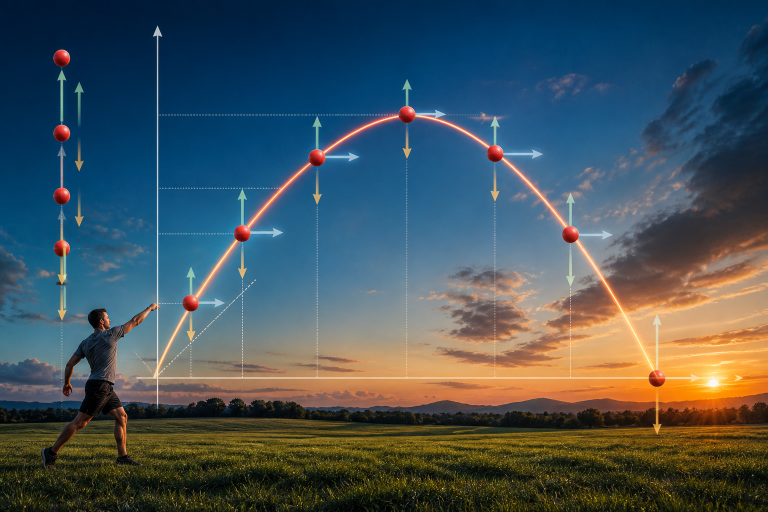
Projectile motion is a fascinating aspect of physics that reveals how objects travel through the air under the influence of gravity. This type of motion is characterized by a curved trajectory, which is the result of two independent linear motions: horizontal and vertical. The interplay between these motions defines the path that a projectile will take, and understanding this interaction is crucial for predicting the outcome of any projectile-related scenario.
At the heart of this concept lies the equation R = v²sin2θ/g. This formula offers a quantitative grasp of how different variables such as velocity, angle, and gravity determine the range of a projectile. Specifically, the equation describes the maximum horizontal distance (R) a projectile can reach, given its initial velocity (v) and launch angle (θ). The gravitational constant (g) plays a pivotal role in this calculation by accounting for the Earth’s pull on the object.
The Physics of Projectiles
Understanding the physics of projectiles requires a breakdown of these two independent components:
- Horizontal Motion: This component is uniform, meaning that the horizontal velocity remains constant as the projectile moves forward. There is no acceleration in the horizontal direction as long as air resistance is negligible.
- Vertical Motion: In contrast, the vertical component is subject to acceleration due to gravity. This causes the projectile to decelerate as it ascends and accelerate as it descends back to the ground.
Combining these two motions allows us to predict the projectile’s trajectory, which is typically a parabolic path. The angle of projection plays a crucial role in determining both the distance and the height of the projectile’s flight.
Optimal Launch Angle: 45 Degrees
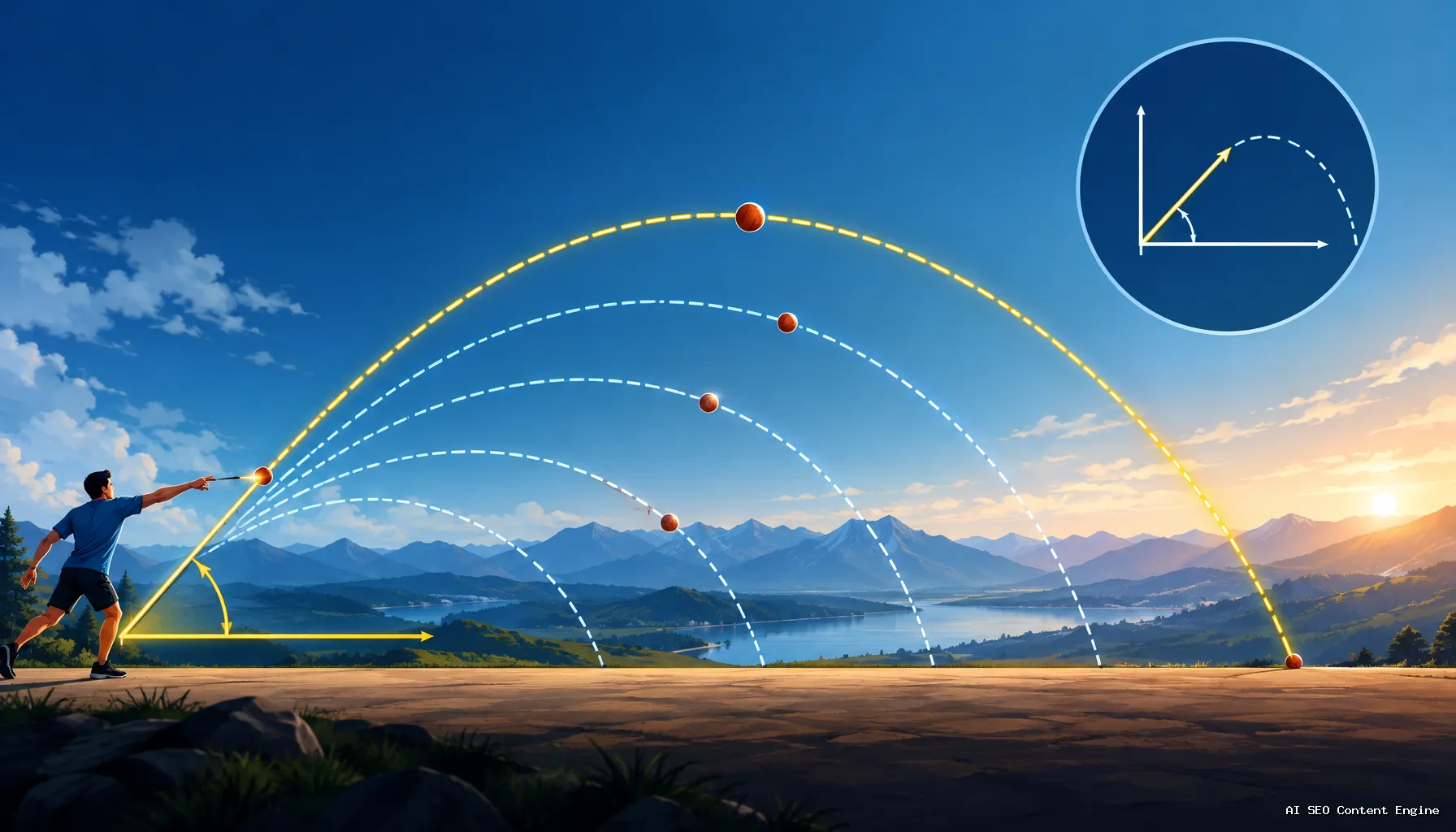
Among the various launch angles, 45 degrees stands out as the **optimal launch angle** for achieving the maximum range. This is because, at this angle, the horizontal and vertical components of velocity are balanced perfectly, maximizing the distance covered. The equation R = v²sin2θ/g mathematically proves this relationship, showing that the sine of 2θ reaches its peak value when θ is 45 degrees.
For those interested in exploring related concepts in physics, such as the principles of nuclear reactions, check out our detailed article on Nuclear Fission vs Fusion: Understanding E = mc², Binding Energy, and Their Mechanisms.
In conclusion, delving into the intricacies of projectile motion not only enhances our understanding of motion dynamics but also provides practical insights into various applications, from sports to engineering. This foundational knowledge serves as a stepping stone for further exploration into the realms of physics and motion.
Explaining the Range Formula: R = v²sin2θ/g
The range formula, **R = v²sin2θ/g**, is a cornerstone of understanding projectile motion, providing insights into how far a projectile will travel when launched at a specific angle and velocity. To fully grasp this formula, it’s essential to break down its components and understand the physics of projectiles.
Components of the Range Formula
– **v**: Represents the initial velocity of the projectile. The higher the initial velocity, the farther the projectile will travel.
– **sin2θ**: This term signifies the sine of double the launch angle (θ). The sine function is critical because it determines the optimal combination of horizontal and vertical velocities.
– **g**: Denotes the acceleration due to gravity, approximately 9.81 m/s² on Earth. This constant affects how quickly the projectile will fall back to the ground.
Why 45° Is the Maximum Range Angle
The **maximum range angle** is achieved when sin2θ reaches its maximum value, which is 1. This occurs when 2θ equals 90°, meaning θ is 45°. At this angle, the **horizontal and vertical components** of the initial velocity are equal, ensuring that the projectile’s trajectory covers the maximum possible distance. This is why the 45-degree angle is often referred to as the **optimal launch angle** for achieving the greatest range.
Practical Applications of the Range Formula
Understanding **R = v²sin2θ/g — Projectile Motion Range and Why 45° Is Maximum** has numerous applications:
– **Sports**: Athletes use this principle to optimize their techniques in activities like javelin throw or long jump.
– **Engineering**: Engineers apply this knowledge to design trajectories for missiles and rockets.
For those intrigued by the fundamental concepts of motion and energy, our detailed article on Thermal Energy and Internal Energy can provide further insights.
In summary, the range formula encapsulates the delicate balance between velocity, angle, and gravity, offering a mathematical explanation for why 45° is the optimal launch angle for projectile motion. This understanding forms a foundational aspect of physics, with widespread applications across various fields.
Why 45° is the Optimal Angle in R = v²sin2θ/g
Understanding why 45 degrees is the optimal angle for achieving maximum range in projectile motion is a fascinating exploration into the physics of projectiles. The mathematical expression **R = v²sin2θ/g — Projectile Motion Range and Why 45° Is Maximum** reveals the intricate relationship between launch angle, initial velocity, and gravitational force. Let’s delve deeper into the reasons behind this optimal angle.
The Role of Sin2θ in Maximizing Range
– The formula for projectile range hinges on the term **sin2θ**. This trigonometric function reaches its peak value of 1 when 2θ equals 90 degrees.
– Therefore, for sin2θ to be maximized, θ must be 45 degrees. At this angle, the product of velocity components maximizes the distance traveled.
Balancing Vertical and Horizontal Components
– **Vertical Component**: At 45 degrees, the vertical component of the velocity (v sin θ) is equal to the horizontal component (v cos θ), providing an ideal balance.
– **Horizontal Component**: This balance ensures that the projectile remains in the air for the longest time while covering the maximum horizontal distance.
Practical Implications and Applications
– **Sports and Engineering**: In sports, optimizing launch angles can significantly impact performance in events like javelin throw and long jump. Similarly, engineers use these principles to calculate trajectories for projectiles in defense and aerospace applications.
– For a deeper dive into how forces and energy interplay, our article on Understanding the Simple Pendulum and Its Period Formula: T = 2π√(L/g) provides additional insights into motion dynamics.
Conclusion
In conclusion, the angle of 45 degrees exemplifies the **optimal launch angle 45 degrees** due to its ability to equalize the vertical and horizontal velocity components, maximizing the projectile’s range. This principle is not only central to understanding the physics of projectiles but also has substantial practical applications. As we explore more about projectile motion, the insights gained from **R = v²sin2θ/g — Projectile Motion Range and Why 45° Is Maximum** continue to underline the importance of precise mathematical formulations in real-world scenarios.
Frequently Asked Questions
How to calculate the maximum distance of a projectile?
The maximum distance, or range, of a projectile can be calculated using the formula R = v²sin2θ/g where v is the initial velocity, θ is the launch angle, and g is the acceleration due to gravity. For maximum range, the angle θ should be 45°.
How does angle affect projectile motion?
The angle of launch significantly affects the trajectory and range of a projectile. A higher angle results in a higher trajectory and shorter range, whereas a lower angle results in a flatter trajectory. An optimal angle of 45° provides the maximum range for a given initial velocity.
Which launch angle gives a projectile the greatest range?
The launch angle that yields the greatest range for a projectile is 45°. This is because, at 45°, the horizontal and vertical components of the initial velocity are optimized to cover the maximum possible distance.
When the range of a projectile is maximum, its angle of projection may be 45 or 135?
While mathematically, both 45° and 135° can maximize the range in terms of the formula R = v²sin2θ/g, in practical scenarios where the projectile is launched from the ground and lands back on it, 45° is the angle that provides maximum range. The angle of 135° would result in a negative vertical component, which is not feasible in typical projectile motion situations.