What Is Latent Heat? Fusion, Vaporisation and Phase Changes Explained
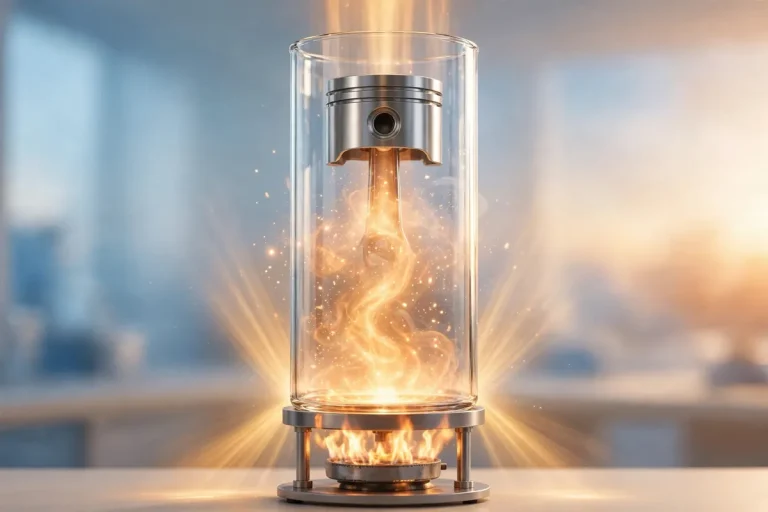
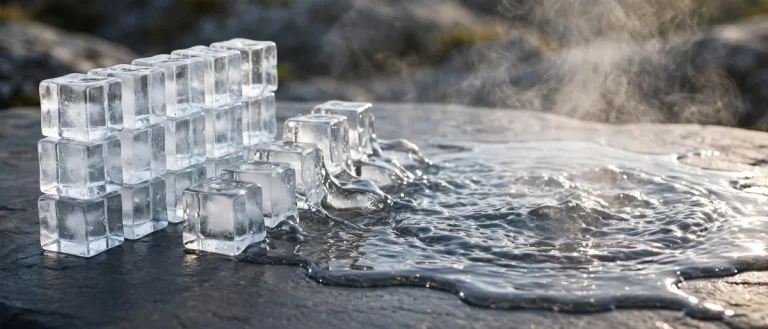
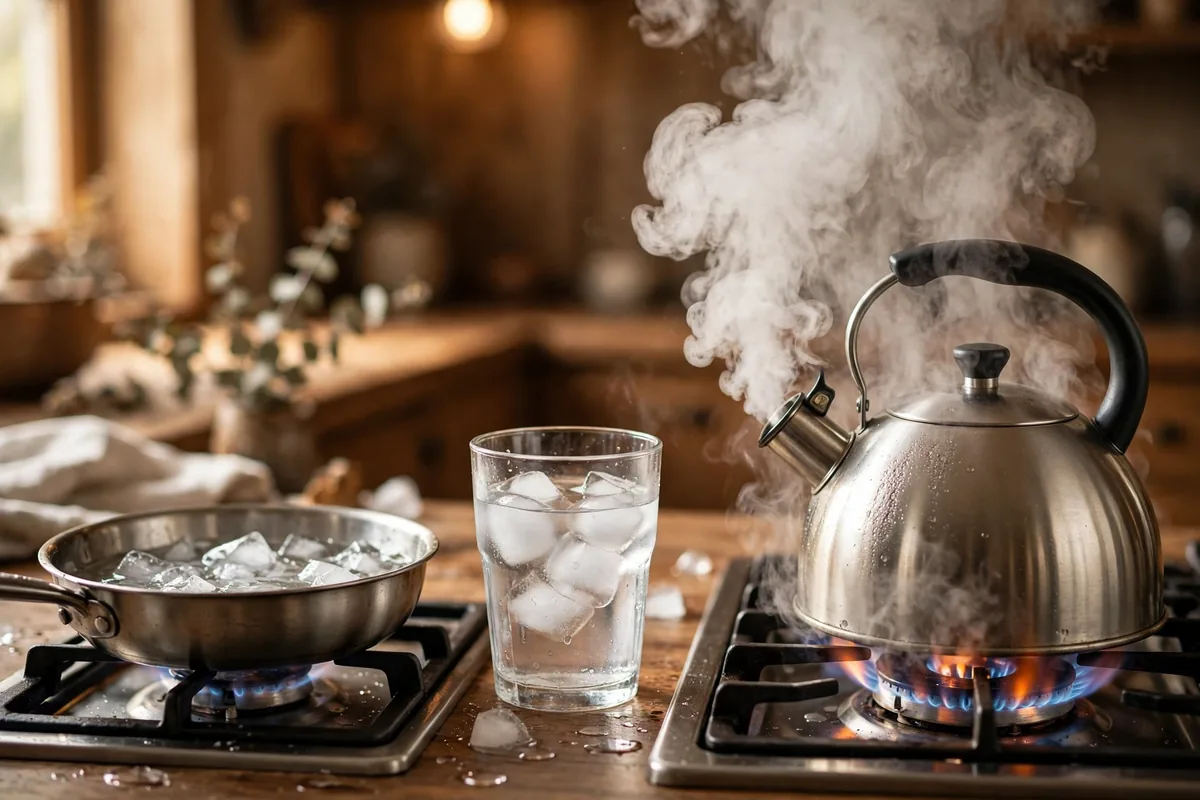
Put a pan of ice water on a hot stove and watch the thermometer. The ice shrinks, and the thermometer sits at 0 °C the whole time. Turn the heat up under a kettle and the same thing happens at the other end: the water boils hard at 100 °C and the temperature refuses to budge. Heat keeps pouring in, yet nothing gets hotter.
The energy hiding in that flat thermometer reading has a name, and this article explains what is latent heat, how much energy a phase change takes, and how to work it out with one short formula.
Latent heat is the energy a substance absorbs or releases when it changes phase at constant temperature and pressure. Melting, freezing, boiling and condensing all run on it. The word latent comes from the Latin word for hidden, and the name fits: the energy goes in or out without showing up on a thermometer.
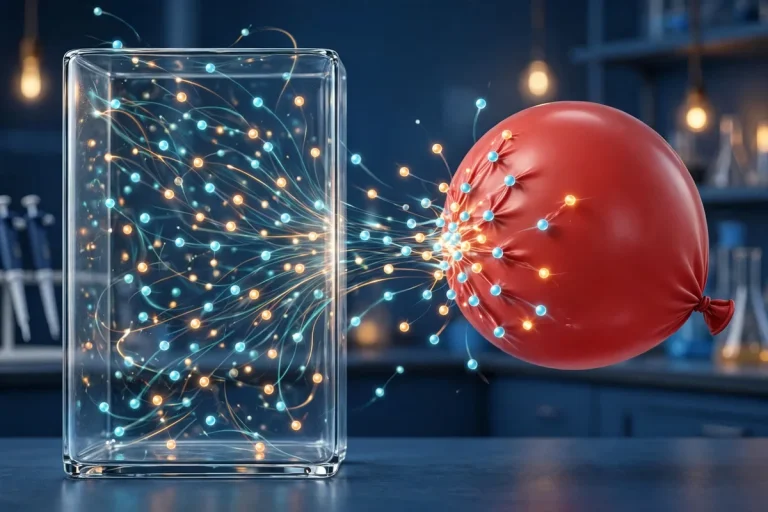
It rearranges the bonds between molecules instead of speeding the molecules up, so the temperature stays put while the substance changes state.
What Is Latent Heat?
Start with the molecules. In ice, water molecules sit locked in a rigid lattice, held in place by hydrogen bonds. Add heat and the molecules vibrate faster, but the bonds hold, so the ice warms up. At 0 °C the bonds start to break. From that point on, every joule of heat you add goes into breaking bonds, not into making molecules move faster.
The temperature cannot rise until the lattice has fallen apart, so the thermometer holds at 0 °C while the ice turns to water.
That is the whole idea in one picture. Temperature measures how fast molecules move on average. Latent heat changes how molecules are arranged. A phase change is a rearrangement job, and the energy for it comes from the heat you supply. Once the rearrangement is done, the temperature can move again.
Two details in the definition matter for exams. First, the temperature stays constant, so a phase change happens at one fixed temperature for a given pressure. Water melts at 0 °C and boils at 100 °C at normal atmospheric pressure. Second, the energy is per kilogram, not per lump.
A swimming pool of ice needs far more energy to melt than a single ice cube, even though both melt at 0 °C. That per kilogram number is the specific latent heat, and it differs for every substance.
Once you can answer what is latent heat in your own words, the formula becomes easy to use. The rest of this article builds the picture piece by piece: the six phase changes, the two latent heats of water, the formula, and two worked examples you can copy into exam answers.
Sensible Heat or Latent Heat? Telling Them Apart
Students mix these two up more than any other pair in this topic, so here is the clean split. Sensible heat changes the temperature of a substance. You feel it, and a thermometer shows it. Its formula is Q = mcΔT, where c is the specific heat capacity and ΔT is the temperature change. Latent heat changes the phase of a substance.
You do not feel it as a temperature change, and a thermometer cannot show it. Its formula is Q = mL, where L is the specific latent heat.
| Sensible heat | Latent heat | |
|---|---|---|
| Formula | Q = mcΔT | Q = mL |
| What changes | Temperature | Phase |
| Thermometer reading | Moves | Stays still |
| Happens when | Heating or cooling within one phase | Melting, freezing, boiling, condensing |
Most real heating jobs use both. Warming a kettle from 20 °C to 100 °C is sensible heat. Turning that water into steam is latent heat. Worked example 2 below adds the two stages together, and it is the kind of combined question examiners love to set.
The Six Phase Changes
A substance has three familiar phases: solid, liquid and gas. Each pair of phases gives two transitions, one in each direction, so there are six in total. Three of them take heat in. Three give heat out.
| Transition | From | To | Heat flow |
|---|---|---|---|
| Melting | Solid | Liquid | Absorbs |
| Freezing | Liquid | Solid | Releases |
| Vaporisation | Liquid | Gas | Absorbs |
| Condensation | Gas | Liquid | Releases |
| Sublimation | Solid | Gas | Absorbs |
| Deposition | Gas | Solid | Releases |
The absorbing three are endothermic. The releasing three are exothermic. One memory trick: the transitions that break bonds or loosen molecules take energy in, and the transitions that form bonds or pack molecules together give energy out. Freezing is the reverse of melting, so it releases exactly the energy melting absorbs. Condensation is the reverse of vaporisation, so it releases exactly the energy vaporisation absorbs.
Two routes lead from liquid to gas, and students often confuse them. Boiling happens throughout the liquid at one fixed temperature, the boiling point, when bubbles of vapour form inside the liquid. Evaporation happens only at the surface and at any temperature, which is why a puddle dries on a cool day and why sweat cools your skin.
Both are vaporisation, and both need latent heat, but boiling is fast and happens at a fixed temperature while evaporation is slow and happens at any temperature.
Latent Heat of Fusion
The latent heat of fusion, written Lf, is the energy needed to melt one kilogram of a solid at its melting point, with no change in temperature. For water the number is 334 kJ/kg, which is 334,000 J/kg. Melt one kilogram of ice at 0 °C and you must supply 334 kJ.
Freeze one kilogram of water at 0 °C and the water hands back the same 334 kJ to its surroundings. The two directions use the same number because freezing simply runs melting in reverse.
Different substances hold their molecules together with different strengths, so Lf varies a lot. Here are three for comparison.
| Substance | Melting point | Lf |
|---|---|---|
| Water | 0 °C | 334 kJ/kg |
| Ethanol | -114 °C | 109 kJ/kg |
| Sulphur | 115 °C | 54 kJ/kg |
Water needs far more energy to melt than ethanol or sulphur, kilogram for kilogram. Its hydrogen bonds are strong, and breaking a whole lattice of them costs energy. That high number is one reason ice is such a good coolant: a single kilogram of melting ice soaks up 334 kJ from whatever sits next to it, and it does so without warming up at all. A cold drink stays cold because the ice keeps stealing heat to melt.
One more detail trips students up. The value of Lf belongs to a specific melting point. Water melts at 0 °C, and 334 kJ/kg is the number at that temperature. If a question gives you a different substance or a different Lf, use the number in the question, not the number for water.
Latent Heat of Vaporisation
The latent heat of vaporisation, written Lv, is the energy needed to turn one kilogram of a liquid into gas at its boiling point, with no change in temperature. For water the number is 2,260 kJ/kg, which is 2,260,000 J/kg. Turn one kilogram of water at 100 °C into steam and you must supply 2,260 kJ. Let one kilogram of steam condense back to water at 100 °C and it hands back the same 2,260 kJ.
Now compare the two numbers for water: 334 kJ/kg to melt, 2,260 kJ/kg to boil. Vaporisation costs nearly seven times as much as fusion. The reason sits in the molecules. Melting only loosens the lattice so molecules can slide past each other. The molecules stay close and keep most of their bonds.
Vaporisation pulls the molecules completely apart so they can fly free as a gas, and that means breaking nearly every bond between them. Pulling things fully apart costs far more energy than loosening them.
That gap explains a familiar hazard. A steam burn hurts far worse than a scald from boiling water at the same temperature, and the extra damage comes from the latent heat. Steam at 100 °C carries the same temperature as boiling water, but it also carries 2,260 kJ per kilogram locked up as latent heat.
When steam hits your skin it condenses, and it dumps all that energy onto one small patch of skin in a fraction of a second. Boiling water can only cool down to skin temperature, which releases far less energy. Same temperature, very different energy.
The Latent Heat Formula Q = mL
The formula is short: Q = mL. Q is the energy transferred in joules. m is the mass in kilograms. L is the specific latent heat in joules per kilogram. Multiply mass by the per kilogram cost and you get the total cost of the phase change. The formula has no temperature in it, which makes sense, because the temperature does not change during a phase change.
Two rearrangements cover every question type. Divide both sides by L and you get m = Q / L, which finds the mass melted or boiled by a known amount of energy. Divide both sides by m and you get L = Q / m, which finds the specific latent heat from a measured energy and mass. Learn the one formula and the two rearrangements follow from it, so there is nothing extra to memorise.
Use the right L for the right transition. Melting and freezing use Lf. Vaporisation and condensation use Lv. Sublimation has its own value, Ls, but most school questions stick to the first two. Swapping Lf and Lv is the single most common error in this topic, and it throws the answer out by a factor of nearly seven for water, so check which transition the question describes before you pick a number.
Sign tells you the direction of energy flow. Take Q as positive when the substance absorbs energy, during melting, vaporisation and sublimation. Take Q as negative when the substance releases energy, during freezing, condensation and deposition. Some textbooks flip the sign and count energy released as positive, so read the question and stay consistent with its convention. The size of the number never changes, only the sign.
A heating curve makes the flat sections visible. Heat a block of ice from -20 °C and the temperature climbs steadily until it reaches 0 °C. Then the line goes flat: the temperature holds at 0 °C while the ice melts.
Once the last crystal has gone, the temperature climbs again until it reaches 100 °C, where the line goes flat a second time while the water boils. The flat stretches are the latent heat stages, and their lengths show how much energy each stage swallows.
The boiling flat is nearly seven times as long as the melting flat for water, which is the same ratio as Lv to Lf.
Combined problems stack the stages. Warming, melting, warming again, then boiling is four stages, each with its own formula, and you add the energies. Worked example 2 does exactly that with two stages, and the method scales to any number.
Worked Example 1: Melting Ice
Question: how much energy does it take to melt 2.0 kg of ice at 0 °C?
Step 1: write down what you know. Mass m = 2.0 kg. The ice is already at its melting point, 0 °C, so the whole job is a phase change. The specific latent heat of fusion for water is Lf = 334 kJ/kg.
Step 2: pick the formula. Melting is a phase change at constant temperature, so use Q = mLf.
Step 3: substitute the numbers. Q = 2.0 kg × 334 kJ/kg = 668 kJ.
Step 4: check the units and the sense of the answer. Kilograms cancel against per kilogram, leaving kilojoules, which is an energy unit. The answer is large because melting two kilograms of ice takes real energy, even though the temperature never moves.
Answer: 668 kJ, with zero temperature change. The water stays at 0 °C from the first drop to the last.
Flip the question and the same number answers it. Freeze 2.0 kg of water at 0 °C and the water releases 668 kJ into its surroundings. The size is the same, only the direction of energy flow changes.
Worked Example 2: Boiling Water in Two Stages
Question: how much energy does it take to turn 0.50 kg of water at 20 °C into steam at 100 °C?
This one has two stages. First the water warms from 20 °C to 100 °C, which is sensible heat. Then it boils at 100 °C, which is latent heat. Add the two energies.
Stage 1: warming the water. Use Q = mcΔT. The specific heat capacity of water is c = 4,186 J/(kg °C). The temperature change is ΔT = 100 °C minus 20 °C = 80 °C. So Q = 0.50 kg × 4,186 J/(kg °C) × 80 °C. Multiply 4,186 by 80 to get 334,880, then halve it for the 0.50 kg, which gives 167,440 J. That is about 167 kJ.
Stage 2: boiling the water. Use Q = mLv. The latent heat of vaporisation for water is Lv = 2,260 kJ/kg. So Q = 0.50 kg × 2,260 kJ/kg = 1,130 kJ.
Now add the two stages together. Total Q = 167 kJ + 1,130 kJ = 1,297 kJ, roughly.
Answer: about 1,297 kJ. Notice where the energy went. The phase change cost 1,130 kJ, while warming the water through 80 °C cost only 167 kJ. Boiling takes nearly seven times the energy of the warming stage, which is the same ratio as Lv to Lf. If you ever forget one stage in a two-stage question, your answer will be wildly low, so count the stages before you start calculating.
Common Mistakes
Confusing latent heat with specific heat capacity. The two formulas answer different questions. If the temperature changes, use Q = mcΔT. If the phase changes at constant temperature, use Q = mL. Using Q = mcΔT on a melting block of ice gives ΔT = 0, which gives Q = 0, which is obviously wrong: melting takes hundreds of kilojoules.
Using Lf where Lv belongs, or the other way round. Melting and freezing take Lf. Boiling and condensing take Lv. For water the two differ by a factor of nearly seven, so a swapped value wrecks the answer.
Claiming the water gets hotter while it boils. It does not. The thermometer holds at 100 °C from the first bubble to the last drop of liquid. Extra heat only makes the boiling faster, not hotter.
Mixing up kJ/kg and J/kg. Water’s Lf is 334 kJ/kg, which is 334,000 J/kg. Drop three zeroes and the answer shrinks by a factor of 1,000. Keep every number in the same unit before you multiply, and convert kilojoules to joules, or joules to kilojoules, at the start.
Treating melting and freezing as needing different amounts of energy. They need the same amount. Freezing releases what melting absorbs, joule for joule. The same holds for vaporisation and condensation.
Forgetting the direction of energy flow. Freezing and condensation release energy, so Q is negative under the absorbed-is-positive convention. Forgetting the sign gives the right size with the wrong meaning, and examiners mark that.
Using the Celsius temperature instead of the temperature change in Q = mcΔT. Here is the good news: a change of 1 °C is exactly the same size as a change of 1 K, so ΔT works out the same in either scale. You only need the change, never the absolute temperature, so 100 °C minus 20 °C is 80 °C and also 80 K.
Conclusion
So what is latent heat? It is the energy a phase change hides from the thermometer. The temperature holds steady while the energy breaks bonds or forms them, and the formula that counts it is Q = mL. Melting and freezing run on the latent heat of fusion, Q = mLf, which is 334 kJ/kg for water.
Vaporisation and condensation run on the latent heat of vaporisation, Q = mLv, which is 2,260 kJ/kg for water. Sensible heat changes temperature, latent heat changes phase, and a full heating job usually needs both, added stage by stage. Keep the two formulas straight, match the right L to the right transition, and the numbers follow.
Frequently Asked Questions
What is latent heat?
Latent heat is the energy a substance absorbs or releases when it changes phase at constant temperature and pressure. The word latent means hidden, because the energy does not show up on a thermometer. Instead of speeding molecules up, it rearranges the bonds between them, breaking bonds during melting and vaporisation and forming bonds during freezing and condensation. The temperature stays fixed until the phase change is complete.
What is the latent heat of fusion?
The latent heat of fusion, written Lf, is the energy needed to melt one kilogram of a solid at its melting point, with no change in temperature. For water it is 334 kJ/kg, so melting 1 kg of ice at 0 °C takes 334 kJ. Freezing releases exactly the same amount, because freezing runs melting in reverse. Other substances have different values: ethanol is 109 kJ/kg and sulphur is 54 kJ/kg.
What is the latent heat of vaporisation of water?
The latent heat of vaporisation of water is 2,260 kJ/kg, the energy needed to turn one kilogram of liquid water into steam at its boiling point of 100 °C, with no temperature change. Condensing one kilogram of steam back to water at 100 °C releases the same 2,260 kJ. That is why steam burns are so severe: the steam dumps all that stored energy onto the skin when it condenses.
What is the latent heat formula Q = mL?
The latent heat formula is Q = mL, where Q is the energy transferred in joules, m is the mass in kilograms, and L is the specific latent heat in joules per kilogram. Multiply the mass by the per-kilogram cost of the phase change to get the total energy. Use Lf for melting and freezing and Lv for vaporisation and condensation. The formula has no temperature term, because the temperature does not change during a phase change.
Why does temperature stay constant during a latent heat phase change?
Temperature stays constant during a phase change because the heat supplied goes into rearranging molecules instead of speeding them up. Temperature measures how fast molecules move on average, so it can only rise when molecules move faster. During melting, the energy breaks the bonds holding the solid lattice together; during boiling, it pulls molecules completely apart. Until that rearrangement is finished, the temperature cannot move.
What is the difference between latent heat of fusion and latent heat of vaporisation?
The latent heat of fusion is the energy needed to melt a solid, while the latent heat of vaporisation is the energy needed to turn a liquid into a gas, both at constant temperature. For water, fusion costs 334 kJ/kg and vaporisation costs 2,260 kJ/kg, nearly seven times more. Melting only loosens the molecular lattice so molecules can slide past each other, while vaporisation pulls molecules completely apart, breaking nearly every bond between them.