Zeroth Law of Thermodynamics and Temperature Scales Explained
Two cups of tea sit on a kitchen table. You touch one, then the other, and you know at once that they feel equally hot. But how do you know?
You never poured one into the other. You never let them touch.
Something in your head compared the two sensations and called them equal, and a thermometer does the same job with far better precision. The rule that lets a thermometer make that comparison is the zeroth law of thermodynamics, and it sits underneath every temperature reading you have ever taken.
Most students meet the first law and the second law first. They learn about energy and entropy, and they assume temperature needs no explaining. It does.
Temperature is a slippery idea, and the zeroth law pins it down. This article states the law in plain words, explains what thermal equilibrium means, and walks through the three temperature scales with the conversion formulas and worked examples you need for exams.
What Thermal Equilibrium Really Means
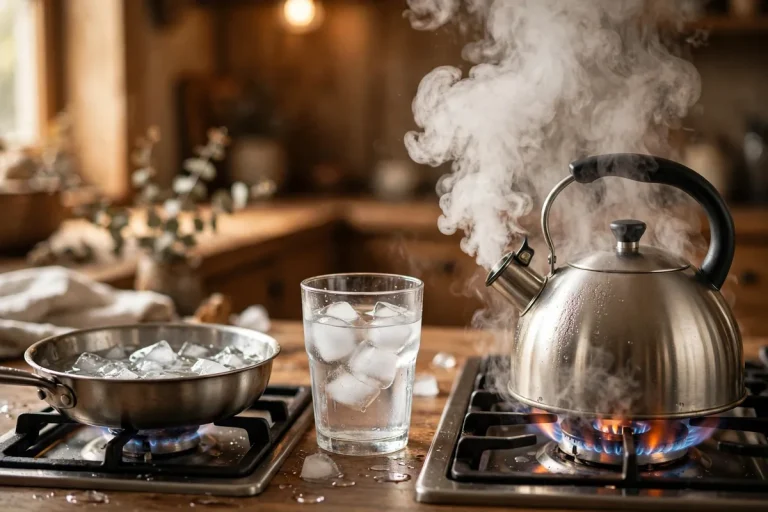
Put a hot spoon in a cold glass of water and something starts at once. Heat flows from the spoon into the water. The spoon cools, the water warms, and after a while both settle at the same temperature.
At that point the flow stops, or rather the flows in each direction balance out. Physicists call that state thermal equilibrium.
Thermal equilibrium means two bodies in thermal contact exchange no net heat. The word net matters. Molecules still collide and trade energy in both directions, but the amounts match, so neither body gains or loses energy overall. A system in thermal equilibrium with its surroundings keeps a steady temperature, and that steadiness is what makes temperature a useful measurement at all.
Temperature itself is the property that bodies in thermal equilibrium share. Two bodies at the same temperature sit in thermal equilibrium with each other. Different temperatures mean no equilibrium.
That sounds circular, and in a way it is, which is exactly why physics needs a law to break the circle. First, though, get two ideas straight, because exams love to mix them up.
Temperature measures the average kinetic energy of the particles in a body. Hotter means the particles jiggle faster on average. Heat is something else entirely.
Heat means energy in transit, energy moving from one body to another because their temperatures differ. A body holds internal energy. It does not hold heat. You can say a kettle holds hot water, but you cannot say it holds heat, because heat only exists while energy moves.
That distinction clears up a common confusion. A spark from a sparkler can reach 1,000 °C, yet it barely warms your skin, because it carries almost no energy. A bath at 40 °C holds far more energy and warms you right through. Temperature tells you how hot, not how much energy sits there.
The Zeroth Law of Thermodynamics
Now the law itself. Take three systems and call them A, B and C. Suppose A sits in thermal equilibrium with C, and B also sits in thermal equilibrium with C. The zeroth law of thermodynamics says A and B sit in thermal equilibrium with each other.
In symbols, A ≡ C and B ≡ C imply A ≡ B. Logicians call this transitivity, the same pattern as “if A equals C and B equals C, then A equals B”, applied to temperature instead of numbers.
Why does this need a law at all? It feels obvious. Put three cups of water on a table, and if the first matches the third and the second matches the third, surely the first two match.
But physics does not accept “surely”. Nature could have worked differently.
Two bodies could each settle with a thermometer yet refuse to settle with each other. Experiments show they always do settle, and that experimental fact is the whole content of the law. No one has derived it from the first or second law, because it stands on its own as a fact about the world.
The name has a story. Physicists worked out the first and second laws in the 1800s, and only later realised they had skipped the idea that comes logically first. In the 1930s Ralph Fowler gave this missing piece the number zero, since it belongs before law number one. The zeroth law of thermodynamics is therefore the foundation, not an afterthought, and every temperature scale rests on it.
In practice the third body C is usually a thermometer. You press a thermometer against a cup of tea, wait until they share a temperature, and read the scale. Then you press the same thermometer against a second cup.
If it shows the same reading, the zeroth law tells you the two cups share a temperature, even though they never touched. Without that guarantee, the thermometer would tell you nothing about the second cup at all.
Why Your Thermometer Works at All
A thermometer works because some physical property changes steadily as temperature changes. Physicists call such a property a thermometric property.
The length of a mercury column grows with temperature. The pressure of a gas in a fixed container grows with temperature. The electrical resistance of a metal wire grows with temperature. Pick one, mark two fixed points on it, divide the gap into equal steps, and you have a scale.
That sounds simple, and it hides a problem. Two thermometers built on different properties, mercury and gas for instance, will agree at the two fixed points you used to calibrate them.
Between those points they disagree, sometimes by a degree or more. The mercury column and the gas pressure simply do not grow in the same way between the fixed points. So a temperature reading depends on the substance inside the thermometer, and that is a flaw, not a feature.
The way out of the flaw is to pick one property that behaves the same for every gas, and that leads to the ideal gas scale, which a later section covers. For now, note the key point. A thermometer only measures temperature because the zeroth law of thermodynamics guarantees that equilibrium with the thermometer means equilibrium with the body. The scale itself is a human choice, and different choices give different numbers for the same physical state.
Celsius, Fahrenheit and Kelvin Side by Side
Three scales dominate everyday life and science, and each one grew out of a different history. Anders Celsius proposed his scale in 1742, fixing 0 °C at the freezing point of water and 100 °C at its boiling point under standard atmospheric pressure, with 100 equal divisions between them. Daniel Fahrenheit built his scale a couple of decades earlier, fixing 32 °F at the ice point and 212 °F at the steam point, with 180 divisions between them. The Kelvin scale came much later, and it works differently from both.
Kelvin is the absolute scale. Its zero sits at absolute zero, the lowest temperature nature allows, and its divisions match the Celsius degree in size. Water freezes at 273.15 K and boils at 373.15 K.
Kelvin is the SI unit of temperature, and you write it as K with no degree sign. Writing °K or “degrees Kelvin” is a mistake examiners love to penalise, so get the habit right early.
The table below puts the three scales side by side. Read it as a map, not as a list to memorise cold. The pattern to notice is that the Celsius and Kelvin scales share the same step size, while Fahrenheit uses smaller steps, which is why its numbers run higher.
| Scale | Ice point | Steam point | Absolute zero | Divisions between ice and steam points |
|---|---|---|---|---|
| Celsius | 0 °C | 100 °C | −273.15 °C | 100 |
| Fahrenheit | 32 °F | 212 °F | −459.67 °F | 180 |
| Kelvin | 273.15 K | 373.15 K | 0 K | 100 |
One kelvin step equals one degree Celsius step. That single fact makes Celsius to Kelvin conversion trivial, and it also explains why scientists prefer kelvin for any calculation. A temperature difference of 10 degrees means the same energy change on both scales, so you can swap them freely when only a difference matters. A reading is another matter, and that is where the conversion formulas come in.
The Conversion Formulas You Actually Need
Every conversion between the three scales comes from the fixed points, and you only need three formulas plus one rule about differences. Start with Celsius to Kelvin conversion, the one you will use most. Add 273.15 to the Celsius reading:
T(K) = T(°C) + 273.15
So 25 °C becomes 298.15 K, and 0 °C becomes 273.15 K. In rough work many textbooks round the offset to 273, which gives 298 K for 25 °C, close enough for a quick estimate but wrong in precise work. Keep the .15 when the question gives data to three significant figures or asks for an exact value.
Fahrenheit needs two steps because its zero sits in a different place and its degrees are smaller. To go from Celsius to Fahrenheit, multiply by 9/5 and add 32:
T(°F) = (9/5)T(°C) + 32
To go the other way, subtract 32 first, then multiply by 5/9:
T(°C) = (5/9)(T(°F) − 32)
The order matters. Subtract before you multiply, or the answer lands far from the truth. Students who multiply first and subtract after get a number that looks plausible and scores zero, so write the brackets in and follow them.
All three formulas collapse into one master relation, which is worth learning because it lets you jump between any two scales without remembering each formula separately:
C/5 = (F − 32)/9 = (K − 273.15)/5
Here C, F and K stand for the readings on the Celsius, Fahrenheit and Kelvin scales. Pick the two parts you need, cross multiply, and solve.
Temperature differences follow a simpler rule. A difference has no zero point to worry about, so the 32 and the 273.15 both drop out. A rise of 10 °C equals a rise of 10 K and a rise of 18 °F:
ΔC = ΔK = (5/9)ΔF
That is the formula people forget most often. Converting a reading and converting a difference are two different jobs, and mixing them up is the single most common error in this topic. The worked examples below show both jobs in action, and the common mistakes section collects the rest.
Worked Example 1: 70 °F to Kelvin
A comfortable room temperature is 70 °F. Convert it to kelvin.
Step 1: Convert Fahrenheit to Celsius. Use T(°C) = (5/9)(T(°F) − 32) and put 70 in place of T(°F):
T(°C) = (5/9)(70 − 32) = (5/9)(38) = 190/9 = 21.1 °C
Step 2: Convert Celsius to kelvin. Use T(K) = T(°C) + 273.15 and put 21.1 in place of T(°C):
T(K) = 21.1 + 273.15 = 294.25 K
Step 3: Round to a sensible number of figures. The question gave 70 °F to two significant figures, so 294 K is the answer to report. Room temperature sits near 294 K, or about 21 °C, and you can now use that number in any thermodynamic calculation without a second thought.
Notice the route. Fahrenheit never converts straight to kelvin in one step, so Celsius acts as the bridge. Every Fahrenheit to Kelvin conversion runs the same way: Fahrenheit to Celsius first, then add 273.15.
Worked Example 2: Where Celsius and Fahrenheit Meet
Find the temperature at which the Celsius and Fahrenheit scales give the same number.
Step 1: Call the unknown temperature x and set both readings equal to it, so T(°C) = x and T(°F) = x.
Step 2: Put both into the Celsius to Fahrenheit formula T(°F) = (9/5)T(°C) + 32:
x = (9/5)x + 32
Step 3: Collect the x terms on one side. Subtract (9/5)x from both sides:
x − (9/5)x = 32
−(4/5)x = 32
Step 4: Divide both sides by −(4/5), which is the same as multiplying by −5/4:
x = 32 × (−5/4) = −40
The answer is −40 °C = −40 °F. The two scales cross at minus forty, the only temperature where they agree.
The minus sign surprises people, and it should not. Fahrenheit starts 32 degrees above the ice point, so its numbers run ahead of Celsius through the whole everyday range. The Celsius scale only catches up once both readings drop far below freezing, and the catch-up point lands at −40. Examiners love this question because it tests whether you can set up the algebra instead of guessing, and because the answer is a single memorable number.
Absolute Zero and the Ideal Gas Temperature Scale
Every gas behaves the same way when you cool it at constant volume. Its pressure falls in a straight line, and if you extend that line past the coldest temperature you can reach, every gas hits zero pressure at the same temperature: −273.15 °C. That temperature is absolute zero, and no gas, no liquid and no solid can go below it. The result does not depend on which gas you used, which is the first hint that this scale is something special.
Physicists turned that hint into a definition. Take a gas thermometer at constant volume, measure its pressure p at the temperature you want, and compare it with its pressure p_triple at the triple point of water, the one temperature where ice, liquid water and water vapour all exist together. The triple point sits at 273.16 K by definition, and the ideal gas temperature scale reads:
T = 273.16 × (p / p_triple)
With a single fixed point instead of two, this scale escapes the substance problem entirely. Different gases give the same temperature, because the extrapolation to zero pressure wipes out the differences between them. That is why the kelvin scale counts as absolute, and why the Celsius and Fahrenheit scales count as practical conveniences built on top of it.
Thermodynamic equations demand kelvin, and the ideal gas law shows why. The law reads pV = nRT, and T there must sit in kelvin. Put a Celsius reading in and the maths breaks, because Celsius can hit zero and go negative, and a gas at 0 °C still holds plenty of energy.
Ratios of temperatures also need kelvin. Doubling the temperature from 300 K to 600 K doubles the average kinetic energy of the particles. Doubling from 10 °C to 20 °C does no such thing, because 10 °C is really 283.15 K and 20 °C is 293.15 K.
One more point, because textbooks sometimes blur it. Absolute zero means the lowest possible internal energy, not a world where every molecule freezes dead still. Quantum mechanics keeps a small zero point energy even at 0 K, so particles still carry a minimum of motion. The third law of thermodynamics adds that you can approach absolute zero as closely as you like but never quite reach it in a finite number of steps, which is why 0 K stays a limit rather than a place you can visit.
Common Mistakes Students Keep Making
Confusing temperature with heat tops the list. Temperature measures average kinetic energy. Heat means energy moving because temperatures differ. A question that asks for heat and gets a temperature as the answer has gone wrong at the first step.
Adding 273 instead of 273.15 in precise work comes next. The rounded version is fine for a rough estimate, but a question that gives data to three significant figures expects 273.15, and the missing .15 can cost the final mark.
Using Celsius in the ideal gas law or any thermodynamic formula that requires kelvin is the mistake that loses the most marks across a whole exam. Whenever a formula multiplies or divides by temperature, or takes a ratio of temperatures, convert to kelvin first. No exceptions.
Converting a temperature difference with the reading formula is another trap. A rise of 18 °F equals a rise of 10 °C, and the +32 plays no part in it. If your difference calculation still contains a 32, start again.
Writing “degrees Kelvin” or °K instead of K marks you out at once. Kelvin takes no degree sign and no word “degrees”. Write 300 K, never 300 °K.
Assuming the zeroth law of thermodynamics is obvious or derivable from the first and second laws misses the point of the whole article. The law is an experimental fact. It states something nature could have refused to do, and experiments show nature does it every time.
Thinking thermal equilibrium means nothing moves at the molecular level is the last one. Molecules in equilibrium keep colliding and trading energy. The trades balance, so the temperature stays put, but the motion never stops.
The Formulas Worth Keeping
The zeroth law of thermodynamics says that if A and B each sit in thermal equilibrium with a third system C, then A and B sit in thermal equilibrium with each other. That transitivity is what makes temperature measurable, and it is the reason a thermometer can compare two bodies that never touch.
Keep these conversions close. Celsius to Kelvin: T(K) = T(°C) + 273.15. Celsius to Fahrenheit: T(°F) = (9/5)T(°C) + 32.
Fahrenheit to Celsius: T(°C) = (5/9)(T(°F) − 32). And absolute zero, the floor under all of them: 0 K = −273.15 °C = −459.67 °F. With those four lines and a thermometer you trust, you can move between any two scales and know exactly what each reading means.
Next time you check a room thermometer, remember what it is really doing. It is borrowing the zeroth law to compare your room with a column of liquid, and the number it shows only means something because that law holds. Learn the formulas, work a few conversions by hand, and the rest of thermodynamics gets easier, because every law after this one takes temperature for granted.
Frequently Asked Questions
What does the zeroth law of thermodynamics state in simple words?
The zeroth law states that if systems A and B are each in thermal equilibrium with a third system C, then A and B are in thermal equilibrium with each other. In symbols, A ≡ C and B ≡ C imply A ≡ B. This transitivity means two bodies at the same temperature exchange no net heat in thermal contact. It is an experimental fact, not derived from the first or second law, and it makes temperature a measurable property.
Why is it called the zeroth law of thermodynamics instead of the third law?
It is called the zeroth law because it was named after the first and second laws already existed, yet logically it comes before them. In the 1930s Ralph Fowler gave this missing foundation the number zero, since it belongs before law number one. The law defines thermal equilibrium and makes temperature measurable, so every other law of thermodynamics takes it for granted. The name marks its logical priority, not a lack of importance.
How does the zeroth law of thermodynamics explain how a thermometer works?
A thermometer works because the zeroth law guarantees that equilibrium with the thermometer means equilibrium with the body being measured. You press the thermometer against a body, wait until they share a temperature, and read the scale. Pressing the same thermometer against a second body that gives the same reading tells you the two bodies share a temperature, even though they never touched. Without that guarantee, the reading would say nothing about the second body.
What is the formula to convert Celsius to Kelvin, and why must temperature be in kelvin for thermodynamics?
The formula is T(K) = T(°C) + 273.15, so 25 °C becomes 298.15 K. Temperature must be in kelvin for thermodynamics because equations such as the ideal gas law, pV = nRT, multiply or divide by temperature, and Celsius can be zero or negative. Ratios of temperatures also need kelvin: doubling from 300 K to 600 K doubles the average kinetic energy, while doubling from 10 °C to 20 °C does not.
At what temperature do the Celsius and Fahrenheit temperature scales read the same value?
The Celsius and Fahrenheit scales read the same value at −40 °C = −40 °F. Set T(°C) = T(°F) = x in the formula T(°F) = (9/5)T(°C) + 32, giving x = (9/5)x + 32, so x = −40. The answer is negative because Fahrenheit starts 32 degrees above the ice point, so its numbers run ahead of Celsius through the everyday range, and Celsius only catches up far below freezing.
What is absolute zero on the Kelvin, Celsius and Fahrenheit temperature scales?
Absolute zero is 0 K = −273.15 °C = −459.67 °F, the lowest temperature nature allows. It is found by extrapolating the pressure of a gas at constant volume to zero, which gives −273.15 °C for every gas. At absolute zero a system has its minimum possible internal energy, although quantum mechanics keeps a small zero point energy, so particles still carry a minimum of motion.