What Is Thermal Conductivity? Heat Flow Through Materials Explained
Put a metal spoon and a wooden spoon into the same pot of hot soup. Wait thirty seconds. The metal handle burns your fingers. The wooden handle feels barely warm. Both spoons sat in the same soup at the same temperature, so the heat source cannot explain the difference. The difference sits inside the materials themselves. One passes heat along quickly. The other holds it back.
That speed, the rate at which a material carries heat from its hot end to its cold end, is what thermal conductivity measures. Once you can put a number on it, you can predict how fast a pan handle heats up, how much warmth escapes through a wall in winter, and why a foam cup keeps coffee hot longer than a steel mug.
What Is Thermal Conductivity?
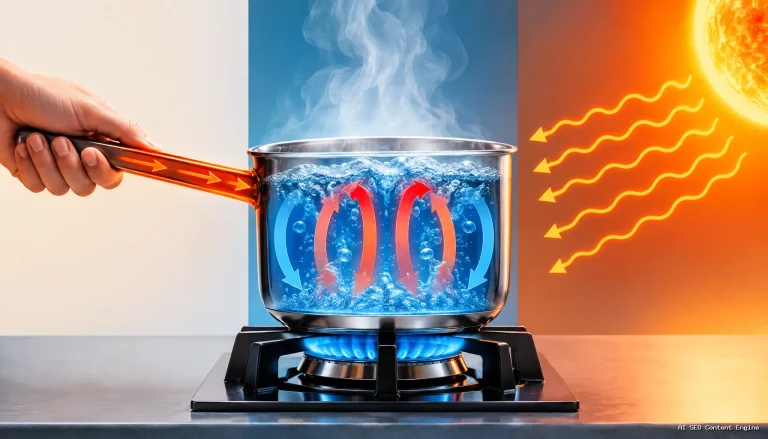
Ask what is thermal conductivity and the short answer is this: it is a property of a material that tells you how easily heat flows through it by conduction. Conduction is heat transfer through direct contact, molecule bumping into molecule, with no bulk movement of the material itself. A high thermal conductivity means heat races through. A low value means heat creeps.
Physicists write thermal conductivity with the symbol k. Its unit is the watt per metre kelvin, written W/(m·K). Read that unit as an engineering statement. A material with k equal to 1 W/(m·K) lets 1 watt of heat flow through a 1 metre thick slab of 1 square metre area when the two faces differ by 1 kelvin. The number answers a practical question: for a given push of temperature, how much heat gets through?
Two points about k matter before you use it in a calculation. First, k belongs to the material, not to the object. A copper rod and a copper plate share the same k, even though the rod and the plate have different shapes and sizes. Shape enters the formula separately, through area and thickness. Second, heat always flows from hot to cold on its own. Nobody has to push it. A material with a high k simply lets that natural flow run faster.
Think of k as a speed limit for heat inside a solid. Copper posts a high limit. Wood posts a low one. Air posts a lower one still. The number never changes the direction of flow. It only sets the pace.
Fourier’s Law of Heat Conduction
Joseph Fourier, a French mathematician working in the early 1800s, turned the idea of heat flow into a formula that still runs engineering today. The thermal conductivity formula below is the one students meet first, and engineers still use it daily. Fourier’s law says the rate of heat flow through a slab depends on four things: the material, the area, the temperature difference, and the thickness. In symbols:
Q/t = kAΔT/d
Each symbol carries a meaning you should be able to state out loud. Q is the amount of heat transferred, measured in joules. The letter t is the time taken, in seconds. Q/t is therefore the rate of heat flow, measured in watts, and one watt equals one joule per second.
The symbol k is the thermal conductivity of the material, in W/(m·K). A is the cross sectional area the heat flows through, in square metres. ΔT is the temperature difference between the two faces, in kelvin. The letter d is the thickness of the slab, the distance the heat must travel, in metres.
Read the formula as a story. A bigger area gives heat more room to cross, so the flow rises. A bigger temperature difference pushes harder, so the flow rises. A thicker slab makes heat travel further, so the flow falls. A higher k makes the material a better carrier, so the flow rises. Every part of the formula matches common sense, which is why students who forget the exact arrangement can often rebuild it from the story.
Engineers often use a shorter version of the same law called heat flux. Heat flux, written q, is the rate of heat flow per unit area. Divide both sides of Fourier’s law by the area and you get:
q = kΔT/d
Heat flux has the unit W/m². It tells you how much heat crosses each square metre every second. Wall insulation, for example, is usually quoted in heat flux, because a builder wants to know the loss per square metre of wall before multiplying by the total wall area.
You may also meet Fourier’s law written with a minus sign:
q = −k∇T
The symbol ∇T, read as the temperature gradient, describes how temperature changes with position. The minus sign records the direction of flow: heat always moves from hot toward cold. If temperature rises as you move to the right, heat flows to the left.
One assumption hides inside the simple form Q/t = kAΔT/d. It describes steady state heat flow. Steady state means the temperatures at the two faces stay fixed and the flow rate stays constant over time. Each point inside the slab holds a fixed temperature while heat passes through at a steady rate.
Most textbook problems, and many real walls in winter, sit close enough to steady state for the formula to work well. A pan fresh on a flame is still warming up, and the formula describes it less accurately during those first seconds.
Thermal Conductivity of Common Materials
The k values of everyday materials span an enormous range. A metal can conduct heat ten thousand times faster than still air. That range is the whole reason insulation works, and it is the reason your choice of material matters more than the thickness of a wall in most designs.
| Material | Thermal conductivity k, W/(m·K) |
|---|---|
| Copper | ~400 |
| Aluminium | ~237 |
| Iron | ~80 |
| Glass | ~1.0 |
| Brick | ~0.72 |
| Water | ~0.606 |
| Wood | ~0.15 |
| Fibreglass | ~0.04 |
| Still air | ~0.026 |
These values are room temperature values. They shift a little with temperature and with the exact grade of the material, so a table in a different textbook may show copper as 401 and brick as 0.6 or 0.8. The order never changes, and the order is what matters for understanding. Metals sit at the top. Ceramics and stone sit in the middle. Foams, fibres and gases sit at the bottom.
Metals conduct heat well because of their free electrons. In a metal, the outer electrons roam through the whole piece, free of any single atom. When one end of a metal rod gets hot, those electrons pick up energy and carry it to the cold end far faster than atoms bumping into each other ever could. Copper has more mobile electrons doing this work than iron, which is one reason copper beats iron by a factor of five.
Insulators work by the opposite trick. They have no free electrons, so heat must travel by a slower route. In a solid like glass or wood, heat passes from atom to atom through vibrations, a process physicists call phonon transport. It is slow.
Foam and fibreglass go further: they trap tiny pockets of still air inside a solid skeleton. Air itself is a poor conductor, and trapped air cannot move around to carry heat by convection either. The result is a material that blocks heat far better than either ingredient alone.
This explains a puzzle students often notice. A brick wall feels cold to the touch in winter, yet brick conducts heat far worse than a steel beam. The cold feeling comes from the wall pulling heat out of your hand, which it does steadily because the wall is thick and its outer face is cold. Feeling cold and conducting fast are not the same thing.
Worked Example 1: Heat Flow Through a Copper Rod
A uniform copper rod has thermal conductivity k = 400 W/(m·K). Its cross sectional area is 2.0 × 10⁻⁴ m² and its length is 0.50 m. One end is held at a temperature 40 K higher than the other end. Find the rate of heat flow through the rod.
Start by listing what you know. The conductivity k is 400 W/(m·K). The area A is 2.0 × 10⁻⁴ m². The temperature difference ΔT is 40 K. The thickness d, which here is the length of the rod, is 0.50 m. The unknown is Q/t, the rate of heat flow in watts.
Fourier’s law gives the answer directly:
Q/t = kAΔT/d
Put the numbers in:
Q/t = (400 W/(m·K)) × (2.0 × 10⁻⁴ m²) × (40 K) / (0.50 m)
Work through the multiplication in stages so a slip is easy to spot. First multiply k by A: 400 × 2.0 × 10⁻⁴ = 0.080 W/K. Then multiply by the temperature difference: 0.080 × 40 = 3.2 W. Finally divide by the thickness: 3.2 / 0.50 = 6.4 W.
Q/t = 6.4 W
The answer means 6.4 joules of heat pass through the rod every second. That is a modest rate, about the power of a small LED bulb, yet it is enough to make the cold end of a short copper rod noticeably warm within a minute. A rod of wood with the same size and the same temperature difference would carry about 2500 times less heat, which is why a wooden handle stays safe to hold.
Worked Example 2: Heat Loss Through a Brick Wall
A house wall is made of brick 0.25 m thick, with thermal conductivity k = 0.72 W/(m·K). The inside face of the wall is at 21 °C and the outside face is at −3 °C. First find the heat flux through the wall, then find the total heat loss for a wall of area 10 m². Finally, work out how much a 100 mm layer of fibreglass insulation would cut the loss.
Start with the temperature difference. The inside is 21 °C and the outside is −3 °C, so ΔT = 21 − (−3) = 24 K. A temperature difference in kelvin equals the same number in degrees Celsius, because the two scales share the same size of degree. Only differences matter here, so no conversion to absolute temperature is needed.
Use the heat flux form of Fourier’s law:
q = kΔT/d
Put the numbers in:
q = (0.72 W/(m·K)) × (24 K) / (0.25 m)
Multiply 0.72 by 24 to get 17.28. Divide by 0.25, which is the same as multiplying by 4, to get 69.12 W/m². Rounded sensibly, the heat flux is about 69 W/m². Every square metre of this bare brick wall leaks roughly 69 watts on a cold night.
Scale that up to the whole wall. The wall area is 10 m², so the total rate of heat loss is:
Q/t = q × A = 69 W/m² × 10 m² = 690 W
A bare brick wall of this size loses heat at roughly the rate of a small electric heater running flat out. Over a whole house, with several walls, a roof and windows, the losses add up fast. That is why insulation pays for itself.
Now add 100 mm of fibreglass, k = 0.04 W/(m·K), to the inside of the wall. The fibreglass layer has a thermal resistance of d/k = 0.10 m / 0.04 W/(m·K) = 2.5 m²K/W. The brick layer has a resistance of 0.25 / 0.72 = 0.35 m²K/W. Add them to get a total resistance of about 2.85 m²K/W.
The new heat flux is q = ΔT / R = 24 / 2.85 = 8.4 W/m². Compare 8.4 with the original 69. The insulation cuts the loss by roughly 88 percent, close to 90 percent. A thin layer of trapped air does more work than the whole brick wall.
Thermal Resistance: the Electrical Analogy
Insulation catalogues rarely quote k on its own. They quote R values. Thermal resistance, written R, measures how strongly a particular slab resists heat flow. It combines the material and the thickness into one number:
R = d/(kA)
Here d is the thickness in metres, k is the thermal conductivity in W/(m·K), and A is the area in square metres. The unit of R is K/W. A bigger R means a better insulator. Double the thickness and R doubles. Swap in a material with half the k and R doubles too.
Fourier’s law takes a tidy new shape with R in it:
Q/t = ΔT/R
Compare that with Ohm’s law from electricity, V = IR, or rearranged, I = V/R. The two formulas line up exactly. Temperature difference plays the role of voltage. Heat flow rate plays the role of electric current. Thermal resistance plays the role of electrical resistance. This is more than a neat coincidence. It lets you borrow every circuit idea you already know and apply it to heat.
The most useful borrowed idea is series resistance. A real wall is never one slab. It is brick plus insulation plus plasterboard, layered together. Heat must cross each layer in turn, just as current must cross each resistor in a series circuit. Resistances in series add, so the total resistance is the sum of the layers:
R_total = R_1 + R_2 + R_3
That is exactly the calculation used in the brick wall example above. The brick contributed 0.35 m²K/W and the fibreglass contributed 2.5 m²K/W. Their sum gave the total, and the total set the heat flux. Notice which layer dominates. The thin fibreglass layer contributed seven times the resistance of the thick brick. When you want to slow heat down, the material matters far more than the thickness.
For a wall, builders often use resistance per unit area, written R with units m²K/W, which is d/k without dividing by area. The two versions differ only by the area factor. Keep track of which one a question uses, and the numbers will behave.
Common Mistakes Students Make with Thermal Conductivity
Thermal conductivity trips students up in the same few places. Each of these errors looks small on paper and costs full marks in an exam, so it is worth naming them plainly.
- Confusing thermal conductivity with heat capacity. Thermal conductivity k is a rate, how fast heat moves through a material. Heat capacity is a storage, how much heat a material must absorb before its temperature rises by one kelvin. A material can have a high heat capacity and a low conductivity at the same time. Water is the classic case: it stores a lot of heat yet conducts it slowly.
- Mixing up heat and heat flow rate. Heat Q is energy, measured in joules. Heat flow rate Q/t is power, measured in watts. A question asking for the rate wants watts. Giving joules answers a different question, and examiners mark it wrong.
- Forgetting to convert thickness to metres. Thickness is the classic unit slip. A wall 250 mm thick is 0.25 m, and a fibreglass layer 100 mm thick is 0.10 m. Put millimetres straight into Fourier’s law and the answer comes out a thousand times too large. Convert first, calculate second.
- Using Celsius and kelvin wrongly. For a temperature difference, Celsius and kelvin are interchangeable: a gap of 24 °C is a gap of 24 K. For an absolute temperature, they are not. Fourier’s law needs only the difference, so students who convert each temperature to kelvin first waste time but still get the right difference. The danger is the reverse, using an absolute temperature in Celsius where the formula needs kelvin, which happens in radiation problems rather than conduction ones.
- Treating k as a fixed constant. Thermal conductivity varies with temperature, and it varies between grades of the same material. The value of k for copper at room temperature differs from its value near its melting point. Textbook values are room temperature values unless the question says otherwise. Use the k the question gives you, not one you remember from a different table.
- Calling a thick object a good insulator. Thickness and conductivity are separate factors. A thick slab of copper still conducts heat far faster than a thin sheet of foam. Insulation needs low k. Thickness only multiplies whatever k already gives. A thick bad insulator is still a bad insulator.
What to Remember About Thermal Conductivity and Fourier’s Law
What is thermal conductivity, in plain terms? It is the answer to one question: how fast does heat travel through this material? The spoon in the soup gives the intuition, and Fourier’s law gives the number.
The law, Q/t = kAΔT/d, says heat flow rises with conductivity, area and temperature difference, and falls with thickness. The heat flux form, q = kΔT/d, gives the loss per square metre, which is the form builders and engineers reach for first. Thermal resistance, R = d/(kA), turns the whole problem into a circuit, with temperature difference as voltage and heat flow as current, and lets layers add up in series.
The numbers tell the story in one line. Copper at around 400 W/(m·K) carries heat thousands of times faster than still air at 0.026 W/(m·K), which is why metals feel cold and foam keeps things warm. A copper rod with a 40 K difference across it carries 6.4 W. A bare brick wall leaks about 69 W through every square metre on a cold night, and 100 mm of fibreglass cuts that loss by roughly 90 percent.
Hold the three formulas close, Q/t = kAΔT/d for the flow, q = kΔT/d for the flux and R = d/(kA) for the resistance, keep thickness in metres and temperature gaps in kelvin, and the next conduction question you meet will feel less like a puzzle and more like a short calculation you already know how to finish.
Frequently Asked Questions
What is thermal conductivity in simple terms?
Thermal conductivity is a property of a material that measures how easily heat flows through it by conduction. A material with high thermal conductivity, such as copper at about 400 W/(m·K), lets heat pass quickly from its hot end to its cold end. A material with low thermal conductivity, such as wood or still air, slows heat down. The value k belongs to the material itself, not to the size or shape of the object.
What is the formula for thermal conductivity in Fourier's law?
Fourier's law gives the rate of heat flow as Q/t = kAΔT/d. Here Q/t is the rate of heat flow in watts, k is the thermal conductivity in W/(m·K), A is the cross sectional area in square metres, ΔT is the temperature difference in kelvin, and d is the thickness in metres. Heat flow rises with k, A and ΔT, and falls as thickness d increases. The heat flux form is q = kΔT/d, measured in W/m².
What are the units of thermal conductivity?
Thermal conductivity k is measured in watts per metre kelvin, written W/(m·K). The unit can be read as an engineering statement: a material with k equal to 1 W/(m·K) lets 1 watt of heat flow through a 1 metre thick slab of 1 square metre area when its two faces differ by 1 kelvin. Remember that k is a rate of flow, not a storage of heat, so its units describe power per unit length per kelvin.
Which material has the highest thermal conductivity?
Among common materials, copper has one of the highest thermal conductivities at about 400 W/(m·K), with aluminium next at about 237 W/(m·K) and iron at about 80 W/(m·K). Metals lead the table because their free electrons carry heat energy quickly from the hot end to the cold end. At the other end, still air measures only about 0.026 W/(m·K), which is why trapped air makes foam and fibreglass such effective insulators.
What is the difference between thermal conductivity and thermal diffusivity?
Thermal conductivity k measures how fast heat flows through a material, while thermal diffusivity measures how quickly the temperature of the material itself changes in response. Diffusivity is defined as α = k/(ρcp), where ρ is density and cp is specific heat capacity. A material can conduct heat well yet warm up slowly if it stores a lot of heat. Water shows this clearly: it stores much heat but conducts it slowly, so its temperature changes gradually.
How does thermal conductivity affect insulation?
Thermal conductivity decides whether a material insulates or conducts. Insulators have low k values, so heat crosses them slowly: fibreglass measures about 0.04 W/(m·K) and still air about 0.026 W/(m·K). The article's brick wall example shows the effect clearly: adding 100 mm of fibreglass cut heat loss from about 69 W/m² to 8.4 W/m², a drop of roughly 90 percent. Low k plus enough thickness gives the best insulation.