
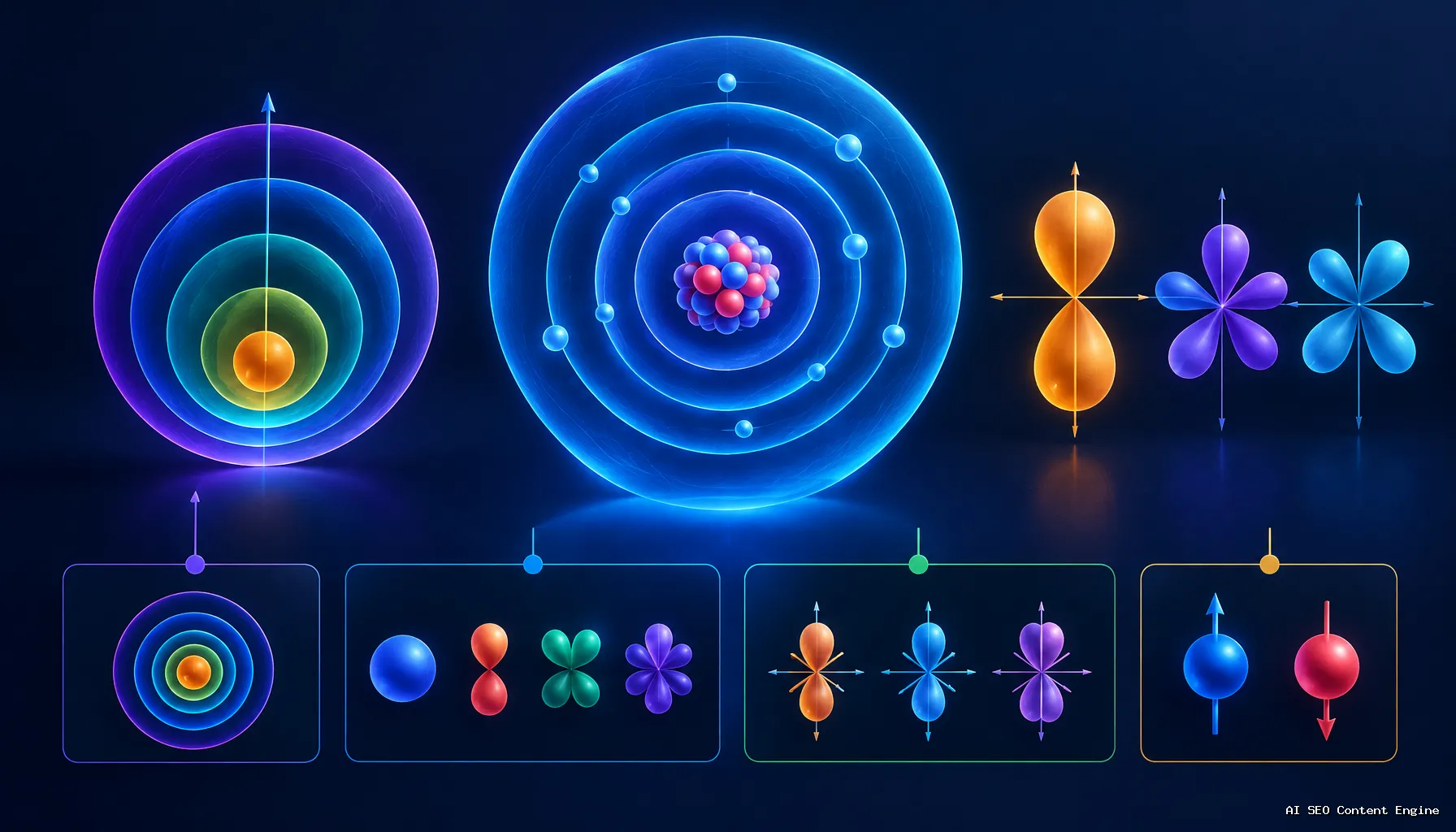
Understanding Quantum Numbers: n, l, mₗ, mₛ Explained for Beginners
What Are Quantum Numbers? n, l, mₗ, mₛ Explained in this beginner-friendly guide will unravel the mysteries behind these fundamental concepts in quantum mechanics. If you’ve ever found yourself puzzled by these terms while diving into the world of atomic structures, you’re not alone. Quantum numbers serve as the backbone of modern physics, helping to describe the unique properties of electrons in an atom.
In this article, we will delve into each quantum number—principal (n), azimuthal (l), magnetic (mₗ), and spin (mₛ)—to provide a clear understanding of their roles and significance. From explaining their function to illustrating how they interact, we’ll make sure you grasp these foundational ideas. But why stop here? To get a deeper dive into quantum numbers and their applications, feel free to explore more comprehensive resources.
Whether you’re a student or a curious mind, our home page offers various resources to expand your knowledge about the fascinating world of physics. Let’s embark on this journey to decode what makes the quantum realm so intriguing and essential to our understanding of the universe.
Introduction to What Are Quantum Numbers? n, l, mₗ, mₛ Explained
Quantum numbers are fundamental to understanding the structure and behavior of atoms in the field of quantum mechanics. These numbers provide a unique identifier for each electron within an atom, much like how a zip code and house number uniquely define an address. The question “What Are Quantum Numbers? n, l, mₗ, mₛ Explained” delves into these identifiers, which are crucial for explaining the arrangement and energies of electrons in atoms.
At the heart of quantum mechanics, quantum numbers arise from the solutions to the Schrödinger equation for electrons in atoms. Each electron is described by a set of four quantum numbers:
- Principal Quantum Number (n): This number indicates the main energy level or shell occupied by the electron. It is integral to the quantum mechanical model and helps in determining the size and energy of the orbital. The principal quantum number is essential for understanding the electron’s energy state.
- Azimuthal Quantum Number (l): Also known as the angular momentum quantum number, it defines the shape of the electron’s orbital. Each value of ‘l’ corresponds to a specific subshell (s, p, d, f), and it ranges from 0 to (n-1). This quantum number plays a pivotal role in the Aufbau principle and the distribution of electrons.
- Magnetic Quantum Number (mₗ): This number describes the orientation of the orbital in space relative to the other orbitals. It ranges from -l to +l, including zero, and is crucial for determining the spatial orientation of the electron cloud. The magnetic quantum number is derived from the magnetic quantum number formula and is integral in understanding phenomena like the Zeeman effect.
- Spin Quantum Number (mₛ): Spin is a unique property of electrons that refers to their intrinsic angular momentum. The spin quantum number can be either +1/2 or -1/2, indicating the two possible spin states of an electron. This concept is fundamental to the Pauli exclusion principle, which states that no two electrons can have the same set of all four quantum numbers.
Understanding these quantum numbers is critical for anyone diving into the intricate world of atomic and molecular physics. They explain not only the structure of atoms but also the properties and behaviors of elements across the periodic table. As we explore the fascinating principles underlying these quantum numbers, we invite you to further your knowledge by exploring related topics such as radioactive decay and half-life.
Principal Quantum Number (n)
The principal quantum number, denoted as n, is the first in the series of quantum numbers that define the unique quantum state of an electron. It is a critical component of the quantum mechanical model of the atom, which offers profound insights into atomic structure and behavior. Understanding the principal quantum number is essential for grasping complex concepts like radioactive decay and half-life.
Definition and Significance of Principal Quantum Number
The principal quantum number defines the energy level or shell of an electron within an atom. It is a positive integer (n = 1, 2, 3, …) and directly correlates with the size and energy of the electron cloud:
- As n increases, the electron’s energy and distance from the nucleus increase.
- Higher energy levels mean electrons reside further from the nucleus, impacting their potential energy and stability.
This concept is vital when considering electron transitions, which occur when an electron moves between energy levels. The energy absorbed or emitted during these transitions is quantized, reflecting the discrete nature of quantum mechanics.
Role in the Quantum Model
Within the quantum mechanical framework, the principal quantum number provides the primary classification for orbitals. It lays the groundwork for understanding more complex quantum numbers, such as the azimuthal quantum number (l), which further divides these energy levels into subshells. The principal quantum number is also foundational to the Aufbau principle, which dictates the order in which electrons fill atomic orbitals. This principle emphasizes that electrons occupy the lowest available energy levels before moving to higher ones, supporting the structured arrangement of the periodic table.
Connection to Other Quantum Numbers
The principal quantum number works in tandem with other quantum numbers:
- Azimuthal Quantum Number (l): Defines the shape of the orbital and ranges from 0 to n-1 for each principal quantum number.
- Magnetic Quantum Number (mₗ): Provides the number of orbitals and their orientation in space, crucial for understanding phenomena like the Zeeman effect.
- Spin Quantum Number (mₛ): Indicates the electron’s spin direction, a fundamental aspect of the Pauli exclusion principle.
For anyone delving deeper into quantum mechanics, asking the question “What Are Quantum Numbers? n, l, mₗ, mₛ Explained” leads to a greater comprehension of the atomic world. This foundational knowledge underpins advanced topics in physics and chemistry, such as understanding the differences and similarities in nuclear fission and fusion.
Azimuthal Quantum Number (l)
The Azimuthal Quantum Number, often symbolized as l, plays a pivotal role in defining the characteristics of an electron within an atom. It is also known as the angular momentum quantum number, and it determines the shape of the electron orbital. This quantum number is crucial for understanding the spatial distribution of electrons and, by extension, the chemical bonding and reactivity of elements.
Understanding the Azimuthal Quantum Number
In the context of the question “What Are Quantum Numbers? n, l, mₗ, mₛ Explained,” the Azimuthal Quantum Number offers significant insight into the electron’s behavior within an atom. Here’s how it functions:
- Range and Values: The azimuthal quantum number can take on integer values from 0 to n-1, where n is the principal quantum number. For example, if n = 3, then l can be 0, 1, or 2.
- Orbital Shapes: Each value of l corresponds to a specific type of orbital shape:
- l = 0: s-orbital (spherical shape)
- l = 1: p-orbital (dumbbell shape)
- l = 2: d-orbital (cloverleaf shape)
- l = 3: f-orbital (complex shapes)
- Subshells: The value of l also determines the number of subshells within a principal energy level.
Significance in Quantum Mechanics
The azimuthal quantum number’s significance is underscored by its relationship with other quantum numbers:
- Magnetic Quantum Number (mₗ): This quantum number, which provides the orientation of the orbital in space, is directly dependent on the value of l.
- Spin Quantum Number (mₛ): While not directly related, understanding both l and mₛ is crucial for applying the Pauli exclusion principle.
By grasping the concept of the azimuthal quantum number, one gains a deeper understanding of electron configuration and the Aufbau principle, which is fundamental in predicting an element’s chemical properties and behavior.
Magnetic Quantum Number (mₗ)
The magnetic quantum number (mₗ) is a critical component in the detailed exploration of quantum numbers, specifically addressing the orientation of an electron’s orbital in space. As we delve into “What Are Quantum Numbers? n, l, mₗ, mₛ Explained,” it’s essential to recognize how mₗ plays a pivotal role in the quantum mechanical model of the atom.
Understanding the Magnetic Quantum Number
The magnetic quantum number is directly related to the azimuthal quantum number (l), dictating the orientation of orbitals within a given subshell. It determines the number of orbitals and their orientation by providing possible values ranging from -l to +l. For any given value of l, mₗ can have a total of (2l + 1) possible values.
- For l = 0: mₗ = 0 (one orientation)
- For l = 1: mₗ = -1, 0, +1 (three orientations)
- For l = 2: mₗ = -2, -1, 0, +1, +2 (five orientations)
- For l = 3: mₗ = -3, -2, -1, 0, +1, +2, +3 (seven orientations)
Significance in Electron Configuration
The magnetic quantum number is crucial for understanding how electrons are spatially distributed in an atom’s electron cloud. This distribution is significant when applying the Pauli exclusion principle, as it ensures no two electrons in an atom share the same set of quantum numbers. With the aid of mₗ, each electron in a subshell occupies a unique orbital, thus influencing the magnetic properties of an atom.
Connection to Other Quantum Numbers
The magnetic quantum number’s relevance is further underscored when considered alongside other quantum numbers:
- Principal Quantum Number (n): While n sets the energy level and size of the orbitals, mₗ defines their orientation.
- Azimuthal Quantum Number (l): As previously mentioned, it determines the possible range of mₗ values.
- Spin Quantum Number (mₛ): Although mₛ describes the electron’s spin direction, understanding mₗ and mₛ together is essential for full electron configuration.
By comprehending the magnetic quantum number, one gains a more profound insight into the structure and behavior of atoms, which is a cornerstone in the study of quantum mechanics and chemistry. This understanding is pivotal in predicting how atoms will interact in various chemical and physical processes.
Spin Quantum Number (mₛ)
The Spin Quantum Number (mₛ) is a fundamental component in the quantum mechanical model of the atom, providing critical insights into the behavior and properties of electrons. As part of the exploration of “What Are Quantum Numbers? n, l, mₗ, mₛ Explained,” understanding the spin quantum number completes the picture of electron configuration and its implications in quantum chemistry.
Understanding the Spin Quantum Number (mₛ)
The spin quantum number, denoted as mₛ, describes the intrinsic spin of the electron, a fundamental property akin to the electron’s angular momentum. Unlike other quantum numbers, mₛ is not derived from solving the Schrödinger equation for hydrogen-like atoms but is instead a result of relativistic quantum mechanics.
- Values of mₛ: The spin quantum number can take one of two possible values: +1/2 or -1/2. These values correspond to the two possible spin orientations of an electron, commonly referred to as “spin-up” and “spin-down”.
- Role in Electron Configuration: The inclusion of spin in electron configurations allows for the distinction between electrons occupying the same orbital. According to the Pauli exclusion principle, no two electrons in the same atom can have identical sets of quantum numbers, meaning that even if two electrons share the same n, l, and mₗ values, their mₛ values must differ.
Interplay with Other Quantum Numbers
While the principal quantum number (n), azimuthal quantum number (l), and magnetic quantum number (mₗ) define the spatial distribution and orientation of an electron’s orbital, the spin quantum number (mₛ) adds another layer of complexity by introducing quantum spin. This is crucial for:
- Explaining Magnetic Properties: The alignment of electron spins within an atom can significantly influence its magnetic properties. This is an area where the magnetic quantum number and spin quantum number work in tandem to dictate the atom’s overall behavior in magnetic fields.
- Adherence to the Aufbau Principle: When filling electron orbitals, electrons are added in a way that minimizes the atom’s energy, utilizing the spin quantum number to ensure compliance with the Aufbau principle and the Pauli exclusion principle.
In summary, the spin quantum number is indispensable for a holistic understanding of quantum mechanics and the electronic structure of atoms. It complements the other quantum numbers by defining the electron’s intrinsic angular momentum, enabling precise predictions of atomic behavior in chemical reactions and physical phenomena.
For further exploration of atomic structures and quantum mechanics, consider reading our comprehensive guide on Nuclear Fission vs Fusion: Understanding E = mc², Binding Energy, and Their Mechanisms, which delves into the energy transformations and principles underlying nuclear reactions.
The Importance of Quantum Numbers in Quantum Mechanics
Quantum numbers are crucial in the realm of quantum mechanics as they provide a comprehensive framework to describe the unique quantum state of an electron in an atom. Understanding What Are Quantum Numbers? n, l, mₗ, mₛ Explained is fundamental for grasping the complexities of quantum mechanics and atomic theory.
Defining Electron Configuration
Quantum numbers serve as the address for each electron in an atom, defining its position, energy, and magnetic orientation:
- Principal Quantum Number (n): Indicates the energy level and size of the electron’s orbit. Higher values of ‘n’ correspond to larger and higher energy orbitals.
- Azimuthal Quantum Number (l): Determines the shape of the orbital, with values ranging from 0 to (n-1). This number is crucial for understanding the orbital’s angular momentum.
- Magnetic Quantum Number (mₗ): Specifies the orientation of the orbital in space, which can be crucial when considering the magnetic quantum number formula and its applications.
- Spin Quantum Number (mₛ): Describes the intrinsic spin of the electron, a fundamental property influencing an electron’s magnetic field and adherence to the Pauli exclusion principle.
Predicting Chemical Behavior
Quantum numbers enable chemists and physicists to predict how atoms will interact and bond. By knowing an electron’s quantum numbers, scientists can infer:
- The atom’s electronic configuration, which is vital for chemical reactivity and bonding.
- Behavior in magnetic fields, enhancing our understanding of phenomena such as paramagnetism and diamagnetism.
- Compliance with the Pauli exclusion principle, ensuring no two electrons in an atom have the same set of quantum numbers.
Foundation for Quantum Mechanical Models
Quantum numbers are integral to quantum mechanical models, such as Schrödinger’s equation, which relies on these parameters to solve for the behavior of electrons in atoms. These models predict atomic behavior with remarkable accuracy, providing insights into energy transformations, which are also explored in nuclear reactions.
In conclusion, quantum numbers are indispensable for a deep understanding of quantum mechanics, as they describe the fundamental characteristics and behaviors of electrons within atoms. Their precise application allows for accurate predictions of chemical properties and reactions, making them a cornerstone of modern physics and chemistry.
Quantum Numbers and Electron Configuration
Understanding electron configuration is crucial for grasping how atoms interact and form chemical bonds. This section delves into how quantum numbers—specifically the principal (n), azimuthal (l), magnetic (mₗ), and spin (mₛ) quantum numbers—play a pivotal role in detailing the arrangement of electrons within an atom.
The Four Quantum Numbers
- Principal Quantum Number (n): Determines the electron shell or energy level of an atom. The higher the value of n, the greater the energy level and the larger the atomic orbital.
- Azimuthal Quantum Number (l): Also known as the angular momentum quantum number, it defines the shape of the orbital. It can take any integer value from 0 to n-1 for each principal quantum number.
- Magnetic Quantum Number (mₗ): Specifies the orientation of the orbital in space. It can range from -l to +l. This quantum number is crucial for understanding the behavior of electrons in magnetic fields, which is further explained in the concept of magnetic quantum numbers.
- Spin Quantum Number (mₛ): Indicates the direction of the electron’s spin. It can either be +1/2 or -1/2 and is foundational in explaining the Pauli exclusion principle, which states that no two electrons can have the same set of quantum numbers within an atom.
Electron Configuration and Aufbau Principle
Electron configuration refers to the distribution of electrons among the various atomic orbitals. Quantum numbers are instrumental in determining this configuration by following the Aufbau principle. According to this principle, electrons fill orbitals starting from the lowest energy level to the highest, adhering to specific rules dictated by the quantum numbers.
For instance, the sequence in which orbitals are filled is primarily based on the principal quantum number (n) and the azimuthal quantum number (l). This sequence is vital for predicting an atom’s chemical properties and reactivity.
Pauli Exclusion Principle and Electron Configuration
The Pauli exclusion principle is a fundamental concept that ensures the uniqueness of electron configurations. It states that no two electrons in an atom can possess identical sets of quantum numbers (n, l, mₗ, mₛ). This principle is vital for understanding how electrons are arranged within their respective orbitals, thereby influencing the atom’s chemical behavior.
By applying these principles and understanding What Are Quantum Numbers? n, l, mₗ, mₛ Explained, scientists can accurately predict electron configuration, which in turn helps in understanding the chemical and physical properties of elements. For more on energy transformations in atomic processes, explore our article on nuclear fission vs fusion.
Real-World Applications of Quantum Numbers
Understanding the intricacies of quantum numbers is not only pivotal in theoretical physics but also has profound real-world applications that extend across various fields of science and technology. By exploring “What Are Quantum Numbers? n, l, mₗ, mₛ Explained,” we uncover their crucial role in the development of numerous technological advancements and scientific methodologies.
1. Quantum Chemistry and Molecular Modeling
Quantum numbers are fundamental in quantum chemistry, where they help in the modeling of molecules and their interactions. By using the principal quantum number (n) and the azimuthal quantum number (l), researchers can predict the shapes and energies of electron orbitals, which are essential for understanding molecular bonding and reactions.
2. Semiconductor Technology
The development of semiconductors relies heavily on quantum mechanics. Quantum numbers assist in determining the energy levels of electrons in materials, which is critical for designing electronic components such as transistors and diodes. The understanding of the magnetic quantum number (mₗ) and the spin quantum number (mₛ) facilitates the creation of materials with precise electronic properties.
3. Magnetic Resonance Imaging (MRI)
In the medical field, MRI technology utilizes principles of quantum mechanics, specifically the spin quantum number, to generate detailed images of the human body. The alignment and spin states of hydrogen nuclei are manipulated to produce contrast in images, providing critical insights into human anatomy and medical conditions.
4. Quantum Computing
Quantum numbers play a vital role in the development of quantum computers, which promise to revolutionize computing by performing complex calculations at unprecedented speeds. The manipulation of qubits, which rely on the principles of superposition and entanglement, is informed by a deep understanding of quantum numbers and their interactions.
5. Spectroscopy and Atomic Clocks
Spectroscopy, a technique for analyzing the composition of substances, utilizes quantum numbers to determine the energy levels of atoms and molecules. This information is crucial for chemical analysis and the development of atomic clocks, which are among the most precise timekeeping devices available.
In summary, the question “What Are Quantum Numbers? n, l, mₗ, mₛ Explained” is not just of academic interest but is foundational to many technologies that power our modern world. To delve deeper into how these principles influence atomic processes, consider reading our article on nuclear fission vs fusion.
Conclusion
Quantum numbers serve as the foundational language for describing the unique properties of electrons within an atom, providing a detailed framework for understanding atomic structure and electron configurations. The principal quantum number (n), azimuthal quantum number (l), magnetic quantum number (mₗ), and spin quantum number (mₛ) collectively offer a comprehensive insight into the energy levels, shapes, orientations, and intrinsic spins of electron orbitals. Mastery of these concepts not only enhances one’s grasp of chemistry and physics but also forms the basis for exploring more advanced topics in quantum mechanics and atomic theory.
Frequently Asked Questions
What do all of the quantum numbers mean?
Quantum numbers are sets of numerical values that provide solutions to the Schrödinger equation for atoms. They describe the energy levels, shapes, orientations, and spins of electron orbitals. The principal quantum number (n) indicates the energy level, the azimuthal quantum number (l) describes the shape of the orbital, the magnetic quantum number (mₗ) specifies the orientation of the orbital, and the spin quantum number (mₛ) denotes the spin direction of the electron.
What is the 2 8 8 18 rule in chemistry?
The 2 8 8 18 rule refers to the distribution of electrons across different energy levels or shells in an atom. According to this rule, the first shell can hold up to 2 electrons, the second and third shells can each accommodate up to 8 electrons, and the fourth shell can hold up to 18 electrons. This rule helps in predicting the electron configuration of elements.
What is the angular momentum quantum number (L) for the 3p subshell?
The angular momentum quantum number (l) for the 3p subshell is 1. In general, for any p subshell, the azimuthal quantum number l is equal to 1, reflecting the characteristic dumbbell shape of p orbitals.
How to find spin quantum number and magnetic quantum number?
The spin quantum number (mₛ) can have values of +1/2 or -1/2, indicating the two possible spin states of an electron. The magnetic quantum number (mₗ) is derived from the azimuthal quantum number (l) and can take on integer values from -l to +l. For instance, if l = 1, then mₗ can be -1, 0, or +1. These values describe the orientation of the orbital in space.