What Is Electric Current? I = Q/t, Drift Velocity Explained
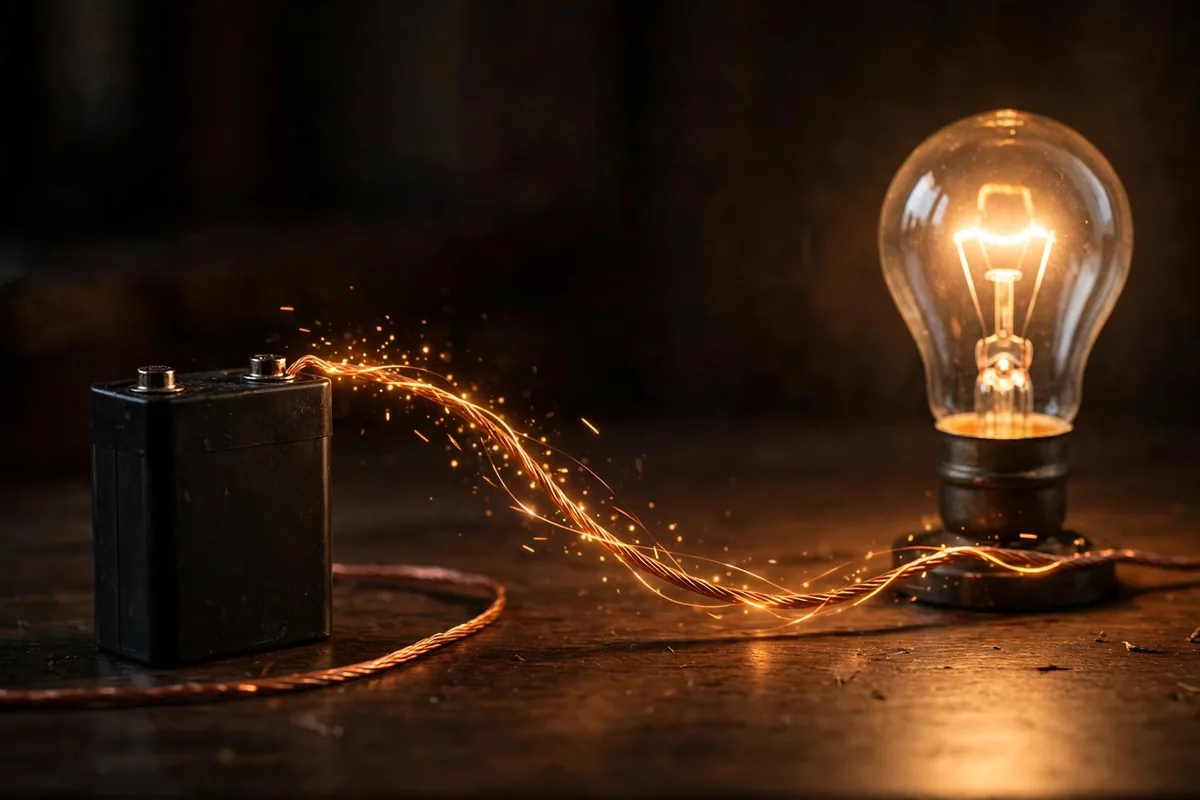
Flip a switch, and the lamp across the room lights up at once. Nothing seems to travel anywhere, yet something has clearly happened inside the wires. So what is electric current, exactly, and why does the light appear instantly if the electrons inside the wire move so slowly?
This article answers both questions in plain language. You will learn the definition of electric current, the formula I = Q/t, the meaning of the ampere, the difference between conventional current and electron flow, and the idea of drift velocity. Two fully worked examples tie everything together, and a list of common mistakes will help you avoid the traps that catch students in exams.
By the end, you will be able to calculate charge from current and time, calculate drift velocity in a copper wire, and explain in one clear sentence why a lamp lights instantly even though its electrons crawl.
What Is Electric Current? Rate of Flow of Charge
Electric current is the rate of flow of charge past a point in a circuit. Whenever charge moves in an organised way through a wire, a current flows. The faster charge passes a chosen point, the larger the current.
To make this idea precise, physicists define current with a simple formula. Let Q stand for the amount of charge, measured in coulombs (C), that passes a point in a time t, measured in seconds (s). Then the current I is:
I = Q / t
In words, current equals charge divided by time. The symbol I is used for current for historical reasons, and its unit is the ampere, shortened to A and named after the French physicist André-Marie Ampère.
One ampere means one coulomb of charge passing a point every second:
1 A = 1 C / s
That definition is worth memorising exactly as written, because exam questions often ask for it in words. A current of 2.0 A, for example, means that 2.0 coulombs of charge pass any chosen point in the wire every second.
The formula I = Q/t can be rearranged, just like any simple equation, to find the other two quantities:
- Charge: Q = I × t
- Time: t = Q / I
Always keep the units matched: current in amperes, charge in coulombs, and time in seconds. If a question gives time in minutes, convert it to seconds before you substitute any numbers.
It helps to picture what is happening inside a metal wire. A metal contains a huge number of free electrons, which are electrons that are not tied to a single atom and can move through the metal. When a battery is connected, it pushes these free electrons around the circuit in an organised stream. That organised stream of charge is the current.
Two finer points matter here. First, the formula I = Q/t gives the average current over the time interval t. If the current changes during that time, the value you calculate is the average, not the value at one particular instant. The instantaneous current is the rate of flow at a single moment, and it is what an ammeter shows when the current is steady.
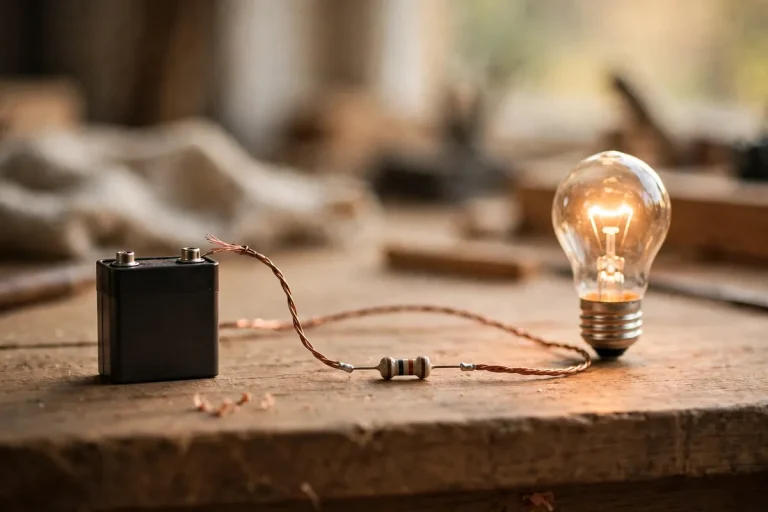
Second, when the current is steady, the same current flows everywhere in a single loop of circuit. This surprises many students. The current entering a lamp is the same as the current leaving it. The lamp uses energy, not current. Charge is conserved: what flows in must flow out. If 2.0 A enters a lamp, 2.0 A leaves it, and the lamp glows because the moving charges transfer energy to it as they pass through.
Here is a summary table of the symbols and units used in this section:
| Symbol | Meaning | Unit |
|---|---|---|
| I | Electric current | Ampere (A) |
| Q | Charge | Coulomb (C) |
| t | Time | Second (s) |
Notice how the whole topic starts from one idea: count how much charge passes a point, divide by how long it takes, and you have the current. Every formula in this article grows out of that single definition.
Conventional Current Versus Electron Flow
Here is a historical quirk that confuses almost every student at first. The direction we call the direction of current is not the direction the electrons actually move in a metal wire. Both directions are used in physics, so you need to know both and never mix them up.
Conventional current is defined as the direction in which positive charge would flow. In a circuit, conventional current flows out of the positive terminal of the battery, around the outside circuit, and back into the negative terminal. Circuit diagrams, ammeter readings, and most textbook explanations all use conventional current.
Electron flow is the direction the electrons themselves actually move. In a metal wire, the charge carriers are free electrons, and electrons carry negative charge. A battery pushes electrons away from its negative terminal and towards its positive terminal. So in a metal wire, electron flow is in the opposite direction to conventional current.
Why does this backwards convention exist? It dates from a time before anyone knew that electrons carry current in metals. Early scientists guessed that current was a flow of positive charge, and the convention stuck. By the time electrons were discovered, every circuit diagram and rule already used conventional current, so physicists kept it. The convention is harmless as long as you are consistent, because all the circuit rules work the same either way.
It is worth noting that electrons are not the only possible charge carriers. In an electrolyte, which is a liquid that conducts electricity, the carriers are ions, which are atoms or groups of atoms that have gained or lost electrons and therefore carry charge. Positive ions move one way and negative ions move the other way, and both movements contribute to the current.
In a metal wire, though, only the free electrons move; the positive metal ions stay fixed in place. For the circuits in school physics, remember the simple rule: conventional current runs from positive to negative around the outside circuit, while electrons in a metal drift from negative to positive.
A useful exam habit is to label both directions on a diagram when a question asks about electron motion. Draw the conventional current arrow first, from the positive terminal around to the negative terminal, then draw the electron flow arrow pointing the other way. That two-second step prevents the single most common sign error in this topic.
Drift Velocity: What It Is and Why It Is Tiny
Drift velocity is the average velocity of the charge carriers in the direction of the current. The word average is doing important work in that definition, as you will see.
Inside a metal, free electrons are never still. Even with no battery connected, they rush around at high speeds in random directions, colliding with the fixed metal ions. This random thermal motion is fast, but because it points in every direction equally, it carries no net charge anywhere. The average velocity is zero, and no current flows.
Connecting a battery changes the picture only slightly. The battery sets up an electric field inside the wire, and that field gives every free electron a tiny extra push in one direction. Between collisions, each electron gains a small velocity along the field, and when it collides, it loses that extra motion and starts again. The result is a slow, steady average drift in one direction, superimposed on the fast random motion. That slow average velocity is the drift velocity, usually written as vd.
Drift velocity is surprisingly small. In a typical copper wire carrying an ordinary current, it is around 10^-4 metres per second, which is roughly a fraction of a millimetre per second. An electron would take minutes to drift a few centimetres along the wire. This is the heart of the lamp puzzle: the electrons crawl, yet the lamp lights at once.
The resolution is that the lamp does not wait for any particular electron to travel from the switch to the lamp. The electric field spreads through the whole circuit almost instantly, at a speed close to the speed of light. Every free electron in the wire, including the ones already inside the lamp filament, starts drifting at essentially the same moment. The light appears at once because the electrons near the lamp begin moving at once, not because an electron has raced all the way from the switch.
So signal speed and drift speed are two different things, and confusing them is the classic error in this topic. The signal, which is the spread of the electric field, travels extremely fast. The carriers themselves drift extremely slowly. Keep those two speeds in separate boxes in your mind, and the puzzle disappears.
Drift velocity is connected to current by a second key formula. Consider a wire of cross-sectional area A. Let n be the number of free electrons per cubic metre of the metal, and let q be the charge on each carrier. For electrons, q is the elementary charge, 1.60 × 10^-19 C, and we use its magnitude here.
In a time t, the electrons drift a distance vd × t along the wire. All the free electrons in that length of wire, a cylinder of volume A × vd × t, pass a chosen point in that time. The number of electrons in that volume is n × A × vd × t, and the total charge is that number multiplied by q:
Q = n × A × vd × t × q
Divide both sides by t, and use I = Q/t, to get the drift velocity formula:
I = n × A × vd × q
Rearranged for drift velocity, it becomes:
vd = I / (n × A × q)
Read the formula as a story. A bigger current needs faster drift, or more carriers, or a fatter wire. A wire with a huge carrier density, like copper, can carry a large current with a tiny drift velocity, because there are so many carriers sharing the job. Copper has about 8.5 × 10^28 free electrons per cubic metre, an enormous number, which is exactly why its drift velocities come out around 10^-4 metres per second.
Here is a summary table for this formula:
| Symbol | Meaning | Typical value or unit |
|---|---|---|
| vd | Drift velocity | Metres per second (m/s) |
| n | Number of free carriers per cubic metre | About 8.5 × 10^28 per m³ for copper |
| A | Cross-sectional area of the wire | Square metres (m²) |
| q | Charge on one carrier | 1.60 × 10^-19 C for an electron |
One practical warning before the worked examples: the area A must be in square metres, and it comes from the radius, not the diameter. If a question gives the diameter, halve it first, convert millimetres to metres, and only then square it. Getting this step wrong is the most common arithmetic error in drift velocity questions, and Worked Example 2 shows the correct sequence in full.
Worked Example 1: Charge from Current and Time
A steady current of 2.0 A flows through a lamp for 30 s. Find the charge passing through the lamp, and state the current leaving the lamp.
Step 1: Write down what you know. Current I = 2.0 A, time t = 30 s, and the unknown is charge Q.
Step 2: Choose the formula. From I = Q/t, rearranged, Q = I × t.
Step 3: Substitute the numbers. Q = 2.0 A × 30 s = 60 C.
Step 4: State the answer with units. The charge passing through the lamp is 60 C.
Step 5: Answer the second part. Current is not used up by a component, so the current leaving the lamp is also 2.0 A, the same as the current entering it. The lamp transfers energy from the moving charges, but the charges themselves continue around the circuit.
As a quick sense check, 2.0 coulombs pass every second, and there are 30 seconds, so 2.0 × 30 = 60 coulombs is exactly the size of answer you should expect. If your answer had come out as 15 C or 240 C, you would know at once that something had gone wrong with the arithmetic.
Worked Example 2: Drift Velocity in a Copper Wire
A current of 1.8 A flows in a copper wire of diameter 0.80 mm. The number of free electrons per cubic metre in copper is 8.5 × 10^28 per m³. Find the electron drift speed, and state its direction relative to conventional current.
Step 1: Write down what you know. Current I = 1.8 A, diameter d = 0.80 mm, carrier density n = 8.5 × 10^28 per m³, and electron charge q = 1.60 × 10^-19 C. The unknowns are the drift velocity vd and its direction.
Step 2: Find the radius, and convert to metres before anything else. The radius is half the diameter: r = 0.80 mm / 2 = 0.40 mm. Convert millimetres to metres: 0.40 mm = 0.40 × 10^-3 m = 4.0 × 10^-4 m.
Step 3: Calculate the cross-sectional area. A = π × r² = π × (4.0 × 10^-4 m)². Squaring gives (4.0 × 10^-4)² = 16 × 10^-8 = 1.6 × 10^-7 m², so A = π × 1.6 × 10^-7 m² ≈ 5.0 × 10^-7 m².
Step 4: Use the drift velocity formula. vd = I / (n × A × q). Substitute: vd = 1.8 / (8.5 × 10^28 × 5.0 × 10^-7 × 1.60 × 10^-19).
Step 5: Work out the denominator. Multiply the numbers: 8.5 × 5.0 × 1.60 = 68. Add the powers of ten: 28 + (-7) + (-19) = 2, so the denominator is 68 × 10² = 6.8 × 10³.
Step 6: Divide. vd = 1.8 / (6.8 × 10³) ≈ 2.6 × 10^-4 m/s.
Step 7: State the direction. The carriers are electrons, which are negatively charged, so they drift in the opposite direction to conventional current.
Answer: the electron drift speed is about 2.6 × 10^-4 m/s, roughly 0.26 millimetres per second, in the direction opposite to conventional current.
Pause on that number. A drift speed of a quarter of a millimetre per second feels absurdly slow for something that lights a lamp instantly, and that is precisely the point. The lamp does not wait for these electrons to cross the room. The electric field reaches the lamp’s filament almost immediately, and the electrons already there start drifting at once. Slow carriers, fast signal: that is the whole puzzle resolved.
Common Mistakes
Students lose marks on this topic in predictable ways. Watch out for each of these traps:
- Confusing drift velocity with signal speed. Drift velocity is the slow average motion of the carriers, around 10^-4 m/s in copper. The signal, the spread of the electric field, travels at nearly the speed of light. A lamp lights instantly because of the signal speed, not because electrons travel fast.
- Using the diameter instead of the radius when calculating the cross-sectional area. Area uses A = πr², so halve the diameter first. Using the diameter directly makes the area four times too large and the drift velocity four times too small.
- Forgetting to convert millimetres to metres, and square millimetres to square metres, before substituting into vd = I/(nAq). The formula needs SI units throughout: area in m², carrier density per m³, and charge in coulombs. Convert first, square second.
- Treating current as something consumed by a lamp or resistor. Current is conserved around a series loop. What a component uses is energy, not charge and not current. The current leaving a lamp equals the current entering it.
- Giving drift velocity the direction of conventional current when the carriers are electrons. Electrons drift opposite to conventional current. If a question asks for direction, that opposite direction is the mark-earning detail.
- Mixing up I = Q/t, which gives the average current over a time interval, with the instantaneous current at one moment. If the current is steady, the two are equal, but if it varies, I = Q/t only gives the average.
- Forgetting that q in I = nAvq is the charge on one carrier, 1.60 × 10^-19 C for an electron, not the total charge Q. Mixing up q and Q is an easy slip when both appear in the same question.
Conclusion
To sum up what is electric current and how it connects to drift velocity: electric current is the rate of flow of charge past a point, measured by I = Q/t, with its rearrangements Q = It and t = Q/I. One ampere is one coulomb per second, 1 A = 1 C/s, and current is conserved around a circuit rather than used up by a component.
The carriers behind the current in a metal are free electrons, which drift opposite to conventional current, and their slow average motion is described by I = nAvq, rearranged as vd = I/(nAq). In copper, with about 8.5 × 10^28 free electrons per cubic metre, that drift speed is only around 10^-4 metres per second.
Remember the one-line distinction that ties the whole article together: current counts how much charge passes per second, while drift velocity describes how slowly the individual carriers move on average. The lamp lights instantly because the electric field spreads through the circuit almost at once, even though the electrons themselves only crawl. If you can state that distinction, use both formulas with correct units, and halve the diameter before finding the area, you have mastered this topic.
Frequently Asked Questions
What is electric current in simple words?
Electric current is the rate of flow of charge past a point in a circuit. When free electrons in a metal wire move in an organised stream, charge passes a chosen point every second, and that flow is the current. It is measured in amperes, where 1 A means 1 C of charge passing per second. Current is not used up by a lamp; the same current leaves as enters.
How do you use the electric current formula I = Q/t to find charge or time?
Use I = Q/t when you know two of the three quantities and need the third. To find charge, rearrange it to Q = I × t, multiplying current in amperes by time in seconds. To find time, use t = Q / I, dividing charge in coulombs by current in amperes. Convert minutes to seconds first, keep units matched, and remember the formula gives average current over the interval.
What is drift velocity, and why is drift velocity so slow in a copper wire?
Drift velocity is the small average velocity of charge carriers in the direction of the current, superimposed on their fast random thermal motion. Without a field, random motion averages to zero and no current flows. Copper is slow because it has about 8.5 × 10^28 free electrons per cubic metre, so a large current is shared among enormous numbers of carriers, giving typical drift speeds around 10^-4 metres per second.
If drift velocity is so slow, why does an electric current light a lamp instantly?
A lamp lights instantly because it does not wait for an electron to travel from the switch to the lamp. When the switch closes, the electric field spreads through the whole circuit almost instantly, close to the speed of light. Every free electron, including those already in the lamp filament, starts drifting at essentially the same moment, so the lamp glows at once despite drift speeds around 10^-4 metres per second.
What is the difference between conventional electric current and electron flow?
Conventional current is the direction positive charge would flow, out of the positive terminal, around the outside circuit, and back into the negative terminal. Electron flow is the actual motion of electrons in a metal wire, from the negative terminal towards the positive terminal. The two directions are opposite because electrons carry negative charge, so in metals electron flow runs against conventional current.
How is electric current related to drift velocity through the formula I = nAvq?
The formula I = nAvq links current to drift velocity through the carriers in the wire. Here n is the number of free carriers per cubic metre, A is the cross-sectional area, vd is the drift velocity, and q is the charge on one carrier. Rearranged, vd = I/(nAq), it shows that a bigger current, fewer carriers, or a thinner wire all mean faster drift, while copper's huge carrier density keeps drift velocity tiny.