What Is Torque? Formula and Real-World Examples
If you have ever wondered what is torque, the answer starts with a stuck jar lid. You grip the lid, twist hard, and nothing moves. Then someone with a better grip, or a rubber pad, twists the same lid and it pops open. The push was similar. The result was not.
A heavy door tells the same story. Push near the handle and it swings easily. Push near the hinge with the same effort and it barely moves. The force did not change. The place where you applied it did.
Torque is the name physicists give to that twisting effect. It explains why a long wrench beats a short one, why a seesaw balances, and why car engines are rated in newton metres as well as horsepower. This article gives you a plain definition, the formula with every symbol explained, two worked calculations, and the everyday examples that make it stick.
What Is Torque in Simple Terms
Torque is the rotational equivalent of force. Force pushes or pulls an object in a straight line. Torque turns an object around a fixed point. When you push a door open, your hand applies a force, and the door turns on its hinges. The turning effect your push creates is torque.
Every torque needs a pivot. The pivot is the fixed point or line that an object turns around. For a door, the pivot is the hinge. For a wheel, the pivot is the axle at its centre. For a bolt, the pivot is the centre of the bolt head. Nothing turns without a pivot, so the first question in any torque problem is always where the pivot sits.
The pivot is not the only thing that matters. The distance from the pivot to the point where the force acts matters just as much. Physicists call this distance the lever arm. Push a door one metre from its hinge and you get a certain turning effect. Push the same door two metres from its hinge with the same force and you get twice the turning effect. That is why door handles sit as far from the hinge as possible, and why nobody puts a doorknob in the middle of the door.
A seesaw shows the same idea from the other side. Two children of different weights can balance if the heavier child sits closer to the pivot and the lighter child sits further away. The torque on each side depends on both the weight and the distance. Balance arrives when the two torques match, not when the two weights match.
Torque also has a direction. A force can turn an object clockwise or counterclockwise, and the two directions are opposites. Tightening an ordinary bolt turns it clockwise. Loosening the same bolt turns it counterclockwise. Physicists treat torque as a vector quantity, which means it has both a size and a direction.
The right hand rule gives the direction a tidy form. Curl the fingers of your right hand in the direction of the rotation and your thumb points in the direction of the torque vector. For a counterclockwise turn, the thumb points out of the page toward you. For a clockwise turn, it points into the page away from you. You will not need this rule for every calculation, but it keeps the sign of a torque straight when two torques oppose each other, which happens often in balance problems.
One more distinction is worth fixing early. Torque is not force. Force is measured in newtons and it changes how fast an object moves in a straight line. Torque is measured in newton metres and it changes how fast an object spins. A strong person can push hard on a door near the hinge and produce almost no torque at all. The force was large. The turning effect was tiny.
The Torque Formula Explained
The torque formula is short, and every symbol in it earns its place. In vector form it reads τ = r × F. The Greek letter tau, τ, stands for torque. The letter r stands for the distance from the pivot to the point where the force acts, measured in metres. The letter F stands for the force, measured in newtons. The cross symbol, ×, means this is a cross product, which is a kind of multiplication that produces a vector.
Most school and college problems use the magnitude form of the formula, which gives the size of the torque. It reads τ = rF sin θ. Here θ, the Greek letter theta, is the angle between the lever arm r and the force F. The sine of that angle decides how much of the force actually contributes to turning.
Think of sin θ as an efficiency factor. When the force acts at 90 degrees to the lever arm, sin 90° equals 1, and the full force goes into turning. When the force acts along the lever arm, at 0 degrees, sin 0° equals 0, and none of the force goes into turning. At any angle in between, only part of the force turns the object. This is why the formula carries a sine term and not just r times F.
The idea behind the sine term has a name of its own: the lever arm. Strictly, the lever arm is r sin θ, the perpendicular distance from the pivot to the line along which the force acts. Picture the force as an arrow. Draw a line from the pivot at right angles to that arrow. The length of that line is the lever arm. Only the perpendicular part of the force has a lever arm worth speaking of, so only that part creates torque.
When the force is perpendicular to the lever arm, the formula simplifies nicely. The angle is 90 degrees, sin 90° equals 1, and the formula becomes τ = rF. This is the version you will use most often, because wrenches, door handles and bicycle pedals are all designed so that the push lands at right angles. Learn the full form first, then use the short form whenever the angle is 90 degrees.
Torque can also be zero while a force is still being applied, and the formula shows exactly when. If the force acts at the pivot, r equals zero, so τ equals zero. Pushing on a hinge does not turn the door, however hard you push. If the force points straight at the pivot or straight away from it, θ equals 0 degrees, sin θ equals zero, and again the torque is zero. Pushing a door straight toward its hinge only presses the door against the frame.
The SI unit of torque is the newton metre, written N·m. It comes straight from the formula: r in metres multiplied by F in newtons. Students often ask why torque is not measured in joules, since a joule is also a newton metre. The reason is that a joule measures energy or work, which are scalar quantities. Torque is a vector quantity that measures a turning effect. Same dimensions, different physical meaning, so physicists keep the units distinct. Writing joules for torque is one of the most common marking errors in exams, and it is easy to avoid once you know the reason.
How to Calculate Torque Step by Step
Torque problems look harder than they are. The same four steps solve nearly all of them.
Step one is to identify the pivot. Find the fixed point the object turns around. For a door it is the hinge. For a wrench it is the centre of the bolt. For a seesaw it is the fulcrum at the centre. Get the pivot wrong and every number that follows is wrong too.
Step two is to measure r, the distance from the pivot to the point where the force acts. Measure it in metres. This is where most arithmetic slips happen. A wrench handle of 40 centimetres is 0.40 metres, not 40 metres and not 40 in the formula. Convert centimetres to metres before you substitute anything.
Step three is to find the angle θ between the lever arm r and the force F. Draw both arrows from the same starting point and measure the angle between them. A perpendicular push means 90 degrees. A push along the handle means 0 degrees. An angled push needs a protractor or a stated value in the question.
Step four is to apply the formula τ = rF sin θ, substituting each value with its unit. Then check the answer. Torque should come out in newton metres. If your value is absurdly large, check whether you used centimetres by mistake. If it is zero, check whether the angle was 0 degrees or the force acted at the pivot. A thirty second unit check catches most errors before they cost marks.
Worked Example 1: Tightening a Bolt with a Wrench
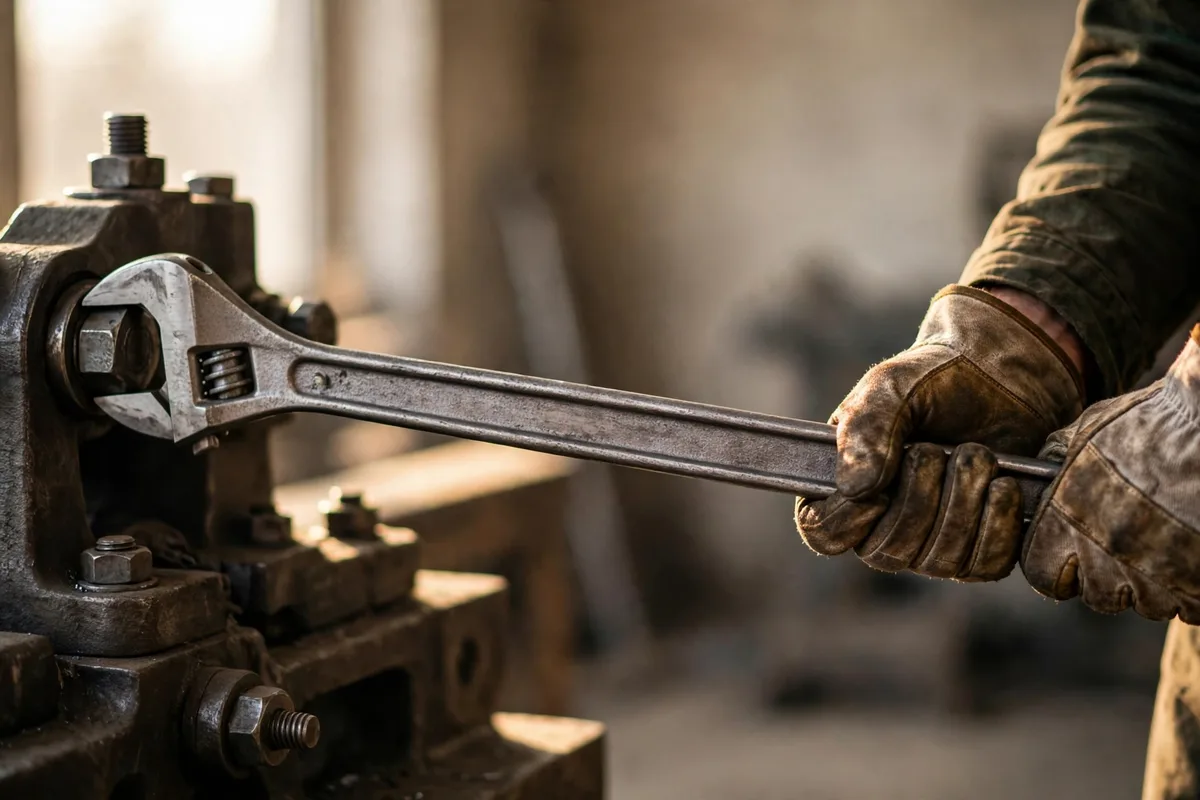
A mechanic tightens a bolt with a wrench that is 0.40 m long. She pushes at the end of the handle with a force of 150 N, at right angles to the handle. What torque does she apply to the bolt?
Start by identifying the pivot. The wrench turns the bolt, so the pivot is the centre of the bolt. The distance from the pivot to the point where the force acts is the length of the wrench, so r = 0.40 m. The force is F = 150 N. The push is perpendicular to the handle, so the angle θ = 90° and sin 90° = 1.
Now substitute into the formula:
τ = rF sin θ
τ = 0.40 × 150 × sin 90°
τ = 0.40 × 150 × 1
τ = 60 N·m
The mechanic applies a torque of 60 N·m to the bolt. The direction is clockwise, which tightens an ordinary right handed bolt.
The same calculation shows why a longer wrench makes the job easier. Suppose the mechanic uses a 0.60 m wrench and wants the same torque of 60 N·m. Rearranging the formula gives F = τ / r, so F = 60 / 0.60 = 100 N. The longer wrench needs only 100 N instead of 150 N. That is the whole point of a long handle: it trades distance for force. The torque stays the same, and the person pushing does less work with their muscles. This is also why a stuck bolt often yields to a longer wrench when a short one fails, and why a cheater bar slipped over a wrench handle can free a bolt that refused to move.
Worked Example 2: Pushing a Door at an Angle
A door is 0.80 m wide. A student pushes it with a force of 25 N, but the push lands at an angle of 60° to the door instead of square on. What torque does the push produce?
Again, start with the pivot. The door turns on its hinge, so the pivot is the hinge. The distance from the pivot to the point of the push is the width of the door, so r = 0.80 m. The force is F = 25 N. The angle between the lever arm and the force is θ = 60°, and sin 60° = 0.866.
Substitute into the formula:
τ = rF sin θ
τ = 0.80 × 25 × sin 60°
τ = 0.80 × 25 × 0.866
τ = 17.3 N·m
The push produces a torque of 17.3 N·m, turning the door counterclockwise if the student pushes from the correct side.
Compare this with a square push. If the same 25 N force acted at 90° to the door, sin 90° would equal 1 and the torque would be τ = 0.80 × 25 × 1 = 20 N·m. The angled push loses 2.7 N·m, roughly 13 percent of the turning effect, because part of the force pushes into the hinge instead of swinging the door. That lost part does no turning at all. It only presses the door against its frame.
This is a practical result, not just an exam trick. When a door feels stiff, people often push harder in the same angled direction. The smarter move is to change the angle. A smaller force applied square on can beat a larger force applied at a shallow angle. The sine term in the formula is the mathematical version of that everyday advice.
Torque in Everyday Life
Once you know what to look for, torque turns up everywhere. The table below lists the places most people meet it first.
| Where you meet it | How torque works there |
|---|---|
| Wrenches and screwdrivers | A long handle gives a large lever arm, so a modest force produces a large torque on a bolt or screw. |
| Car engines | Burning fuel pushes pistons down, and the crankshaft converts that push into torque that turns the wheels. |
| Bicycle pedals and gears | Your foot applies force to the pedal crank, and the gears trade torque for speed or speed for torque. |
| Seesaws | Children balance when the torque on one side equals the torque on the other side. |
| Wind turbines | Wind pushes on long blades far from the hub, creating a large torque that spins a generator. |
| Cranes and counterweights | A heavy counterweight sits close to the pivot while the load hangs far out, so the two torques balance. |
| Opening a jar lid | Your hand grips the rim, far from the centre, and twists. A wider lid gives a longer lever arm. |
Car engines deserve a closer look because they show torque and power working together. Engine makers quote two numbers: torque in newton metres and power in horsepower or kilowatts. Torque tells you how hard the engine can twist the crankshaft. Power tells you how fast it can keep doing that work. A diesel truck engine produces a large torque at low speed, which is what you want for pulling a heavy load from a standstill. A sports car engine produces its power at high speed, which suits fast driving. Neither number alone tells the full story.
Bicycle gears are a torque lesson on two wheels. In a low gear, each turn of the pedals produces a large torque at the back wheel, so climbing a hill feels easier. The cost is speed: the wheel turns slowly. In a high gear, the same pedalling produces less torque but more speed, which suits a flat road. Shifting gears is really choosing how to split your effort between torque and speed.
Wind turbines scale the same idea up enormously. Their blades can be tens of metres long, so even a gentle wind creates a large torque at the hub. The hub turns a generator, and the generator produces electricity. The long blades are not just for catching more wind. They are long lever arms, and a long lever arm multiplies the torque from a given force.
All of these examples rest on one further idea: net torque. When several torques act on one object, they add up, keeping their directions in mind. Torques that turn one way are positive, torques that turn the other way are negative, and the sum is the net torque. If the net torque is zero, the object does not change its rotation. It either stays still or keeps spinning at a steady rate. Physicists call this rotational equilibrium, and it is the turning version of balanced forces. A balanced seesaw is in rotational equilibrium. So is a crane holding its load steady. The full treatment of net torque and equilibrium belongs to a later topic, but the door is already open: once you can calculate one torque, you can add several together.
Common Mistakes When Working with Torque
Torque problems have a small set of traps, and examiners return to them year after year. Here they are, with the fix for each one.
Pushing at the hinge and expecting rotation is the first. A force applied at the pivot has r equal to zero, so the torque is zero no matter how large the force is. If a door will not move, check where you are pushing before you push harder.
Forgetting the sin θ factor is the second. The simplified formula τ = rF only applies when the force is perpendicular to the lever arm. For an angled force, you must use τ = rF sin θ. Using the short form on an angled push overstates the torque, as the door example showed: 20 N·m instead of the correct 17.3 N·m.
Mixing up torque and work is the third. Both are measured in newton metres in terms of dimensions, but torque is measured in newton metres and work is measured in joules. They are different quantities. A torque of 60 N·m is a turning effect, not an amount of energy. Write joules for torque and you lose the mark even if the number is right.
Using centimetres for r without converting is the fourth. The formula needs r in metres. A 40 cm wrench is 0.40 m. Putting 40 into the formula gives an answer one hundred times too large. Convert first, calculate second.
Confusing torque with force itself is the fifth. A large force does not guarantee a large torque. Force times lever arm times sin θ gives the torque, and any one of those three can be zero. A huge push at the pivot, or along the handle, produces no rotation at all.
Ignoring direction and sign is the sixth. When two torques oppose each other, they partly cancel. A clockwise torque of 30 N·m and a counterclockwise torque of 20 N·m give a net torque of 10 N·m clockwise, not 50 N·m. Keep the signs straight, especially in balance problems where the net torque is zero.
Conclusion
Torque is the turning effect of a force about a pivot, and what is torque comes down to three ingredients: how hard you push, how far from the pivot you push, and the angle of the push. The full formula is τ = rF sin θ, where τ is the torque in newton metres, r is the distance from the pivot in metres, F is the force in newtons, and θ is the angle between the lever arm and the force.
When the force is perpendicular, the formula shortens to τ = rF, because sin 90° equals 1. That short form covers most everyday cases, from wrenches to door handles. Three levers increase torque: more force, a longer lever arm, and a more perpendicular push. Change any one of them and the torque changes with it.
The two worked examples show the method in action. A 150 N push on a 0.40 m wrench gives 60 N·m, and a longer wrench reaches the same torque with less force. A 25 N push on a 0.80 m door at 60° gives 17.3 N·m, while the same push at 90° gives 20 N·m. Work through both examples with a calculator, then try changing one number at a time and watch the torque move. That habit, more than memorising the formula, is what makes torque stick.
Frequently Asked Questions
What is torque in simple words?
Torque is the twisting effect of a force about a pivot, and it is the rotational equivalent of force. When you push a door open, your hand applies a force, and the turning effect that push creates is torque. It depends on how hard you push, how far from the pivot you push, and the angle of the push. A push near the handle swings a door easily, while the same push near the hinge barely moves it.
What is the torque formula?
The torque formula is τ = rF sin θ. τ is the torque in newton-metres (N·m), r is the distance from the pivot to where the force acts, in metres, F is the force in newtons, and θ is the angle between the lever arm and the force. The sine term shows how much of the force turns the object. When the force is perpendicular, θ equals 90°, sin 90° equals 1, and the formula simplifies to τ = rF.
How do you calculate torque from force and distance?
You calculate torque from force and distance by identifying the pivot, measuring r in metres, finding the angle θ, and applying τ = rF sin θ. Measure r as the distance from the pivot to the point where the force acts, converting centimetres to metres first. Then substitute the values into the formula and check that the answer comes out in newton-metres (N·m). For a perpendicular push, use τ = rF, since sin 90° equals 1.
What is the unit of torque, and why is torque not measured in joules?
The SI unit of torque is the newton-metre, written N·m. It comes straight from the formula: r in metres multiplied by F in newtons gives newton-metres. Torque is not measured in joules because a joule measures energy or work, which are scalar quantities, while torque is a vector quantity that measures a turning effect. The two quantities share the same dimensions, but they describe different physical things, so physicists keep the units distinct.
What is the difference between torque and force?
Force pushes or pulls an object in a straight line, while torque turns an object around a pivot. Force is measured in newtons and changes how fast an object moves in a straight line. Torque is measured in newton-metres and changes how fast an object spins. Torque depends on the force, the distance from the pivot, and the angle of the push, so a large force near a hinge can produce almost no torque at all.
When is torque zero even if a force is applied?
Torque is zero even when a force is applied if the force acts at the pivot or points straight towards it. If the force acts at the pivot, r equals zero, so τ = rF sin θ gives zero no matter how large the force is. When the force points straight at the pivot, θ equals 0°, sin 0° equals 0, and the torque is zero. Pushing a door towards its hinge only presses the door against the frame.