Mass vs Weight: W = mg Explained with Worked Examples
Step on a bathroom scale and it reads 70 kg. Most people look at that number and say they weigh 70 kg. The scale tells a slightly different story. It measured a mass, and the difference between the two matters the moment you leave Earth or sit an exam.
Mass vs weight is one of those pairs that physics teachers return to again and again, because everyday language blurs them together. Shops sell potatoes by the kilogram. Gyms talk about losing weight in kilograms.
Nobody in daily life stops to correct any of this, and for buying potatoes it hardly matters. In physics it matters a great deal, because mass and weight are different quantities with different units, and mixing them up turns a simple calculation into a wrong answer.
This article settles the difference once. You will learn what mass is, what weight is, where the weight formula W = mg comes from, and how to use it. Two worked examples carry the numbers all the way through, one on Earth and one on the Moon, so you can see exactly how the same person can weigh 686 N in one place and 113.4 N in another while nothing about their body changes at all.
What Is Mass?
Mass is the amount of matter in an object. A bag of flour has a mass. A car has a mass.
You have a mass. Count the atoms, add up what they amount to, and you have the mass. It is a property of the object itself, and it goes wherever the object goes.
Mass is also a measure of inertia. Inertia is the resistance of an object to a change in its motion. Push a shopping trolley and it rolls away easily.
Push a loaded van with the same effort and it barely moves. The van has more mass, so it has more inertia, so it resists your push more strongly. This is the same idea that sits inside Newton’s second law, F = ma.
For a given force F, a larger mass m gives a smaller acceleration a. Mass is the number that decides how much an object fights back when a force tries to speed it up, slow it down, or turn it.
Mass is a scalar quantity. That means it has a size but no direction. You would never say a mass of 70 kg points north. It just is 70 kg.
Its unit is the kilogram, written kg. Smaller masses use grams, and 1000 g make 1 kg. That conversion turns up constantly in exam questions, and it is worth fixing in your head now, because W = mg only works when the mass is in kilograms.
The key fact about mass is that it does not change with location. Your mass on Earth is your mass on the Moon, on Mars, and floating in deep space far from any planet. Travel does not add atoms to your body or take them away. Nothing about moving somewhere else changes how much matter you are made of.
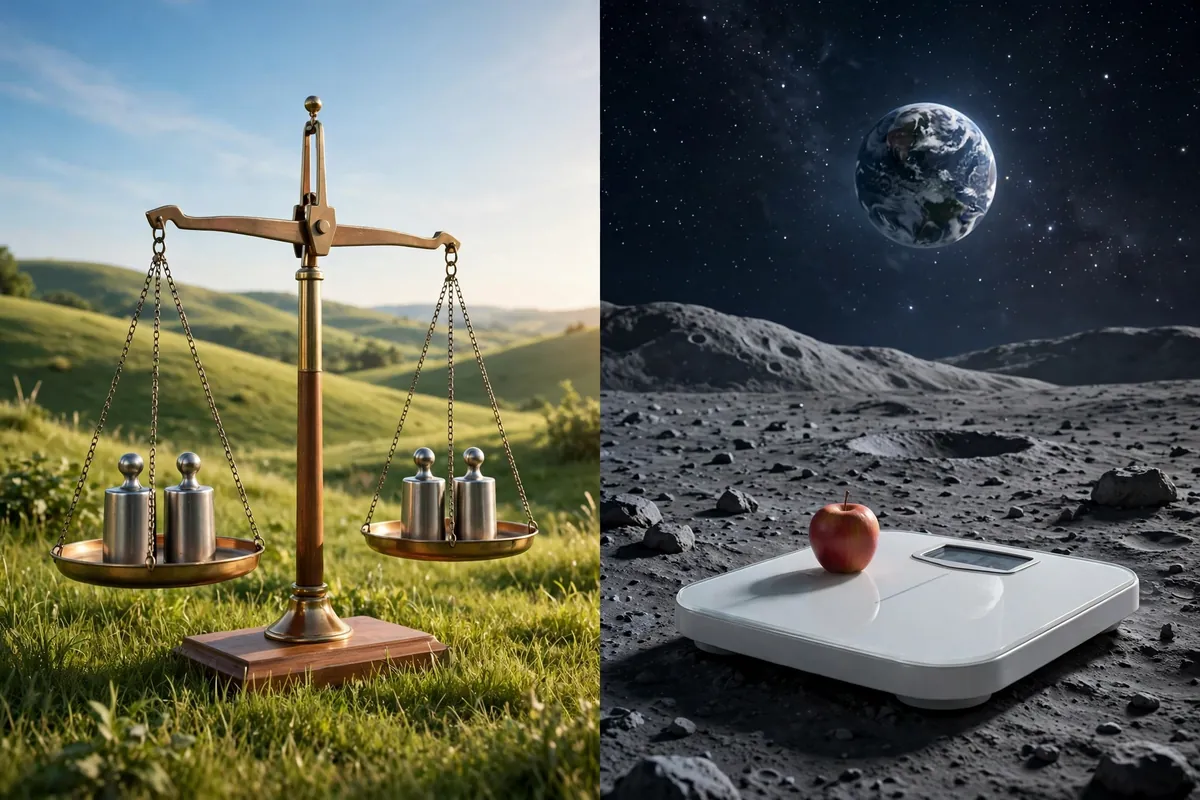
Scientists measure mass with a balance. A beam balance compares an unknown mass with known masses until the beam sits level. Gravity pulls on both sides at once, so the comparison still works on the Moon.
A balance on the Moon would give the same reading as a balance on Earth for the same object, because it compares masses against each other rather than measuring a force. That is a useful clue.
If an instrument gives the same reading on the Moon as on Earth, it is measuring mass. If the reading changes, it is measuring something else.
Mass also appears in more of physics than this one topic. It sits in momentum, p = mv. It sits in kinetic energy, E = 1/2 mv². It sits in gravitational potential energy, E = mgh.
Every time you see m in a formula, it is this same quantity, the amount of matter, doing its job. Learning it properly here pays off across the whole subject.
What Is Weight?
Weight is a force. More precisely, weight is the gravitational force that a planet exerts on a mass. Earth pulls you down. That pull is your weight.
The Moon pulls you down too, but more weakly, so your weight on the Moon is smaller. Your weight depends on two things acting together: your body and the planet you happen to be standing on.
Weight is a vector quantity. It has a size and a direction. Its direction is always toward the centre of the planet pulling on you, which for everyday purposes means straight down.
Its unit is the newton, written N, the same unit as every other force. A weight of 686 N is a force of 686 N pulling downward.
Giving a weight in kilograms is simply wrong, in the same way that giving a distance in seconds would be wrong. The units belong to different quantities.
Scientists measure weight with a spring scale, also called a force meter. Hang a mass from the spring and gravity stretches it. A stronger pull stretches it further.
The scale reads the force, in newtons. A bathroom scale works on the same principle, with a spring or a load cell inside that compresses under your weight.
The dial shows kilograms only because the maker divided the force by 9.8 for you, assuming you are standing on Earth. Take that same bathroom scale to the Moon and it would read about one sixth of your Earth reading, because the force stretching its spring has dropped to one sixth, even though your mass has not changed at all.
The formula for weight is W = mg. Each letter stands for one quantity. W is the weight, in newtons.
m is the mass, in kilograms. g is the gravitational field strength, in newtons per kilogram, N/kg. On Earth g is 9.8 N/kg.
On the Moon g is 1.62 N/kg. The formula says something simple. Your weight equals your mass multiplied by the strength of gravity where you are standing.
Gravitational field strength g deserves a closer look, because it carries two sets of units that mean the same thing. You will see g written as 9.8 m/s² and also as 9.8 N/kg. Both describe the same number on Earth.
The m/s² version comes from thinking of g as an acceleration, the acceleration of a freely falling object. The N/kg version comes from thinking of g as a force per unit mass, how many newtons of pull each kilogram of mass feels.
The two are equivalent, and you can use whichever form the question gives you. In W = mg, g in N/kg multiplies a mass in kg and leaves newtons, which is exactly what a weight should be.
One more point about g is worth remembering. Its value changes from planet to planet, and even slightly from place to place on Earth, because it depends on the mass of the planet and on your distance from its centre. On Earth it is 9.8 near the surface.
On the Moon it is 1.62. On Jupiter it would be about 25. The formula W = mg stays the same everywhere. Only the value of g changes, and the weight follows it.
Mass vs Weight: The Key Differences
Put side by side, the contrast is sharp. Mass belongs to the object. Weight belongs to the interaction between the object and a planet. Mass is measured in kilograms.
Weight is measured in newtons. Mass is a scalar with no direction. Weight is a vector pointing down.
Mass stays the same wherever you go. Weight changes the moment g changes.
| Property | Mass | Weight |
|---|---|---|
| Definition | Amount of matter in an object | Gravitational force on that object |
| Symbol | m | W |
| Unit | Kilogram (kg) | Newton (N) |
| Scalar or vector | Scalar | Vector, toward the planet’s centre |
| Changes with location | No, same everywhere | Yes, it follows g |
| Measured with | Balance | Spring scale or force meter |
| Zero in deep space | No, mass remains | Yes, no gravity means no weight |
If you remember one line from this section, make it this one. Mass is portable and weight is local. You carry your mass with you.
Your weight depends on where you are standing. An astronaut in orbit still has exactly the same mass she had on the launch pad. Her weight, though, is effectively zero while she floats, because she is in free fall around Earth and no floor pushes back on her.
People call this weightlessness, and the name is accurate. It is the weight that has gone, not the mass. She still needs the same force to change her motion, because her inertia has not changed.
That last example also clears up a confusion that exam papers love to test. An object can be weightless without being massless. Massless and weightless are different words for a reason.
Light has no rest mass in the classical sense, yet it is not what anyone means by weightless. An astronaut is weightless and still has plenty of mass. Keep the two words apart and a whole family of trick questions falls flat.
Where Does W = mg Come From?
The weight formula W = mg comes straight out of Newton’s second law, F = ma, in one short step. That law says the force on an object equals its mass multiplied by its acceleration. Now think about an object falling freely, with nothing holding it up and air resistance ignored.
The only force acting on it is its own weight, so F is the weight W. Its acceleration is the acceleration due to gravity, which is g.
Put those two substitutions into F = ma and you get W = mg. The formula is Newton’s second law wearing the clothes of a falling object.
This derivation explains something that surprises most students the first time they meet it. Drop a hammer and a feather on the Moon, where there is no air to slow the feather, and they hit the ground together. The hammer weighs far more than the feather, so gravity pulls on it with a far larger force.
But the hammer also has far more mass, so it needs far more force to accelerate it at the same rate. Go back to a = F/m. For the hammer, F is mg, so a = mg/m, and the m cancels to leave a = g.
The same cancellation happens for the feather. Every mass, heavy or light, falls with the same acceleration g, because the extra weight of a heavier object is exactly matched by its extra inertia.
The formula W = mg carries both facts at once. Weight grows with mass, and so does the resistance to acceleration, and the two cancel in free fall.
The formula also rearranges, and the rearrangements are worth learning as a set rather than deriving under exam pressure. If you know the weight and the gravitational field strength and need the mass, use m = W/g.
If you know the weight and the mass and need the field strength, use g = W/m. All three versions say the same thing in different clothes, and exam questions use all three.
A question that gives you a weight of 490 N on Earth and asks for the mass is a m = W/g question. A question that gives you a weight of 162 N for a 100 kg mass and asks where the object is will lead you to g = W/m = 1.62 N/kg, which is the Moon.
Notice what the rearranged forms reveal about g. Divide a weight in newtons by a mass in kilograms and you get newtons per kilogram, which is why g carries those units. The number 9.8 N/kg on Earth means every kilogram of mass feels a pull of 9.8 N.
A 70 kg person feels 70 lots of 9.8 N, which is 686 N. That is all W = mg is doing. It counts how many kilograms there are and multiplies by the pull on each one.
Worked Example 1: Weight of a Person on Earth
Here is the first worked example, done the way an examiner wants to see it. The pattern is fixed, and it works for every W = mg question.
Write down what you are given. Write down the formula. Substitute the numbers. Give the answer with units.
A person has a mass of 70 kg. Calculate their weight on Earth, where g = 9.8 m/s².
Given: mass m = 70 kg, gravitational field strength g = 9.8 m/s².
Formula: W = mg.
Substitution: W = 70 × 9.8.
Answer: W = 686 N.
The person weighs 686 N on Earth. Saying the person weighs 70 kg would be wrong. 70 kg is the mass. The weight is 686 N, a force, and it needs the newton unit to show that.
If the question had asked for the mass instead, 70 kg would have been the answer, and no calculation would have been needed at all. That is the whole confusion in one pair of numbers. Same person, same body, two different quantities, two different units.
It is worth pausing on the size of the answer, because 686 N surprises people who have only ever thought in kilograms. Nearly seven hundred newtons sounds like a lot.
It is the force Earth exerts on an adult every moment of the day, and the floor pushes back with an equal force, which is why you do not sink through it. You feel that push as the pressure of the floor on your feet.
When you stand on a scale, the scale measures that push and converts it to kilograms for display. The 686 N is real, and it is there whether or not anyone measures it.
Worked Example 2: The Same Mass on the Moon
Now take the same person to the Moon. Nothing about their body changes. The only number that changes is g, and the weight follows it.
The same person, mass 70 kg, travels to the Moon, where g = 1.62 m/s². Calculate their weight on the Moon.
Given: mass m = 70 kg, gravitational field strength g = 1.62 m/s².
Formula: W = mg.
Substitution: W = 70 × 1.62.
Answer: W = 113.4 N.
On the Moon the person weighs 113.4 N, against 686 N on Earth. Divide 686 by 113.4 and you get about 6. The Moon weight is roughly one sixth of the Earth weight, which matches the ratio of the two values of g, 9.8 divided by 1.62, which is also about 6.
This is why astronauts on the Moon could hop around in heavy suits and lift rocks that would have been far too heavy on Earth. Their muscles were moving the same mass, so the inertia was unchanged, but the downward pull they had to fight was six times weaker.
The mass, meanwhile, stayed exactly 70 kg. No step in the calculation changed it, because no step could. Travelling to the Moon does not remove matter from a body.
A balance on the Moon would still read 70 kg for this person, while a spring scale would read 113.4 N. Two instruments, two quantities, two answers, and both correct.
That contrast is the cleanest test of whether the difference has sunk in. If someone asks what changes on the Moon, the answer is the weight, because g changed. The mass never moves.
Students sometimes ask whether the person would feel lighter on the Moon. Yes, in the everyday sense of the word, because feeling light is about the force your body has to support, and that force has dropped to 113.4 N.
Your legs carry less load. Jumping takes less effort to leave the ground, though landing still needs care, because your mass and therefore your momentum are unchanged. Weight and mass split apart in exactly this way.
One governs how hard gravity pulls. The other governs how hard it is to change your motion. On the Moon the first drops and the second stays put.
Common Mistakes
The most common mistake is also the most everyday one. People say “I weigh 70 kg” and write kg as the unit of a weight. In an exam that answer loses the mark.
70 kg is a mass. A weight needs newtons. Whenever you write an answer, check the unit first. If the question asked for a weight and your answer is in kg, something has gone wrong before you even check the number.
A second mistake is putting grams straight into W = mg. The formula needs mass in kilograms. A mass of 500 g must become 0.5 kg before it goes anywhere near the formula.
Students who skip that conversion get an answer one thousand times too large and often do not notice, because the working looks tidy. Convert grams to kilograms first, every time, and the error disappears.
A third mistake is mixing two values of g inside one question. Some textbooks round g to 10 m/s² for rough work, and Earth questions usually use 9.8. Both are acceptable if the question allows them, but they are not interchangeable inside a single calculation.
Pick the value the question gives you and use it all the way through. Using 9.8 in one step and 10 in another gives an answer that matches neither convention.
A fourth mistake is thinking mass changes on the Moon or in orbit. It does not. Mass is the amount of matter, and moving somewhere else changes nothing about how much matter there is.
Weight changes because g changes. If a question asks what happens to mass on the Moon, the answer is nothing. That one word is worth a mark, and it is the mark most often lost on this topic.
A fifth mistake is confusing weight with the normal force. Weight is mg, the pull of gravity. The normal force is the push of a surface, and it equals mg only when the surface is flat and still.
Stand in a lift that accelerates upward and the floor pushes harder than mg, so the scale reads more than your weight, even though your weight has not changed. Stand in a lift that accelerates downward and the scale reads less.
The scale reads the normal force, not the weight. The two match only in the simple case, and exam questions about lifts exist precisely to catch students who assume they always match.
A sixth mistake is forgetting that weight is a vector. It has a direction, toward the centre of the planet.
That direction matters as soon as a question involves forces in more than one direction, because vectors add by direction as well as size. Mass never needs a direction, so students who treat weight the same way lose the direction and with it the physics. Whenever you draw a weight arrow on a diagram, point it straight down toward the centre of Earth.
Conclusion
The mass vs weight confusion survives because everyday language treats the two as one thing. Physics does not, and now you can see why. Mass is the amount of matter in an object, measured in kilograms, and it never changes with location. Weight is the force of gravity on that mass, measured in newtons, and it changes whenever g changes.
Three formulas carry the whole topic. W = mg gives the weight from the mass and the gravitational field strength. m = W/g gives the mass from the weight. g = W/m gives the field strength from the weight and the mass.
On Earth g is 9.8 m/s², so a 70 kg person weighs 686 N. On the Moon g is 1.62 m/s², so the same person weighs 113.4 N with the mass still 70 kg.
Carry one habit out of this article and the marks will follow. Check the unit before you trust the number. Kilograms mean mass. Newtons mean weight.
Get that right, convert grams to kilograms, keep one value of g through the whole question, and W = mg becomes one of the most reliable formulas in the subject.
Frequently Asked Questions
What is the difference between mass and weight?
Mass is the amount of matter in an object, measured in kilograms, while weight is the gravitational force on that mass, measured in newtons. Mass is a scalar that stays the same everywhere, but weight is a vector pointing toward the planet's centre and changes when g changes. Mass is measured with a balance; weight is measured with a spring scale.
What is the formula for weight, and what does W = mg mean?
The formula for weight is W = mg, where W is weight in newtons, m is mass in kilograms, and g is gravitational field strength in newtons per kilogram. On Earth g is 9.8 N/kg, so a 70 kg person weighs 70 × 9.8 = 686 N. The formula means weight equals mass multiplied by the strength of gravity where you are standing.
Why is my weight different on the Moon but my mass stays the same?
Your weight changes on the Moon because weight is W = mg and g is only 1.62 m/s² there, compared with 9.8 m/s² on Earth. A 70 kg person weighs 70 × 1.62 = 113.4 N on the Moon, about one sixth of 686 N on Earth. Your mass stays 70 kg because mass is the amount of matter in your body, and travelling does not add or remove matter.
How do I calculate weight using W = mg?
Write down what you are given, write the formula W = mg, substitute the numbers, and give the answer in newtons. For a 70 kg person on Earth, W = 70 × 9.8 = 686 N. Always convert the mass to kilograms first, since grams would make the answer one thousand times too large, and use one value of g through the whole calculation.
Can mass and weight ever be the same number?
No, mass and weight are never the same quantity, even if the numbers happen to match in a particular case. Mass is measured in kilograms and weight in newtons, so a mass of 70 kg and a weight of 686 N describe the same person but different quantities. A weight value in kilograms is simply wrong, and an exam answer with the wrong unit loses the mark.
What units are mass and weight measured in, and why is weight in newtons?
Mass is measured in kilograms (kg) and weight in newtons (N). Weight is measured in newtons because weight is a force, and the newton is the unit of force. Giving a weight in kilograms is wrong in the same way that giving a distance in seconds would be wrong, because the units belong to different quantities, so always check the unit before trusting the number.