How Einstein Explained the Photoelectric Effect
In 1887, Heinrich Hertz noticed something odd. When ultraviolet light fell on a metal plate, the plate threw off tiny charged particles. Shine a bright red lamp on the same plate and nothing happened. Turn the red lamp down, switch on a faint ultraviolet lamp, and electrons flew off at once. Brightness lost. Colour won.
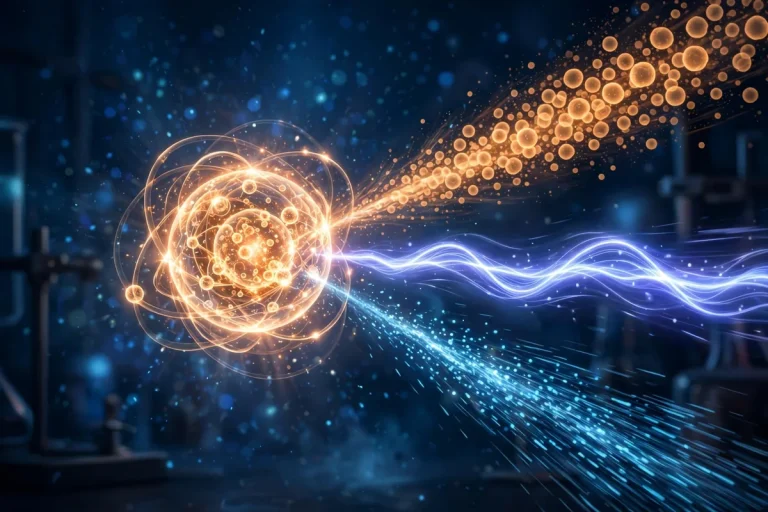
That result is the photoelectric effect: light knocking electrons out of a clean metal surface in a vacuum. The name sounds technical, but the experiment is simple, and it broke the best physics of its day. The wave theory of light had explained reflection, refraction and interference for a century, yet it could not explain what Hertz saw, or what Philipp Lenard measured in more detail fifteen years later. Einstein fixed it in 1905 with one idea. Light travels in packets called photons, and each packet hands all its energy to a single electron. That paper, not relativity, won him the Nobel Prize in 1921.
What Is the Photoelectric Effect?
The photoelectric effect is the ejection of electrons from a metal surface when light of high enough frequency falls on it. The ejected electrons are called photoelectrons. The effect only shows up cleanly under the right conditions, so physicists study it inside a vacuum tube called a photocell.
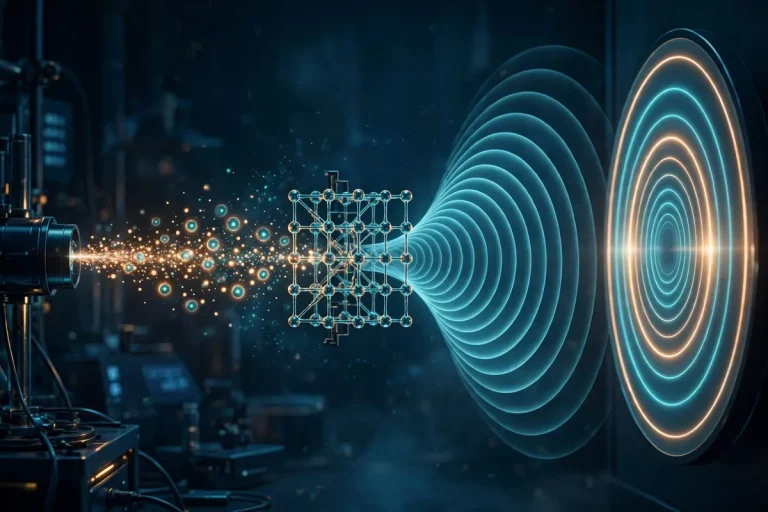
A photocell is a glass tube with the air pumped out. Inside it sits a metal plate, the cathode, wired to the negative side of a circuit. Opposite it sits a collector plate, the anode. Light enters through a window and strikes the cathode. If the light can knock electrons free, they cross the gap to the anode, and a tiny current flows. An ammeter measures that current, and a variable voltage supply can push back against the electrons to find out how much energy they carry.
Hertz stumbled on the effect in 1887 while testing radio waves. He saw that ultraviolet light made sparks jump more easily across a gap. Lenard took the work further in 1902. He measured the energy of the ejected electrons and found it did not behave the way wave theory said it should. His results sat unexplained for three years until Einstein published his photon paper in 1905.
To follow the rest of this article you need one quantity: the energy of a single photon. Max Planck had already proposed in 1900 that light energy comes in discrete lumps, but he treated the idea as a maths trick for black body radiation. Einstein took it literally. A photon of frequency f carries energy
E = hf
where h is Planck’s constant, h = 6.626 × 10⁻³⁴ J·s. In electronvolts, a unit that suits atomic scale energies far better than joules, h = 4.14 × 10⁻¹⁵ eV·s. Because frequency and wavelength are linked by f = c/λ, photon energy can also be written as
E = hc/λ
where c is the speed of light, 3.00 × 10⁸ m/s. Short wavelength means high frequency, and high frequency means a more energetic photon. That single fact runs the whole story.
One more unit note before we start calculating. An electronvolt is the energy an electron gains when it moves through a potential difference of one volt. One electronvolt equals 1.602 × 10⁻¹⁹ J. Exam questions mix joules and electronvolts freely, and the conversion is where most marks are lost. Keep 1 eV = 1.602 × 10⁻¹⁹ J in mind whenever a question gives you a value in one unit and asks for an answer in the other.
Three Observations the Wave Model Could Not Explain
Classical physics treated light as a continuous wave. A wave spreads its energy smoothly over its whole front, and a brighter wave carries more energy. That picture made three clear predictions about electrons knocked out of a metal. All three were wrong.
First, there is a threshold frequency. Below a certain frequency, called the threshold frequency f0, no electrons escape at all, however bright the light is and however long you wait. A red lamp ten times brighter than the Sun would still eject nothing from a plate whose threshold sits in the ultraviolet. Wave theory said otherwise. A bright wave carries plenty of energy, so given enough brightness it should always manage to shake an electron loose. It never does.
Second, emission is instant. Even very dim light above the threshold ejects electrons the moment it hits the plate, with no measurable delay. The wave picture said a dim wave would need time to build up enough energy in one electron, like a slow drip filling a cup. Measurements put the delay below a billionth of a second. There is no build up. The electron leaves at once or not at all.
Third, the maximum kinetic energy of the ejected electrons depends on the frequency of the light, not on its intensity. Turn up the brightness of light above the threshold and you get more electrons per second, so the photocurrent rises, but the fastest electrons do not get any faster. Change the colour instead, moving toward shorter wavelengths, and the fastest electrons speed up. Wave theory predicted the opposite: brighter light should mean more energetic electrons, and frequency should make no difference.
Each observation on its own is strange. Together they rule out the wave picture for this experiment. Energy arrives in lumps, and each lump either has enough energy to free an electron or it does not.
Einstein’s Photon Explanation
Einstein’s proposal was blunt. Light also travels as a stream of discrete packets, photons, each carrying energy E = hf. When a photon meets an electron in the metal, the exchange is all or nothing. The photon gives its entire energy to one electron. It cannot split its energy between two electrons, and it cannot hand over half now and half later.
An electron inside a metal needs a minimum amount of energy to escape the surface. That minimum is the work function, written with the Greek letter phi, φ. The work function is a property of the metal itself. It takes more energy to pull an electron out of copper than out of caesium, because the atoms hold their electrons differently.
Now the three puzzles fall into place. A photon with energy below the work function cannot free an electron, no matter how many photons arrive. That is the threshold. The threshold frequency f0 is the frequency at which a photon’s energy exactly equals the work function:
φ = hf0, so f0 = φ/h
Below f0, every photon is too weak, and the plate stays quiet. Above f0, each photon has energy to spare. The spare energy becomes the electron’s kinetic energy. Einstein wrote this as the photoelectric equation:
hf = φ + Kmax, or Kmax = hf − φ
Kmax is the maximum kinetic energy of an ejected electron. It is a maximum, not a typical value, because some electrons lose energy in collisions on their way out of the metal and leave with less. The fastest ones lose nothing, and they carry exactly hf − φ.
That one equation explains all three observations. Kmax depends on frequency because hf is the only term that changes when you change the colour. Intensity changes the number of photons, and so the number of electrons, but each photon still carries the same hf, so the fastest electrons keep the same energy. And because a single photon delivers its energy in one hit, there is no waiting for energy to accumulate. Emission is instant.
Physicists measure Kmax with the stopping potential. In the photocell, a voltage can be applied to push back against the escaping electrons. Turn the retarding voltage up until even the fastest electrons cannot reach the anode and the current drops to zero. That voltage is the stopping potential, Vs. At that point the electric potential energy needed to stop an electron exactly equals its maximum kinetic energy:
eVs = Kmax
where e is the charge on an electron. If Kmax is measured in electronvolts, the stopping potential in volts is numerically the same as Kmax in electronvolts. A Kmax of 1.0 eV means a stopping potential of 1.0 V. That shortcut saves a lot of arithmetic in exams, and it is worth remembering.
The work function varies from metal to metal. Some common values:
| Metal | Work function φ (eV) |
|---|---|
| Caesium | 1.9 to 2.1 |
| Sodium | 2.36 |
| Copper | 4.5 |
Caesium gives up electrons easily, which is why it turns up in photocells and light sensors. Copper holds on much harder, so it needs ultraviolet light before anything happens. This table is the reason exam questions always name the metal. The answer depends on it.
The equation also gives a neat graph. Plot Kmax against frequency f and you get a straight line. The gradient is Planck’s constant h. The line crosses the frequency axis at f0, the threshold frequency, and it crosses the energy axis at −φ. Every metal gives a line with the same slope but a different intercept, because h is universal and φ is not. Robert Millikan measured those lines carefully in 1916 and found exactly the slope Einstein had predicted. Millikan had set out to prove Einstein wrong. His own data forced him to admit Einstein was right. Five years later, Einstein received the Nobel Prize for this work.
Worked Example 1: UV Light on Copper
Ultraviolet light of wavelength 250 nm strikes a copper surface. The work function of copper is φ = 4.5 eV. Find the maximum kinetic energy of the ejected electrons.
Step 1: Find the frequency of the light. Use f = c/λ. The wavelength is 250 nm, which is 250 × 10⁻⁹ m.
f = c/λ = 3.00 × 10⁸ / 250 × 10⁻⁹ = 1.2 × 10¹⁵ Hz
Step 2: Find the energy of one photon. Use E = hf. Planck’s constant in electronvolts is h = 4.14 × 10⁻¹⁵ eV·s, which keeps the answer in electronvolts and avoids a messy conversion.
hf = 4.14 × 10⁻¹⁵ × 1.2 × 10¹⁵ = 4.96 eV
Each photon carries 4.96 eV. That is more than the work function of 4.5 eV, so electrons will be ejected.
Step 3: Apply Einstein’s photoelectric equation, Kmax = hf − φ.
Kmax = 4.96 − 4.5 = 0.46 eV
The fastest electrons leave the copper with a maximum kinetic energy of 0.46 eV. Most leave with less, because they lose energy in collisions inside the metal, but none leaves with more.
Notice how tight the margin is. The photon carries only 0.46 eV more than the escape cost. If the wavelength were a little longer, the photon energy would fall below 4.5 eV and nothing would come out at all, however bright the lamp. Copper’s high work function is why ordinary visible light does nothing to it.
Worked Example 2: Stopping Potential for Sodium
Light of frequency 8.0 × 10¹⁴ Hz strikes a sodium surface. The work function of sodium is φ = 2.3 eV. Find the maximum kinetic energy of the ejected electrons and the stopping potential.
Step 1: Find the energy of one photon. Use E = hf with h = 4.14 × 10⁻¹⁵ eV·s.
hf = 4.14 × 10⁻¹⁵ × 8.0 × 10¹⁴ = 3.3 eV
Step 2: Apply Einstein’s photoelectric equation, Kmax = hf − φ.
Kmax = 3.3 − 2.3 = 1.0 eV
Step 3: Find the stopping potential from eVs = Kmax. Since Kmax is 1.0 eV, the stopping potential is
Vs = 1.0 V
A retarding voltage of 1.0 V is enough to stop even the fastest photoelectrons from sodium under this light.
Now check what happens below the threshold. The threshold frequency for sodium is f0 = φ/h = 2.3 / 4.14 × 10⁻¹⁵, which is about 5.6 × 10¹⁴ Hz. Light below that frequency carries less than 2.3 eV per photon, so no electron escapes, however bright the light is. A floodlight at 5.0 × 10¹⁴ Hz would produce zero current. A faint lamp at 8.0 × 10¹⁴ Hz produces current at once. Frequency decides. Intensity only decides how many electrons come out once the frequency is high enough.
Common Mistakes to Avoid
These six traps catch students every exam season. Each one comes from mixing up two ideas that sound similar but behave differently.
- Brighter light does not give photoelectrons more energy. Intensity changes the number of photons arriving per second, so it changes the number of electrons ejected and the size of the photocurrent. The maximum kinetic energy of each electron depends on frequency alone.
- Do not use a negative Kmax below the threshold. If hf is less than φ, the equation Kmax = hf − φ gives a negative number, but a negative kinetic energy has no meaning here. Below f0 there is simply no emission, and the equation does not apply.
- Do not mix up photon energy and kinetic energy. The photon’s energy is hf. That is what the light delivers. Kmax is what is left after the work function is paid. They are equal only in the imaginary case where φ is zero.
- Watch the units. Convert between joules and electronvolts with 1 eV = 1.602 × 10⁻¹⁹ J, and convert between wavelength and frequency with f = c/λ before you use E = hf. A wavelength in nanometres used as if it were in metres will throw the answer out by a factor of a billion.
- The work function is a property of the material, and it differs from metal to metal. Caesium, sodium and copper have different values, so a question that names the metal is giving you a number you must use. Check the value before you calculate.
- Einstein did not win the Nobel Prize for relativity. He won it in 1921 for his explanation of the photoelectric effect. It is one of the most repeated wrong answers in physics exams, and it is easy marks if you remember it.
The Four Formulas to Keep
The photoelectric effect forced physics to accept that light behaves as particles as well as waves. One experiment, three failed predictions, and a single equation that fixed all of them. That equation opened the door to quantum mechanics, and it still runs the light sensors in cameras, solar panels and automatic doors today.
Keep these four formulas together and most photoelectric effect questions solve themselves. Photon energy is E = hf = hc/λ. Einstein’s photoelectric equation is Kmax = hf − φ. The threshold frequency is f0 = φ/h, with the work function given by φ = hf0. And the stopping potential follows from eVs = Kmax. Learn what each symbol means, watch the units, and check the threshold first. If the light is below f0, the answer is no electrons, and no amount of brightness will change it.
Frequently Asked Questions
What is the photoelectric effect in simple terms?
The photoelectric effect is the ejection of electrons from a clean metal surface when light of high enough frequency falls on it. The ejected electrons are called photoelectrons. Inside a vacuum tube called a photocell, the freed electrons flow to a collector plate and form a tiny current. Heinrich Hertz first noticed the effect in 1887, and Philipp Lenard measured it in 1902. Only light above a certain frequency can free electrons at all.
How did Einstein explain the photoelectric effect with photons?
Einstein proposed in 1905 that light travels as a stream of discrete packets called photons, each carrying energy E = hf. When a photon meets an electron, it gives its entire energy to that one electron in one hit. If the photon energy is below the work function φ, no electron escapes. If it is above φ, the spare energy becomes the electron’s kinetic energy. This explains the threshold frequency, instant emission and why Kmax depends on frequency.
What is the photoelectric equation Kmax = hf − φ and what does each symbol mean?
Einstein’s photoelectric equation is Kmax = hf − φ, which states that the maximum kinetic energy of an ejected electron equals the photon energy minus the work function. Kmax is the maximum kinetic energy of a photoelectron. h is Planck’s constant, 6.626 × 10⁻³⁴ J·s, and f is the frequency of the incoming light, so hf is the energy of one photon. φ is the work function, the minimum energy needed to free an electron from the metal.
What is the work function in the photoelectric effect, and how is it related to the threshold frequency f0 = φ/h?
The work function φ is the minimum energy needed to free an electron from the surface of a particular metal. Its value varies by metal: caesium is near 2 eV, sodium is 2.36 eV and copper is 4.5 eV. The threshold frequency f0 is the frequency at which a photon’s energy exactly equals the work function, so f0 = φ/h. Below f0, no photon carries enough energy and no electrons are ejected, however bright the light is.
Why does increasing the intensity of light not increase the maximum kinetic energy of photoelectrons?
Increasing the intensity adds more photons per second, but it does not change the energy of each photon. Each photon still carries energy hf, which depends only on frequency, so the fastest electron still gains at most Kmax = hf − φ. Brighter light ejects more electrons per second, so the photocurrent rises, but the maximum kinetic energy stays the same. Only light of higher frequency gives each photon more energy and raises Kmax.
How do you calculate the stopping potential eVs = Kmax in the photoelectric effect?
The stopping potential Vs is the retarding voltage that stops the fastest photoelectrons, so the photocurrent drops to zero. At that voltage, the energy needed to stop an electron equals its maximum kinetic energy, eVs = Kmax. First find Kmax from Kmax = hf − φ, then divide by the electron charge e to get Vs = Kmax/e. If Kmax is in electronvolts, Vs in volts is numerically the same: a Kmax of 1.0 eV gives Vs = 1.0 V.