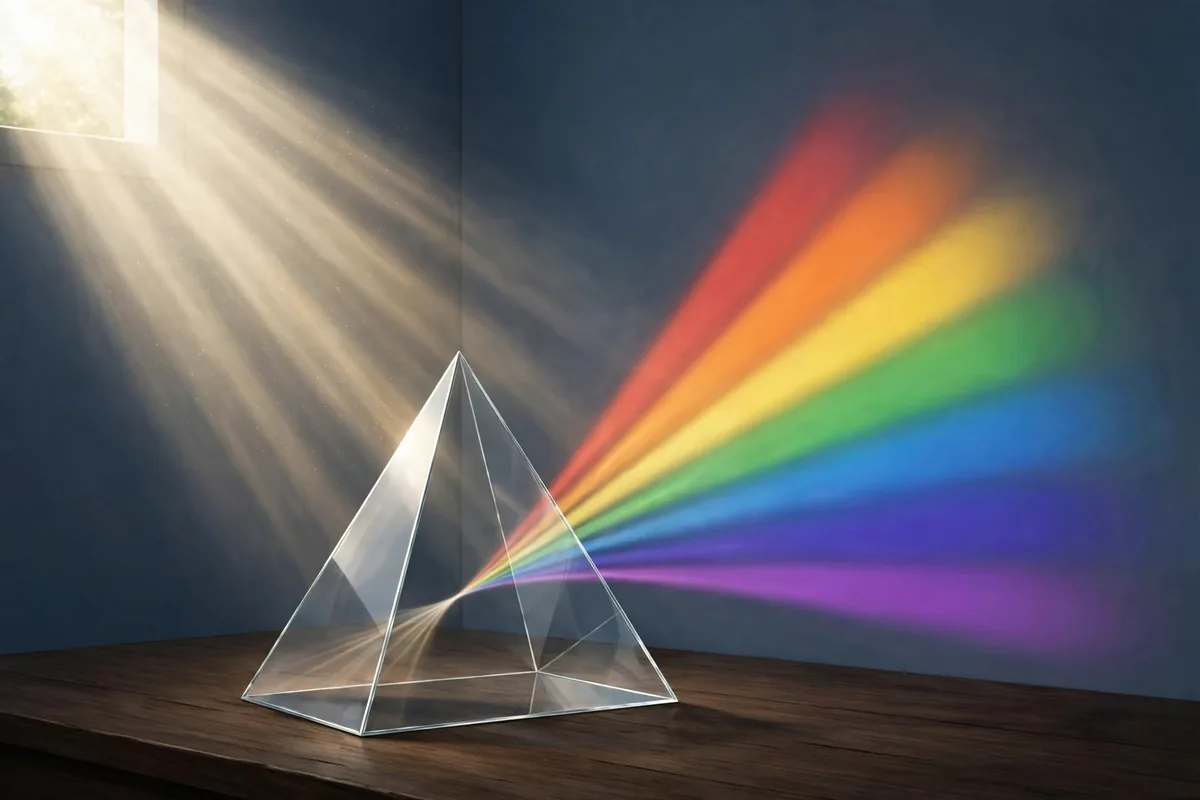
Dispersion of Light by a Prism: How It Splits White Light into a Spectrum
Dispersion of light by a prism is the splitting of white light into its separate colours when it passes through a triangular piece of glass. Sunlight looks white, yet it carries every colour of the rainbow at once. A prism sorts the colours already in the light, because each colour bends by a slightly different amount as it enters and leaves the glass.
Violet bends the most and red bends the least, so the colours fan out into a spectrum on the wall.
Isaac Newton showed this in 1666 with an experiment that still settles the question today. He let a narrow beam of sunlight pass through a prism and watched the spectrum form. Then he placed a second prism in the path of one single colour from that spectrum. The colour came out unchanged.
If the first prism had created the colours, the second prism would have split that single colour again. It did not. The colours were already in the white light, waiting to be separated.
This article walks through the physics behind that rainbow, step by step. You will see why the refractive index of glass changes with colour, how a prism bends a ray twice, and how to calculate the spread between colours with numbers you can check yourself. Two worked examples use real values for real glass, and a section near the end lists the mistakes that cost students marks on this topic again and again.
What dispersion actually means
Dispersion is the spreading of white light into its spectrum because the refractive index of a material depends on wavelength. That one sentence carries the whole topic, so it is worth unpacking slowly.
White light is not one kind of light. It is a mixture of wavelengths running from about 380 nm to about 700 nm. Your eye blends all of them together and reports white. A prism unblends them.
Each wavelength meets the glass with its own refractive index, so each wavelength follows its own path through the prism. The paths are close together, but they are not the same, and the gap between them is the spectrum you see.
The refractive index grows as the wavelength shrinks. Physicists describe this with Cauchy’s relation, which says in plain words that n is larger for short wavelengths and smaller for long ones. Violet light sits at the short end of the visible range, near 410 nm, so it meets the largest refractive index. Red light sits at the long end, near 660 nm, so it meets the smallest.
Every other colour falls somewhere in between, in the order of its wavelength.
Real glass makes this concrete. The table below gives measured refractive indices for two common types of glass. Look at how much n changes across the visible range. The change looks small, a few hundredths at most, yet it is enough to paint a spectrum across a classroom wall.
| Glass | Red light, 660 nm | Violet light, 410 nm |
|---|---|---|
| Crown glass | n = 1.512 | n = 1.530 |
| Flint glass | n = 1.662 | n = 1.698 |
Two things stand out in that table. First, flint glass has higher refractive indices than crown glass for every colour, so it bends light more strongly overall. Second, the gap between red and violet is wider in flint glass, 0.036 against 0.018 in crown glass. Flint glass therefore spreads the colours further apart.
That is why flint glass shows up whenever a strong spectrum matters, and why crown glass shows up where a gentler spread is wanted.
The order of the colours in the spectrum follows the order of their wavelengths. Violet bends the most and ends up furthest from the original direction of the beam. Red bends the least and stays closest. Between them sit indigo, blue, green, yellow and orange, in that order.
Schoolbooks remember the sequence as VIBGYOR, read from the most bent colour to the least. The spectrum itself has no sharp borders. One colour melts into the next across a continuous range, and the seven names are labels we put on a smooth gradient.
Why the prism bends light twice, not once
A prism is a triangular block of transparent material, usually glass. It has two flat faces that meet at the top, called the refracting faces, and a flat base at the bottom. The angle where the two refracting faces meet is the apex angle, written as A. A ray of white light enters through one face, travels through the glass, and leaves through the other face.
It bends at both faces. The two bends are the whole trick, and the geometry of the triangle decides how they combine.
At each face, Snell’s law fixes the bend. The law says n1 sin theta1 = n2 sin theta2, where n1 and n2 are the refractive indices on the two sides of the boundary and theta1 and theta2 are the angles the ray makes with the normal, the line drawn at right angles to the surface.
Light travels slower in glass than in air, so the ray bends towards the normal when it enters the prism and away from the normal when it leaves. Both bends turn the ray in the same direction, towards the base of the prism. That is the point students miss most often. The two bends add up instead of cancelling, because the two faces of a prism are not parallel.
A flat glass slab shows the opposite behaviour. Its two faces are parallel, so the bend at the entry face and the bend at the exit face are equal and opposite. The ray comes out parallel to the way it went in, shifted sideways by a small amount. A prism breaks that symmetry.
Its faces meet at the apex angle A, so the second bend cannot undo the first. The ray leaves heading in a new direction, and the angle between its original direction and its final direction is the angle of deviation, written as delta.
Three equations describe the ray’s path through the prism. First, the geometry of the triangle ties the two internal angles together: A = r1 + r2, where r1 is the angle of refraction at the first face and r2 is the angle of incidence at the second face.
Second, the total deviation is delta = i + e − A, where i is the angle of incidence at the first face and e is the angle of emergence at the second face. Measure i and e from the normal at each face, not from the surface of the glass. That mix-up is one of the most common errors in prism problems.
As you turn the prism and change the angle of incidence, the deviation changes too. It falls to a minimum value and then rises again. At that minimum deviation, the ray passes through the prism symmetrically: the angle of incidence equals the angle of emergence, and the two internal angles are equal, each one half of the apex angle. This symmetry gives the prism formula, the standard laboratory method for measuring refractive index:
n = sin[(A + delta_m) / 2] / sin(A / 2)
Here delta_m is the angle of minimum deviation. Measure A and delta_m with a spectrometer, plug them into the formula, and you get n for the colour of light you used. Change the colour, repeat the measurement, and you get a different n. That is dispersion, measured directly.
For a thin prism, one with a small apex angle and small angles of incidence, the maths simplifies. The deviation becomes almost independent of the angle of incidence, and the formula reduces to delta ≈ (n − 1) A. This thin prism approximation is handy for quick estimates, but it only holds for small apex angles, strictly under about 10 degrees, and small incidence angles. Apply it to a standard 60 degree prism and the answer will be wrong.
The worked examples below show both the exact Snell’s law route and the thin prism route, so you can see where each one belongs.
Dispersion of light by a prism: why violet bends more than red
Now trace two colours through the same prism side by side. A ray of red light and a ray of violet light enter at the same angle of incidence. The violet ray meets a larger refractive index, so Snell’s law gives it a larger bend at the first face. Inside the glass, the violet ray travels at a slightly steeper angle than the red ray.
At the second face the same thing happens again: violet meets the larger index change and bends further. The two bends add up for each colour, and because violet bends more at both faces, the gap between the colours grows at each step. By the time the rays leave the prism, red and violet head in clearly different directions.
That gap has a name. Angular dispersion is the difference between the deviations of two colours, usually the two ends of the spectrum: angular dispersion = D_violet − D_red, where D_violet is the deviation of violet light and D_red is the deviation of red light. It tells you how far apart the colours spread, in degrees. A prism with a large angular dispersion paints a wide spectrum on the wall.
A prism with a small one squeezes the colours into a narrow band.
Dispersive power is the related number that compares one glass with another. It asks how much a material spreads the colours relative to how much it bends light on average. The formula uses three standard colours, the red C line at 656 nm, the yellow D line at 589 nm and the blue F line at 486 nm:
omega = (n_V − n_R) / (n_Y − 1)
Here n_V is the refractive index for violet or blue light, n_R is the index for red light, and n_Y is the index for yellow light. Omega has no units. A larger omega means the glass spreads colours more strongly for the same average bend. Flint glass has a larger dispersive power than crown glass, which is why the table in the previous section shows a wider red to violet gap for flint.
Lens makers care about this number a lot. A single lens made of one glass spreads colours and smears the image with coloured fringes, an effect called chromatic aberration. Pairing a crown glass lens with a flint glass lens in an achromatic doublet cancels most of that spread, because the two glasses bend light by similar amounts while dispersing it by different amounts.
Rainbows run on the same physics, with water drops standing in for the prism. Sunlight enters a raindrop, refracts, reflects off the back of the drop, and refracts again on the way out. Each colour bends by its own amount, so the drops send red light to your eye from one angle and violet light from a slightly different angle. Millions of drops at different heights in the sky add up to the arc you see.
The geometry differs from a glass prism, but the cause is identical: refractive index depends on wavelength.
Spectrometers put dispersion to work in the laboratory. A prism or a diffraction grating spreads the light from a source into its spectrum, and a detector reads the brightness at each wavelength. Astronomers use this to read the composition of stars. Chemists use it to identify substances by their spectral lines.
The humble classroom prism and the spectrograph on a telescope are the same idea at different scales: split the light, then read what the split tells you.
Worked example 1: how far red and violet split inside flint glass
White light enters a flint glass block at an angle of incidence of 43.2 degrees. The refractive index of the flint glass is 1.662 for red light at 660 nm and 1.698 for violet light at 410 nm. Find the angle of refraction for each colour, and the angular spread between them inside the glass.
Step 1: Write down Snell’s law for the first surface. Light travels from air, where n is 1.00, into glass. Snell’s law gives sin r = sin i / n, where i is 43.2 degrees and n depends on the colour.
Step 2: Find sin 43.2 degrees. From tables or a calculator, sin 43.2° = 0.6846. This value is the same for both colours, because both rays enter at the same angle.
Step 3: Work out the red ray. Divide by the refractive index for red: sin r_red = 0.6846 / 1.662 = 0.4119. Take the inverse sine: r_red = 24.3 degrees.
Step 4: Work out the violet ray the same way. Divide by the refractive index for violet: sin r_violet = 0.6846 / 1.698 = 0.4032. Take the inverse sine: r_violet = 23.8 degrees.
Step 5: Find the spread. Subtract the two angles: 24.3° − 23.8° = 0.5 degrees. The angular spread between red and violet inside the glass is about 0.5 degrees.
That half a degree looks tiny, and it is. But notice what it means. A difference of only 0.036 in refractive index already separates the colours by a measurable angle after a single refraction. The second face of a real prism bends each colour again and widens the gap further.
The spectrum on the wall is the result of two such bends, not one. If you repeat this calculation for crown glass, where the red to violet gap in n is only 0.018, the spread comes out smaller, which matches the table: crown glass disperses less than flint glass.
Worked example 2: angular dispersion and dispersive power of a thin flint prism
A thin flint glass prism has an apex angle A = 20 degrees. The refractive indices are n_red = 1.6434 for the red C line at 656 nm, n_yellow = 1.6550 for the yellow D line at 589 nm, and n_blue = 1.6648 for the blue F line at 486 nm. Find the deviation of the red and blue rays, the angular dispersion, and the dispersive power of the glass.
Step 1: Choose the right formula. The prism is thin, so use the thin prism approximation delta = (n − 1) A. This gives the deviation of each colour directly from its refractive index.
Step 2: Work out the deviation of the red ray. Subtract 1 from the refractive index for red: 1.6434 − 1 = 0.6434. Multiply by the apex angle: 0.6434 × 20° = 12.87 degrees. The red ray deviates by 12.87 degrees.
Step 3: Work out the deviation of the blue ray the same way. Subtract 1 from the refractive index for blue: 1.6648 − 1 = 0.6648. Multiply by the apex angle: 0.6648 × 20° = 13.30 degrees. The blue ray deviates by 13.30 degrees.
Step 4: Find the angular dispersion. Subtract the red deviation from the blue deviation: 13.30° − 12.87° = 0.43 degrees. The colours spread by 0.43 degrees as they leave the prism.
Step 5: Find the dispersive power. The formula is omega = (n_V − n_R) / (n_Y − 1). The top of the fraction is the spread of refractive index between blue and red: 1.6648 − 1.6434 = 0.0214. The bottom is the yellow index minus 1: 1.6550 − 1 = 0.6550.
Divide: 0.0214 / 0.6550 = 0.033. The dispersive power of this flint glass is about 0.033, with no units.
Two things deserve a second look here. First, the dispersive power is a property of the glass, not of this one prism. Any prism made from this flint glass has the same omega, whatever its apex angle. The angular dispersion, on the other hand, grows with the apex angle, because a wider prism bends every colour further and stretches the spread.
Second, remember the validity condition. The thin prism formula applies only for small apex angles, strictly under about 10 degrees, and small angles of incidence. An apex angle of 20 degrees is already past that strict limit, so this calculation is an approximation, useful for comparing colours and glasses but not exact.
For a standard 60 degree prism, use the full geometry, A = r1 + r2 and delta = i + e − A, with Snell’s law at each face.
Common mistakes students keep making
Dispersion is a short topic, but it collects a steady crop of exam errors. Most of them come from mixing up two similar ideas, or from reaching for a formula outside the conditions where it works. Here are the ones to watch for.
- Confusing dispersion with diffraction or scattering. Dispersion splits light because refractive index depends on wavelength. Diffraction spreads light when it passes an edge or a slit. Scattering throws light in many directions when it hits small particles. Three different effects, three different causes.
- Thinking the prism adds colour to white light. Newton settled this one in 1666. His second prism left a single colour unchanged, which proved the colours were already present in the white light. The prism separates what is there. It creates nothing.
- Saying red bends the most. It bends the least. Violet has the shortest visible wavelength, the largest refractive index, and the largest bend. Red has the longest visible wavelength, the smallest refractive index, and the smallest bend. If your answer has red on the outside of the bend, check it again.
- Applying delta = (n − 1) A to a standard 60 degree prism. The thin prism formula only works for small apex angles and small angles of incidence. A 60 degree prism needs the full treatment: Snell’s law at both faces, A = r1 + r2, and delta = i + e − A.
- Using one single refractive index for all colours in a prism calculation. That erases the very effect you are calculating. If a question gives n for red and n for violet, it expects you to use both, one for each ray. A single n gives a single deviation, and no spectrum at all.
- Mixing up deviation with dispersion. Deviation is how far one ray turns from its original direction. Dispersion is how far the colours spread apart from each other. A prism can deviate a ray a long way while dispersing it only slightly, if the glass has a small dispersive power.
- Assuming the spectrum has only seven sharp colours. The spectrum is a continuous range of wavelengths from about 380 nm to about 700 nm. VIBGYOR names seven bands for convenience. Between any two named colours sit countless unnamed shades, and no sharp line divides them.
The formulas to carry into the exam
Dispersion of light by a prism comes down to one physical fact and a small set of equations. The fact is that the refractive index of glass depends on wavelength, so violet light bends more than red light at every surface it crosses. Everything else follows from that.
Snell’s law, n1 sin theta1 = n2 sin theta2, fixes the bend at each face. The geometry of the prism ties the internal angles together with A = r1 + r2, and the total deviation follows from delta = i + e − A. At minimum deviation, the prism formula n = sin[(A + delta_m) / 2] / sin(A / 2) turns a measured angle into a refractive index, one colour at a time.
For a thin prism, delta ≈ (n − 1) A gives a quick estimate. The spread between colours is the angular dispersion, D_violet − D_red, and the glass itself is rated by its dispersive power, omega = (n_V − n_R) / (n_Y − 1).
If you remember one number, make it the pair from the worked examples: flint glass spreads red and violet by about 0.5 degrees at a single surface, and a thin flint prism with a 20 degree apex angle shows an angular dispersion of 0.43 degrees with a dispersive power of about 0.033. Those numbers show how a difference of a few hundredths in refractive index becomes a rainbow you can see.
Next time sunlight falls across a glass of water or a cut gemstone throws coloured patches on a table, you will know exactly which bend put each colour where it landed.
Frequently Asked Questions
What is dispersion of light by a prism in simple words?
Dispersion of light by a prism is the splitting of white light into its spectrum as it passes through a triangular glass prism. White light contains wavelengths from about 380 nm to 700 nm, and each wavelength meets a different refractive index in the glass. Because the index is larger for short wavelengths, violet bends most and red bends least, so the colours fan out in the order VIBGYOR.
Why does a prism split white light into a spectrum but a flat glass slab does not?
A prism splits white light because its two refracting faces are not parallel, so the bends at entry and exit add up instead of cancelling. Each colour bends by a different amount at both faces, since refractive index depends on wavelength, and the total deviation is delta = i + e − A. A flat slab has parallel faces, so the two bends are equal and opposite and the ray leaves parallel to its original direction, with no spectrum.
Which colour bends the most in dispersion through a prism, red or violet, and why?
Violet bends the most, and red bends the least. Violet light has the shortest visible wavelength, near 410 nm, so it meets the largest refractive index in glass; for flint glass, n is 1.698 for violet against 1.662 for red at 660 nm. By Snell's law, n1 sin theta1 = n2 sin theta2, the larger index gives violet a larger bend at both faces of the prism, placing it furthest in the spectrum.
How do you calculate angular dispersion for a prism using the formula delta = D_violet − D_red?
First find the deviation of each colour, then subtract the red deviation from the violet deviation. For the thin flint prism in this article, the thin-prism formula delta = (n − 1)A gives D_red = 12.87 degrees and D_blue = 13.30 degrees with A = 20 degrees. Angular dispersion = 13.30 − 12.87 = 0.43 degrees. A larger value means the prism spreads the colours over a wider spectrum.
What is dispersive power of a prism, and how is it calculated from refractive indices?
Dispersive power, omega, measures how strongly a glass spreads colours relative to how much it bends light on average. It is calculated from three refractive indices with omega = (n_V − n_R) / (n_Y − 1), using the red C line at 656 nm, the yellow D line at 589 nm and the blue F line at 486 nm. For the flint glass in this article, omega = 0.0214 / 0.6550 = 0.033, and it has no units.
Did Newton prove with his prism experiment that the colours are already present in white light?
Yes, Newton proved it in 1666 with his second-prism test. He passed sunlight through a first prism to form a spectrum, then sent one single colour from that spectrum through a second prism. The colour came out unchanged instead of splitting again. If the first prism had created the colours, the second prism would have split that single colour further, so the colours must already be present in white light.