How Sound Intensity Works: Decibels and the Inverse Square Law
A whisper next to your ear can be hard to catch. A jet engine can be heard across an airfield. The wave in both cases is the same kind of thing, a pressure disturbance travelling through air. What changes is how much power the wave carries through each square metre of space, and how your ear reads that power. Sound intensity is the name for that power per square metre, and it turns the vague word loud into a number you can calculate.
This article builds that number from scratch. You will learn the formula for sound intensity, see why loudness is measured in decibels instead of watts per square metre, and work out why moving away from a sound makes it fade much faster than most people expect. Three formulas do nearly all the work, and two worked examples at the end put them to use with real numbers.
What Is Sound Intensity?
Sound intensity is the power carried by a sound wave through each square metre of area. Power means the rate at which energy moves from one place to another, measured in watts. Area is measured in square metres. Put them together and intensity has units of watts per square metre, written W/m².
The formula is short:
I = P/A
Here I stands for intensity, P stands for power in watts, and A stands for the area in square metres through which the power passes. If a source puts out 10 W of sound power and that power passes through an area of 2 m², the intensity is 5 W/m². The same power spread over a bigger area gives a smaller intensity, because the energy is thinner on the ground.
That thinning out is the whole story of this article, so it pays to picture it clearly. Imagine a tap filling a bucket. The tap delivers water at a fixed rate. If the water spreads across a wide tray, the layer stays shallow. If the same flow is forced through a narrow pipe, the stream is fierce. Sound power behaves the same way. A fixed amount of power spread over a large area gives a low intensity. The same power squeezed through a small area gives a high intensity.
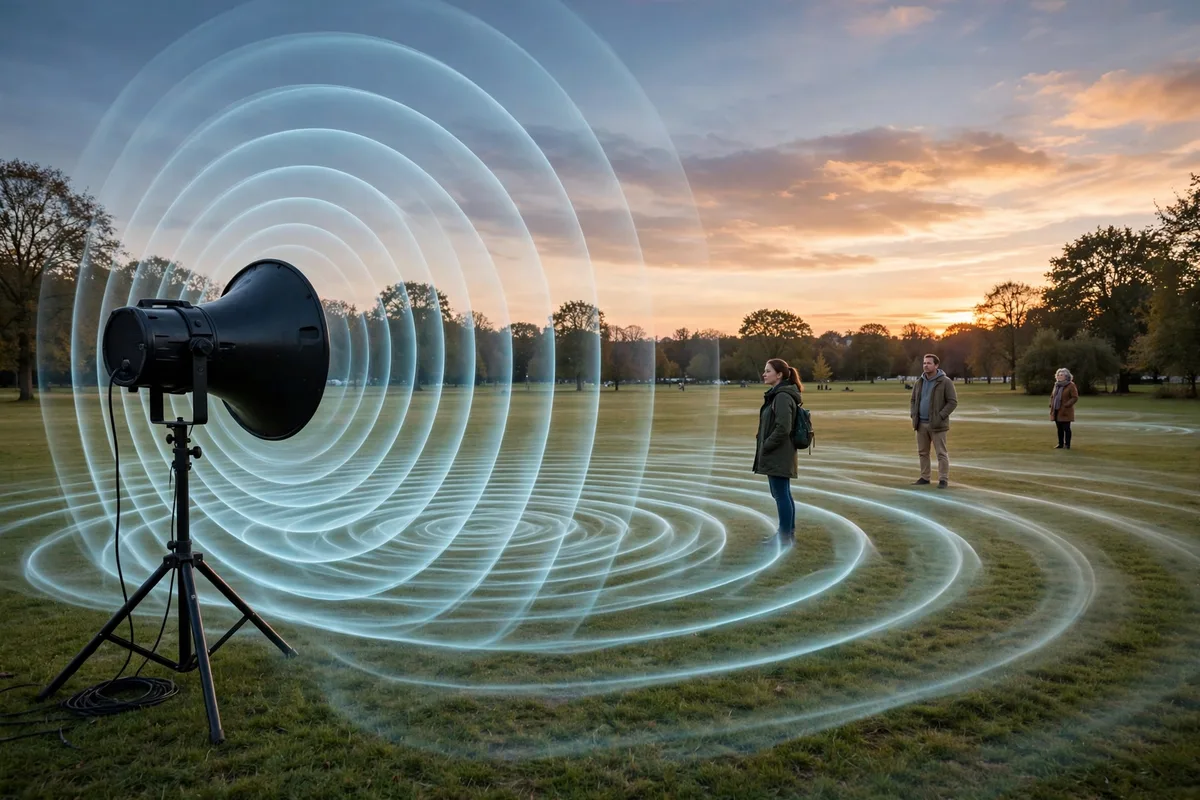
Now think about a source that radiates sound equally in every direction, like a small loudspeaker hanging in open air. The sound spreads out as an expanding sphere. At a distance r from the source, the power has spread over the surface of a sphere with area A = 4πr². Substituting that area into the intensity formula gives the version you will use most often in problems:
I = P/(4πr²)
Here P is the total sound power of the source in watts, r is the distance from the source in metres, and I is the intensity at that distance in W/m². The 4πr² in the denominator is the surface area of the sphere. As r grows, the denominator grows, and the intensity falls.
One more link matters, and it shows up in exam questions more often than students expect. Sound intensity is proportional to the square of the amplitude of the wave. Amplitude is the maximum displacement of the air particles as the wave passes, or equivalently the maximum pressure change. Double the amplitude and the intensity quadruples, because 2² equals 4. Halve the amplitude and the intensity drops to a quarter. This is why a small increase in how hard a speaker cone moves can make a large difference to the power reaching your ear.
It helps to keep three quantities straight from the start, because mixing them up causes most of the errors later. Power is the total rate at which the source gives out energy, measured in watts. Intensity is how concentrated that power is at a particular place, measured in W/m². Loudness is what your brain reports when your ear receives that intensity, and loudness is a perception, not a physical quantity you can read off a meter.
The formulas in this article deal with power and intensity. Loudness only enters the picture when we talk about decibels, and even then the decibel scale measures a level, not a sensation.
Before moving on, take a second to feel the size of the numbers. Ordinary sounds carry tiny amounts of power. A normal conversation involves sound power of roughly a hundred-thousandth of a watt at the source, yet it is perfectly audible a metre away. The reason is that the human ear is astonishingly sensitive, and that sensitivity is exactly why physicists needed a new scale to describe loudness. That scale is the subject of the next section.
Why Your Ear Needs a Logarithmic Scale
The quietest sound a healthy young ear can detect has an intensity of about 1.0×10⁻¹² W/m². The loudest sound you can stand without immediate pain is around 1 W/m². The second number is a trillion times the first. A trillion is 1,000,000,000,000, and no linear scale handles a range that wide gracefully. If you plotted ordinary sounds on a scale that ran from zero to 1 W/m², every everyday sound would squash into an invisible sliver near zero. The scale would be technically correct and practically useless.
Your ear solves this problem by responding roughly logarithmically. A logarithm compresses a huge range into a small one. Adding the same amount to a logarithm multiplies the original number by the same factor. That matches how hearing works. A sound that is ten times more intense sounds like a fixed step up, the same kind of step as the next tenfold increase. Your ear notices ratios, not differences.
Physicists capture this with the sound intensity level, written with the Greek letter beta, β. The formula is:
β = 10 log₁₀(I/I₀)
Here I is the intensity you are measuring, I₀ is a reference intensity, and the level β is measured in decibels, written dB. The reference intensity I₀ is the threshold of hearing, 1.0×10⁻¹² W/m². It is the quietest sound an average young ear can detect at a frequency of about 1000 Hz, and the whole decibel scale is anchored to it.
Read the formula slowly, because every part of it earns its place. I/I₀ is a ratio, so it has no units. A sound at the threshold of hearing has I equal to I₀, so the ratio is 1, and log₁₀(1) is 0. That gives β equal to 0 dB at the threshold, which is exactly what you would want.
A sound ten times more intense than the threshold has a ratio of 10, log₁₀(10) is 1, and β equals 10 dB. A sound a million times more intense has a ratio of 10⁶, log₁₀(10⁶) is 6, and β equals 60 dB. Each factor of ten in intensity adds exactly 10 dB. The factor of 10 in front of the logarithm is what turns bels into decibels. One bel is log₁₀(I/I₀), and a decibel is a tenth of a bel, so multiplying by 10 converts the unit.
Two rules of thumb fall straight out of the formula, and they are worth memorising because they answer quick questions without a calculator. Multiply the intensity by 10 and the level rises by 10 dB. Multiply the intensity by 2 and the level rises by about 3 dB, because 10 log₁₀(2) is about 3.01. Run the rules backwards and they are just as useful. Halve the intensity and the level falls by 3 dB. Divide the intensity by 10 and the level falls by 10 dB.
The table below gives a feel for the scale. These are typical values, not exact constants, and different textbooks round them slightly differently. The pattern matters more than any single row.
| Sound | Sound intensity level |
|---|---|
| Rustling leaves | 10 dB |
| Whisper at close range | 20 dB |
| Quiet room | 30 dB |
| Normal conversation | 60 dB |
| Busy city traffic | 80 dB |
| Rock concert near the speakers | 120 dB |
| Jet engine at close range | 140 dB |
Look at the gap between a whisper at 20 dB and a normal conversation at 60 dB. The difference is 40 dB, which means the conversation is 10⁴, or ten thousand, times more intense than the whisper. Your ear hears that as a large but entirely ordinary step up, not as something ten thousand times louder. That is the logarithmic response in action, and it is why the decibel scale feels natural once you get used to it.
One point deserves emphasis because textbooks sometimes leave it vague. A decibel is a level measured relative to the reference intensity I₀, unlike a watt or a metre, which are absolute units. Saying a sound is 60 dB is shorthand for saying its intensity is a million times the threshold of hearing. Without the reference, the number would mean nothing.
That is also why you cannot add decibel levels the way you add ordinary numbers. Two separate 60 dB sounds playing together do not make 120 dB. Their intensities add, and doubling the intensity adds only about 3 dB, giving roughly 63 dB. This trips up a lot of students, and it gets its own entry in the common mistakes section later.
There is also a practical warning hidden in the top rows of the table. Sounds above about 85 dB can damage hearing with prolonged exposure, and sounds near 120 dB can cause pain. The numbers in the table are the reason workplaces set limits on noise exposure and why ear protection matters at concerts and on construction sites. The physics and the health advice point the same way.
The Inverse Square Law: Why Sound Fades So Fast
Stand next to a loudspeaker and the sound is overwhelming. Walk a few steps away and it drops off noticeably. Walk further and it fades to a murmur. The change feels too fast for the distance covered, and there is a reason for that. The power spreads over a larger and larger sphere, so less of it passes through each square metre.
The geometry is the same sphere you met in the first section. At distance r from a point source, the power P spreads over an area 4πr², so the intensity is I = P/(4πr²). Since P is fixed for a given source, intensity is proportional to 1/r². Double the distance and the area of the sphere grows by a factor of four, so the intensity falls to a quarter. Triple the distance and the area grows by a factor of nine, so the intensity falls to a ninth. This is the inverse square law, and it applies to anything that spreads evenly in all directions from a point, including light and gravity.
Comparing two distances is usually more useful than calculating an absolute intensity, and the ratio form of the law does that cleanly:
I₂/I₁ = (r₁/r₂)²
Here I₁ is the intensity at distance r₁ and I₂ is the intensity at distance r₂. The source power cancels out, so you do not even need to know it. If r₂ is twice r₁, the ratio is (1/2)², which is 1/4. If r₂ is ten times r₁, the ratio is (1/10)², which is 1/100.
The law also combines neatly with decibels, and this combination is where exam questions love to live. A quarter of the intensity means a level change of 10 log₁₀(1/4), which is about minus 6 dB. So doubling your distance from a sound source drops the level by 6 dB. Tripling the distance drops it by about 9.5 dB, since 10 log₁₀(1/9) is about minus 9.5. Increasing the distance tenfold drops the level by 20 dB, because 10 log₁₀(1/100) is minus 20.
The 6 dB per doubling shortcut is the single most useful fact in this section. Walk from 2 m to 4 m away from a speaker and the level falls by 6 dB. Walk from 4 m to 8 m and it falls by another 6 dB. Two doublings mean a 12 dB drop in total. You can answer questions like that in your head once the shortcut is familiar, and worked example 2 below shows the full calculation behind it.
But the law has limits, and knowing them is part of understanding it. It assumes a point source radiating equally in all directions in open space, with no reflections and no absorption. Real life breaks those assumptions constantly. Indoors, walls, floors and ceilings reflect sound back, so the level falls more slowly than the inverse square law predicts. Outdoors, air absorbs high frequencies faster than low ones, which is why distant thunder sounds like a low rumble while nearby thunder cracks sharply.
A large source, like a long line of traffic or a row of speakers, does not behave like a point source at close range either. Its intensity falls more slowly with distance until you are far enough away for it to look like a point. When a question says a source radiates uniformly in all directions, or calls it a point source, that is the question telling you the inverse square law applies. When a question describes a room with hard walls, expect the real behaviour to be messier than the law alone suggests.
It is worth pausing on the spray paint image that many teachers use, because it makes the geometry stick. Picture a can of spray paint held close to a wall. The paint lands in a small, dense patch. Hold the can twice as far away and the same amount of paint covers four times the area, so the coating is a quarter as thick. The paint did not vanish. It spread out. Sound power does the same thing, except the wall is a sphere that keeps growing as the sound travels outward.
Worked Example 1: Intensity and Decibel Level of a Loudspeaker
Here is the kind of problem that ties the first two sections together. Read it once, then follow the working line by line. Every substitution is shown, including the logarithm step that usually causes trouble.
A loudspeaker radiates 80 W of sound power uniformly in all directions. (a) Find the sound intensity 3.0 m from the speaker. (b) Find the sound intensity level in decibels at that distance.
Start by listing what you know. Power P is 80 W. Distance r is 3.0 m. The reference intensity I₀ is 1.0×10⁻¹² W/m². You need intensity I first, because part (b) needs the value of I before you can take its logarithm.
Part (a). The speaker radiates uniformly in all directions, so the point source formula applies:
I = P/(4πr²)
Substitute P = 80 W and r = 3.0 m:
I = 80/(4π × 3.0²)
Work out the denominator first. 3.0² is 9.0, and 4π × 9.0 is about 113.1. So:
I = 80/113.1
I ≈ 0.707 W/m²
That is a very high intensity for a sound wave. A rock concert near the speakers is around 1 W/m², so standing 3 m from an 80 W loudspeaker is in that territory. The number is a warning as much as an answer. Do not stand that close to a powerful speaker.
Part (b). Now convert the intensity to a decibel level with the formula:
β = 10 log₁₀(I/I₀)
Substitute I = 0.707 W/m² and I₀ = 1.0×10⁻¹² W/m²:
β = 10 log₁₀(0.707/(1.0×10⁻¹²))
Divide inside the logarithm first. 0.707 divided by 1.0×10⁻¹² is 7.07×10¹¹. So:
β = 10 log₁₀(7.07×10¹¹)
Now take the base 10 logarithm. log₁₀(7.07×10¹¹) is log₁₀(7.07) plus log₁₀(10¹¹), which is about 0.85 plus 11, giving about 11.85. Multiply by 10:
β ≈ 118.5 dB
So the sound intensity 3.0 m from the loudspeaker is about 0.707 W/m², and the sound intensity level there is about 118.5 dB. Both answers carry their units, and both follow from the same two substitutions. If your calculator gives a slightly different last digit, check that you used log base 10 and not the natural logarithm, and check that you entered the reference intensity with its full exponent. Those two slips account for nearly every wrong answer to this type of question.
Worked Example 2: How Much Quieter at Four Times the Distance?
The second example uses the inverse square law and the decibel rules together. It is shorter than the first, but it teaches the move that appears in more exam questions than any other in this topic: turning a distance change into a decibel change without ever finding the absolute intensity.
A sound measures 85 dB at 2 m from its source. What is the sound intensity level at 8 m from the source, assuming the source radiates uniformly in open space?
Start with the distance change. The distance grows from 2 m to 8 m, which is a factor of 4. By the inverse square law, the intensity ratio is:
I₂/I₁ = (r₁/r₂)² = (2/8)² = (1/4)² = 1/16
At 8 m the intensity is one sixteenth of its value at 2 m. That makes sense. Four times the distance means sixteen times the area of the sphere, so the power is spread sixteen times thinner.
Now convert that ratio into a decibel change. The change in level is:
Δβ = 10 log₁₀(I₂/I₁) = 10 log₁₀(1/16)
log₁₀(1/16) is about minus 1.204, so:
Δβ ≈ 10 × (−1.204) = −12 dB
The level drops by 12 dB. The level at 2 m was 85 dB, so the level at 8 m is:
β₂ = 85 dB − 12 dB = 73 dB
There is a quicker way to the same answer, and it is worth learning because it turns questions like this into mental arithmetic. Going from 2 m to 8 m is two doublings of distance: 2 m to 4 m, then 4 m to 8 m. Each doubling drops the level by 6 dB. Two doublings give 2 × 6 dB, which is a 12 dB drop. 85 dB minus 12 dB is 73 dB. Same answer, no logarithm needed.
Notice what you did not need to know. You never found the intensity at 2 m or at 8 m in W/m², and you never used the power of the source. The ratio form of the inverse square law plus the decibel rules was enough. Exam questions are often built this way on purpose. They give you a level and two distances, and they expect the ratio method, not a long calculation through absolute intensities. If you find yourself hunting for a power value the question never gave you, step back and check whether the ratio route gets you there.
Common Mistakes to Watch For
Adding decibels like ordinary numbers is the most common error in this topic. Two 60 dB sounds together give about 63 dB, not 120 dB. Decibels measure a level on a logarithmic scale, so you add intensities and then convert, never the decibel numbers themselves. The same trap catches people who think a 80 dB sound is twice as loud as a 40 dB sound. The intensity is ten thousand times greater, but loudness is a perception, and a 10 dB increase sounds roughly twice as loud to most listeners, so 80 dB sounds far more than twice as loud as 40 dB.
Confusing the three quantities is the next trap. Intensity is measured in W/m². Intensity level is measured in dB. Loudness is a perception with no SI unit. A question that asks for intensity wants a number in W/m², and a question that asks for level wants a number in dB. Swapping them loses the mark even if the arithmetic was right.
Using the natural logarithm instead of log base 10 in the decibel formula is a quiet error because the calculator still gives you a number. It just gives the wrong one. The decibel formula uses log base 10, always. If your calculator has a log button and a ln button, the decibel formula wants the log button. Check before you trust the answer.
Forgetting the reference intensity, or using the wrong value for it, is another frequent slip. The decibel formula divides by I₀, and I₀ is 1.0×10⁻¹² W/m². Leaving it out gives a logarithm of a quantity with units, which makes no sense, and using a different reference shifts every answer by a fixed amount. Write I₀ down with its value at the start of every decibel calculation, the way you would write down any other given constant.
Thinking that doubling the distance halves the intensity is wrong in the same way that thinking doubling the side of a square doubles its area is wrong. Doubling the distance quadruples the area of the sphere, so the intensity falls to a quarter. If your answer says the intensity halved when the distance doubled, the inverse square law has been applied as an inverse law instead of an inverse square law, and the factor of two has gone missing.
Mixing up power and intensity in I = P/A is easy when a question gives you one and asks for the other. Power is the total output in watts. Intensity is power per unit area in W/m². If a question gives power and a distance, you need the sphere area 4πr² before you can find intensity. If it gives intensity and an area, multiply to get power. Say the units out loud as you work and the mix up usually reveals itself.
Assuming the inverse square law holds indoors is the last trap, and it is a physics error rather than an arithmetic one. In a room, reflections from walls, floor and ceiling add sound back, so the level falls more slowly with distance than the law predicts. The law assumes open space with no reflections. If a question describes a concert hall or a classroom, treat the inverse square law as an approximation for the direct sound only, not as a description of the whole room.
Putting the Three Formulas Together
Three formulas carry this whole topic. Sound intensity is power per unit area, I = P/A, and for a point source spreading evenly in all directions that becomes I = P/(4πr²). The sound intensity level measures that intensity on a logarithmic scale relative to the threshold of hearing, β = 10 log₁₀(I/I₀), with I₀ = 1.0×10⁻¹² W/m². And the inverse square law, I ∝ 1/r², says the intensity falls with the square of the distance, so doubling the distance quarters the intensity and drops the level by 6 dB.
Work a few problems with these formulas and the pattern settles. Find the intensity first, convert it to decibels second, and use ratios whenever a question gives you two distances instead of a power. Check your units at each step, use log base 10, and remember that decibels add through intensities, never directly. The worked examples above are a good place to start. Cover the answers, try them yourself, and compare your working line by line.
Frequently Asked Questions
What is sound intensity, and how do you calculate it with the formula I = P/A?
Sound intensity is the power carried by a sound wave through each square metre of area, measured in watts per square metre (W/m²). You calculate it with I = P/A, where P is the sound power in watts and A is the area in square metres through which that power passes. For a point source radiating equally in all directions, the power spreads over a sphere of area 4πr², so the formula becomes I = P/(4πr²).
How do you convert sound intensity to decibels using the formula β = 10 log(I/I₀)?
You convert sound intensity to decibels with β = 10 log₁₀(I/I₀), where I is the intensity you are measuring, I₀ is the reference intensity of 1.0×10⁻¹² W/m², and β is the sound intensity level in decibels (dB). First divide I by I₀ to get a unitless ratio, then take the base 10 logarithm of that ratio and multiply by 10. Each factor of ten in intensity adds exactly 10 dB, and doubling the intensity adds about 3 dB.
What is the threshold of hearing, I₀ = 1.0×10⁻¹² W/m², and why is it the reference for the decibel scale?
The threshold of hearing is the quietest sound a healthy young ear can detect, at an intensity of about 1.0×10⁻¹² W/m² at a frequency of about 1000 Hz. It is the reference for the decibel scale because every decibel level is measured relative to it. At the threshold, I equals I₀, the ratio I/I₀ is 1, and log₁₀(1) is 0, so the level is 0 dB. Without this fixed reference, a decibel number would mean nothing.
Why does sound intensity follow the inverse square law, I ∝ 1/r²?
Sound intensity follows the inverse square law because a point source spreads its power over the surface of an expanding sphere. At distance r, the power P spreads over an area of 4πr², so I = P/(4πr²). Since P is fixed, intensity is proportional to 1/r². Doubling the distance quadruples the sphere's area, so the same power is spread four times thinner and the intensity falls to a quarter.
How many decibels does the sound intensity level drop when you double your distance from a sound source?
The sound intensity level drops by 6 dB when you double your distance from a sound source. Doubling the distance quadruples the sphere's area, so by the inverse square law the intensity falls to a quarter of its value. The decibel change is 10 log₁₀(1/4), which is about minus 6 dB. Each further doubling drops the level by another 6 dB, so two doublings give a 12 dB drop in total.
Is a sound of 80 decibels twice as loud as a sound of 40 decibels?
No, a sound of 80 decibels is not twice as loud as a sound of 40 decibels. The 40 dB difference means the 80 dB sound is 10⁴, or ten thousand times, more intense than the 40 dB sound. Loudness is a perception, not a physical quantity, and a 10 dB increase sounds roughly twice as loud to most listeners. So 80 dB sounds far more than twice as loud as 40 dB.